
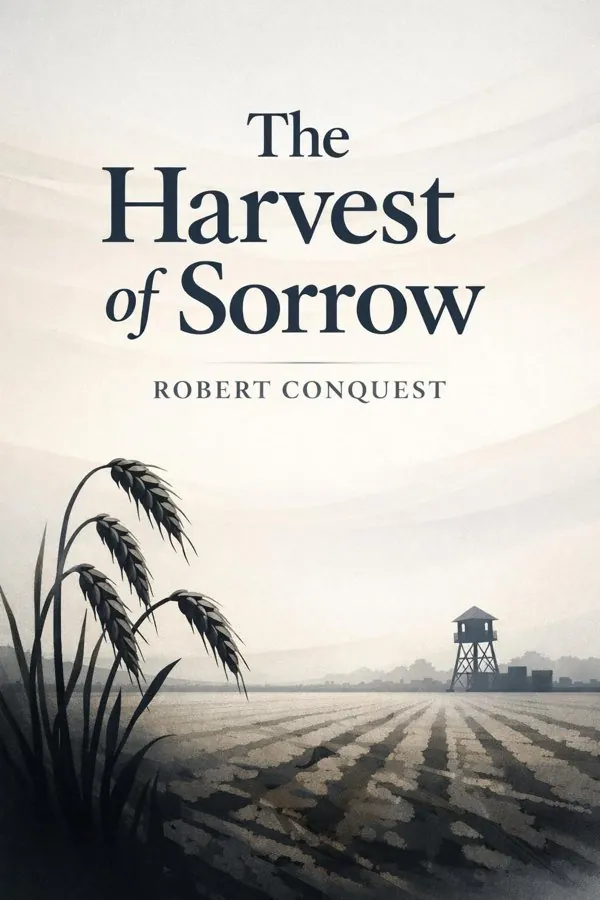
The Harvest of Sorrow: Soviet Collectivization and the Terror-Famine: Summary & Key Insights
 10 min11 chapters
What Is The Harvest of Sorrow: Soviet Collectivization and the Terror-Famine About?
The Harvest of Sorrow: Soviet Collectivization and the Terror-Famine by Robert Conquest is a world_history book spanning 11 pages. A detailed historical account of the Soviet Union's forced collectivization of agriculture and the resulting famine in Ukraine and other regions between 1929 and 1933. Conquest documents the policies of the Communist Party under Stalin that led to mass deportations, executions, and starvation, arguing that the famine was a deliberate act of terror against the peasantry and Ukrainian nationhood.
This FizzRead summary covers all 11 key chapters of The Harvest of Sorrow: Soviet Collectivization and the Terror-Famine in approximately 10 minutes, distilling the most important ideas, arguments, and takeaways from Robert Conquest's work.
The Harvest of Sorrow: Soviet Collectivization and the Terror-Famine
A detailed historical account of the Soviet Union's forced collectivization of agriculture and the resulting famine in Ukraine and other regions between 1929 and 1933. Conquest documents the policies of the Communist Party under Stalin that led to mass deportations, executions, and starvation, arguing that the famine was a deliberate act of terror against the peasantry and Ukrainian nationhood.
Who Should Read The Harvest of Sorrow: Soviet Collectivization and the Terror-Famine?
This book is perfect for anyone interested in world_history and looking to gain actionable insights in a short read. Whether you're a student, professional, or lifelong learner, the key ideas from The Harvest of Sorrow: Soviet Collectivization and the Terror-Famine by Robert Conquest will help you think differently.
- ✓Readers who enjoy world_history and want practical takeaways
- ✓Professionals looking to apply new ideas to their work and life
- ✓Anyone who wants the core insights of The Harvest of Sorrow: Soviet Collectivization and the Terror-Famine in just 10 minutes
Want the full summary?
Get instant access to this book summary and 100K+ more with Fizz Moment.
Get Free SummaryAvailable on App Store • Free to download
Key Chapters
After the 1917 Revolution, the Bolsheviks inherited a vast, agrarian empire fractured by war and hunger. The peasantry had been the majority of Russia’s population, bearing centuries of serfdom and exploitation. Under Lenin, the early Soviet government attempted to stabilize this volatile countryside with the New Economic Policy (NEP), which reintroduced limited private trade and small-scale farming. It was a strategic retreat, not an ideological conversion—a temporary concession to reality after the excesses of War Communism. The peasants responded with cautious hope. For a brief time, food availability increased, and local markets revived. But within the Party’s inner circles, resentment simmered. Marxist orthodoxy viewed the peasantry as backward, individualistic, and resistant to collectivist ideals. The NEP men were tolerated only as necessary evils, and their very success became ammunition for Stalin’s later campaign to destroy them. As I describe in *The Harvest of Sorrow*, this uneasy balance between Marxist dogma and agricultural pragmatism collapsed as Stalin rose to power. The rural population was increasingly vilified as “kulaks”—a flexible label that could mean any peasant who resisted state policy or merely achieved modest prosperity. The stage was being set for confrontation. Collectivization was not born solely of economic necessity; it was the culmination of years of ideological contempt. Stalin’s circle envisioned an agricultural revolution modeled on industrial command structures—complete subordination of rural labor to centralized control. Lenin’s toleration ended when ideology regained dominance, and in that shift lay the tragedy of the Soviet countryside.
By 1928, Stalin had consolidated near-absolute power within the Communist Party, marginalizing potential rivals like Bukharin who advocated moderation toward peasants. Conquest’s research shows that Stalin’s rhetoric of “catching up with and overtaking” capitalist nations became a justification for brutal domestic acceleration. Grain procurement crises, largely manufactured by unrealistic central quotas, were used to blame independent farmers and justify compulsory collectivization. In my narrative, this decision wasn’t an economic reform—it was a political purge masked as progress. Stalin invoked the specter of sabotage, accusing kulaks of hoarding grain, and framed the campaign as class warfare. To the Party faithful, destruction of the peasantry meant purifying society of its last vestiges of resistance. From the center outward, the Party apparatus began orchestrating this transformation: thousands of bureaucrats dispatched to villages, each armed with ideological conviction and quotas they could never meet. In Moscow, collectivization was recorded as progress; in the countryside, it meant chaos, dispossession, and death. The rationale was monstrous in its efficiency: individual farmers, once independent producers, would now be transformed into state labor units. Personal property—livestock, tools, harvests—was to be surrendered to collective farms. Those who resisted weren’t “non-compliant citizens”; they were declared enemies of the people. Stalin’s speeches, interwoven with pseudo-scientific Marxist arguments, gave this program moral authority within the Party, and fear ensured obedience everywhere else. What I hoped to make clear is that collectivization was not an inevitable stage of socialism but a chosen weapon of totalitarian control.
+ 9 more chapters — available in the FizzRead app
All Chapters in The Harvest of Sorrow: Soviet Collectivization and the Terror-Famine
About the Author
Robert Conquest (1917–2015) was a British historian, poet, and diplomat known for his influential works on Soviet history, particularly his studies of Stalinism and political repression in the USSR. He was a research fellow at Stanford University's Hoover Institution and a member of the British Academy.
Get This Summary in Your Preferred Format
Read or listen to the The Harvest of Sorrow: Soviet Collectivization and the Terror-Famine summary by Robert Conquest anytime, anywhere. FizzRead offers multiple formats so you can learn on your terms — all free.
Available formats: App · Audio · PDF · EPUB — All included free with FizzRead
Download The Harvest of Sorrow: Soviet Collectivization and the Terror-Famine PDF and EPUB Summary
Key Quotes from The Harvest of Sorrow: Soviet Collectivization and the Terror-Famine
“After the 1917 Revolution, the Bolsheviks inherited a vast, agrarian empire fractured by war and hunger.”
“By 1928, Stalin had consolidated near-absolute power within the Communist Party, marginalizing potential rivals like Bukharin who advocated moderation toward peasants.”
Frequently Asked Questions about The Harvest of Sorrow: Soviet Collectivization and the Terror-Famine
The Harvest of Sorrow: Soviet Collectivization and the Terror-Famine by Robert Conquest is a world_history book that explores key ideas across 11 chapters. A detailed historical account of the Soviet Union's forced collectivization of agriculture and the resulting famine in Ukraine and other regions between 1929 and 1933. Conquest documents the policies of the Communist Party under Stalin that led to mass deportations, executions, and starvation, arguing that the famine was a deliberate act of terror against the peasantry and Ukrainian nationhood.
You Might Also Like
The Age of Capital
Eric Hobsbawm
10 min
The Gulag Archipelago
Aleksandr Solzhenitsyn
10 min
Jerusalem: The Biography
Simon Sebag Montefiore
10 min
The Anglo-Saxons
James Campbell
10 min
The Boer War
Thomas Pakenham
10 min
The Industrial Revolutionaries: The Making of the Modern World 1776–1914
Gavin Weightman
10 minBrowse by Category
Ready to read The Harvest of Sorrow: Soviet Collectivization and the Terror-Famine?
Get the full summary and 100K+ more books with Fizz Moment.