
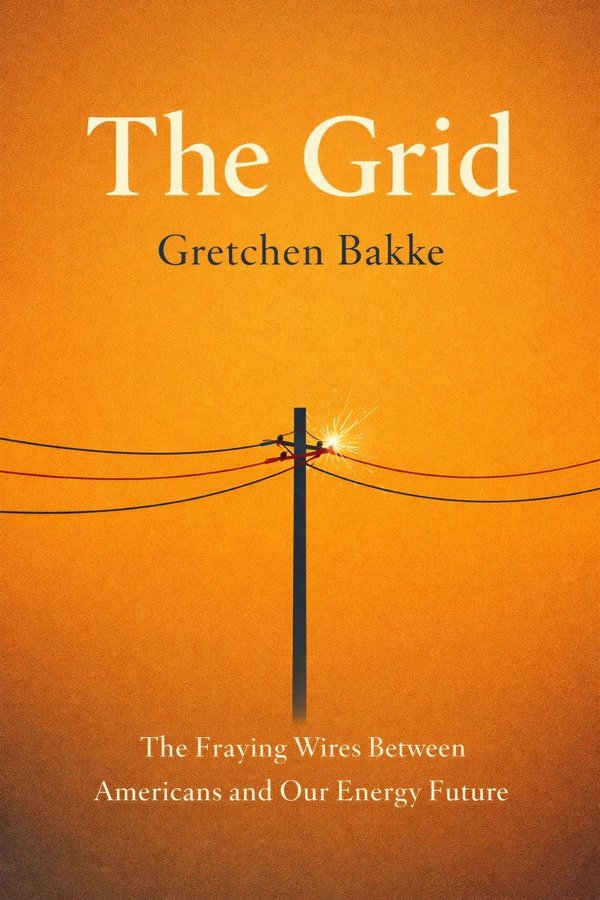
The Grid: The Fraying Wires Between Americans and Our Energy Future: Summary & Key Insights
 10 min11 chaptersAudio available
What Is The Grid: The Fraying Wires Between Americans and Our Energy Future About?
The Grid: The Fraying Wires Between Americans and Our Energy Future by Gretchen Bakke is a environment book spanning 11 pages. In this insightful work, cultural anthropologist Gretchen Bakke explores the complex and aging infrastructure of the American electrical grid. She examines how technological, economic, and social factors have shaped the grid’s development and how its fragility poses challenges for the future of energy in the United States. The book combines historical analysis with contemporary case studies to reveal the tension between innovation and obsolescence in the nation’s power systems.
This FizzRead summary covers all 11 key chapters of The Grid: The Fraying Wires Between Americans and Our Energy Future in approximately 10 minutes, distilling the most important ideas, arguments, and takeaways from Gretchen Bakke's work. Also available as an audio summary and Key Quotes Podcast.
The Grid: The Fraying Wires Between Americans and Our Energy Future
In this insightful work, cultural anthropologist Gretchen Bakke explores the complex and aging infrastructure of the American electrical grid. She examines how technological, economic, and social factors have shaped the grid’s development and how its fragility poses challenges for the future of energy in the United States. The book combines historical analysis with contemporary case studies to reveal the tension between innovation and obsolescence in the nation’s power systems.
Who Should Read The Grid: The Fraying Wires Between Americans and Our Energy Future?
This book is perfect for anyone interested in environment and looking to gain actionable insights in a short read. Whether you're a student, professional, or lifelong learner, the key ideas from The Grid: The Fraying Wires Between Americans and Our Energy Future by Gretchen Bakke will help you think differently.
- ✓Readers who enjoy environment and want practical takeaways
- ✓Professionals looking to apply new ideas to their work and life
- ✓Anyone who wants the core insights of The Grid: The Fraying Wires Between Americans and Our Energy Future in just 10 minutes
Want the full summary?
Get instant access to this book summary and 100K+ more with Fizz Moment.
Get Free SummaryAvailable on App Store • Free to download
Key Chapters
The story of the American grid begins in the incandescent glow of the late nineteenth century. In those early decades, electricity was more a marvel than a necessity — a spectacle of modernity confined to city centers and industrial hubs. Competing inventors, most famously Thomas Edison and George Westinghouse, fought over the very nature of power: direct current versus alternating current. Their rivalry was not only technical but philosophical — about who would control this new network, and how far it would reach.
In those first decades, electrification spread unevenly. Private companies, often backed by local industry, built small generating stations to serve nearby neighborhoods. In rural areas, darkness reigned, as it was simply not profitable to extend lines to scattered homes. This patchwork pattern reflected the deep regional and economic divides in American life. Yet it also laid the groundwork for a defining tension that persists today: the desire for universal access versus the reality of market-driven supply.
To understand those origins is to grasp that from the very start, electricity was as much a social experiment as a technical one. It reshaped perceptions of time, work, and leisure; it made cities glow longer into the night and transformed homes into sites of technological wonder. But crucially, the early grid was decentralized. Each plant served a small area — flexible, local, and responsive to immediate need. Only later would it become the vast and tangled web we now call the national grid.
As the twentieth century unfolded, a wave of consolidation transformed those local systems into a cohesive, regulated infrastructure. With increasing demand and technological innovation came the need for standardization — the synchronization of voltages, frequencies, and operational procedures that made it possible to interconnect regions and share power. This era, driven by both engineering prowess and federal policy, gave rise to utilities so large and influential that they became symbols of progress.
The New Deal era was decisive. The federal government, through agencies like the Tennessee Valley Authority and the Rural Electrification Administration, made electricity a public good, extending power to millions who had been left behind. Meanwhile, private utilities invested heavily in generation capacity, often powered by coal or hydroelectric systems. In this expansionary moment, electricity became synonymous with modernization and prosperity. The grid knit the nation together, its wires tracing the veins of an industrial powerhouse.
Yet with every new transmission line came a loss of local control. The grid’s centralized design encouraged massive generation plants and rigid hierarchical management structures. Power flowed one way — from producer to consumer. It was efficient, yet brittle, dependent on the flawless operation of technology and the smooth functioning of bureaucracy. This centralized paradigm worked well for decades, until social and technological changes began to outpace its capacity to adapt.
+ 9 more chapters — available in the FizzRead app
All Chapters in The Grid: The Fraying Wires Between Americans and Our Energy Future
About the Author
Gretchen Bakke is an American cultural anthropologist and writer. She holds a Ph.D. in cultural anthropology from the University of Chicago and has taught at McGill University. Her research focuses on the intersection of technology, culture, and environmental change.
Get This Summary in Your Preferred Format
Read or listen to the The Grid: The Fraying Wires Between Americans and Our Energy Future summary by Gretchen Bakke anytime, anywhere. FizzRead offers multiple formats so you can learn on your terms — all free.
Available formats: App · Audio · PDF · EPUB — All included free with FizzRead
Download The Grid: The Fraying Wires Between Americans and Our Energy Future PDF and EPUB Summary
Key Quotes from The Grid: The Fraying Wires Between Americans and Our Energy Future
“The story of the American grid begins in the incandescent glow of the late nineteenth century.”
“As the twentieth century unfolded, a wave of consolidation transformed those local systems into a cohesive, regulated infrastructure.”
Frequently Asked Questions about The Grid: The Fraying Wires Between Americans and Our Energy Future
The Grid: The Fraying Wires Between Americans and Our Energy Future by Gretchen Bakke is a environment book that explores key ideas across 11 chapters. In this insightful work, cultural anthropologist Gretchen Bakke explores the complex and aging infrastructure of the American electrical grid. She examines how technological, economic, and social factors have shaped the grid’s development and how its fragility poses challenges for the future of energy in the United States. The book combines historical analysis with contemporary case studies to reveal the tension between innovation and obsolescence in the nation’s power systems.
You Might Also Like

A Life on Our Planet: My Witness Statement and a Vision for the Future
David Attenborough
10 min
A Sky Full Of Birds
Matt Merritt
10 min
Carbon Zero: Imagining Cities That Can Save the Planet
Alex Steffen
10 min
Eaarth: Making a Life on a Tough New Planet
Bill McKibben
10 min
The Social Contract and Environmental Governance
Various Editors
10 min
The Wild Places
Robert Macfarlane
10 minBrowse by Category
Ready to read The Grid: The Fraying Wires Between Americans and Our Energy Future?
Get the full summary and 100K+ more books with Fizz Moment.