
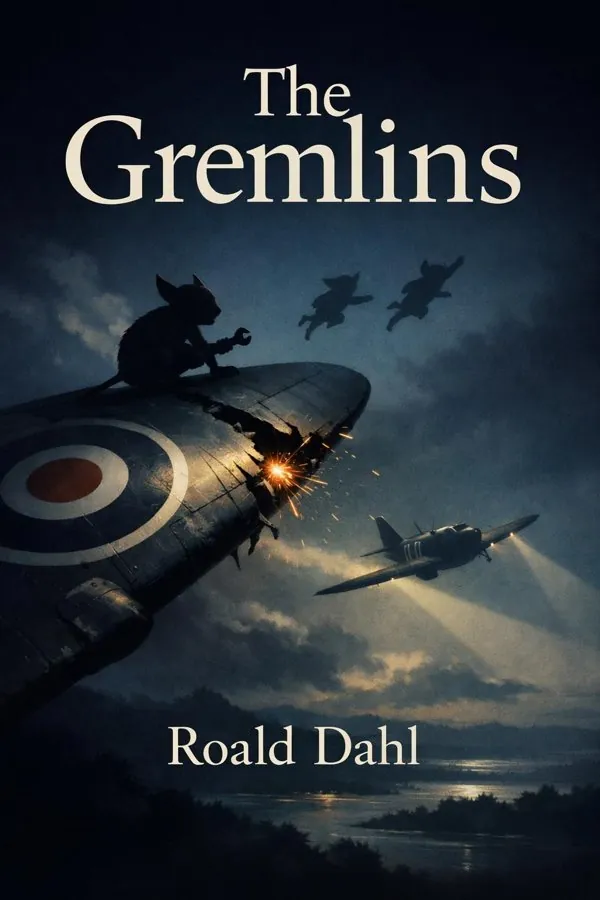
The Gremlins: Summary & Key Insights
by Roald Dahl
 10 min8 chaptersAudio available
Key Takeaways from The Gremlins
Every dangerous system creates its own myths, and wartime aviation was no exception.
Fear often shrinks when we finally see what we imagined.
Some of the strongest partnerships begin with misunderstanding.
The difference between sabotage and strategy is often the target.
Stories often reveal their deepest truths through scale, and The Gremlins is a perfect example.
What Is The Gremlins About?
The Gremlins by Roald Dahl is a classics book spanning 5 pages. The Gremlins is one of Roald Dahl’s most unusual and fascinating early works: a wartime fairy tale that turns cockpit superstition into an imaginative children’s story. First published in 1943 and originally developed alongside Walt Disney Productions, the book follows tiny, mischievous creatures blamed for sabotaging Royal Air Force planes during World War II. At first, these Gremlins seem like the hidden enemy behind every sputtering engine and failed instrument. But when RAF pilot Gus meets them face to face, the story shifts from fear and frustration to understanding, cooperation, and shared purpose. What makes The Gremlins especially memorable is the way it blends fantasy with the emotional atmosphere of war. Dahl, who had served as an RAF pilot, wrote with firsthand knowledge of aviation, danger, and military morale. That experience gives the story authenticity even as it embraces whimsy. More than a curious historical footnote, The Gremlins reveals themes that would later define Dahl’s career: rebellion, cleverness, dark humor, and sympathy for small outsiders. It matters because it shows an emerging master storyteller learning how to transform anxiety, folklore, and conflict into enduring imaginative fiction.
This FizzRead summary covers all 8 key chapters of The Gremlins in approximately 10 minutes, distilling the most important ideas, arguments, and takeaways from Roald Dahl's work. Also available as an audio summary and Key Quotes Podcast.
The Gremlins
The Gremlins is one of Roald Dahl’s most unusual and fascinating early works: a wartime fairy tale that turns cockpit superstition into an imaginative children’s story. First published in 1943 and originally developed alongside Walt Disney Productions, the book follows tiny, mischievous creatures blamed for sabotaging Royal Air Force planes during World War II. At first, these Gremlins seem like the hidden enemy behind every sputtering engine and failed instrument. But when RAF pilot Gus meets them face to face, the story shifts from fear and frustration to understanding, cooperation, and shared purpose.
What makes The Gremlins especially memorable is the way it blends fantasy with the emotional atmosphere of war. Dahl, who had served as an RAF pilot, wrote with firsthand knowledge of aviation, danger, and military morale. That experience gives the story authenticity even as it embraces whimsy. More than a curious historical footnote, The Gremlins reveals themes that would later define Dahl’s career: rebellion, cleverness, dark humor, and sympathy for small outsiders. It matters because it shows an emerging master storyteller learning how to transform anxiety, folklore, and conflict into enduring imaginative fiction.
Who Should Read The Gremlins?
This book is perfect for anyone interested in classics and looking to gain actionable insights in a short read. Whether you're a student, professional, or lifelong learner, the key ideas from The Gremlins by Roald Dahl will help you think differently.
- ✓Readers who enjoy classics and want practical takeaways
- ✓Professionals looking to apply new ideas to their work and life
- ✓Anyone who wants the core insights of The Gremlins in just 10 minutes
Want the full summary?
Get instant access to this book summary and 100K+ more with Fizz Moment.
Get Free SummaryAvailable on App Store • Free to download
Key Chapters
Every dangerous system creates its own myths, and wartime aviation was no exception. In The Gremlins, Roald Dahl begins with a mystery familiar to many Royal Air Force pilots: planes malfunction at the worst possible moment, instruments fail without warning, and engines seem to develop a will of their own. Instead of treating these breakdowns as mere technical faults, the story gives shape to an old airmen’s superstition by imagining tiny creatures secretly responsible for the chaos. This opening is more than clever fantasy. It captures the emotional truth of flying in wartime, where fear, uncertainty, and mechanical fragility could turn every mission into a gamble.
Dahl’s choice matters because it transforms abstract anxiety into something concrete. A pilot can hardly argue with bad luck, but he can imagine confronting a Gremlin. In this way, the story reflects how people often cope with stress: they personify the invisible. Children do it with monsters under the bed; adults do it with phrases like “everything is against me.” Dahl takes that instinct and turns it into narrative energy.
The mystery of sabotaged planes also establishes the book’s tone. The world is serious, even deadly, yet the explanation is playful. That balance allows Dahl to discuss wartime pressure without becoming grim. For readers, the lesson extends beyond aircraft. When repeated problems seem random, it helps to name them, examine them, and tell a story about them. Teams today do this in lighter ways when they joke about “the bug in the system” or “the gremlin in the machine” to discuss recurring errors without panic.
The practical application is simple: when confusion spreads, make the problem visible. Define it, describe it, and investigate it before blaming fate. Actionable takeaway: turn vague frustration into a specific question, because named problems are easier to solve than mysterious ones.
Fear often shrinks when we finally see what we imagined. One of the most important moments in The Gremlins comes when Gus, the pilot at the center of the story, stops dealing with anonymous sabotage and actually encounters the creatures believed to be causing it. Until that moment, Gremlins are a rumor, a joke, an excuse, and a menace all at once. Once Gus meets them, however, the story moves from suspicion to relationship. The unknown becomes knowable.
This is a classic Dahl move in embryonic form: the world hides strange beings, but they are not always what authority or rumor says they are. The Gremlins are mischievous, yes, but they are also organized, emotional, and motivated by their own history. They do not simply break things because they are evil. They act from grievance, habit, and loyalty to their own kind. By allowing Gus to encounter them directly, Dahl turns a flat enemy into a community with perspective.
That shift has broad relevance. In life, many conflicts worsen because people never move beyond labels. A difficult coworker becomes “the problem.” A rival group becomes “the enemy.” A frustrating customer becomes “impossible.” The moment we learn what drives their behavior, new options emerge. Understanding does not require approval, but it does open the door to strategy.
Gus’s encounter also shows courage of a different kind. Combat bravery is one thing; curiosity in the face of annoyance is another. Instead of doubling down on hostility, he pays attention. That is why this scene matters so much: it creates the possibility of alliance.
A practical way to apply this idea is to investigate recurring conflict at its source rather than reacting to symptoms. Ask what the other side wants, fears, or remembers. Actionable takeaway: whenever a recurring problem feels personal or mysterious, seek direct understanding before escalating the fight.
Some of the strongest partnerships begin with misunderstanding. After Gus meets the Gremlins, The Gremlins develops its central moral insight: an enemy is not always an enemy forever. What began as sabotage evolves into cooperation because Gus recognizes that punishment alone will not solve the problem. The Gremlins have their own reasons for resenting aircraft and humans, and the breakthrough comes when those motives are acknowledged rather than dismissed.
This idea gives the story surprising depth for a children’s wartime fantasy. In many conflict tales, the hero defeats the troublesome force and restores order. Dahl chooses a more inventive path. Gus does not simply overpower the Gremlins; he communicates with them and helps redirect their energy. This turns the book from a tale of elimination into one of conversion and shared purpose.
The concept applies far beyond the page. In organizations, families, and communities, raw opposition can sometimes be transformed when people feel heard and given a meaningful role. A rebellious child may become a leader when trusted with responsibility. A cynical employee may become an innovator when invited to improve the system they criticize. Even strong-willed competitors can become excellent collaborators if their talents are aimed at a common goal.
Dahl does not portray alliance as sentimental. The Gremlins remain spirited and unruly. Partnership works not because their nature changes completely, but because their abilities are rechanneled. That is an important distinction. Effective cooperation often depends less on changing personality than on changing direction.
The broader insight is that conflict can hide unused value. The very traits that make someone difficult—energy, skepticism, daring, cleverness—can become strengths in the right context. Actionable takeaway: before trying to remove every source of friction, ask whether it can be redirected into contribution.
The difference between sabotage and strategy is often the target. Once Gus and the Gremlins find common cause, the creatures’ mischief stops being merely disruptive and becomes useful in the fight against the enemy. This is one of the book’s most satisfying reversals. The same talents that once made Gremlins feared—stealth, dexterity, mechanical interference, and mischievous cleverness—are now aimed outward, away from RAF planes and toward wartime opposition.
Dahl’s point is subtle but powerful: abilities are morally shaped by purpose. The Gremlins are not remade into polite little saints. They remain quick, daring, and fond of causing trouble. What changes is where that trouble goes. This makes the story more convincing than a simple reform narrative. Instead of erasing the creatures’ identity, the plot gives it a mission.
In practical terms, this is a lesson in channeling energy. Every person has tendencies that can be destructive in one setting and valuable in another. A child who constantly questions rules may be difficult in class but brilliant in debate. A worker who notices flaws in every process may seem negative until placed in quality control or risk management. A restless imagination can create distraction or innovation depending on where it is directed.
The wartime context sharpens this idea because stakes are high. Cooperation is not just about getting along; it is about survival and service. Yet the principle remains useful in ordinary life. Rather than suppress every unruly impulse, wise leaders ask how it can serve a meaningful end.
The takeaway here is practical: identify the strengths hidden inside difficult behavior. Instead of saying, “How do I stop this energy?” ask, “Where can this energy help?” Actionable takeaway: reframe disruptive traits as raw material and assign them a constructive target.
Stories often reveal their deepest truths through scale, and The Gremlins is a perfect example. Dahl’s tiny creatures are physically small, but symbolically they carry a surprising amount of weight. They represent hidden causes, overlooked actors, and the unseen forces that shape major events. In a war story filled with planes, military power, and national struggle, it is striking that the book gives such importance to miniature beings operating behind the scenes.
This contrast suggests that grand outcomes are not always determined by obvious powers alone. Tiny actions matter. Small faults can bring down machines. Minor interventions can alter missions. Invisible morale factors can affect performance as much as official plans. The Gremlins embody all the little things people ignore until they become impossible to ignore.
There is also a democratic quality to this symbolism. The story implies that even the smallest figures can influence history, for good or ill. That message would have resonated in wartime, when ordinary individuals were being asked to contribute to massive national efforts. It still resonates now. In any complex system, small acts compound. A missed detail changes a project. A kind word shifts a team dynamic. A minor maintenance issue becomes a major failure if neglected.
For readers, the practical lesson is to stop dismissing what appears insignificant. Whether in relationships, work, or personal habits, little patterns often govern larger results. Dahl wraps this truth in fantasy, but the insight is realistic.
A useful application is to pay closer attention to recurring small problems, small helpers, and small decisions. They often hold more power than dramatic gestures. Actionable takeaway: treat minor factors seriously, because what seems tiny today may determine the outcome tomorrow.
Hard realities become more approachable when imagination gives them form. One of the most enduring strengths of The Gremlins is its ability to filter war through fantasy without erasing the seriousness beneath it. The setting is unmistakably World War II, with RAF pilots, dangerous flights, and a sense of national emergency. Yet Dahl does not write a blunt military tale for children. Instead, he offers a magical framework that makes conflict emotionally understandable rather than overwhelming.
This is an early example of a storytelling strategy that remains powerful today: use fantasy to process fear. Children rarely grasp complex political causes, but they understand broken machines, troublesome creatures, bravery, teamwork, and transformation. By turning wartime uncertainty into a story about Gremlins, Dahl creates an imaginative bridge between adult reality and child perception.
The method has practical relevance for parents, teachers, and anyone explaining difficult events to young readers. Abstract threats are often terrifying because they feel shapeless. Stories can provide boundaries, characters, and moral direction. They do not need to lie about hardship; they simply need to translate it into forms children can think with. Even adults use this technique, whether through metaphors, humor, or fictional analogies that make stressful topics discussable.
Dahl’s version is especially effective because it mixes danger with wit. The tone says, in effect, that the world can be frightening, but it can also be faced with cleverness and imagination. That balance builds resilience rather than denial.
A practical application is to explain difficult situations through age-appropriate stories, images, or metaphors rather than raw facts alone. This can reduce fear while preserving truth. Actionable takeaway: when reality feels too large or harsh, use story to create understanding without losing honesty.
A writer’s first works often contain the seeds of everything that follows. The Gremlins may not be Roald Dahl’s most famous book, but it offers a fascinating glimpse of the style and themes that would later define his career. Here we already see his affection for small, mischievous beings; his sympathy for outsiders; his delight in hidden worlds existing beside ordinary life; and his tendency to challenge authority with humor rather than solemnity.
Even in this early wartime story, Dahl shows a talent for making the strange feel vivid and immediate. He understands that children respond to sharp images, energetic situations, and creatures with distinct attitudes. He also reveals the tonal mixture that would become his signature: danger paired with comedy, menace softened by wit, and fantasy anchored in recognizably human emotions.
Reading The Gremlins in hindsight is especially rewarding because it lets us trace the origins of later classics. The playful rebellion of the Gremlins anticipates the anarchic energy found in many of Dahl’s child heroes and magical beings. The idea that small figures can outwit larger systems echoes through books such as The BFG, Fantastic Mr. Fox, and Matilda.
For readers and writers alike, this offers an important reminder: early work matters not because it is perfect, but because it reveals a creative mind in formation. Studying beginnings can sharpen our understanding of mastery. In our own lives, first attempts may seem rough, but they often contain the core of what we later do best.
A practical use of this insight is to revisit your early projects, notes, or interests and ask what recurring themes they reveal. Actionable takeaway: look for the patterns in your beginnings, because they often point toward your enduring strengths.
Sometimes a book becomes important not only for what it is, but for the unrealized project surrounding it. The Gremlins occupies a special place in literary and film history because it was conceived in connection with Walt Disney Productions, which explored adapting the story into an animated feature during the 1940s. The film was never completed, yet that unfinished collaboration adds an unusual layer to the book’s identity. It stands at the intersection of publishing, wartime propaganda, folklore, and early animation history.
This background matters because it helps explain the book’s visual and episodic quality. The Gremlins feels designed to be seen as much as read. The creatures are distinctive, the scenes are cinematic, and the premise has the kind of conceptual clarity animation loves: small invisible beings causing mechanical mayhem in wartime aircraft. Even without the completed film, readers can sense the larger imaginative world that might have expanded across screen and page.
There is a broader lesson here about creative projects. Not every ambitious collaboration reaches its final form. Some remain fragments, prototypes, or cultural curiosities. Yet unfinished ideas can still leave a mark. The book survives independently, and its historical oddity now adds to its charm. In work and life, people often undervalue projects that do not achieve their original scale. But partial success can still produce something worthwhile.
This perspective is useful for creators, professionals, and students alike. A canceled initiative, abandoned concept, or unlaunched partnership may still contain valuable output, experience, or insight. Actionable takeaway: judge your projects not only by whether the full vision happened, but also by what meaningful creation emerged along the way.
All Chapters in The Gremlins
About the Author
Roald Dahl (1916–1990) was a British novelist, short story writer, screenwriter, and former Royal Air Force pilot. Born in Wales to Norwegian parents, he first gained recognition for his wartime experiences and later became one of the most beloved children’s authors of the twentieth century. His books, including Charlie and the Chocolate Factory, Matilda, The BFG, James and the Giant Peach, and Fantastic Mr. Fox, are known for their imaginative worlds, dark humor, memorable villains, and clever young heroes. Dahl also wrote acclaimed short fiction for adults. The Gremlins, published in 1943, was his first children’s book and drew directly from RAF folklore and his own aviation background, offering an early glimpse of the inventive storytelling voice that would define his career.
Get This Summary in Your Preferred Format
Read or listen to the The Gremlins summary by Roald Dahl anytime, anywhere. FizzRead offers multiple formats so you can learn on your terms — all free.
Available formats: App · Audio · PDF · EPUB — All included free with FizzRead
Download The Gremlins PDF and EPUB Summary
Key Quotes from The Gremlins
“Every dangerous system creates its own myths, and wartime aviation was no exception.”
“Fear often shrinks when we finally see what we imagined.”
“Some of the strongest partnerships begin with misunderstanding.”
“The difference between sabotage and strategy is often the target.”
“Stories often reveal their deepest truths through scale, and The Gremlins is a perfect example.”
Frequently Asked Questions about The Gremlins
The Gremlins by Roald Dahl is a classics book that explores key ideas across 8 chapters. The Gremlins is one of Roald Dahl’s most unusual and fascinating early works: a wartime fairy tale that turns cockpit superstition into an imaginative children’s story. First published in 1943 and originally developed alongside Walt Disney Productions, the book follows tiny, mischievous creatures blamed for sabotaging Royal Air Force planes during World War II. At first, these Gremlins seem like the hidden enemy behind every sputtering engine and failed instrument. But when RAF pilot Gus meets them face to face, the story shifts from fear and frustration to understanding, cooperation, and shared purpose. What makes The Gremlins especially memorable is the way it blends fantasy with the emotional atmosphere of war. Dahl, who had served as an RAF pilot, wrote with firsthand knowledge of aviation, danger, and military morale. That experience gives the story authenticity even as it embraces whimsy. More than a curious historical footnote, The Gremlins reveals themes that would later define Dahl’s career: rebellion, cleverness, dark humor, and sympathy for small outsiders. It matters because it shows an emerging master storyteller learning how to transform anxiety, folklore, and conflict into enduring imaginative fiction.
More by Roald Dahl
You Might Also Like




Browse by Category
Ready to read The Gremlins?
Get the full summary and 100K+ more books with Fizz Moment.