
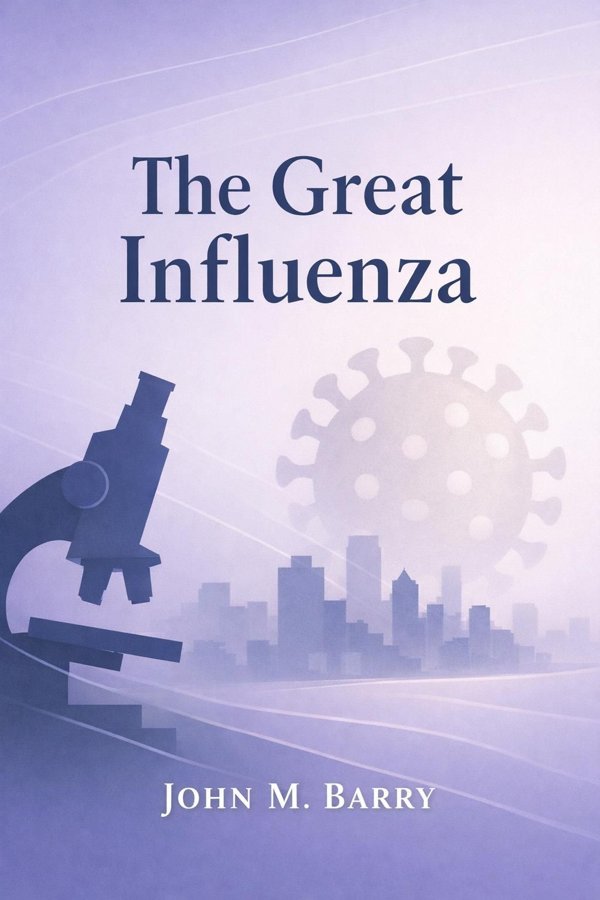
The Great Influenza: The Story of the Deadliest Pandemic in History: Summary & Key Insights
 10 min6 chaptersAudio available
What Is The Great Influenza: The Story of the Deadliest Pandemic in History About?
The Great Influenza: The Story of the Deadliest Pandemic in History by John M. Barry is a world_history book spanning 6 pages. In this meticulously researched narrative, John M. Barry chronicles the 1918 influenza pandemic that killed millions worldwide. The book explores the intersection of science, politics, and human behavior as medical researchers struggled to understand and contain the virus. Barry vividly portrays the scientists who laid the foundations of modern medicine and the social upheaval that accompanied the pandemic.
This FizzRead summary covers all 6 key chapters of The Great Influenza: The Story of the Deadliest Pandemic in History in approximately 10 minutes, distilling the most important ideas, arguments, and takeaways from John M. Barry's work. Also available as an audio summary and Key Quotes Podcast.
The Great Influenza: The Story of the Deadliest Pandemic in History
In this meticulously researched narrative, John M. Barry chronicles the 1918 influenza pandemic that killed millions worldwide. The book explores the intersection of science, politics, and human behavior as medical researchers struggled to understand and contain the virus. Barry vividly portrays the scientists who laid the foundations of modern medicine and the social upheaval that accompanied the pandemic.
Who Should Read The Great Influenza: The Story of the Deadliest Pandemic in History?
This book is perfect for anyone interested in world_history and looking to gain actionable insights in a short read. Whether you're a student, professional, or lifelong learner, the key ideas from The Great Influenza: The Story of the Deadliest Pandemic in History by John M. Barry will help you think differently.
- ✓Readers who enjoy world_history and want practical takeaways
- ✓Professionals looking to apply new ideas to their work and life
- ✓Anyone who wants the core insights of The Great Influenza: The Story of the Deadliest Pandemic in History in just 10 minutes
Want the full summary?
Get instant access to this book summary and 100K+ more with Fizz Moment.
Get Free SummaryAvailable on App Store • Free to download
Key Chapters
At the dawn of the twentieth century, America’s medical establishment stood precariously behind Europe’s. The best minds sought training in Germany or France if they wished to engage in serious research. Hospitals were often little more than charities for the poor, and medical schools, many of them for-profit, could grant degrees after a few months of lectures. Against this backdrop, a quiet revolution began at Johns Hopkins University. Inspired by European models, Hopkins created a new medical culture in which anatomy, physiology, and pathology were to be explored by experiment and evidence, not memorized from textbooks. This was where figures like William Welch, William Osler, and Simon Flexner became the architects of modern medical science in America.
When I speak of Welch and Osler, I speak of visionaries. Welch was not a physician in the narrow sense—he was a scientist who believed medicine must be rooted in laboratory work. Osler, the clinician, embodied the ideal that science and bedside practice should serve one another. Their elevation of research transformed Johns Hopkins into a symbol of rigor. By 1918, their academic children filled the nation’s medical schools and laboratories, carrying with them a shared faith: that through the mind and method, humankind could decipher nature’s mysteries.
It was an idealistic time. Few yet knew how cruelly the coming virus would test those convictions, how it would mock the hubris of men who thought they could control life itself with microscopes and reason.
In early 1918, in rural Haskell County, Kansas, an invisible shift began. Farmers there watched with bewilderment as strong, young men suddenly fell ill with fevers, coughing, and an exhaustion that seemed unnatural. The sickness spread rapidly to nearby military camps, including Camp Funston, where troops trained before embarking for the war in Europe. In the claustrophobic barracks and trenches of a mobilized world, the virus found the perfect host: humanity itself, compressed and mobile.
At this early stage, the influenza seemed unremarkable, mild compared to past epidemics. Those infected recovered quickly; deaths were few. But viruses mutate, and when this one returned in the fall, it would carry with it a new lethality—its second incarnation giving rise to cyanotic faces, lungs filled with fluid, and a speed of death that stunned even the most seasoned physicians.
As the contagion gained power, it moved with soldiers who traveled by train and ship, carried unknowingly across oceans and continents. The very machinery of modern war became the engine of global infection. In tracing this path, I sought not only to reveal the journey of a pathogen, but to expose how interconnectedness—human movement, trade, and technology—can amplify vulnerability. It was, and remains, a warning about the consequences of ignoring biology’s quiet borders.
+ 4 more chapters — available in the FizzRead app
All Chapters in The Great Influenza: The Story of the Deadliest Pandemic in History
About the Author
John M. Barry is an American historian and author known for his works on science, politics, and history. He has written several acclaimed books, including 'Rising Tide: The Great Mississippi Flood of 1927 and How It Changed America.' Barry is recognized for his ability to weave scientific and historical narratives with clarity and depth.
Get This Summary in Your Preferred Format
Read or listen to the The Great Influenza: The Story of the Deadliest Pandemic in History summary by John M. Barry anytime, anywhere. FizzRead offers multiple formats so you can learn on your terms — all free.
Available formats: App · Audio · PDF · EPUB — All included free with FizzRead
Download The Great Influenza: The Story of the Deadliest Pandemic in History PDF and EPUB Summary
Key Quotes from The Great Influenza: The Story of the Deadliest Pandemic in History
“At the dawn of the twentieth century, America’s medical establishment stood precariously behind Europe’s.”
“In early 1918, in rural Haskell County, Kansas, an invisible shift began.”
Frequently Asked Questions about The Great Influenza: The Story of the Deadliest Pandemic in History
The Great Influenza: The Story of the Deadliest Pandemic in History by John M. Barry is a world_history book that explores key ideas across 6 chapters. In this meticulously researched narrative, John M. Barry chronicles the 1918 influenza pandemic that killed millions worldwide. The book explores the intersection of science, politics, and human behavior as medical researchers struggled to understand and contain the virus. Barry vividly portrays the scientists who laid the foundations of modern medicine and the social upheaval that accompanied the pandemic.
You Might Also Like
The Age of Capital
Eric Hobsbawm
10 min
The Gulag Archipelago
Aleksandr Solzhenitsyn
10 min
Jerusalem: The Biography
Simon Sebag Montefiore
10 min
The Anglo-Saxons
James Campbell
10 min
The Boer War
Thomas Pakenham
10 min
The Industrial Revolutionaries: The Making of the Modern World 1776–1914
Gavin Weightman
10 minBrowse by Category
Ready to read The Great Influenza: The Story of the Deadliest Pandemic in History?
Get the full summary and 100K+ more books with Fizz Moment.