
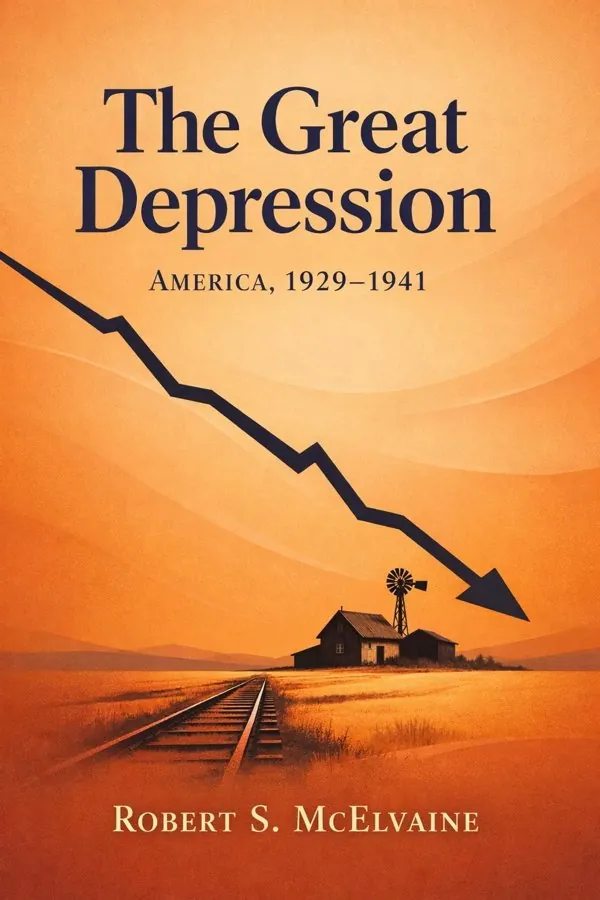
The Great Depression: America, 1929–1941: Summary & Key Insights
 10 min12 chaptersAudio available
What Is The Great Depression: America, 1929–1941 About?
The Great Depression: America, 1929–1941 by Robert S. McElvaine is a world_history book spanning 12 pages. A comprehensive historical analysis of the Great Depression in the United States, exploring its economic, political, and social dimensions. McElvaine examines how the crisis reshaped American life, from government policy to cultural attitudes, and how it influenced the nation's trajectory through the New Deal and beyond.
This FizzRead summary covers all 12 key chapters of The Great Depression: America, 1929–1941 in approximately 10 minutes, distilling the most important ideas, arguments, and takeaways from Robert S. McElvaine's work. Also available as an audio summary and Key Quotes Podcast.
The Great Depression: America, 1929–1941
A comprehensive historical analysis of the Great Depression in the United States, exploring its economic, political, and social dimensions. McElvaine examines how the crisis reshaped American life, from government policy to cultural attitudes, and how it influenced the nation's trajectory through the New Deal and beyond.
Who Should Read The Great Depression: America, 1929–1941?
This book is perfect for anyone interested in world_history and looking to gain actionable insights in a short read. Whether you're a student, professional, or lifelong learner, the key ideas from The Great Depression: America, 1929–1941 by Robert S. McElvaine will help you think differently.
- ✓Readers who enjoy world_history and want practical takeaways
- ✓Professionals looking to apply new ideas to their work and life
- ✓Anyone who wants the core insights of The Great Depression: America, 1929–1941 in just 10 minutes
Want the full summary?
Get instant access to this book summary and 100K+ more with Fizz Moment.
Get Free SummaryAvailable on App Store • Free to download
Key Chapters
The first shock came swiftly, but the forces behind it had been building for years. America in the 1920s was consumed by the spectacle of prosperity: booming stock prices, easy credit, and boundless faith in capitalism’s self-correcting mechanisms. Yet beneath the glittering surface lay deep imbalances. Wages lagged behind productivity, rural America suffered from falling crop prices, and speculative frenzy in financial markets detached valuation from reality. When the bubble burst in October 1929, millions watched their dreams evaporate overnight.
From my perspective as a historian, it was not simply an accident—it was the logical consequence of a system driven by greed and illusion. The collapse revealed an unstable economy whose foundations had been eroded by inequality. The nation’s productive capacity remained immense, but the distribution of purchasing power meant that factories produced goods for people who could no longer afford to buy them. What followed was a cascade: banks failed, credit froze, and confidence disintegrated. Wall Street’s fall was emblematic, but the real devastation was felt in farms, towns, and homes across the country.
One must understand that the crash was both an economic and psychological event. The faith that prosperity was a permanent condition was shattered. Americans confronted the realization that unrestrained capitalism could fail catastrophically. That recognition would haunt political life for more than a decade and reshape public consciousness for generations.
In the wake of the crash, confusion reigned. President Herbert Hoover and his administration clung to an ideology of voluntarism—believing that business leaders and charitable efforts could correct the downturn without significant government intervention. But relief sporadically offered by private sources could not meet the scale of destruction. Factories stopped production, unemployment climbed exponentially, and farms foreclosed under crushing debt.
The failure was not only structural but moral. People who had trusted the system now saw leaders unwilling to act beyond sermons of self-reliance. Hoover’s reluctance stemmed from deep conviction: he feared that direct federal aid would undermine character. Yet as hunger spread, the abstract talk of rugged individualism rang hollow. Across the nation, citizens began to question whether government owed responsibility beyond rhetoric.
In those early years, the Depression exposed the limits of laissez-faire governance. It was a painful education in economic interdependence, and an awakening that liberty without security could not sustain dignity. The seeds of reform were sown not through ideology but necessity.
+ 10 more chapters — available in the FizzRead app
All Chapters in The Great Depression: America, 1929–1941
About the Author
Robert S. McElvaine is an American historian and professor emeritus at Millsaps College, known for his works on the Great Depression and modern American history. His scholarship often combines economic analysis with cultural and social perspectives.
Get This Summary in Your Preferred Format
Read or listen to the The Great Depression: America, 1929–1941 summary by Robert S. McElvaine anytime, anywhere. FizzRead offers multiple formats so you can learn on your terms — all free.
Available formats: App · Audio · PDF · EPUB — All included free with FizzRead
Download The Great Depression: America, 1929–1941 PDF and EPUB Summary
Key Quotes from The Great Depression: America, 1929–1941
“The first shock came swiftly, but the forces behind it had been building for years.”
“In the wake of the crash, confusion reigned.”
Frequently Asked Questions about The Great Depression: America, 1929–1941
The Great Depression: America, 1929–1941 by Robert S. McElvaine is a world_history book that explores key ideas across 12 chapters. A comprehensive historical analysis of the Great Depression in the United States, exploring its economic, political, and social dimensions. McElvaine examines how the crisis reshaped American life, from government policy to cultural attitudes, and how it influenced the nation's trajectory through the New Deal and beyond.
You Might Also Like
The Age of Capital
Eric Hobsbawm
10 min
The Gulag Archipelago
Aleksandr Solzhenitsyn
10 min
Jerusalem: The Biography
Simon Sebag Montefiore
10 min
The Anglo-Saxons
James Campbell
10 min
The Boer War
Thomas Pakenham
10 min
The Industrial Revolutionaries: The Making of the Modern World 1776–1914
Gavin Weightman
10 minBrowse by Category
Ready to read The Great Depression: America, 1929–1941?
Get the full summary and 100K+ more books with Fizz Moment.