
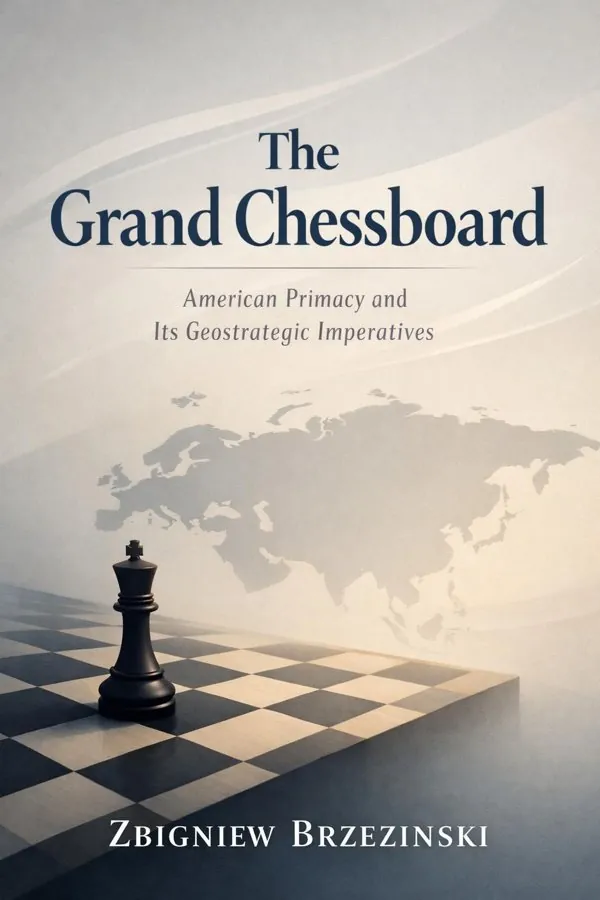
The Grand Chessboard: American Primacy and Its Geostrategic Imperatives: Summary & Key Insights
 10 min10 chaptersAudio available
What Is The Grand Chessboard: American Primacy and Its Geostrategic Imperatives About?
The Grand Chessboard: American Primacy and Its Geostrategic Imperatives by Zbigniew Brzezinski is a politics book spanning 10 pages. In this influential work, Zbigniew Brzezinski analyzes the geopolitical landscape following the Cold War, arguing that the United States must skillfully manage Eurasia—the 'grand chessboard'—to maintain global primacy. He outlines strategic imperatives for American foreign policy, emphasizing the importance of stability, alliances, and the prevention of rival powers from dominating the Eurasian continent.
This FizzRead summary covers all 10 key chapters of The Grand Chessboard: American Primacy and Its Geostrategic Imperatives in approximately 10 minutes, distilling the most important ideas, arguments, and takeaways from Zbigniew Brzezinski's work. Also available as an audio summary and Key Quotes Podcast.
The Grand Chessboard: American Primacy and Its Geostrategic Imperatives
In this influential work, Zbigniew Brzezinski analyzes the geopolitical landscape following the Cold War, arguing that the United States must skillfully manage Eurasia—the 'grand chessboard'—to maintain global primacy. He outlines strategic imperatives for American foreign policy, emphasizing the importance of stability, alliances, and the prevention of rival powers from dominating the Eurasian continent.
Who Should Read The Grand Chessboard: American Primacy and Its Geostrategic Imperatives?
This book is perfect for anyone interested in politics and looking to gain actionable insights in a short read. Whether you're a student, professional, or lifelong learner, the key ideas from The Grand Chessboard: American Primacy and Its Geostrategic Imperatives by Zbigniew Brzezinski will help you think differently.
- ✓Readers who enjoy politics and want practical takeaways
- ✓Professionals looking to apply new ideas to their work and life
- ✓Anyone who wants the core insights of The Grand Chessboard: American Primacy and Its Geostrategic Imperatives in just 10 minutes
Want the full summary?
Get instant access to this book summary and 100K+ more with Fizz Moment.
Get Free SummaryAvailable on App Store • Free to download
Key Chapters
When the Soviet Union dissolved, an entire architecture of global competition crumbled. The bipolar tension that had defined world affairs for half a century vanished, leaving the United States as the only power capable of projecting influence across all regions. In my view, this was not simply a matter of military preeminence—it was a convergence of technological, economic, and cultural supremacy. American primacy after the Cold War was marked by unmatched capacity in global communications, a dynamic economy, and an appeal rooted in democratic ideals that resonated far beyond its borders.
Yet, primacy is not the same as permanence. I argued that the United States must recognize the fragility of its position. Dominance achieved through circumstance can erode through complacency or misjudgment. The challenge for America is to transform its temporary preponderance into a sustainable condition of influence, which requires strategic management rather than interventionist zeal. The essence of primacy lies in preventing the emergence of a rival center of power that could threaten global equilibrium. This means maintaining balanced relationships within Eurasia and nurturing the institutional frameworks that tie its regions to American leadership, such as NATO, the European Union partnership, and Pacific alliances.
At the heart of this conception stands the moral question: should a democratic power seek to preserve supremacy? My answer, of course, was not simple endorsement of domination. The post–Cold War world needed a stabilizing anchor, and the United States was uniquely equipped to play that role. But that position must be exercised with restraint and imagination. Leadership requires legitimacy, and legitimacy depends on the perception that American power serves wider international interests, not merely national advantage. Thus, primacy, properly understood, is a form of stewardship—maintaining an open global order grounded in cooperation and democracy.
Eurasia, extending from the Western Atlantic to the Eastern Pacific, is the central arena of global politics. Every empire that has ever sought world dominance has involved itself in its affairs: from Rome and Persia, through Britain and Russia, to the United States today. The logic is elementary yet profound—control over Eurasia implies influence over the world because it is home to most of the global population, technological centers, and material wealth.
In *The Grand Chessboard*, I propose viewing this continent as a complex system rather than a unified field. Western Europe represents democratic consolidation and prosperity; Eastern Europe stands as a zone of strategic transition; Russia embodies vast resources and strategic unpredictability; Central Asia and the Caucasus, rich in energy and territorial volatility, form the key junction between major powers; South and East Asia hold the world’s emerging economic giants—China, India, and Japan. Together, these regions constitute the spaces where competition for influence defines the future world order.
Eurasia’s political map is fluid, but its geographical structure is enduring. Stability in its western reaches (Europe) allows projection of soft power; instability in its center (Russia and Central Asia) invites confrontation; dynamism in the east (China, India, Japan) creates opportunity. The American task is not to dominate this vast region militarily but to manage its balance strategically—to cultivate cooperation where possible and to contain potential hegemonies where necessary.
The metaphor of the chessboard captures both precision and uncertainty. Every move—whether a policy initiative, alliance, or economic partnership—must anticipate reactions, consequences, and the shifting patterns of influence. The United States, as grandmaster of this board, must play with foresight, ensuring that no combination of Eurasian powers—Russia with China, or China with Iran, or European estrangement—coalesces into an alliance capable of challenging the global balance. This framework defines the book’s analytic core: geopolitics as statecraft, geography as destiny, and strategy as the art of long-term prevention.
+ 8 more chapters — available in the FizzRead app
All Chapters in The Grand Chessboard: American Primacy and Its Geostrategic Imperatives
About the Author
Zbigniew Brzezinski (1928–2017) was a Polish-American diplomat and political scientist. He served as National Security Advisor to President Jimmy Carter and was a prominent scholar of international relations, known for his expertise in geopolitics and U.S. foreign policy.
Get This Summary in Your Preferred Format
Read or listen to the The Grand Chessboard: American Primacy and Its Geostrategic Imperatives summary by Zbigniew Brzezinski anytime, anywhere. FizzRead offers multiple formats so you can learn on your terms — all free.
Available formats: App · Audio · PDF · EPUB — All included free with FizzRead
Download The Grand Chessboard: American Primacy and Its Geostrategic Imperatives PDF and EPUB Summary
Key Quotes from The Grand Chessboard: American Primacy and Its Geostrategic Imperatives
“When the Soviet Union dissolved, an entire architecture of global competition crumbled.”
“Eurasia, extending from the Western Atlantic to the Eastern Pacific, is the central arena of global politics.”
Frequently Asked Questions about The Grand Chessboard: American Primacy and Its Geostrategic Imperatives
The Grand Chessboard: American Primacy and Its Geostrategic Imperatives by Zbigniew Brzezinski is a politics book that explores key ideas across 10 chapters. In this influential work, Zbigniew Brzezinski analyzes the geopolitical landscape following the Cold War, arguing that the United States must skillfully manage Eurasia—the 'grand chessboard'—to maintain global primacy. He outlines strategic imperatives for American foreign policy, emphasizing the importance of stability, alliances, and the prevention of rival powers from dominating the Eurasian continent.
More by Zbigniew Brzezinski

You Might Also Like

Antifa: The Anti-Fascist Handbook
Mark Bray
10 min
Attack from Within: How Disinformation Is Sabotaging America
Barbara McQuade
10 min
Coercion, Capital, and European States, AD 990–1992
Charles Tilly
10 min
Digital Democracy: Concepts, Methodologies, Tools, and Applications
Various Authors
10 min
Fascism
Stanley G. Payne
10 min
Fire And Fury: Inside The Trump White House
Michael Wolff
10 minBrowse by Category
Ready to read The Grand Chessboard: American Primacy and Its Geostrategic Imperatives?
Get the full summary and 100K+ more books with Fizz Moment.