
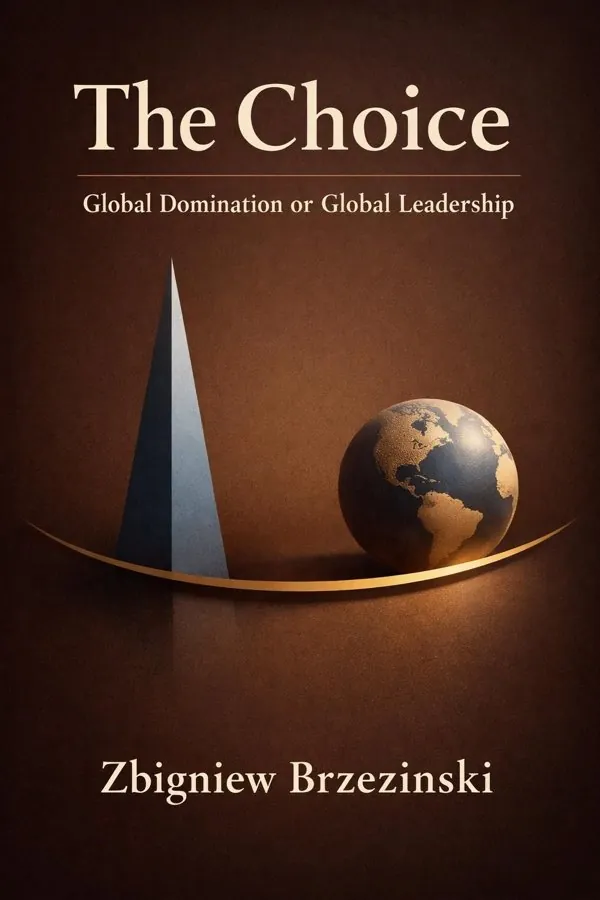
The Choice: Global Domination or Global Leadership: Summary & Key Insights
 10 min10 chaptersAudio available
What Is The Choice: Global Domination or Global Leadership About?
The Choice: Global Domination or Global Leadership by Zbigniew Brzezinski is a politics book spanning 10 pages. In this influential work, Zbigniew Brzezinski examines the strategic challenges facing the United States in the post–Cold War world. He argues that America must choose between pursuing unilateral dominance or fostering cooperative global leadership. Drawing on his experience as a national security advisor, Brzezinski outlines a vision for a stable international order based on shared responsibility and pragmatic engagement.
This FizzRead summary covers all 10 key chapters of The Choice: Global Domination or Global Leadership in approximately 10 minutes, distilling the most important ideas, arguments, and takeaways from Zbigniew Brzezinski's work. Also available as an audio summary and Key Quotes Podcast.
The Choice: Global Domination or Global Leadership
In this influential work, Zbigniew Brzezinski examines the strategic challenges facing the United States in the post–Cold War world. He argues that America must choose between pursuing unilateral dominance or fostering cooperative global leadership. Drawing on his experience as a national security advisor, Brzezinski outlines a vision for a stable international order based on shared responsibility and pragmatic engagement.
Who Should Read The Choice: Global Domination or Global Leadership?
This book is perfect for anyone interested in politics and looking to gain actionable insights in a short read. Whether you're a student, professional, or lifelong learner, the key ideas from The Choice: Global Domination or Global Leadership by Zbigniew Brzezinski will help you think differently.
- ✓Readers who enjoy politics and want practical takeaways
- ✓Professionals looking to apply new ideas to their work and life
- ✓Anyone who wants the core insights of The Choice: Global Domination or Global Leadership in just 10 minutes
Want the full summary?
Get instant access to this book summary and 100K+ more with Fizz Moment.
Get Free SummaryAvailable on App Store • Free to download
Key Chapters
To understand the nature of today’s decision, we must retrace the evolution of U.S. global purpose. Since World War II, America’s power has rested upon two intertwined pillars: unmatched military might and the persuasive appeal of its democratic ideals. In the postwar decades, this combination sustained an unprecedented global system. Through the Marshall Plan, NATO, and a network of alliances across Asia, we built not an empire of conquest but a structure of partnership. Our leadership was respected because it was connected to a vision of shared prosperity and freedom.
But this cooperative hegemony also contained contradictions. Over time, American exceptionalism evolved into a belief that the United States had a moral entitlement to define global order. The Cold War’s binary logic—free world versus communism—reinforced a world view in which American leadership became synonymous with global order itself. When that bipolar framework dissolved, it left a vacuum in both power and purpose. America suddenly found itself without a grand ideological rival yet burdened with vast global responsibilities.
The post–Cold War moment required redefinition: what was America’s raison d’être in a world no longer divided by enemy blocs? My central argument is that the United States must rediscover a sense of mission rooted not in dominance but in legitimacy. Leadership requires vision and restraint, a capacity to inspire others through example and cooperation rather than coercion.
The 1990s inaugurated what scholars termed the 'unipolar moment'—a time when the United States stood alone as the unchallenged superpower. This situation was historically unprecedented. For the first time in modern history, one state enjoyed supremacy in every domain: military, economic, technological, and cultural. Yet this unipolarity carried within it the seeds of temptation. Unconstrained by any peer competitor, American policymakers began to believe that the world could be remade in America’s image at will. Interventionism became a reflex. The idea of preventive wars and regime change gained currency, especially after the shock of September 11, 2001.
I caution against mistaking supremacy for omnipotence. Dominance, if pursued unilaterally, inevitably breeds resentment and resistance. Empires have always fallen victim to overextension—the Romans, the British, and now, potentially, the Americans. The moral hubris of unilateralism undermines not only global stability but also America’s own security. Rather than creating a secure world, it invites disorder, asymmetrical threats, and the erosion of trust in American intentions. The true challenge of unipolarity, therefore, was not how to preserve it indefinitely but how to translate it into a foundation for enduring cooperation.
+ 8 more chapters — available in the FizzRead app
All Chapters in The Choice: Global Domination or Global Leadership
About the Author
Zbigniew Brzezinski (1928–2017) was a Polish-American diplomat and political scientist who served as National Security Advisor to U.S. President Jimmy Carter. A leading strategist in international relations, he authored numerous books on geopolitics and American foreign policy, shaping debates on global strategy for decades.
Get This Summary in Your Preferred Format
Read or listen to the The Choice: Global Domination or Global Leadership summary by Zbigniew Brzezinski anytime, anywhere. FizzRead offers multiple formats so you can learn on your terms — all free.
Available formats: App · Audio · PDF · EPUB — All included free with FizzRead
Download The Choice: Global Domination or Global Leadership PDF and EPUB Summary
Key Quotes from The Choice: Global Domination or Global Leadership
“To understand the nature of today’s decision, we must retrace the evolution of U.”
“The 1990s inaugurated what scholars termed the 'unipolar moment'—a time when the United States stood alone as the unchallenged superpower.”
Frequently Asked Questions about The Choice: Global Domination or Global Leadership
The Choice: Global Domination or Global Leadership by Zbigniew Brzezinski is a politics book that explores key ideas across 10 chapters. In this influential work, Zbigniew Brzezinski examines the strategic challenges facing the United States in the post–Cold War world. He argues that America must choose between pursuing unilateral dominance or fostering cooperative global leadership. Drawing on his experience as a national security advisor, Brzezinski outlines a vision for a stable international order based on shared responsibility and pragmatic engagement.
More by Zbigniew Brzezinski

You Might Also Like
Antifa: The Anti-Fascist Handbook
Mark Bray
10 min
Attack from Within: How Disinformation Is Sabotaging America
Barbara McQuade
10 min
Coercion, Capital, and European States, AD 990–1992
Charles Tilly
10 min
Digital Democracy: Concepts, Methodologies, Tools, and Applications
Various Authors
10 min
Fascism
Stanley G. Payne
10 min
Fire And Fury: Inside The Trump White House
Michael Wolff
10 minBrowse by Category
Ready to read The Choice: Global Domination or Global Leadership?
Get the full summary and 100K+ more books with Fizz Moment.