
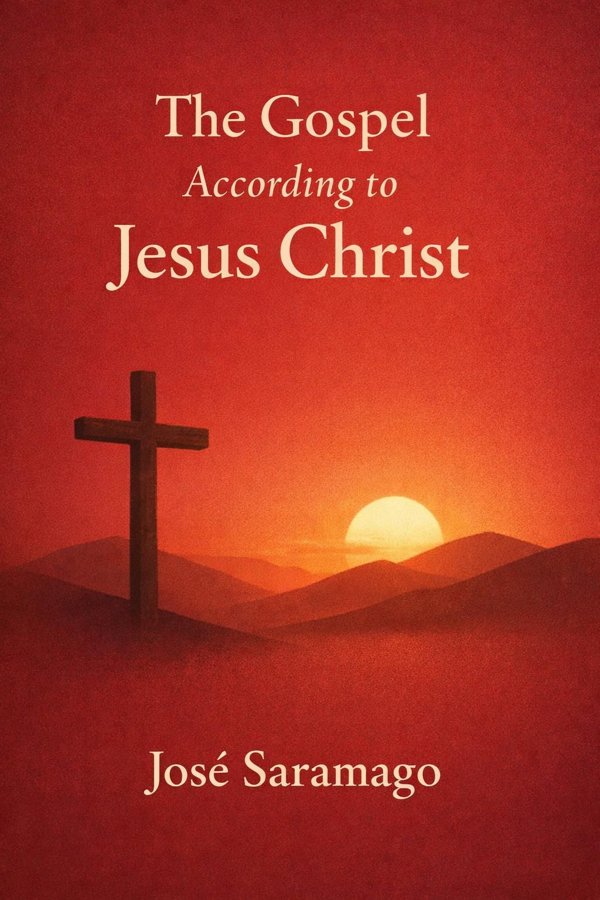
The Gospel According to Jesus Christ: Summary & Key Insights
 10 min9 chaptersAudio available
Key Takeaways from The Gospel According to Jesus Christ
A single act of silence can shape generations.
Growing up is often the slow discovery that the world is not just imperfect, but unjust.
There comes a point when a person can no longer live as if life’s tragedies belong to someone else.
To make a sacred figure fully human, you must allow him to love.
The most unsettling conversations are often the ones that expose the logic beneath power.
What Is The Gospel According to Jesus Christ About?
The Gospel According to Jesus Christ by José Saramago is a classics book spanning 7 pages. Originally published in 1991, The Gospel According to Jesus Christ is José Saramago’s bold and deeply human retelling of one of the most influential stories in Western civilization. Rather than presenting Jesus as a distant divine figure, Saramago imagines him as a man shaped by fear, tenderness, desire, guilt, and moral uncertainty. The novel follows Jesus from childhood to crucifixion, but its true subject is larger than biblical narrative: it asks what happens when innocence collides with power, when obedience confronts conscience, and when divine plans demand human suffering. What makes the book so enduring is not merely its controversy, but its compassion. Saramago writes with irony, lyricism, and philosophical depth, exposing the tension between religious authority and lived humanity. A Nobel Prize–winning author known for blending allegory, history, and moral inquiry, Saramago brings unusual authority to this reimagining. The result is a classic that challenges belief without dismissing spiritual longing, inviting readers to reconsider faith, responsibility, and freedom through one of literature’s most provocative portraits of Jesus.
This FizzRead summary covers all 9 key chapters of The Gospel According to Jesus Christ in approximately 10 minutes, distilling the most important ideas, arguments, and takeaways from José Saramago's work. Also available as an audio summary and Key Quotes Podcast.
The Gospel According to Jesus Christ
Originally published in 1991, The Gospel According to Jesus Christ is José Saramago’s bold and deeply human retelling of one of the most influential stories in Western civilization. Rather than presenting Jesus as a distant divine figure, Saramago imagines him as a man shaped by fear, tenderness, desire, guilt, and moral uncertainty. The novel follows Jesus from childhood to crucifixion, but its true subject is larger than biblical narrative: it asks what happens when innocence collides with power, when obedience confronts conscience, and when divine plans demand human suffering. What makes the book so enduring is not merely its controversy, but its compassion. Saramago writes with irony, lyricism, and philosophical depth, exposing the tension between religious authority and lived humanity. A Nobel Prize–winning author known for blending allegory, history, and moral inquiry, Saramago brings unusual authority to this reimagining. The result is a classic that challenges belief without dismissing spiritual longing, inviting readers to reconsider faith, responsibility, and freedom through one of literature’s most provocative portraits of Jesus.
Who Should Read The Gospel According to Jesus Christ?
This book is perfect for anyone interested in classics and looking to gain actionable insights in a short read. Whether you're a student, professional, or lifelong learner, the key ideas from The Gospel According to Jesus Christ by José Saramago will help you think differently.
- ✓Readers who enjoy classics and want practical takeaways
- ✓Professionals looking to apply new ideas to their work and life
- ✓Anyone who wants the core insights of The Gospel According to Jesus Christ in just 10 minutes
Want the full summary?
Get instant access to this book summary and 100K+ more with Fizz Moment.
Get Free SummaryAvailable on App Store • Free to download
Key Chapters
A single act of silence can shape generations. Saramago begins not with the glory of incarnation, but with Joseph’s failure: after learning of Herod’s massacre, Joseph saves only his own family and does not warn the other parents of Bethlehem. This omission becomes one of the novel’s founding wounds. In traditional Gospel narratives, Joseph is a protective and righteous figure. Here, he is something more disturbing and therefore more recognizable: a decent man who cannot carry the full weight of moral courage when history suddenly demands it.
Saramago uses Joseph to explore a painful truth about innocence. We often imagine guilt belonging only to those who commit direct harm, but the novel insists that guilt can also arise from inaction, from surviving when others perish, and from choosing private safety over public responsibility. Joseph’s remorse does not remain his alone. It becomes a kind of inheritance, a burden Jesus absorbs before he even understands its origin. The father’s silence becomes the son’s destiny.
This idea has striking contemporary relevance. In daily life, moral failure often appears not as cruelty but as avoidance: not speaking up in a workplace when someone is mistreated, not intervening when we see prejudice, not acting because the problem seems too large. Saramago asks us to consider how these quiet failures ripple outward.
The novel’s insight is severe but clarifying: being good is not the same as being blameless. Joseph’s tragedy shows that ordinary people are shaped by moments when they did too little, too late.
Actionable takeaway: examine one area of your life where silence has replaced responsibility, and take one concrete step—however small—to break that silence today.
Growing up is often the slow discovery that the world is not just imperfect, but unjust. In Saramago’s retelling, Jesus’s childhood is not wrapped in serene holiness. It is marked by confusion, unease, and the gradual awakening of moral consciousness. He senses that something in his family’s history is unsettled, that suffering surrounds ordinary life, and that adulthood carries secrets children are expected to bear without explanation.
This matters because Saramago refuses the idea of a fully formed savior descending untouched into human life. Instead, Jesus learns. He observes hierarchy, cruelty, shame, labor, and fear. His moral imagination develops through encounters with vulnerability, not through untouchable perfection. The novel suggests that wisdom is born less from doctrine than from exposure to suffering and the inability to forget it.
One of the most powerful implications here is that ethical awareness begins before certainty. Children often perceive injustice with uncomfortable clarity: favoritism, hypocrisy, punishment, and exclusion are visible to them before adults learn to rationalize such things. Saramago turns that insight into a portrait of spiritual formation. Jesus’s early life becomes a study in how empathy and disturbance form character.
For modern readers, this theme invites reflection on education, parenting, and self-knowledge. Do we teach moral rules, or do we help people notice pain honestly? Do we protect innocence, or do we numb moral perception? Saramago would likely say that true moral vision begins when comfort is interrupted.
The child in this novel is not naive. He is becoming capable of seeing what others prefer not to see. And that capacity—to notice suffering without looking away—is the beginning of conscience.
Actionable takeaway: practice moral attention by noticing one overlooked form of unfairness in your daily environment and asking what response it requires from you.
There comes a point when a person can no longer live as if life’s tragedies belong to someone else. In The Gospel According to Jesus Christ, death is not merely an event; it is the force that drives Jesus out of innocence. Joseph’s death, along with the shadow of earlier violence, compels Jesus to confront the tangled relationship between fate, guilt, and responsibility. He cannot remain a passive recipient of inherited stories. He must decide what kind of life can be built in the aftermath of loss.
Saramago treats death not as a theological abstraction but as a human rupture. It exposes the fragility of family, the insufficiency of easy explanations, and the impossibility of returning to a simpler moral world. Jesus is forced into motion—physically and spiritually—because suffering has made stillness impossible. This departure is crucial. It marks the transformation from protected son to morally burdened adult.
The broader lesson is that responsibility often begins where certainty ends. Loss can lead people toward bitterness, denial, numbness, or greater depth. Saramago imagines Jesus choosing the difficult path of seeking understanding, even when understanding brings no comfort. That is what gives the novel much of its emotional seriousness: it sees maturity not as confidence, but as the willingness to live with unanswered questions.
In practical terms, many readers will recognize this movement. A death in the family, a betrayal, a public injustice, or a personal failure can become the dividing line between passive life and conscious life. What matters is not whether pain arrives—it will—but whether it deepens one’s sense of responsibility.
Saramago’s Jesus does not become more human despite suffering. He becomes more human through it.
Actionable takeaway: when facing grief or disillusionment, ask not only “Why did this happen?” but also “What responsibility does this experience awaken in me now?”
To make a sacred figure fully human, you must allow him to love. One of Saramago’s most radical and tender choices is his portrayal of Jesus’s relationship with Mary Magdalene. Rather than reducing love to temptation or moral danger, the novel presents intimacy as a site of knowledge, healing, and human completion. Mary is not merely a symbolic sinner redeemed by holiness; she is wise, grounded, sensuous, and emotionally intelligent. Through her, Jesus learns what it means to inhabit his body and affections without shame.
This relationship matters because it resists a long tradition of separating spiritual seriousness from human desire. Saramago suggests that love is not a distraction from truth but one of the ways truth becomes livable. In Mary’s presence, Jesus experiences rest, pleasure, mutual care, and the possibility of a life not wholly defined by mission. That possibility makes the tragedy of his destiny sharper. The reader sees what must be sacrificed—not in abstract terms, but in the concrete form of shared life.
The novel also complicates moral hierarchies. Mary, socially marginal and morally judged, often appears more ethically lucid than the institutions and authorities surrounding Jesus. Saramago thereby shifts the center of wisdom away from official holiness and toward lived compassion.
For modern readers, this theme speaks to the false divide between duty and tenderness. Many people are taught to see love, desire, and bodily life as obstacles to purpose. Saramago argues the opposite: any vision of salvation that despises human intimacy becomes suspect.
Mary Magdalene embodies a humane ethic—care over doctrine, presence over abstraction, mutuality over control. In her company, Jesus becomes not less spiritual, but more deeply alive.
Actionable takeaway: treat your closest relationships not as distractions from meaning, but as places where your deepest values are tested, revealed, and made real.
The most unsettling conversations are often the ones that expose the logic beneath power. In one of the novel’s most famous and provocative sequences, Jesus encounters both God and the Devil, and the result is not a simple battle between good and evil. Instead, Saramago stages a philosophical confrontation in which divine intention itself becomes morally suspect. God is ambitious, strategic, and hungry for expansion. The Devil, while hardly innocent, sometimes appears less deceptive than the system he opposes.
This reversal is central to the novel’s power. Saramago is not merely trying to shock readers by humanizing the Devil or criticizing God. He is asking a deeper question: what if the suffering justified in the name of religious glory is itself part of the problem? God’s plan for Christianity includes martyrdom, empire, and centuries of bloodshed. Jesus realizes that his death will not simply redeem humanity; it will also serve as the founding spectacle of a vast historical machinery.
The scene forces readers to reconsider obedience. Is submission virtuous if the authority commanding it seeks dominion rather than compassion? Can holiness exist without moral scrutiny? Saramago’s answer is clear: no being, however exalted, should be exempt from ethical judgment.
In everyday life, this idea applies far beyond religion. Institutions often present their goals as noble while concealing the human cost—whether in politics, business, family systems, or ideology. The novel warns against confusing grandeur with goodness.
Jesus’s solitude in these encounters is essential. Moral clarity rarely emerges from crowds or slogans. It arises in the difficult space where one must think against inherited certainties.
Actionable takeaway: whenever an authority demands sacrifice for a “greater good,” pause to ask who benefits, who suffers, and whether the cost is being borne by the powerful or the vulnerable.
Not every good deed is morally simple when it serves a questionable system. In Saramago’s retelling, miracles are not presented as uncomplicated proof of divine goodness. They are charged acts, caught between compassion for individuals and obedience to a larger destiny Jesus increasingly distrusts. Healing, teaching, and gathering followers may relieve suffering in the moment, but they also help construct the public image through which his sacrifice will gain historical force.
This tension gives the novel extraordinary ethical depth. Jesus is not simply deciding whether to do good; he is deciding whether each act of good becomes part of a machinery of power. Saramago thus complicates a familiar moral assumption: that beneficial outcomes automatically justify participation. A healing can be kind and still politically useful. A noble action can be absorbed into a structure whose long-term consequences are troubling.
That insight applies widely. Many modern institutions use sincere acts of care to reinforce authority. A corporation may support charity while exploiting workers. A political movement may alleviate one form of pain while creating another. Individuals, too, can perform goodness in ways that secure admiration more than justice. The novel invites readers to examine not only what an action achieves, but what system it strengthens.
At the same time, Saramago does not dismiss compassion. Jesus remains moved by suffering; that is part of what makes his situation tragic. He cannot become indifferent simply because power is corrupt. The ethical challenge is to help without surrendering one’s conscience.
This is one of the novel’s most mature insights: morality is not only about intention or result, but also about context. To act well, we must understand the networks of meaning into which our actions are drawn.
Actionable takeaway: before celebrating a helpful act—your own or someone else’s—ask what wider system it supports, and whether compassion can be offered in a way that preserves moral independence.
The deepest tragedy is to understand too late what your life has been made to serve. In Saramago’s culminating vision of betrayal and crucifixion, the Passion is stripped of triumphant certainty and reframed as a moment of painful revelation. Jesus comes to see that his death is not simply the fulfillment of a sacred script for the good of humanity. It is also the necessary public drama through which God’s power will enlarge itself in history. Crucifixion becomes both sacrifice and exploitation.
This interpretation radically alters the emotional meaning of the ending. Rather than serene acceptance alone, there is anguish, lucidity, and protest. Jesus is no longer only the obedient son; he is the witness to the moral cost of divine ambition. His final understanding does not erase compassion, but it does expose the violence hidden inside official redemption.
Betrayal in the novel is therefore broader than Judas’s role. Betrayal is embedded in the very structure of destiny when a person’s humanity is subordinated to an abstract plan. That insight has enduring force. People are betrayed whenever institutions use their loyalty, labor, or suffering for purposes they were never allowed to evaluate fully.
Yet the ending is not nihilistic. By giving Jesus this final moral awareness, Saramago preserves his dignity. Even in defeat, he sees clearly. The novel suggests that truthfulness in the face of power may be the last form of freedom available.
Readers can take from this not just a reinterpretation of the Passion, but a general ethical lesson: consent without understanding is dangerous, and narratives of sacrifice should always be examined closely.
Actionable takeaway: when asked to endure hardship for a cause, seek full clarity about whose vision is being served and whether your sacrifice reflects your own conscience or someone else’s ambition.
How a story is told can be as revolutionary as what the story claims. Saramago’s distinctive style—long flowing sentences, sparse punctuation, shifting tones, irony blended with lyricism—does more than create atmosphere. It changes the reader’s relationship to sacred narrative. Instead of treating scripture as fixed, distant, and untouchable, the novel’s voice makes it fluid, conversational, and open to moral questioning. The narrator comments, digresses, observes, and quietly unsettles certainty.
This stylistic choice matters because form shapes thought. Traditional religious language often carries authority through solemnity and closure. Saramago replaces closure with movement. His prose feels oral, searching, and restless, as if the story is being discovered even as it is told. That method mirrors the book’s philosophical project: to reopen what has been finalized and to restore ambiguity where dogma imposed certainty.
For many readers, the style is initially challenging. Dialogue may unfold without conventional quotation marks, and the narrator’s irony can feel slippery. But this difficulty is productive. It slows reading down and demands attention. We cannot consume the story passively; we must participate in meaning-making. In that sense, Saramago trains the reader to become ethically alert.
There is a broader application here. Whenever language sounds too polished, too official, or too complete, it may be concealing complexity. One of literature’s gifts is to disrupt familiar speech and thereby recover thought. Saramago’s prose invites readers to resist prefabricated interpretations, whether religious, political, or personal.
The novel’s style is not decoration. It is an argument for freedom of consciousness—a way of reading that refuses submission to inherited formulas.
Actionable takeaway: when engaging with powerful texts or institutions, slow down your reading, notice how language guides belief, and ask what possibilities open up when you question the form as well as the content.
All Chapters in The Gospel According to Jesus Christ
About the Author
José Saramago (1922–2010) was a Portuguese novelist, essayist, and playwright widely regarded as one of the most important literary voices of the modern era. Raised in a working-class family, he came to literature gradually and developed a style unlike any other: long, flowing sentences, minimal punctuation, ironic narration, and philosophical intensity. His fiction often explores power, morality, history, and the fragile dignity of ordinary people. Among his best-known works are Blindness, Baltasar and Blimunda, All the Names, and The Gospel According to Jesus Christ. In 1998, he received the Nobel Prize in Literature for writing that, in the words of the Swedish Academy, makes reality “comprehensible through parables sustained by imagination, compassion and irony.” Saramago remains a defining figure in world literature for his bold, humane, and intellectually challenging novels.
Get This Summary in Your Preferred Format
Read or listen to the The Gospel According to Jesus Christ summary by José Saramago anytime, anywhere. FizzRead offers multiple formats so you can learn on your terms — all free.
Available formats: App · Audio · PDF · EPUB — All included free with FizzRead
Download The Gospel According to Jesus Christ PDF and EPUB Summary
Key Quotes from The Gospel According to Jesus Christ
“A single act of silence can shape generations.”
“Growing up is often the slow discovery that the world is not just imperfect, but unjust.”
“There comes a point when a person can no longer live as if life’s tragedies belong to someone else.”
“To make a sacred figure fully human, you must allow him to love.”
“The most unsettling conversations are often the ones that expose the logic beneath power.”
Frequently Asked Questions about The Gospel According to Jesus Christ
The Gospel According to Jesus Christ by José Saramago is a classics book that explores key ideas across 9 chapters. Originally published in 1991, The Gospel According to Jesus Christ is José Saramago’s bold and deeply human retelling of one of the most influential stories in Western civilization. Rather than presenting Jesus as a distant divine figure, Saramago imagines him as a man shaped by fear, tenderness, desire, guilt, and moral uncertainty. The novel follows Jesus from childhood to crucifixion, but its true subject is larger than biblical narrative: it asks what happens when innocence collides with power, when obedience confronts conscience, and when divine plans demand human suffering. What makes the book so enduring is not merely its controversy, but its compassion. Saramago writes with irony, lyricism, and philosophical depth, exposing the tension between religious authority and lived humanity. A Nobel Prize–winning author known for blending allegory, history, and moral inquiry, Saramago brings unusual authority to this reimagining. The result is a classic that challenges belief without dismissing spiritual longing, inviting readers to reconsider faith, responsibility, and freedom through one of literature’s most provocative portraits of Jesus.
More by José Saramago


You Might Also Like






Browse by Category
Ready to read The Gospel According to Jesus Christ?
Get the full summary and 100K+ more books with Fizz Moment.