
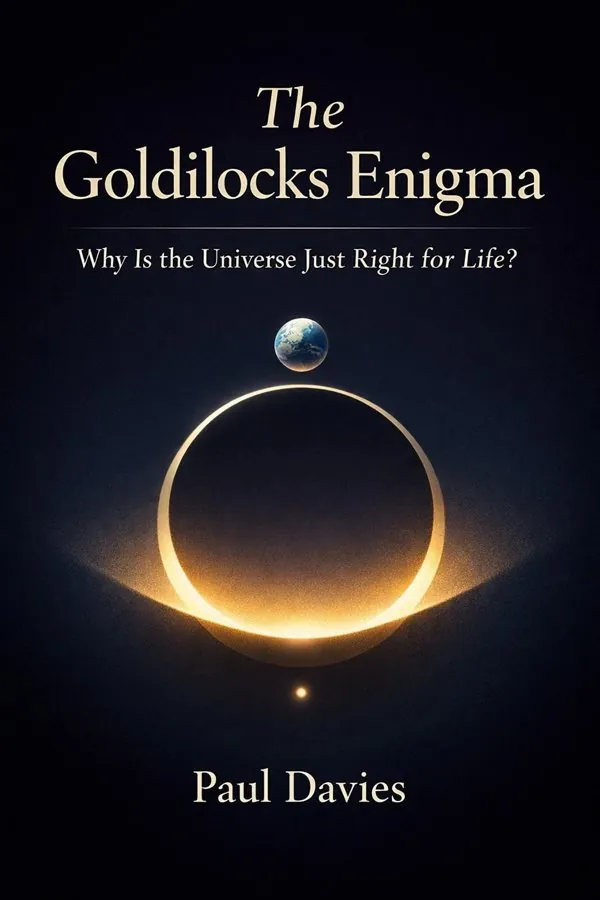
The Goldilocks Enigma: Why Is the Universe Just Right for Life?: Summary & Key Insights
by Paul Davies
 10 min5 chaptersAudio available
What Is The Goldilocks Enigma: Why Is the Universe Just Right for Life? About?
The Goldilocks Enigma: Why Is the Universe Just Right for Life? by Paul Davies is a popular_sci book spanning 5 pages. In this thought-provoking work, physicist and cosmologist Paul Davies explores one of the most profound questions in science: why the universe seems perfectly tuned for life. He examines the fine-tuning of physical constants, the anthropic principle, and the possibility of multiple universes, weaving together insights from cosmology, quantum physics, and philosophy to probe whether the universe’s life-friendly conditions are a coincidence, a necessity, or evidence of deeper purpose.
This FizzRead summary covers all 5 key chapters of The Goldilocks Enigma: Why Is the Universe Just Right for Life? in approximately 10 minutes, distilling the most important ideas, arguments, and takeaways from Paul Davies's work. Also available as an audio summary and Key Quotes Podcast.
The Goldilocks Enigma: Why Is the Universe Just Right for Life?
In this thought-provoking work, physicist and cosmologist Paul Davies explores one of the most profound questions in science: why the universe seems perfectly tuned for life. He examines the fine-tuning of physical constants, the anthropic principle, and the possibility of multiple universes, weaving together insights from cosmology, quantum physics, and philosophy to probe whether the universe’s life-friendly conditions are a coincidence, a necessity, or evidence of deeper purpose.
Who Should Read The Goldilocks Enigma: Why Is the Universe Just Right for Life??
This book is perfect for anyone interested in popular_sci and looking to gain actionable insights in a short read. Whether you're a student, professional, or lifelong learner, the key ideas from The Goldilocks Enigma: Why Is the Universe Just Right for Life? by Paul Davies will help you think differently.
- ✓Readers who enjoy popular_sci and want practical takeaways
- ✓Professionals looking to apply new ideas to their work and life
- ✓Anyone who wants the core insights of The Goldilocks Enigma: Why Is the Universe Just Right for Life? in just 10 minutes
Want the full summary?
Get instant access to this book summary and 100K+ more with Fizz Moment.
Get Free SummaryAvailable on App Store • Free to download
Key Chapters
The mystery begins with the delicate precision of nature’s physical constants. Imagine adjusting the universe’s settings like the knobs on a cosmic control panel. Gravity, the electromagnetic force, the strong and weak nuclear forces—each must have the exact strength it does for stars to shine, for atoms to bond, for chemistry and biology to exist. Shift any one of these parameters even slightly, and the beautiful structures of matter and mind collapse.
As I explain in the book, this realization emerged slowly through modern physics. When Newton revealed the mathematical order of motion and gravity, he could not foresee that his equations would one day be read as a script for life’s possibility itself. Later, Einstein’s relativity and the quantum revolution opened our eyes to deeper levels of precision. For example, if the ratio of the electromagnetic to gravitational force were altered by as little as one part in 10^40, stars would burn too quickly or fail to form altogether. The strength of the strong nuclear force must be just right to bind protons and neutrons within atomic nuclei, yet gentle enough to allow the formation of carbon—a critical element in organic chemistry.
These values feel eerily chosen. Physicists can explain the consequences of these numbers, but we still cannot explain why they have the values they do. Some prefer to treat this as coincidence—a statistical fluke among possible universes. But I found that explanation emotionally and scientifically unsatisfying. The fine-tuning problem isn’t merely about numbers; it’s about the profound fact that those numbers allow us to be here discussing them.
So what are we to make of this? Is fine-tuning evidence of purpose, or simply the inevitable outcome of physical necessity? In searching for answers, I turned to cosmology—to the story of the universe’s birth and the astonishing conditions that had to be in place for everything else to follow.
At the dawn of time, the universe was a blazing cauldron of energy, expanding and cooling in the aftermath of the Big Bang. Out of this chaos, pattern began to emerge: minute fluctuations in matter density grew into galaxies, stars, and planets. The laws governing this unfolding seem uncannily aligned to maintain coherence through all scales—from quarks to clusters of galaxies. The question I wrestle with throughout *The Goldilocks Enigma* is whether this alignment is accidental or inevitable.
Here is where the anthropic principle enters—the idea that the universe must have properties compatible with conscious observers, precisely because observers exist to notice them. The weak form of the principle simply acknowledges that we can only observe a universe compatible with life. The strong form goes further, suggesting that the universe’s parameters are in some sense compelled or ‘selected’ to bring about life.
I treat these ideas not as philosophical indulgences but as necessary frameworks for interpreting fine-tuning. After all, our position as observers inevitably colors our understanding of the cosmos. The anthropic principle raises uncomfortable but fascinating questions: are we at the center of an explanatory structure, or merely incidental products of cosmic laws that never cared about observers at all?
Despite its controversial reputation, the anthropic principle forces us to reconsider what the word ‘necessity’ means. If existence itself filters possible universes through the lens of observation, then perhaps physics and consciousness are not separate domains but reflections of one coherent whole. I argue that both cosmologists and philosophers must face this possibility with intellectual courage, for in doing so we may uncover a deeper symmetry that unites mind and matter under the same cosmic order.
+ 3 more chapters — available in the FizzRead app
All Chapters in The Goldilocks Enigma: Why Is the Universe Just Right for Life?
About the Author
Paul Davies is a British physicist, cosmologist, and astrobiologist known for his work on the origin of life, the nature of time, and the philosophical implications of modern physics. He has authored numerous popular science books and is a professor at Arizona State University, where he directs the Beyond Center for Fundamental Concepts in Science.
Get This Summary in Your Preferred Format
Read or listen to the The Goldilocks Enigma: Why Is the Universe Just Right for Life? summary by Paul Davies anytime, anywhere. FizzRead offers multiple formats so you can learn on your terms — all free.
Available formats: App · Audio · PDF · EPUB — All included free with FizzRead
Download The Goldilocks Enigma: Why Is the Universe Just Right for Life? PDF and EPUB Summary
Key Quotes from The Goldilocks Enigma: Why Is the Universe Just Right for Life?
“The mystery begins with the delicate precision of nature’s physical constants.”
“At the dawn of time, the universe was a blazing cauldron of energy, expanding and cooling in the aftermath of the Big Bang.”
Frequently Asked Questions about The Goldilocks Enigma: Why Is the Universe Just Right for Life?
The Goldilocks Enigma: Why Is the Universe Just Right for Life? by Paul Davies is a popular_sci book that explores key ideas across 5 chapters. In this thought-provoking work, physicist and cosmologist Paul Davies explores one of the most profound questions in science: why the universe seems perfectly tuned for life. He examines the fine-tuning of physical constants, the anthropic principle, and the possibility of multiple universes, weaving together insights from cosmology, quantum physics, and philosophy to probe whether the universe’s life-friendly conditions are a coincidence, a necessity, or evidence of deeper purpose.
More by Paul Davies
You Might Also Like

Structures: Or Why Things Don"t Fall Down
J.E. Gordon
10 min
The Road to Wigan Pier
George Orwell
10 min
Bonk: The Curious Coupling of Science and Sex
Mary Roach
10 min
First Bite: How We Learn to Eat
Bee Wilson
10 min
In Pursuit Of The Unknown: 17 Equations That Changed The World
Ian Stewart
10 min
Napoleon's Buttons: 17 Molecules That Changed History
Penny Le Couteur and Jay Burreson
10 minBrowse by Category
Ready to read The Goldilocks Enigma: Why Is the Universe Just Right for Life??
Get the full summary and 100K+ more books with Fizz Moment.