
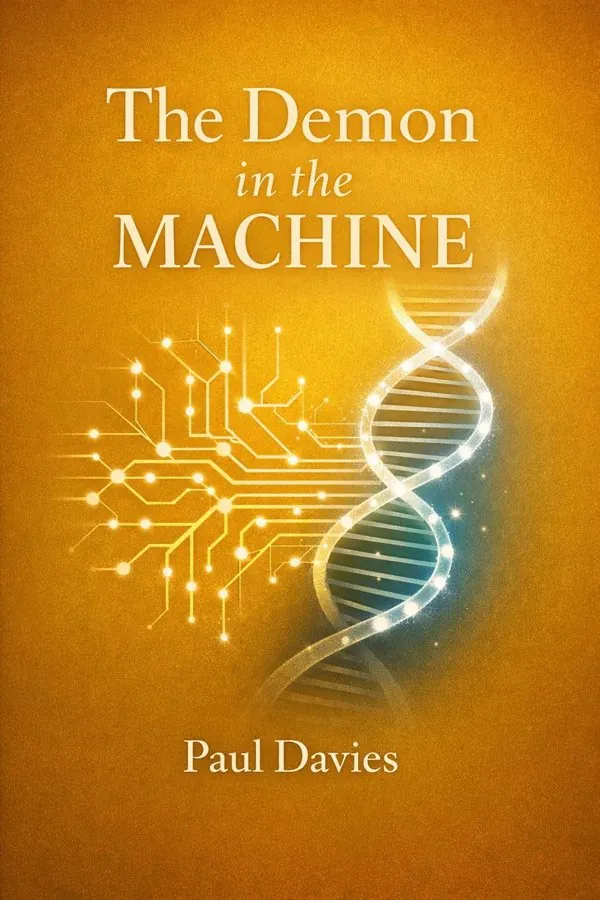
The Demon in the Machine: How Hidden Webs of Information Are Solving the Mystery of Life: Summary & Key Insights
by Paul Davies
 10 min9 chaptersAudio available
Key Takeaways from The Demon in the Machine: How Hidden Webs of Information Are Solving the Mystery of Life
A living cell contains chemicals, but chemistry alone does not explain why those chemicals behave like a coordinated system.
Living things seem to perform a small miracle every day: they build and maintain order in a universe that trends toward disorder.
It is tempting to think DNA is the master secret of life, but Davies shows that genes are only part of the story.
Traditional origin-of-life research often focuses on prebiotic soups, molecular building blocks, and chemical pathways.
We often treat information as a human description of reality, not as something real in its own right.
What Is The Demon in the Machine: How Hidden Webs of Information Are Solving the Mystery of Life About?
The Demon in the Machine: How Hidden Webs of Information Are Solving the Mystery of Life by Paul Davies is a popular_sci book. What if life is not best understood as a lucky chemical accident, but as a system built on information flowing through matter? In The Demon in the Machine, physicist and cosmologist Paul Davies explores one of the deepest questions in science: what makes living things different from nonliving matter? Rather than treating life as merely complex chemistry, Davies argues that information—stored, processed, copied, and acted upon—may be the missing ingredient that explains biological organization, agency, and purpose-like behavior. The book brings together physics, biology, computer science, and philosophy to examine how life seems to direct matter toward goals, preserve order against decay, and build complexity over time. Davies revisits ideas such as Maxwell’s demon, the origin of life, genetics, and cellular computation to show that information may have causal power in the physical world. This matters because understanding life in informational terms could reshape medicine, artificial intelligence, astrobiology, and our search for life’s origins. Davies is uniquely qualified to guide this inquiry. A renowned theoretical physicist and science writer, he is known for tackling big scientific mysteries with clarity and imagination. Here, he offers a bold, accessible, and intellectually adventurous account of life’s hidden logic.
This FizzRead summary covers all 9 key chapters of The Demon in the Machine: How Hidden Webs of Information Are Solving the Mystery of Life in approximately 10 minutes, distilling the most important ideas, arguments, and takeaways from Paul Davies's work. Also available as an audio summary and Key Quotes Podcast.
The Demon in the Machine: How Hidden Webs of Information Are Solving the Mystery of Life
What if life is not best understood as a lucky chemical accident, but as a system built on information flowing through matter? In The Demon in the Machine, physicist and cosmologist Paul Davies explores one of the deepest questions in science: what makes living things different from nonliving matter? Rather than treating life as merely complex chemistry, Davies argues that information—stored, processed, copied, and acted upon—may be the missing ingredient that explains biological organization, agency, and purpose-like behavior.
The book brings together physics, biology, computer science, and philosophy to examine how life seems to direct matter toward goals, preserve order against decay, and build complexity over time. Davies revisits ideas such as Maxwell’s demon, the origin of life, genetics, and cellular computation to show that information may have causal power in the physical world. This matters because understanding life in informational terms could reshape medicine, artificial intelligence, astrobiology, and our search for life’s origins.
Davies is uniquely qualified to guide this inquiry. A renowned theoretical physicist and science writer, he is known for tackling big scientific mysteries with clarity and imagination. Here, he offers a bold, accessible, and intellectually adventurous account of life’s hidden logic.
Who Should Read The Demon in the Machine: How Hidden Webs of Information Are Solving the Mystery of Life?
This book is perfect for anyone interested in popular_sci and looking to gain actionable insights in a short read. Whether you're a student, professional, or lifelong learner, the key ideas from The Demon in the Machine: How Hidden Webs of Information Are Solving the Mystery of Life by Paul Davies will help you think differently.
- ✓Readers who enjoy popular_sci and want practical takeaways
- ✓Professionals looking to apply new ideas to their work and life
- ✓Anyone who wants the core insights of The Demon in the Machine: How Hidden Webs of Information Are Solving the Mystery of Life in just 10 minutes
Want the full summary?
Get instant access to this book summary and 100K+ more with Fizz Moment.
Get Free SummaryAvailable on App Store • Free to download
Key Chapters
A living cell contains chemicals, but chemistry alone does not explain why those chemicals behave like a coordinated system. That is one of Paul Davies’s central insights. He argues that life differs from nonlife not simply because it has the right molecules, but because those molecules are organized by information. In organisms, information is stored in DNA, interpreted by cellular machinery, passed across generations, and used to regulate behavior. The key point is that life is not just matter; it is matter directed by encoded instructions.
Davies pushes readers to see that the same atoms found in a rock can also be found in a bacterium, yet only the bacterium metabolizes, reproduces, adapts, and repairs itself. The difference is not basic material composition but informational architecture. The cell acts like a layered system of codes, feedback loops, and communication networks. Genes do not simply exist; they are read, edited, expressed, and regulated in context.
This framework changes how we think about biology. Instead of asking only what molecules are present, we ask how information flows among them. In medicine, this can shift attention from isolated genes to regulatory networks. In synthetic biology, it suggests that building life-like systems may require more than mixing chemicals; it may require creating robust information-processing structures. In computing, it strengthens analogies between cells and distributed computational systems.
Davies does not deny chemistry. Rather, he argues that chemistry is the substrate on which informational causation operates. Life emerges when matter becomes organized enough to encode goals, maintain identity, and manage complexity across time.
Actionable takeaway: When studying any complex system—whether a cell, company, or software platform—look beyond components and focus on the information flows that coordinate them.
Living things seem to perform a small miracle every day: they build and maintain order in a universe that trends toward disorder. Davies uses the famous thought experiment of Maxwell’s demon to explore this mystery. Maxwell imagined a tiny being that could sort fast and slow molecules, creating order without expending energy in the obvious way. The thought experiment became a gateway to understanding the deep link between thermodynamics and information.
Davies applies this idea to life. Cells constantly sort, select, filter, transport, and regulate molecules with astonishing precision. They preserve local order while exporting entropy into their surroundings. In that sense, biological systems behave like sophisticated information-driven demons: they use knowledge of their environment and internal state to make fine-grained decisions. A membrane channel opens for one ion and not another. An enzyme catalyzes one reaction while suppressing alternatives. A cell activates one genetic program under stress and another during growth.
The significance is profound. Life does not violate the second law of thermodynamics, but it does exploit informational control to produce organized outcomes. Information becomes not a passive description, but an active resource in physical processes. This has practical relevance in bioengineering, nanotechnology, and systems design. A good thermostat, algorithm, or supply chain also reduces waste by making informed selections under constraints.
Davies’s use of Maxwell’s demon helps explain why life looks purposeful without requiring mystical forces. Order arises when matter is guided by information-sensitive mechanisms that harness energy strategically.
Actionable takeaway: To create more effective systems, do not fight disorder blindly; design better selection rules, filters, and feedback mechanisms that use information to channel energy productively.
It is tempting to think DNA is the master secret of life, but Davies shows that genes are only part of the story. DNA stores instructions, yet those instructions are meaningful only within a larger cellular context. A gene must be transcribed, translated, regulated, and interpreted by preexisting molecular machinery. This means information in biology is layered: there is stored information, processing information, contextual information, and environmental information interacting at once.
Davies challenges a simplistic genetic determinism. DNA is essential, but it does not act alone like a command center issuing unilateral orders. Cells contain regulatory circuits, epigenetic markers, signaling pathways, and metabolic networks that determine when and how genes matter. The same genetic sequence can produce different outcomes depending on context, much as the same line of computer code behaves differently inside different operating systems or with different inputs.
This insight matters for modern science and everyday thinking. In health, it warns against assuming that a single gene always determines a trait or disease. In agriculture, it suggests that traits emerge from dynamic interactions among genes, environments, and developmental systems. In organizational life, it offers a powerful metaphor: a written strategy means little without culture, incentives, and execution systems that interpret it correctly.
Davies invites readers to think of life not as a static blueprint but as an active information ecology. DNA matters because it is embedded in a living web capable of reading and acting on it. Without that web, the code is inert.
Actionable takeaway: Whenever you encounter a “root cause” explanation, ask what wider network gives that cause its meaning, power, and effect.
One of the book’s boldest claims is that the origin of life may be better understood as the emergence of information control than as the accidental formation of the right chemicals. Traditional origin-of-life research often focuses on prebiotic soups, molecular building blocks, and chemical pathways. Davies does not reject these efforts, but he argues they may miss the central transition: the moment matter began to process and use information in a self-sustaining way.
The hard problem is not just assembling amino acids, nucleotides, or membranes. It is explaining how a system appeared that could store instructions, interpret them, replicate them with variation, and coordinate processes toward persistence. In other words, when did chemistry become algorithmic? When did molecules stop merely reacting and begin participating in a control architecture?
This perspective reframes one of science’s biggest mysteries. It suggests researchers should search not only for plausible molecules, but for mechanisms that enable coding, memory, error correction, and feedback. It also broadens the search for extraterrestrial life. If life is defined by informational organization, alien life may not resemble Earth’s biochemistry exactly. What matters is whether it uses matter to process information in open-ended, adaptive ways.
In practical terms, the idea influences artificial life, synthetic biology, and astrobiology. Scientists may need to build or identify systems that cross an “information threshold,” where self-maintenance and functional control emerge. Davies encourages a shift from ingredient lists to dynamic architecture.
Actionable takeaway: When thinking about innovation or emergence, ask not only what pieces are present, but when those pieces begin to encode memory, feedback, and self-directed behavior.
We often treat information as a human description of reality, not as something real in its own right. Davies argues that biology challenges this assumption. In living systems, information does not merely describe what is happening; it helps make things happen. The sequence in DNA influences protein production. Signals trigger developmental pathways. Feedback networks regulate metabolism. Informational patterns shape physical outcomes.
This raises a deep philosophical and scientific question: can information be causally effective? Davies suggests that if we ignore this possibility, we miss what is distinctive about life. The arrangement of matter matters as much as matter itself. Two systems with the same chemical ingredients can behave differently if their informational structures differ. A scrambled genome and an ordered genome contain similar atoms, but only one can support a functioning organism.
The practical consequences are significant. In neuroscience, this perspective supports the idea that patterns of connectivity and signaling may matter more than raw material alone. In technology, it helps explain why software can transform hardware performance without changing physical components. In social systems, it shows how organizational rules, incentives, and communication patterns can alter outcomes even when resources remain constant.
Davies does not claim information floats free of physics. Instead, he argues that once physical systems reach sufficient complexity, higher-level informational organization can constrain and direct lower-level processes. That is a crucial insight for understanding agency, regulation, and adaptation.
Actionable takeaway: Pay close attention to patterns, rules, and codes in any system, because structure and organization can exert as much influence as the underlying material resources.
A cell is not a blob of chemicals. It is closer to a real-time problem-solving system. Davies highlights how living organisms sense their environment, process signals, compare inputs against internal states, and respond in adaptive ways. That is why he often describes life in computational terms—not because cells are literal laptops, but because they continuously perform information-processing tasks essential to survival.
Consider a bacterium swimming toward nutrients. It samples the chemical environment, evaluates changes over time, and adjusts movement accordingly. Or consider immune cells distinguishing friend from foe, activating some pathways while suppressing others. These are not random events. They depend on feedback loops, signal integration, threshold detection, and regulatory logic. Life computes in wet, decentralized, molecular form.
Davies uses this insight to blur the boundary between biology and information science. Biological systems do not just react; they assess and regulate. This has direct implications for biotechnology, artificial intelligence, and medicine. Drug design increasingly targets signaling pathways rather than isolated molecules. Engineers building resilient networks can learn from biological redundancy, decentralization, and error tolerance. Educators and managers can also use the idea metaphorically: successful systems adapt best when they gather feedback quickly and update behavior intelligently.
By framing cells as informational control systems, Davies makes biology feel both more elegant and more understandable. The mystery of life becomes less about special substances and more about dynamic organization, responsive control, and continual computation.
Actionable takeaway: Build feedback into your decisions—whether in health, work, or design—because adaptive systems improve by sensing results and adjusting in real time.
Evolution is often described as a process that shapes bodies, traits, and species. Davies asks us to see something deeper: evolution also builds, preserves, and refines information systems. Natural selection does not merely produce better claws, wings, or eyes. It produces better ways of sensing environments, encoding survival-relevant data, regulating development, and coordinating action. Over time, life accumulates solutions in informational form.
This helps explain why organisms are not just complex, but functionally organized. A genome is a historical record of adaptive success, but it is only one layer. Neural circuits, immune memory, developmental pathways, and behavioral routines are also forms of stored and actionable information. Evolution turns environmental regularities into embodied knowledge. A plant “knows” when to flower through regulatory mechanisms shaped by selection. An animal “knows” how to avoid predators through instincts and learning systems.
Davies’s view has practical resonance. In machine learning, systems improve by updating models based on data; evolution does something analogous across generations. In business and institutions, routines and culture can act like inherited information—useful when adaptive, harmful when outdated. In public health, understanding pathogens as evolving information systems can improve strategies against resistance and mutation.
The broader point is that life’s increasing sophistication is not just matter becoming more intricate. It is information becoming more effective at guiding matter under changing conditions. Evolution is therefore not only a biological process, but an informational one.
Actionable takeaway: Treat learning and adaptation as cumulative information-building processes, and regularly update inherited habits so they stay aligned with current reality.
Living things act as if they have goals. Seeds grow into plants, animals seek food, cells repair damage, and organisms reproduce. Modern science has often tried to avoid the language of purpose because it sounds unscientific or mystical. Davies argues that while we should not smuggle in supernatural intent, we also should not ignore the obvious fact that life is organized around goal-directed behavior. The challenge is to explain teleology without superstition.
His answer is rooted in information. Goal-directed behavior can arise when systems contain stored instructions, feedback loops, error-correction mechanisms, and control structures that steer them toward survival-relevant states. A thermostat “aims” to maintain temperature in a limited sense because it uses information to reduce deviation from a target. Cells do something vastly more sophisticated. They monitor, repair, respond, and regulate to preserve viability.
This matters because it helps reconcile biology with physics. We do not need mysterious vital forces to explain the appearance of purpose. But neither should we flatten life into blind chemistry. Organisms are special because they are organized in ways that make future-oriented, function-sensitive behavior possible.
Applications appear everywhere. In robotics, designers seek systems that pursue goals using adaptive information processing. In medicine, healing can be understood as restoring regulatory systems to target states. In personal life, the idea reminds us that effective action requires clear goals plus feedback and correction, not mere motion.
Actionable takeaway: If you want purposeful results, define target states, monitor deviations, and create reliable feedback loops that guide behavior toward those targets.
Perhaps the most important meta-lesson of The Demon in the Machine is that life cannot be fully explained within the boundaries of one discipline. Davies moves across physics, molecular biology, information theory, complexity science, and philosophy because the mystery of life sits at their intersection. If biology is fundamentally about information embodied in matter, then we need concepts from computation and thermodynamics as much as genetics and biochemistry.
This interdisciplinary approach is not academic fashion; it is a necessity. Reductionism has delivered extraordinary successes by breaking systems into parts, but some properties of life emerge only when relationships, feedback, coding, and hierarchy are taken seriously. To understand a living system, we must examine not only molecules, but organization across scales—from genes to cells to organisms to ecosystems.
This shift has real-world implications. In healthcare, it supports systems medicine, which studies networks rather than isolated symptoms. In climate and ecology, it encourages models that track interactions rather than single variables. In education and leadership, it rewards people who can connect domains instead of thinking in silos. Even innovation itself often comes from combining frameworks that were previously separate.
Davies’s broader contribution is to expand the conversation about life beyond the old opposition between mechanism and mystery. He suggests we can be rigorously scientific while also asking bigger questions about meaning, organization, and emergence.
Actionable takeaway: When a problem seems unsolved, widen the lens—breakthroughs often appear when you connect ideas across disciplines instead of staying inside one familiar framework.
All Chapters in The Demon in the Machine: How Hidden Webs of Information Are Solving the Mystery of Life
About the Author
Paul Davies is a theoretical physicist, cosmologist, astrobiologist, and bestselling science writer known for tackling some of the biggest questions in science. Born in the United Kingdom, he has held academic and research positions in Britain, Australia, and the United States, and has written extensively on cosmology, quantum physics, time, consciousness, and the origin of life. Davies is especially admired for making complex scientific ideas accessible without stripping away their depth. His work often explores the borderlands between physics, biology, and philosophy, asking how the universe came to be and how life fits within it. In The Demon in the Machine, he brings that wide-ranging perspective to one of his signature themes: understanding life through the lens of information, order, and fundamental physical law.
Get This Summary in Your Preferred Format
Read or listen to the The Demon in the Machine: How Hidden Webs of Information Are Solving the Mystery of Life summary by Paul Davies anytime, anywhere. FizzRead offers multiple formats so you can learn on your terms — all free.
Available formats: App · Audio · PDF · EPUB — All included free with FizzRead
Download The Demon in the Machine: How Hidden Webs of Information Are Solving the Mystery of Life PDF and EPUB Summary
Key Quotes from The Demon in the Machine: How Hidden Webs of Information Are Solving the Mystery of Life
“A living cell contains chemicals, but chemistry alone does not explain why those chemicals behave like a coordinated system.”
“Living things seem to perform a small miracle every day: they build and maintain order in a universe that trends toward disorder.”
“It is tempting to think DNA is the master secret of life, but Davies shows that genes are only part of the story.”
“One of the book’s boldest claims is that the origin of life may be better understood as the emergence of information control than as the accidental formation of the right chemicals.”
“We often treat information as a human description of reality, not as something real in its own right.”
Frequently Asked Questions about The Demon in the Machine: How Hidden Webs of Information Are Solving the Mystery of Life
The Demon in the Machine: How Hidden Webs of Information Are Solving the Mystery of Life by Paul Davies is a popular_sci book that explores key ideas across 9 chapters. What if life is not best understood as a lucky chemical accident, but as a system built on information flowing through matter? In The Demon in the Machine, physicist and cosmologist Paul Davies explores one of the deepest questions in science: what makes living things different from nonliving matter? Rather than treating life as merely complex chemistry, Davies argues that information—stored, processed, copied, and acted upon—may be the missing ingredient that explains biological organization, agency, and purpose-like behavior. The book brings together physics, biology, computer science, and philosophy to examine how life seems to direct matter toward goals, preserve order against decay, and build complexity over time. Davies revisits ideas such as Maxwell’s demon, the origin of life, genetics, and cellular computation to show that information may have causal power in the physical world. This matters because understanding life in informational terms could reshape medicine, artificial intelligence, astrobiology, and our search for life’s origins. Davies is uniquely qualified to guide this inquiry. A renowned theoretical physicist and science writer, he is known for tackling big scientific mysteries with clarity and imagination. Here, he offers a bold, accessible, and intellectually adventurous account of life’s hidden logic.
More by Paul Davies
You Might Also Like

Structures: Or Why Things Don"t Fall Down
J.E. Gordon
10 min
The Road to Wigan Pier
George Orwell
10 min
Bonk: The Curious Coupling of Science and Sex
Mary Roach
10 min
First Bite: How We Learn to Eat
Bee Wilson
10 min
In Pursuit Of The Unknown: 17 Equations That Changed The World
Ian Stewart
10 min
Napoleon's Buttons: 17 Molecules That Changed History
Penny Le Couteur and Jay Burreson
10 minBrowse by Category
Ready to read The Demon in the Machine: How Hidden Webs of Information Are Solving the Mystery of Life?
Get the full summary and 100K+ more books with Fizz Moment.