
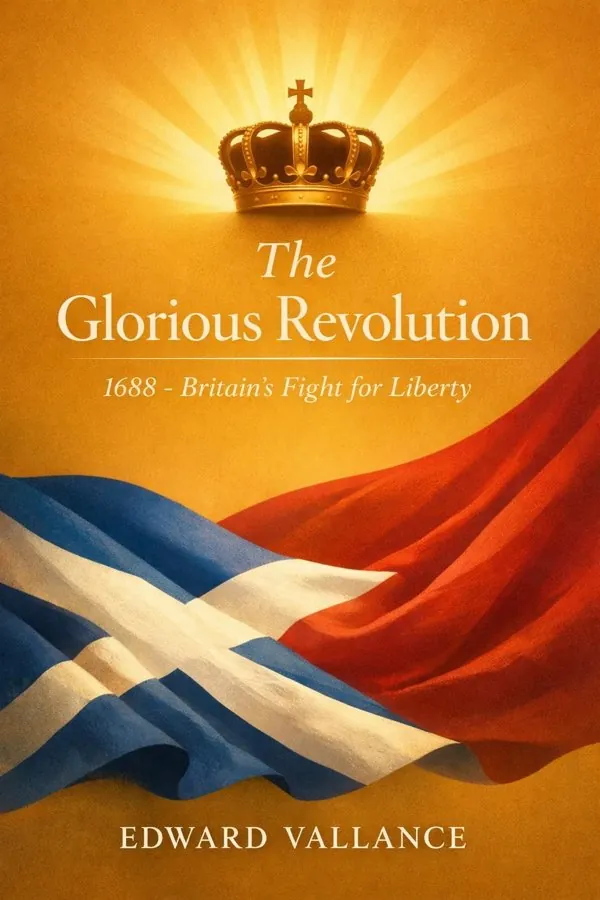
The Glorious Revolution: 1688 - Britain's Fight for Liberty: Summary & Key Insights
 10 min12 chaptersAudio available
What Is The Glorious Revolution: 1688 - Britain's Fight for Liberty About?
The Glorious Revolution: 1688 - Britain's Fight for Liberty by Edward Vallance is a world_history book spanning 12 pages. Edward Vallance’s 'The Glorious Revolution: 1688 - Britain's Fight for Liberty' offers a detailed historical account of the events surrounding the overthrow of King James II and the ascension of William and Mary to the English throne. Vallance reexamines the so-called 'bloodless revolution,' arguing that it was far more complex and contested than traditional narratives suggest. Drawing on contemporary sources, he explores the political, religious, and social upheavals that reshaped Britain’s constitutional monarchy and laid the groundwork for modern democracy.
This FizzRead summary covers all 12 key chapters of The Glorious Revolution: 1688 - Britain's Fight for Liberty in approximately 10 minutes, distilling the most important ideas, arguments, and takeaways from Edward Vallance's work. Also available as an audio summary and Key Quotes Podcast.
The Glorious Revolution: 1688 - Britain's Fight for Liberty
Edward Vallance’s 'The Glorious Revolution: 1688 - Britain's Fight for Liberty' offers a detailed historical account of the events surrounding the overthrow of King James II and the ascension of William and Mary to the English throne. Vallance reexamines the so-called 'bloodless revolution,' arguing that it was far more complex and contested than traditional narratives suggest. Drawing on contemporary sources, he explores the political, religious, and social upheavals that reshaped Britain’s constitutional monarchy and laid the groundwork for modern democracy.
Who Should Read The Glorious Revolution: 1688 - Britain's Fight for Liberty?
This book is perfect for anyone interested in world_history and looking to gain actionable insights in a short read. Whether you're a student, professional, or lifelong learner, the key ideas from The Glorious Revolution: 1688 - Britain's Fight for Liberty by Edward Vallance will help you think differently.
- ✓Readers who enjoy world_history and want practical takeaways
- ✓Professionals looking to apply new ideas to their work and life
- ✓Anyone who wants the core insights of The Glorious Revolution: 1688 - Britain's Fight for Liberty in just 10 minutes
Want the full summary?
Get instant access to this book summary and 100K+ more with Fizz Moment.
Get Free SummaryAvailable on App Store • Free to download
Key Chapters
Before 1688 could be imagined as a revolution, England had to pass through decades of political and religious convulsion. Under Charles II, the restoration of monarchy in 1660 promised peace after the traumas of civil war and republican rule. Yet reconciliation between king, Parliament, and religion remained elusive. Behind the court’s polished façade, fears of secret Catholic sympathies simmered. When the Popish Plot erupted—a web of paranoia and fabricated conspiracy—it exposed the chasm of distrust between the Crown and its subjects.
James, Duke of York, Charles’s brother and heir, was openly Catholic. His very existence became a living threat to Protestant England. Parliament’s attempts to exclude him from succession failed, but they marked a defining fracture: between those who defended hereditary right and those who feared it would doom the kingdom to popery and despotism. The Restoration settlement—carefully balanced between monarchy and Parliament—was beginning to crack.
In this atmosphere, political loyalty meant constant negotiation. Factions rose and fell; courtiers hid their true beliefs; ministers juggled alliances as if survival depended on deceit—which, quite often, it did. By the time Charles II died in 1685, uncertainty had turned into dread. His brother’s accession as James II transformed apprehension into crisis.
James II ascended the throne declaring that he would maintain liberty and law. Yet almost from the start, his actions betrayed those promises. His determination to promote Catholic toleration was genuine but politically disastrous. To him, equality of conscience was a moral duty and a royal prerogative. To much of England, it seemed the thin edge of absolutism.
He packed local offices with Catholics, commissioned officers of his own faith, and dismissed dissenting magistrates. Worse, he bypassed Parliament altogether, using the royal dispensing power to suspend penal laws. In the process, he alienated the very elites—the Anglican gentry and political nobility—whose cooperation sustained monarchy itself. His clash with the Church of England proved fatal. When he commanded bishops to endorse the Declaration of Indulgence, seven of them refused and were tried for seditious libel. Their eventual acquittal was not just a legal victory; it was a seismic political signal that the king’s authority could be resisted in court as well as in conscience.
The irony is that James was not entirely wrong in principle. He sought a religious inclusivity that future generations would partially achieve. But his methods—autocratic, unilateral, and disdainful of custom—destroyed any trust his ideals might have nurtured. By 1688, many who had sworn loyalty to him were quietly preparing for his downfall.
+ 10 more chapters — available in the FizzRead app
All Chapters in The Glorious Revolution: 1688 - Britain's Fight for Liberty
About the Author
Edward Vallance is a British historian specializing in early modern British history, particularly the political and religious transformations of the seventeenth century. He has taught at the University of Roehampton and the University of Sussex and is known for his accessible yet scholarly works on British constitutional and revolutionary history.
Get This Summary in Your Preferred Format
Read or listen to the The Glorious Revolution: 1688 - Britain's Fight for Liberty summary by Edward Vallance anytime, anywhere. FizzRead offers multiple formats so you can learn on your terms — all free.
Available formats: App · Audio · PDF · EPUB — All included free with FizzRead
Download The Glorious Revolution: 1688 - Britain's Fight for Liberty PDF and EPUB Summary
Key Quotes from The Glorious Revolution: 1688 - Britain's Fight for Liberty
“Before 1688 could be imagined as a revolution, England had to pass through decades of political and religious convulsion.”
“James II ascended the throne declaring that he would maintain liberty and law.”
Frequently Asked Questions about The Glorious Revolution: 1688 - Britain's Fight for Liberty
The Glorious Revolution: 1688 - Britain's Fight for Liberty by Edward Vallance is a world_history book that explores key ideas across 12 chapters. Edward Vallance’s 'The Glorious Revolution: 1688 - Britain's Fight for Liberty' offers a detailed historical account of the events surrounding the overthrow of King James II and the ascension of William and Mary to the English throne. Vallance reexamines the so-called 'bloodless revolution,' arguing that it was far more complex and contested than traditional narratives suggest. Drawing on contemporary sources, he explores the political, religious, and social upheavals that reshaped Britain’s constitutional monarchy and laid the groundwork for modern democracy.
You Might Also Like
The Age of Capital
Eric Hobsbawm
10 min
The Gulag Archipelago
Aleksandr Solzhenitsyn
10 min
Jerusalem: The Biography
Simon Sebag Montefiore
10 min
The Anglo-Saxons
James Campbell
10 min
The Boer War
Thomas Pakenham
10 min
The Industrial Revolutionaries: The Making of the Modern World 1776–1914
Gavin Weightman
10 minBrowse by Category
Ready to read The Glorious Revolution: 1688 - Britain's Fight for Liberty?
Get the full summary and 100K+ more books with Fizz Moment.