
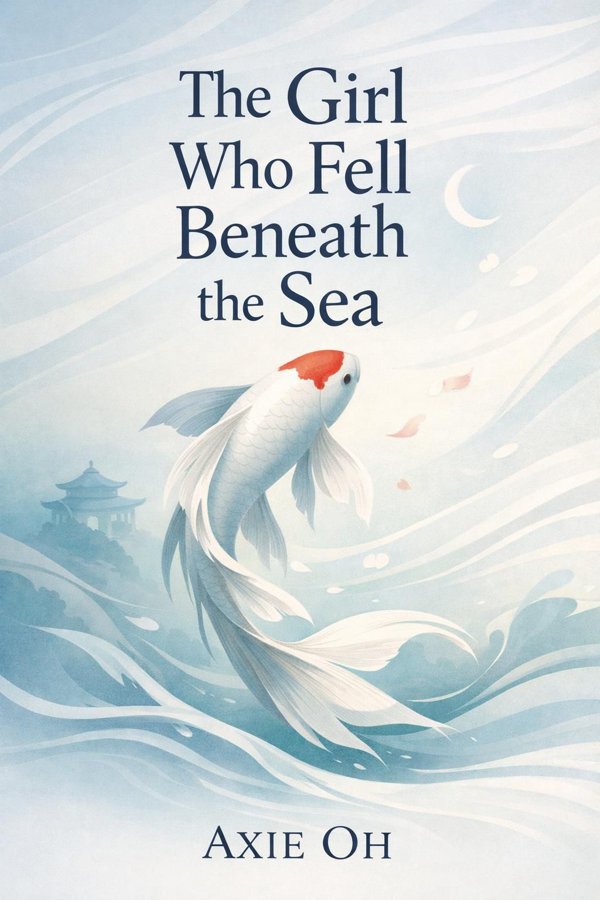
The Girl Who Fell Beneath the Sea: Summary & Key Insights
by Axie Oh
 10 min8 chaptersAudio available
Key Takeaways from The Girl Who Fell Beneath the Sea
The most powerful sacrifices are not the ones forced upon us, but the ones we consciously choose.
Fantasy worlds become memorable when they reveal emotional truths, not just magical spectacle.
What looks like cruelty is sometimes sorrow that has gone unanswered.
To remember someone fully is to resist the forces that turn love into absence.
In many adventure stories, strength is measured by force.
What Is The Girl Who Fell Beneath the Sea About?
The Girl Who Fell Beneath the Sea by Axie Oh is a scifi_fantasy book spanning 4 pages. What if the only way to save your family was to surrender yourself to a god who may no longer be listening? In The Girl Who Fell Beneath the Sea, Axie Oh reimagines a well-known Korean folktale into a luminous fantasy about sacrifice, memory, love, and the quiet bravery it takes to challenge fate. The novel follows Mina, a young woman from a storm-ravaged village who throws herself into the sea in place of her brother’s beloved, hoping to calm the wrath of the Sea God and end years of devastation. Instead of death, she awakens in a dazzling spirit realm filled with gods, demons, hidden bargains, and ancient grief. There, she discovers that the Sea God’s curse is not simply a punishment, but a mystery rooted in loss and forgetting. Axie Oh brings unusual authority to this retelling through her deep engagement with Korean culture, mythology, and storytelling traditions, while crafting a fast-moving, emotionally resonant young adult fantasy. The result is a novel that feels timeless and modern at once: an enchanting adventure that asks what we owe to love, family, and ourselves.
This FizzRead summary covers all 8 key chapters of The Girl Who Fell Beneath the Sea in approximately 10 minutes, distilling the most important ideas, arguments, and takeaways from Axie Oh's work. Also available as an audio summary and Key Quotes Podcast.
The Girl Who Fell Beneath the Sea
What if the only way to save your family was to surrender yourself to a god who may no longer be listening? In The Girl Who Fell Beneath the Sea, Axie Oh reimagines a well-known Korean folktale into a luminous fantasy about sacrifice, memory, love, and the quiet bravery it takes to challenge fate. The novel follows Mina, a young woman from a storm-ravaged village who throws herself into the sea in place of her brother’s beloved, hoping to calm the wrath of the Sea God and end years of devastation. Instead of death, she awakens in a dazzling spirit realm filled with gods, demons, hidden bargains, and ancient grief. There, she discovers that the Sea God’s curse is not simply a punishment, but a mystery rooted in loss and forgetting. Axie Oh brings unusual authority to this retelling through her deep engagement with Korean culture, mythology, and storytelling traditions, while crafting a fast-moving, emotionally resonant young adult fantasy. The result is a novel that feels timeless and modern at once: an enchanting adventure that asks what we owe to love, family, and ourselves.
Who Should Read The Girl Who Fell Beneath the Sea?
This book is perfect for anyone interested in scifi_fantasy and looking to gain actionable insights in a short read. Whether you're a student, professional, or lifelong learner, the key ideas from The Girl Who Fell Beneath the Sea by Axie Oh will help you think differently.
- ✓Readers who enjoy scifi_fantasy and want practical takeaways
- ✓Professionals looking to apply new ideas to their work and life
- ✓Anyone who wants the core insights of The Girl Who Fell Beneath the Sea in just 10 minutes
Want the full summary?
Get instant access to this book summary and 100K+ more with Fizz Moment.
Get Free SummaryAvailable on App Store • Free to download
Key Chapters
The most powerful sacrifices are not the ones forced upon us, but the ones we consciously choose. At the start of The Girl Who Fell Beneath the Sea, Mina lives in a village terrorized by violent storms that the people believe are caused by the Sea God’s anger. Every year, a maiden is offered to the sea in hopes of calming his wrath. When Mina learns that the chosen girl is Shim Cheong, the woman her older brother loves, she refuses to stand by and let another person’s future be consumed by ritual. She takes Cheong’s place and throws herself into the water.
This moment defines Mina’s character. Her action is not born from passivity, but from moral clarity. She understands the cost, yet decides that love means intervention, not observation. That choice transforms the familiar “sacrificial maiden” myth into something more complex. Mina is not merely a victim of tradition; she becomes an agent within it. Her descent beneath the sea is therefore both literal and symbolic: she leaves behind the life others expected for her and enters a realm where she must define herself.
In practical terms, Mina’s decision reflects a truth many readers recognize. Sometimes courage appears when we step into difficult situations to protect others, even when there is no guarantee of success. This does not always mean dramatic self-sacrifice. It can look like speaking up for someone being mistreated, taking responsibility during a family crisis, or choosing integrity over comfort.
The novel reminds us that brave choices often begin in ordinary love: love for family, love for justice, love for a future better than the one tradition offers. Mina’s leap is meaningful because she acts despite fear, not without it.
Actionable takeaway: When you face a difficult moment, ask not only “What am I afraid to lose?” but also “What am I willing to protect?”
Fantasy worlds become memorable when they reveal emotional truths, not just magical spectacle. After Mina falls into the sea, she awakens in the Spirit Realm, a breathtaking place of floating lights, divine courts, masked spirits, curses, and enchanted rules. But this realm is more than an imaginative setting. It mirrors the desires, griefs, ambitions, and flaws of the human world above. Gods are vain, kind, wounded, jealous, playful, and lonely. Spirits keep secrets. Power circulates through relationships as much as through magic.
This is one of the novel’s most compelling achievements. The Spirit Realm could have functioned as a decorative fantasy backdrop, yet Axie Oh uses it to deepen the story’s themes. Mina’s journey through this strange world teaches her that suffering is rarely as simple as people believe. Her village sees storms and assumes divine cruelty. In reality, the spiritual order has become fractured from within. Beneath the sea, appearances mislead, old wounds endure, and people cling to stories that may no longer be true.
Readers can apply this insight beyond fiction. We often imagine that somewhere else—a different job, city, relationship, or social circle—life is cleaner and more meaningful. But every world, magical or mundane, contains complexity. Institutions have hidden histories. Families have unspoken grief. Communities carry myths about themselves. Understanding this helps us move through life with more humility and curiosity.
Mina succeeds not because she dominates the Spirit Realm, but because she learns how to read it. She listens, observes, and adapts. That is a valuable model for entering any unfamiliar environment, from a new workplace to a different culture.
Actionable takeaway: The next time you enter an unfamiliar situation, resist snap judgments. Observe the hidden rules, ask questions, and look beneath appearances before deciding what is really happening.
What looks like cruelty is sometimes sorrow that has gone unanswered. As Mina searches for the truth behind the Sea God’s sleep and the storms ravaging her homeland, she discovers that the crisis is rooted not simply in anger, but in profound loss. The Sea God, once associated with blessing and balance, has become unreachable after the disappearance of his beloved. The enchanted sleep surrounding him is tied to grief, memory, and separation. In other words, the curse is emotional before it is magical.
This idea gives the novel its emotional depth. Many fantasy stories feature a villain who inflicts suffering out of ambition or malice. Here, the central disorder is more tragic. A broken heart has rippled outward until entire communities are paying the price. By reframing the conflict in this way, Axie Oh shifts the story from one of combat to one of understanding. Mina does not simply need to defeat an enemy; she must uncover what has been forgotten and help restore connection.
In real life, unresolved grief can shape behavior in ways that resemble a curse. A person may become distant after loss. A family can repeat painful patterns because no one names the original hurt. A community may remain trapped in fear because it never properly mourned what it lost. The novel suggests that healing begins when someone is brave enough to witness the wound honestly.
Mina’s greatest strength is not brute power but emotional intelligence. She senses that beneath the rituals, divine politics, and old stories lies a simpler truth: something precious was lost, and the world has been distorted ever since. Her task is to remember what others have buried.
Actionable takeaway: When a problem feels irrationally painful or persistent, ask what grief may be hiding underneath it. Naming the wound is often the first step toward lifting the curse.
To remember someone fully is to resist the forces that turn love into absence. One of the novel’s deepest themes is the relationship between memory and identity. As Mina grows closer to the sleeping Sea God and uncovers the hidden story of his lost beloved, she learns that forgetting is not neutral. Memory can be stolen, distorted, suppressed, or traded away, and when that happens, entire worlds fall out of balance.
This theme elevates the story beyond romance. Love in The Girl Who Fell Beneath the Sea is not only about attraction or devotion; it is also about witnessing another person clearly and holding onto the truth of who they are. The emotional stakes grow because remembrance becomes a moral act. To forget is to surrender to disorder. To remember is to restore meaning.
This resonates strongly in ordinary life. People preserve love through rituals of memory: telling family stories, keeping photographs, cooking inherited recipes, revisiting meaningful places, or speaking the names of those who are gone. Memory helps us maintain continuity with what matters. It also protects us from manipulation. On a social level, communities that forget their history often repeat harm. On a personal level, individuals who lose sight of their values can drift into lives that no longer feel like their own.
Mina repeatedly chooses remembrance over convenience. She pays attention to fragments, symbols, and emotional truths that others overlook. Through that attentiveness, she becomes capable of restoring what magic alone cannot fix.
The novel argues that memory is not passive storage. It is active care. To remember someone is to make room for their reality inside your own life.
Actionable takeaway: Preserve one meaningful memory this week—write it down, share it aloud, or create a small ritual around it—so that what matters to you is not left to fade.
In many adventure stories, strength is measured by force. In this novel, kindness repeatedly proves more transformative than power. As Mina navigates the Spirit Realm, she encounters gods, attendants, spirits, and strangers who could be treated as obstacles or tools. Instead, she meets them with empathy, curiosity, and respect. These choices shape the course of her journey. Allies emerge not because Mina commands them, but because she sees their humanity—or divinity—when others do not.
This matters because the world Mina enters is deeply hierarchical. Titles, magical ability, and status determine who is heard and who is dismissed. Yet Mina, a mortal girl with little formal power, alters events precisely because she refuses to accept those assumptions. She listens to the lonely, protects the vulnerable, and responds to others as individuals rather than functions. In doing so, she reveals a different model of leadership: influence grounded in compassion.
In real life, kindness is often underestimated because it does not look dramatic. But in families, classrooms, workplaces, and friendships, the people who create trust are often those who notice others, honor boundaries, and extend generosity without immediate reward. Kindness can de-escalate tension, invite honesty, and build loyalty more effectively than intimidation ever could.
Axie Oh does not portray kindness as softness without cost. Mina’s compassion requires courage because it makes her vulnerable. Caring about others means she can be hurt by betrayal or loss. But the novel insists that this vulnerability is not weakness; it is the very thing that makes connection possible.
Actionable takeaway: In your next conflict, choose one deliberately kind action—listen longer, ask a sincere question, or offer help. Small acts of care often open doors that pressure cannot.
We often discover who we are only after leaving the place where our identity was assigned. Mina begins the novel in a village shaped by fear, duty, and tradition. She is known in relation to others: daughter, sister, mortal girl, potential sacrifice. Once she enters the Spirit Realm, those labels no longer fully define her. She must make decisions without the familiar structures that once told her what her role should be.
That crossing between worlds is one of the novel’s most meaningful coming-of-age elements. Mina does not become someone entirely new beneath the sea; rather, the journey allows her hidden qualities to emerge. She learns to negotiate with uncertainty, recognize deception, trust her instincts, and act from conviction rather than expectation. The supernatural setting externalizes a universal developmental experience: leaving home, stepping into a larger world, and realizing that identity must be chosen as much as inherited.
This is especially relevant for young readers, but it speaks broadly to anyone facing transition. Starting college, entering a new career, moving away from family, or changing communities often creates the same disorienting freedom. Old definitions loosen. We may initially feel unmoored, yet that instability can become the ground of growth.
Mina’s evolution shows that identity is not built by rejecting one’s roots entirely. She carries her love for family and her moral upbringing with her. What changes is her ability to reinterpret them. She becomes more fully herself not by erasing where she came from, but by testing those values against a wider reality.
Actionable takeaway: When entering a new chapter of life, write down which parts of your identity you want to keep, which assumptions you want to question, and what kind of person you hope to become.
A retelling matters most when it honors tradition while making it newly alive. The Girl Who Fell Beneath the Sea draws inspiration from the Korean folktale of Shim Cheong, yet Axie Oh does not merely reproduce the old story. She reshapes it through a modern young adult lens, expanding the role of choice, agency, and emotional complexity. In doing so, she demonstrates why myths survive across generations: they are not static relics, but living frameworks through which cultures continue to ask important questions.
This adaptation is especially effective because it preserves the folktale’s emotional core—sacrifice, devotion, the crossing between worlds—while deepening the heroine’s subjectivity. Mina is not simply symbolic. She is thoughtful, afraid, determined, jealous, loving, and flawed. By giving her a fully realized inner life, Oh invites contemporary readers into a traditional narrative without flattening its cultural roots.
There is a practical lesson here about storytelling, culture, and even personal identity. Traditions remain meaningful when people engage them actively rather than treating them as museum pieces. Families adapt rituals. Artists reinterpret inherited stories. Communities preserve history not by freezing it, but by carrying it forward into present concerns. The same is true of our own lives: we inherit scripts about success, love, gender, duty, and belonging, but we still have responsibility for how we live them out.
The novel is therefore not only a fantasy adventure; it is also a reminder that cultural memory thrives through creative renewal. Readers come away entertained, but also invited to see folklore as a resource for reflection rather than a distant curiosity.
Actionable takeaway: Revisit one story, tradition, or family belief you inherited and ask how it might speak differently to your life today if you retold it in your own words.
Worlds fall out of balance when everyone accepts the surface version of events. Throughout the novel, Mina uncovers how dangerous unquestioned narratives can be. Her village believes the storms are a simple punishment from a wrathful Sea God. The Spirit Realm runs on partial truths, hidden loyalties, and long-maintained illusions. Powerful figures benefit when others remain confused. To restore harmony, Mina must do more than survive magical dangers; she must challenge the stories people have been living inside.
This makes truth-telling one of the book’s central acts of courage. It is easier for communities to rely on ritual than to investigate injustice. It is easier for leaders to preserve order through silence than to face uncomfortable facts. Mina’s journey shows that real restoration depends on exposing what has been buried—whether that is grief, betrayal, forgotten love, or corrupted power.
The relevance to everyday life is immediate. Families often protect themselves with half-truths. Organizations hide dysfunction behind polished narratives. Societies repeat myths that excuse harm. In each case, balance cannot be recovered through denial. Someone must ask better questions. Someone must be willing to risk disapproval in order to speak clearly.
Importantly, the novel does not portray truth as cruelty. Mina is not interested in revelation for its own sake. She seeks truth because healing depends on it. Honesty without compassion can wound; compassion without honesty can enable damage. The story argues for the difficult union of both.
By the end, Mina’s bravery is not only that she went beneath the sea. It is that she kept pursuing reality even when illusion would have been safer.
Actionable takeaway: Identify one story in your life that may be incomplete or convenient. Ask what facts, feelings, or perspectives need to be acknowledged before genuine peace is possible.
All Chapters in The Girl Who Fell Beneath the Sea
About the Author
Axie Oh is a Korean American author celebrated for young adult novels that blend fantasy, romance, and Korean cultural influence. She has built a reputation for writing emotionally resonant stories with vivid worldbuilding, whether in futuristic settings or myth-inspired realms. Her books include Rebel Seoul, Rogue Heart, XOXO, and The Girl Who Fell Beneath the Sea, each showing her range across speculative and contemporary fiction. Oh has been widely praised for bringing Korean folklore, history, and sensibility into stories that feel accessible to international readers without losing cultural texture. Her interest in Korean heritage and storytelling traditions gives her work a distinctive voice, especially in retellings that balance mythic grandeur with intimate emotional stakes. She is recognized as an important contemporary YA author whose fiction connects identity, belonging, love, and imagination.
Get This Summary in Your Preferred Format
Read or listen to the The Girl Who Fell Beneath the Sea summary by Axie Oh anytime, anywhere. FizzRead offers multiple formats so you can learn on your terms — all free.
Available formats: App · Audio · PDF · EPUB — All included free with FizzRead
Download The Girl Who Fell Beneath the Sea PDF and EPUB Summary
Key Quotes from The Girl Who Fell Beneath the Sea
“The most powerful sacrifices are not the ones forced upon us, but the ones we consciously choose.”
“Fantasy worlds become memorable when they reveal emotional truths, not just magical spectacle.”
“What looks like cruelty is sometimes sorrow that has gone unanswered.”
“To remember someone fully is to resist the forces that turn love into absence.”
“In many adventure stories, strength is measured by force.”
Frequently Asked Questions about The Girl Who Fell Beneath the Sea
The Girl Who Fell Beneath the Sea by Axie Oh is a scifi_fantasy book that explores key ideas across 8 chapters. What if the only way to save your family was to surrender yourself to a god who may no longer be listening? In The Girl Who Fell Beneath the Sea, Axie Oh reimagines a well-known Korean folktale into a luminous fantasy about sacrifice, memory, love, and the quiet bravery it takes to challenge fate. The novel follows Mina, a young woman from a storm-ravaged village who throws herself into the sea in place of her brother’s beloved, hoping to calm the wrath of the Sea God and end years of devastation. Instead of death, she awakens in a dazzling spirit realm filled with gods, demons, hidden bargains, and ancient grief. There, she discovers that the Sea God’s curse is not simply a punishment, but a mystery rooted in loss and forgetting. Axie Oh brings unusual authority to this retelling through her deep engagement with Korean culture, mythology, and storytelling traditions, while crafting a fast-moving, emotionally resonant young adult fantasy. The result is a novel that feels timeless and modern at once: an enchanting adventure that asks what we owe to love, family, and ourselves.
You Might Also Like
Red Rising
Pierce Brown
10 min
Stranger in a Strange Land
Robert A. Heinlein
10 min
AI Valley
Chen Qiufan
10 min
Bloodchild
Octavia E. Butler
10 min
Do Androids Dream of Electric Sheep?
Philip K. Dick
10 min
Jujutsu Kaisen, Vol. 24
Gege Akutami
10 minBrowse by Category
Ready to read The Girl Who Fell Beneath the Sea?
Get the full summary and 100K+ more books with Fizz Moment.