
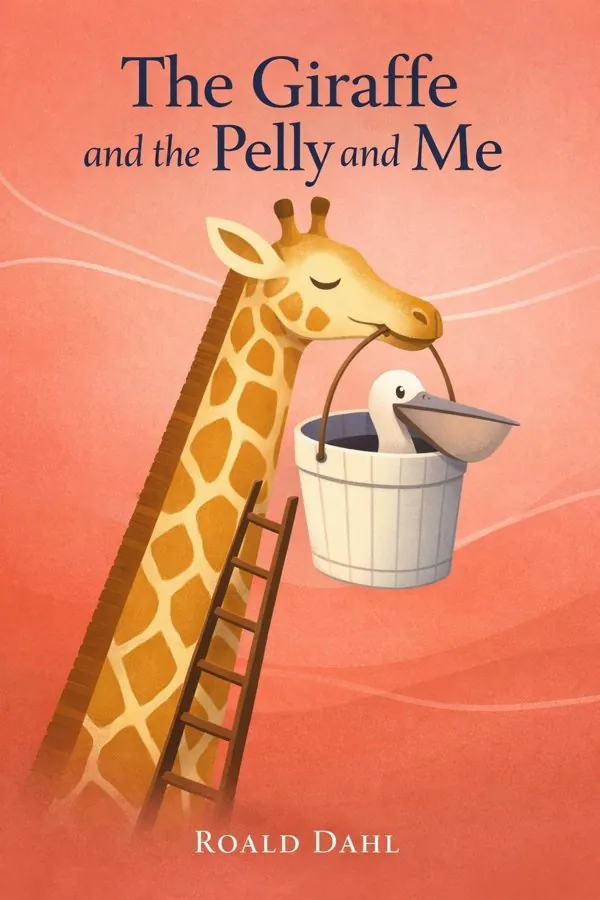
The Giraffe and the Pelly and Me: Summary & Key Insights
by Roald Dahl
 10 min9 chaptersAudio available
Key Takeaways from The Giraffe and the Pelly and Me
Every meaningful adventure starts with a desire that seems almost too modest to matter.
Sometimes the places we think are empty are only waiting for us to look again.
Innovation often looks ridiculous before it looks brilliant.
Some friendships begin not with similarity, but with surprise.
Laughter is one of the quickest ways to lower resistance to imagination.
What Is The Giraffe and the Pelly and Me About?
The Giraffe and the Pelly and Me by Roald Dahl is a classics book spanning 3 pages. The Giraffe and the Pelly and Me is one of Roald Dahl’s most playful and light-footed stories, a small classic that captures everything children love about his writing: oddball characters, comic exaggeration, sudden adventure, and the thrilling sense that the ordinary world might crack open at any moment to reveal something marvelous. At the center is Billy, a boy with a simple but heartfelt dream of one day owning a sweet shop. That dream leads him to an unusual abandoned building called The Grubber, where he encounters an even more unusual team: a giraffe, a pelican, and a monkey running a ladderless window-cleaning company. What follows is more than a whimsical caper. Dahl turns Billy’s wish, the trio’s inventiveness, and their unexpected heroism into a story about imagination, friendship, and the rewards of staying open to surprise. Though brief, the book carries a lasting charm because it treats a child’s dream as something serious and worthy. Roald Dahl, one of the most beloved children’s authors of the twentieth century, brings his signature blend of humor, rhythm, and delightfully exaggerated storytelling to a tale that reminds readers that strange friends and impossible opportunities often arrive together.
This FizzRead summary covers all 9 key chapters of The Giraffe and the Pelly and Me in approximately 10 minutes, distilling the most important ideas, arguments, and takeaways from Roald Dahl's work. Also available as an audio summary and Key Quotes Podcast.
The Giraffe and the Pelly and Me
The Giraffe and the Pelly and Me is one of Roald Dahl’s most playful and light-footed stories, a small classic that captures everything children love about his writing: oddball characters, comic exaggeration, sudden adventure, and the thrilling sense that the ordinary world might crack open at any moment to reveal something marvelous. At the center is Billy, a boy with a simple but heartfelt dream of one day owning a sweet shop. That dream leads him to an unusual abandoned building called The Grubber, where he encounters an even more unusual team: a giraffe, a pelican, and a monkey running a ladderless window-cleaning company.
What follows is more than a whimsical caper. Dahl turns Billy’s wish, the trio’s inventiveness, and their unexpected heroism into a story about imagination, friendship, and the rewards of staying open to surprise. Though brief, the book carries a lasting charm because it treats a child’s dream as something serious and worthy. Roald Dahl, one of the most beloved children’s authors of the twentieth century, brings his signature blend of humor, rhythm, and delightfully exaggerated storytelling to a tale that reminds readers that strange friends and impossible opportunities often arrive together.
Who Should Read The Giraffe and the Pelly and Me?
This book is perfect for anyone interested in classics and looking to gain actionable insights in a short read. Whether you're a student, professional, or lifelong learner, the key ideas from The Giraffe and the Pelly and Me by Roald Dahl will help you think differently.
- ✓Readers who enjoy classics and want practical takeaways
- ✓Professionals looking to apply new ideas to their work and life
- ✓Anyone who wants the core insights of The Giraffe and the Pelly and Me in just 10 minutes
Want the full summary?
Get instant access to this book summary and 100K+ more with Fizz Moment.
Get Free SummaryAvailable on App Store • Free to download
Key Chapters
Every meaningful adventure starts with a desire that seems almost too modest to matter. In The Giraffe and the Pelly and Me, Billy’s dream is not grand in the usual storybook sense. He does not want to be a king, slay monsters, or travel the globe. He wants to own a sweet shop. That small longing gives the story its emotional center, because it reflects how real dreams often work: they begin as private, specific wishes rooted in wonder, comfort, and imagination.
Billy’s attachment to The Grubber, an old abandoned sweet-shop building, shows how strongly children invest places with possibility. To adults, it may be just a worn-out building. To Billy, it is a future. Dahl treats this dream seriously, and that matters. He suggests that imagination is not childish in a dismissive sense; it is the first stage of vision. Billy returns to The Grubber not because he is naive, but because he can still see what something could become.
This idea applies far beyond children’s fiction. Many goals start exactly this way: a person dreams of opening a bakery, starting a library, becoming a teacher, or building something useful in their neighborhood. The dream may seem small from the outside, but it can shape identity and action. Billy’s hope prepares him to notice opportunity when it appears in an unexpected form.
Dahl shows that dreams do not always come true directly. Often, they lead us into detours, friendships, and experiences that eventually make the dream possible. Billy does not gain his sweet shop by passively wishing. He keeps returning, keeps caring, and stays alert to the strange transformation unfolding before him.
Actionable takeaway: Take your smallest sincere dream seriously. Write it down, revisit it often, and stay attentive to unexpected paths that might lead you toward it.
Sometimes the places we think are empty are only waiting for us to look again. The Grubber begins in Billy’s mind as the perfect future sweet shop, but when the building changes hands, it becomes something even more surprising: the headquarters of the Ladderless Window-Cleaning Company. That transformation captures one of Dahl’s favorite storytelling moves—turning disappointment into discovery.
Billy first experiences loss. The building he has loved from afar is no longer simply his dream space. Someone else has taken it over. Yet Dahl does not let the story stop there. Instead, the disappointment opens into curiosity. Who is inside? What kind of business could operate from such a place? Why is everything so odd? In this way, the story teaches a subtle but valuable lesson: not getting exactly what you imagined is sometimes the beginning of a better adventure.
The Grubber also symbolizes how imagination and reality can overlap. It remains a place of wonder, but not in the way Billy expected. Rather than becoming a shop immediately, it becomes a gateway to friendship and action. This reflects a real-life truth. A person may aim for one outcome—a job, a move, a project—and end up discovering collaborators, skills, and opportunities that matter even more than the original plan.
Children especially benefit from stories like this because they normalize change without making it feel bleak. Billy is disappointed, but he is not crushed. He stays curious. That emotional flexibility is one of the book’s quiet strengths.
In practical terms, this idea invites readers to reinterpret setbacks. If a plan changes, the useful question is not only “What did I lose?” but also “What new possibility is now in front of me?” Billy’s willingness to step closer to mystery rather than retreat from it is what brings the story alive.
Actionable takeaway: When a plan changes unexpectedly, pause before dismissing it as failure. Ask what new door the change may have opened, and explore it with curiosity.
Innovation often looks ridiculous before it looks brilliant. The Ladderless Window-Cleaning Company is one of the most charming inventions in the book, and it works because Dahl treats absurdity as practical genius. A giraffe serves as the stretching ladder, a pelican uses his enormous beak as a bucket and tool carrier, and a monkey performs the agile polishing work. Together, they replace clumsy equipment with a living system perfectly suited to the task.
What makes this idea memorable is not just the joke, though the joke is excellent. It is the celebration of specialized strengths. Each animal contributes something unique. The giraffe has reach, the pelican has storage and balance, and the monkey has dexterity. None of them could do the entire job alone as effectively as they do together. Dahl turns physical exaggeration into a lesson about teamwork and problem-solving.
This has many practical applications. In school, group projects work best when each person uses a different strength rather than duplicating effort. In workplaces, the strongest teams often combine vision, organization, communication, and technical skill instead of expecting everyone to think the same way. In family life, even chores can be handled more efficiently when people divide tasks according to what they do best.
The company is also a reminder that unconventional approaches can outperform traditional ones. The world often assumes there is one correct method: one ladder, one route, one way to run a business. Dahl delights in showing a completely different system that is not only effective but superior. Children reading the book absorb a liberating message: weird ideas are worth testing.
Billy’s fascination with the company reflects the reader’s own awakening to this principle. He sees that imagination is not merely decorative; it can solve problems elegantly.
Actionable takeaway: The next time you face a practical problem, list the unique strengths of the people involved and design a solution around them instead of forcing everyone into the same role.
Laughter is one of the quickest ways to lower resistance to imagination. The Giraffe and the Pelly and Me is filled with comic energy: the absurdity of a pelican’s beak, the elastic usefulness of a giraffe’s neck, the monkey’s nimble professionalism, and the exaggerated business of washing windows without ladders. Dahl knows that if readers are laughing, they are also willing to believe. Humor opens the gate for wonder.
This is one reason the book remains effective for both children and adults. Children delight in the silliness directly, while older readers recognize the skill behind it. Dahl uses rhythm, surprise, and playful exaggeration to build a world where impossible things feel not only acceptable but logically satisfying. Once the premise is accepted, everything that follows feels natural within the story’s rules.
Humor also prevents sentimentality. Billy’s dream is touching, and the friendship at the center is warm, but the book never becomes overly sweet. The comedy keeps the tone buoyant. This balance is a major part of Dahl’s authority as a storyteller. He knows that children do not want lectures wrapped in syrup. They want fun, and through fun they absorb deeper truths about courage, kindness, and possibility.
In daily life, humor serves a similar purpose. A difficult situation can become manageable when someone introduces playfulness. Teachers use jokes to make lessons memorable. Parents use silliness to reduce stress. Teams often solve problems better when the atmosphere allows laughter, because tension loosens and creativity expands.
Dahl’s method reminds us that seriousness of meaning does not require seriousness of tone. You can communicate something lasting while still being delightfully ridiculous.
Actionable takeaway: When trying to explain an idea, solve a problem, or connect with others, use a touch of humor. It can make people more open, attentive, and imaginative.
Many people imagine courage as a quality possessed in advance, but stories often reveal a truer pattern: courage appears when circumstances demand it. In this book, Billy and his unusual companions do not set out planning to become heroes. They are running a business, pursuing opportunity, and navigating a strange day. Yet when danger emerges, they respond. Their bravery grows out of action rather than preparation.
This matters because it makes heroism accessible. Dahl does not reserve courage for warriors or chosen figures. He places it inside a whimsical chain of events involving a boy, a giraffe, a pelican, and a monkey. The effect is encouraging. It suggests that ordinary beings, even very odd ones, can do remarkable things when they are attentive, cooperative, and willing to step forward.
The story’s criminal-catching episode carries excitement, but it also reveals how useful courage is when combined with ingenuity. The characters do not overcome danger through force alone. They use timing, teamwork, and the specific advantages they already possess. This is often how real courage works. A student may stand up for a classmate not by dramatic confrontation but by speaking clearly. A coworker may expose a problem by documenting facts. A child may help in an emergency simply by staying calm and alerting an adult.
Billy’s involvement in the heroic turn of the story shows another important point: being present matters. If he had remained only a dreamer at a distance, he would not have grown into someone who participates in meaningful events. By stepping into the world, he becomes capable of brave action.
Actionable takeaway: Do not wait until you feel perfectly fearless. In uncertain moments, focus on the next useful action you can take—courage often appears once you begin moving.
Luck in stories is most satisfying when it meets character, and that is exactly what happens here. Billy’s eventual reward feels magical, but it does not feel random. He receives something wonderful because he has remained hopeful, kind, and engaged throughout the story. Dahl allows chance to operate, but he ties it to openness of spirit.
This is a subtle distinction. Many fairy tales grant rewards through destiny alone. In The Giraffe and the Pelly and Me, the lucky outcome lands on someone who has shown persistence in dreaming and generosity in friendship. Billy’s sweet-shop wish, introduced early, is not forgotten. Instead, it ripens. The story suggests that good outcomes often come to those who are prepared to recognize and receive them.
In practical life, people often call something luck when it is actually the meeting point of desire, patience, and readiness. Someone who loves books and spends years reading may suddenly encounter the chance to work in publishing. Someone who enjoys baking may one day be offered a small business opportunity because others already know their passion and skill. The opportunity may appear sudden, but it was made meaningful by everything that came before.
Dahl does not deny the pleasure of surprise. In fact, he delights in it. But he also reassures readers that their private hopes matter. A dream quietly carried may one day be answered in a form both unexpected and fitting. Billy’s reward is moving because it confirms that his longing was never foolish.
The story therefore teaches an optimistic but grounded lesson: keep your dream alive, keep showing up, and let your character prepare you for what fortune may bring.
Actionable takeaway: Stay ready for opportunity by nurturing the interests you care about now. When luck arrives, it helps most those who already know what they love.
It is easy to admire charming characters and separately admire capable ones, but Dahl gives us both at once. The giraffe, pelican, and monkey are not merely amusing. They are skilled workers. Billy is not merely sweet; he is observant and engaged. This combination is one of the book’s quiet strengths. It argues, without preaching, that warmth and usefulness make a powerful pair.
The Ladderless Window-Cleaning Company succeeds because the trio takes its work seriously. They are imaginative, yes, but they are also disciplined enough to offer a service, cooperate effectively, and seize opportunities when they arise. Their kindness toward Billy does not make them less competent. If anything, it makes their world more admirable. They show that being friendly does not mean being careless or weak.
This has strong real-world relevance. The people who leave the deepest impression are often those who combine good character with real ability: the teacher who is both patient and organized, the manager who is both humane and decisive, the friend who is both supportive and reliable. Children especially benefit from seeing this model, because it corrects a common false choice between being nice and being effective.
Dahl’s story also suggests that competence creates dignity. The trio may seem odd from the outside, but their excellent work earns respect. They do not need to become ordinary to be valued. Their abilities speak for them. At the same time, their kindness ensures that success does not harden them into arrogance.
This balance is worth practicing. In school, friendship improves when people also keep promises. In creative work, imagination matters more when paired with effort. In leadership, empathy gains force when joined to skill.
Actionable takeaway: Aim to develop both character and craft. Be kind in how you treat people, and dependable in what you do.
All Chapters in The Giraffe and the Pelly and Me
About the Author
Roald Dahl (1916–1990) was one of the most influential children’s authors of the twentieth century. Born in Wales to Norwegian parents, he lived a varied life before becoming a writer, working as a fighter pilot, intelligence officer, and diplomat during World War II. These unusual experiences helped shape the vivid imagination and dark comic edge that later defined his fiction. Dahl wrote many beloved classics for children, including Charlie and the Chocolate Factory, Matilda, The BFG, James and the Giant Peach, and The Witches. His stories are known for their inventive plots, unforgettable characters, playful language, and deep sympathy for children facing absurd or unfair adult worlds. He also wrote successful short stories for adults. Dahl’s books continue to be read around the world for their humor, originality, and enduring sense of wonder.
Get This Summary in Your Preferred Format
Read or listen to the The Giraffe and the Pelly and Me summary by Roald Dahl anytime, anywhere. FizzRead offers multiple formats so you can learn on your terms — all free.
Available formats: App · Audio · PDF · EPUB — All included free with FizzRead
Download The Giraffe and the Pelly and Me PDF and EPUB Summary
Key Quotes from The Giraffe and the Pelly and Me
“Every meaningful adventure starts with a desire that seems almost too modest to matter.”
“Sometimes the places we think are empty are only waiting for us to look again.”
“Innovation often looks ridiculous before it looks brilliant.”
“Some friendships begin not with similarity, but with surprise.”
“Laughter is one of the quickest ways to lower resistance to imagination.”
Frequently Asked Questions about The Giraffe and the Pelly and Me
The Giraffe and the Pelly and Me by Roald Dahl is a classics book that explores key ideas across 9 chapters. The Giraffe and the Pelly and Me is one of Roald Dahl’s most playful and light-footed stories, a small classic that captures everything children love about his writing: oddball characters, comic exaggeration, sudden adventure, and the thrilling sense that the ordinary world might crack open at any moment to reveal something marvelous. At the center is Billy, a boy with a simple but heartfelt dream of one day owning a sweet shop. That dream leads him to an unusual abandoned building called The Grubber, where he encounters an even more unusual team: a giraffe, a pelican, and a monkey running a ladderless window-cleaning company. What follows is more than a whimsical caper. Dahl turns Billy’s wish, the trio’s inventiveness, and their unexpected heroism into a story about imagination, friendship, and the rewards of staying open to surprise. Though brief, the book carries a lasting charm because it treats a child’s dream as something serious and worthy. Roald Dahl, one of the most beloved children’s authors of the twentieth century, brings his signature blend of humor, rhythm, and delightfully exaggerated storytelling to a tale that reminds readers that strange friends and impossible opportunities often arrive together.
More by Roald Dahl

You Might Also Like





Browse by Category
Ready to read The Giraffe and the Pelly and Me?
Get the full summary and 100K+ more books with Fizz Moment.