
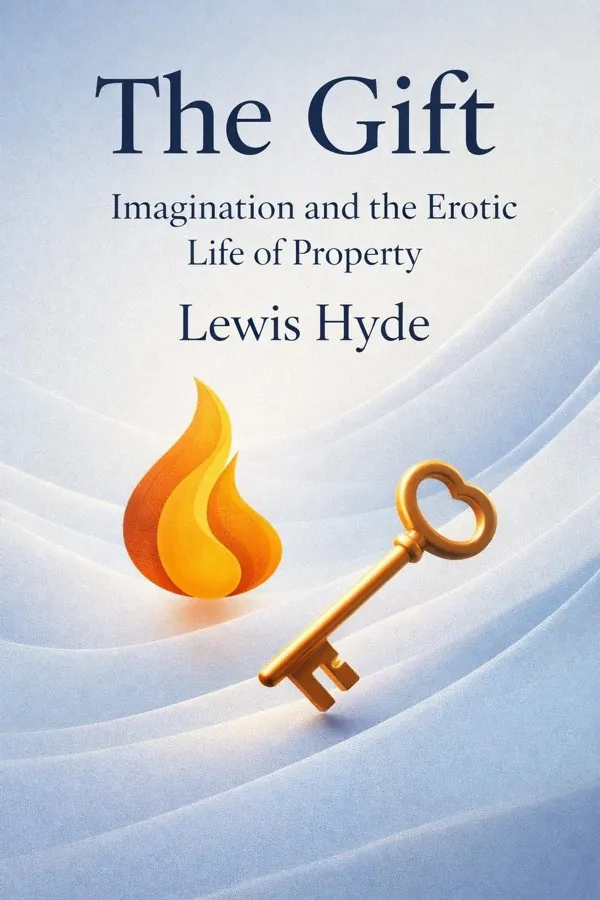
The Gift: Imagination and the Erotic Life of Property: Summary & Key Insights
by Lewis Hyde
 10 min9 chaptersAudio available
What Is The Gift: Imagination and the Erotic Life of Property About?
The Gift: Imagination and the Erotic Life of Property by Lewis Hyde is a creativity book spanning 9 pages. Originally published in 1983, Lewis Hyde’s *The Gift* explores the nature of creativity and the social and moral dimensions of artistic work. Hyde contrasts the 'gift economy' of art—where creative acts are shared freely and enrich the community—with the 'market economy' that commodifies art. Drawing on anthropology, mythology, and literature, Hyde argues that true creativity thrives when art circulates as a gift rather than as a commodity.
This FizzRead summary covers all 9 key chapters of The Gift: Imagination and the Erotic Life of Property in approximately 10 minutes, distilling the most important ideas, arguments, and takeaways from Lewis Hyde's work. Also available as an audio summary and Key Quotes Podcast.
The Gift: Imagination and the Erotic Life of Property
Originally published in 1983, Lewis Hyde’s *The Gift* explores the nature of creativity and the social and moral dimensions of artistic work. Hyde contrasts the 'gift economy' of art—where creative acts are shared freely and enrich the community—with the 'market economy' that commodifies art. Drawing on anthropology, mythology, and literature, Hyde argues that true creativity thrives when art circulates as a gift rather than as a commodity.
Who Should Read The Gift: Imagination and the Erotic Life of Property?
This book is perfect for anyone interested in creativity and looking to gain actionable insights in a short read. Whether you're a student, professional, or lifelong learner, the key ideas from The Gift: Imagination and the Erotic Life of Property by Lewis Hyde will help you think differently.
- ✓Readers who enjoy creativity and want practical takeaways
- ✓Professionals looking to apply new ideas to their work and life
- ✓Anyone who wants the core insights of The Gift: Imagination and the Erotic Life of Property in just 10 minutes
Want the full summary?
Get instant access to this book summary and 100K+ more with Fizz Moment.
Get Free SummaryAvailable on App Store • Free to download
Key Chapters
To understand the meaning of the gift, I turned first to anthropology. The French sociologist Marcel Mauss showed that in many tribal and pre‑capitalist societies, economic life did not revolve around barter or sale but around the circulation of gifts. On the northwest coast of America, for instance, the potlatch ceremonies of indigenous peoples were lavish exchanges in which leaders gave away and even destroyed valuable objects to demonstrate generosity and social prestige. In Polynesia, accolades were tied to one’s ability to give, not to accumulate. What Mauss uncovered is a radically different logic of value: gifts must move. Their worth is in their passage.
A gift that is hoarded loses its vitality; in many myths, it even becomes cursed. Gifts bind communities because they create relationships of reciprocity and gratitude. The gift is never a one‑way act of charity—it initiates a circulation of spirits, feelings, and responsibilities. The object itself is only the vessel for something intangible: a bond. This economy of giving is motivated not by scarcity and competition but by abundance and fertility. It recognizes that wealth increases when it flows.
I remember feeling, while reading Mauss and Polynesian myth, that this model of the world could heal some of the moral narrowing we suffer from in modern economies. When an artist creates, the energy—the insight, the grace—is not owned, it is received. Its power grows only as it moves outward, through sharing. Our creativity, like the potlatch feast, should circulate. In this sense, the circulation of gifts becomes a metaphor for the life of culture itself: a living current, not a ledger.
Every true gift carries a spirit, something alive within it that compels motion. In ancient stories, the gift often appears as an enchanted object—a song, a flame, a magical tool—that loses power if its owner withholds it from use. This is more than metaphor. In human terms, when we receive something given from the heart—an artwork, a poem, a teaching—we sense that it bears an aura of the giver. It invites us to continue the chain by giving in turn.
The spirit of the gift resists stagnation. It asks us to keep the energy alive. That is why we give gifts rather than payments to those we love, why we take pleasure in unearned generosity. In giving, we affirm that some aspects of life should remain outside calculation; they belong to the realm of grace. This is the moral core of the gift: it calls us into relationship. It reminds us that our lives are sustained by exchange not reducible to money.
When I began thinking of art this way, everything about creativity became clearer. The poem or painting does not belong entirely to its maker; it passes through them. To hoard it, to treat it as exclusive private property, causes it to die spiritually. The artist’s role is to be a steward of that spirit—to release the gift into circulation and thereby keep its life moving.
+ 7 more chapters — available in the FizzRead app
All Chapters in The Gift: Imagination and the Erotic Life of Property
About the Author
Lewis Hyde is an American writer, cultural critic, and scholar known for his works on creativity, art, and cultural commons. He has taught at Harvard University and Kenyon College, and his books, including *The Gift* and *Trickster Makes This World*, have influenced generations of artists and thinkers.
Get This Summary in Your Preferred Format
Read or listen to the The Gift: Imagination and the Erotic Life of Property summary by Lewis Hyde anytime, anywhere. FizzRead offers multiple formats so you can learn on your terms — all free.
Available formats: App · Audio · PDF · EPUB — All included free with FizzRead
Download The Gift: Imagination and the Erotic Life of Property PDF and EPUB Summary
Key Quotes from The Gift: Imagination and the Erotic Life of Property
“To understand the meaning of the gift, I turned first to anthropology.”
“Every true gift carries a spirit, something alive within it that compels motion.”
Frequently Asked Questions about The Gift: Imagination and the Erotic Life of Property
The Gift: Imagination and the Erotic Life of Property by Lewis Hyde is a creativity book that explores key ideas across 9 chapters. Originally published in 1983, Lewis Hyde’s *The Gift* explores the nature of creativity and the social and moral dimensions of artistic work. Hyde contrasts the 'gift economy' of art—where creative acts are shared freely and enrich the community—with the 'market economy' that commodifies art. Drawing on anthropology, mythology, and literature, Hyde argues that true creativity thrives when art circulates as a gift rather than as a commodity.
You Might Also Like
Dimensions Of Creativity
Margaret A. Boden
10 min
How to Fly a Horse: The Secret History of Creation, Invention, and Discovery
Kevin Ashton
10 min
Imagine: How Creativity Works
Jonah Lehrer
10 min
The Accidental Creative: How to Be Brilliant at a Moment's Notice
Todd Henry
10 min
The Origins of Creativity
Edward O. Wilson
10 min
Wired to Create: Unraveling the Mysteries of the Creative Mind
Scott Barry Kaufman, Carolyn Gregoire
10 minBrowse by Category
Ready to read The Gift: Imagination and the Erotic Life of Property?
Get the full summary and 100K+ more books with Fizz Moment.