
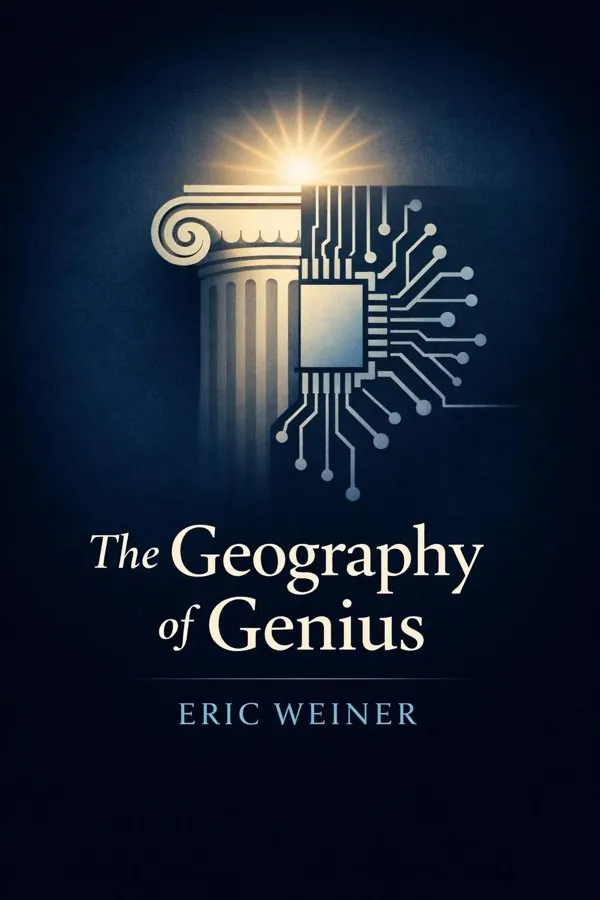
The Geography of Genius: A Search for the World's Most Creative Places, from Ancient Athens to Silicon Valley: Summary & Key Insights
by Eric Weiner
 10 min9 chaptersAudio available
Key Takeaways from The Geography of Genius: A Search for the World's Most Creative Places, from Ancient Athens to Silicon Valley
Genius often begins not with answers but with better questions.
In Weiner’s telling, Hangzhou was not only prosperous and inventive but aesthetically rich, filled with gardens, poetry, elegant design, and refined cultural rituals.
Creative revolutions rarely happen without money, rivalry, and status in the mix.
Sometimes a city’s greatest technology is conversation.
Genius does not always bloom in stable, triumphant societies; sometimes it emerges amid tension, melancholy, and cultural upheaval.
What Is The Geography of Genius: A Search for the World's Most Creative Places, from Ancient Athens to Silicon Valley About?
The Geography of Genius: A Search for the World's Most Creative Places, from Ancient Athens to Silicon Valley by Eric Weiner is a civilization book spanning 8 pages. What makes a particular city erupt with brilliance while others remain merely functional? In The Geography of Genius, Eric Weiner pursues that question across centuries and continents, traveling to places that produced astonishing bursts of creativity and asking what, exactly, was in the air. From the argumentative streets of ancient Athens to the money-fueled workshops of Renaissance Florence and the restless ambition of Silicon Valley, Weiner argues that genius is rarely a private miracle. More often, it is a social achievement shaped by place, timing, institutions, habits, and mood. Part history, part travel narrative, and part inquiry into the psychology of innovation, the book matters because it challenges the comforting myth that talent alone changes the world. Weiner shows that culture can invite originality or smother it, and that great ideas often emerge where freedom, friction, patronage, and cross-pollination meet. As a former NPR correspondent and the author of several intellectually curious travel books, Weiner brings both journalistic rigor and a playful, observant style to the subject. The result is a smart, engaging exploration of how environments help ordinary human potential become extraordinary achievement.
This FizzRead summary covers all 9 key chapters of The Geography of Genius: A Search for the World's Most Creative Places, from Ancient Athens to Silicon Valley in approximately 10 minutes, distilling the most important ideas, arguments, and takeaways from Eric Weiner's work. Also available as an audio summary and Key Quotes Podcast.
The Geography of Genius: A Search for the World's Most Creative Places, from Ancient Athens to Silicon Valley
What makes a particular city erupt with brilliance while others remain merely functional? In The Geography of Genius, Eric Weiner pursues that question across centuries and continents, traveling to places that produced astonishing bursts of creativity and asking what, exactly, was in the air. From the argumentative streets of ancient Athens to the money-fueled workshops of Renaissance Florence and the restless ambition of Silicon Valley, Weiner argues that genius is rarely a private miracle. More often, it is a social achievement shaped by place, timing, institutions, habits, and mood.
Part history, part travel narrative, and part inquiry into the psychology of innovation, the book matters because it challenges the comforting myth that talent alone changes the world. Weiner shows that culture can invite originality or smother it, and that great ideas often emerge where freedom, friction, patronage, and cross-pollination meet. As a former NPR correspondent and the author of several intellectually curious travel books, Weiner brings both journalistic rigor and a playful, observant style to the subject. The result is a smart, engaging exploration of how environments help ordinary human potential become extraordinary achievement.
Who Should Read The Geography of Genius: A Search for the World's Most Creative Places, from Ancient Athens to Silicon Valley?
This book is perfect for anyone interested in civilization and looking to gain actionable insights in a short read. Whether you're a student, professional, or lifelong learner, the key ideas from The Geography of Genius: A Search for the World's Most Creative Places, from Ancient Athens to Silicon Valley by Eric Weiner will help you think differently.
- ✓Readers who enjoy civilization and want practical takeaways
- ✓Professionals looking to apply new ideas to their work and life
- ✓Anyone who wants the core insights of The Geography of Genius: A Search for the World's Most Creative Places, from Ancient Athens to Silicon Valley in just 10 minutes
Want the full summary?
Get instant access to this book summary and 100K+ more with Fizz Moment.
Get Free SummaryAvailable on App Store • Free to download
Key Chapters
Genius often begins not with answers but with better questions. That is what Eric Weiner finds in ancient Athens: not a population of superhuman minds, but a culture that normalized inquiry, argument, and public intellectual life. Athens mattered because it gave thinking a stage. In its marketplaces, schools, and civic spaces, ideas were not hidden inside private study; they were debated, challenged, and refined in full view of others.
The city’s greatness did not come from harmony. It came from productive tension. Philosophers questioned tradition, playwrights probed moral ambiguity, and citizens participated in a political culture that demanded speech and persuasion. This environment rewarded mental agility. Socrates, for example, did not hand out doctrines so much as force people into deeper examination. In that sense, Athenian genius was collective before it was individual. The city cultivated habits of skepticism, discourse, and curiosity that allowed brilliance to multiply.
For modern readers, the lesson is strikingly practical. Creative breakthroughs rarely happen in overly polite, overly certain environments. Teams, schools, and communities become more inventive when disagreement is allowed and questions are valued as much as expertise. A workplace that encourages respectful challenge may produce more originality than one obsessed with smooth consensus. Even in personal life, exposing your thinking to others can sharpen it.
Athens shows that creativity flourishes where people feel free to speak, where public life matters, and where ideas collide often enough to spark. Actionable takeaway: create your own mini-Athens by seeking conversations that challenge your assumptions, joining communities of debate, and treating disagreement as a tool for insight rather than a threat.
We often imagine innovation emerging from harsh competition or technical obsession, but Hangzhou during China’s Song Dynasty suggests another possibility: beauty itself can be productive. In Weiner’s telling, Hangzhou was not only prosperous and inventive but aesthetically rich, filled with gardens, poetry, elegant design, and refined cultural rituals. This was a place where practical ingenuity and artistic sensibility lived side by side.
The result was a civilization that generated major advances, including developments associated with printing, navigation, commerce, and calculation. Hangzhou’s creative power came partly from abundance and confidence. A flourishing urban economy gave people the stability to experiment, while a cultivated appreciation for harmony and refinement elevated craftsmanship. Innovation did not appear as a break from culture; it grew out of culture. When people care deeply about how things look, feel, and fit into life, they often improve how those things function as well.
That insight has modern relevance. Today, some of the most admired products and services succeed not because they are merely efficient but because they combine utility with elegance. Great design can sharpen thought, simplify complexity, and inspire further invention. Creative environments are therefore not built only with funding, labs, and infrastructure. They are also shaped by beauty, atmosphere, and a respect for the senses.
Hangzhou reminds us that innovation can emerge from serenity as well as struggle. A pleasant, stimulating setting may help people notice connections they would miss in a purely transactional environment. Actionable takeaway: improve the aesthetics of your work and learning spaces by adding order, beauty, and moments of reflection, then watch how much easier it becomes to think clearly and create imaginatively.
Creative revolutions rarely happen without money, rivalry, and status in the mix. Renaissance Florence demonstrates this vividly. Weiner presents the city as a place where artists, architects, bankers, and political families created an unusually fertile ecosystem for talent. Florence did not simply admire genius; it commissioned it, funded it, displayed it, and turned it into civic prestige.
The Medici and other patrons played a decisive role. Their support gave artists like Michelangelo and Leonardo room to experiment, but patronage was not passive generosity. It was entangled with ambition. Wealthy families wanted beautiful churches, public works, and artworks that reflected their own influence. This competition, though self-interested, generated extraordinary cultural output. At the same time, Florence was compact enough for ideas to circulate quickly. Workshops, guilds, and public commissions kept people in close contact, allowing techniques and inspiration to spread.
Weiner’s deeper point is that creativity needs infrastructure. Talent alone is fragile. It thrives when institutions reward excellence, when ambitious people are visible to one another, and when society treats making things as a serious civic act. In modern terms, this could mean grants for artists, innovation prizes, mentorship networks, or organizations that celebrate high standards rather than mediocrity.
Florence also warns us that great creativity often arises from unequal and imperfect worlds. The goal is not to romanticize those flaws, but to notice what mechanisms worked: concentrated talent, strong patronage, and intense expectations. Actionable takeaway: if you want more creativity in your organization or community, don’t just praise talent abstractly. Build systems that fund it, showcase it, and create healthy competition that pushes people to do their best work.
Sometimes a city’s greatest technology is conversation. In Enlightenment-era Edinburgh, Weiner finds a place where talk itself became a medium of discovery. Philosophers, economists, doctors, and writers gathered in clubs, taverns, and societies to test ideas in lively, disciplined exchange. This was not idle chatter. It was a cultural habit of thinking together.
Edinburgh’s advantage came partly from scale. It was small enough to be intimate yet large enough to be stimulating. Important figures could actually encounter one another repeatedly. David Hume, Adam Smith, and other thinkers inhabited a social world where ideas moved quickly between disciplines. Economics, philosophy, science, and literature were not sealed compartments. The city’s intellectual culture rewarded breadth, wit, and synthesis, allowing people to connect questions about markets, morality, society, and human nature.
This has important implications for anyone interested in innovation today. Breakthroughs often happen when ideas migrate across fields. A software designer might learn from anthropology; a teacher might improve through theater; a scientist might gain perspective from philosophy. But this kind of cross-fertilization requires spaces where people from different backgrounds can actually meet and speak honestly.
Weiner suggests that genius is often social before it becomes visible as individual accomplishment. The right conversation at the right time can redirect a career or launch a theory. In an age of digital communication, Edinburgh’s lesson is surprisingly fresh: frequent, in-person, unstructured discussion still matters. Actionable takeaway: build regular habits of interdisciplinary conversation by joining salons, discussion groups, or informal gatherings where smart, curious people can exchange ideas without rigid agendas.
Genius does not always bloom in stable, triumphant societies; sometimes it emerges amid tension, melancholy, and cultural upheaval. Weiner’s visit to Calcutta explores a city whose creative energy was tied to contradiction. Colonial pressure, political unrest, poverty, and intellectual ferment combined to produce a remarkable outpouring of literature, art, music, and reformist thought. Calcutta was not comfortable, but it was alive.
What made the city special was its intensity. People argued over identity, morality, modernity, religion, and nationalism. Such debates were painful, yet they demanded imagination. Figures associated with the Bengal Renaissance did not simply imitate the West or cling to tradition. They wrestled with both, producing new forms of synthesis. Rabindranath Tagore exemplifies this spirit: deeply rooted in Bengali culture yet universal in outlook.
Weiner’s treatment of Calcutta broadens the book’s argument. Creative places are not always efficient or polished. Some are messy, emotionally charged, and historically wounded. Their power lies in the urgency of their questions. When a society confronts who it is and who it wants to become, art and thought can become necessary, not decorative.
For modern readers, Calcutta suggests that discomfort can be generative if it is processed through reflection rather than despair. Communities in transition often hold tremendous creative potential because they are forced to invent new narratives. Actionable takeaway: instead of avoiding periods of uncertainty or contradiction, use them as raw material—write, discuss, and create from the tensions you are living through, because unresolved questions often contain the seeds of original work.
Some of history’s richest cultural explosions have emerged from places that looked orderly on the surface but churned underneath. Vienna around 1900 is one of Weiner’s most fascinating examples. Elegant, structured, and highly cultivated, the city also contained anxiety, repression, and an obsession with the hidden life of the mind. Out of that atmosphere came extraordinary work in music, psychology, philosophy, architecture, and art.
Vienna’s genius lay in its contradictions. It respected tradition yet felt its inadequacy. It valued decorum yet was haunted by desire and instability. Freud explored the unconscious, Klimt broke artistic conventions, and composers stretched the boundaries of form. A society trying very hard to maintain composure inadvertently created the pressure that made psychological and artistic depth unavoidable.
Weiner’s broader point is that creativity often feeds on friction between the official story and private experience. When what people feel cannot be fully expressed through existing norms, they invent new languages, new theories, and new aesthetics. This does not mean suffering is automatically noble or productive. Rather, it means that unresolved tension, when examined honestly, can become intellectually fertile.
In contemporary settings, many institutions prize neatness, predictability, and surface professionalism. Vienna suggests that suppressing ambiguity can starve innovation. Teams and creators need room to explore complexity, doubt, and contradiction without immediately simplifying them. Actionable takeaway: make space for deeper reflection by paying attention to what feels unsaid in your work or environment; often the most original idea begins where the polished surface starts to crack.
If Athens taught the art of questioning, Silicon Valley perfected the machinery of experimentation. Weiner approaches the Valley as a modern genius cluster built less on old-world elegance than on velocity, networks, and tolerance for failure. It is a place where risk is not merely accepted but expected, where talent circulates quickly, and where ambitious people gather because everyone else ambitious is already there.
What makes Silicon Valley powerful is not simply the presence of smart individuals or technology firms. It is the ecosystem: venture capital, universities, informal mentorship, startup culture, and a norm of sharing ideas rapidly. Failure carries less stigma, which lowers the emotional cost of trying again. At the same time, the culture prizes scale. People are encouraged not just to improve things slightly but to rethink them entirely.
Weiner also notes that this environment has drawbacks. It can become narrow, self-congratulatory, and blind to human consequences. Yet its creative lesson remains important: innovation accelerates when people can move between institutions, attract capital, and test new concepts without waiting for permission. Dense networks matter. So does a culture that treats experimentation as normal rather than reckless.
For readers outside tech, the application is clear. You do not need to live in Palo Alto to borrow its principles. Encourage prototypes over perfection, shorten feedback loops, and create communities where ambitious people can learn from one another. Actionable takeaway: adopt a startup mindset in your own field by running small experiments, treating setbacks as data, and surrounding yourself with people who energize bold thinking instead of policing it prematurely.
We like to tell stories about solitary geniuses because they are neat and flattering, but Weiner argues that geography deserves far more credit. Places are not passive backdrops. They shape routines, encounters, expectations, emotional tone, and access to resources. A city can encourage wandering, conversation, risk, reverence, beauty, ambition, or conformity—and those conditions influence what kinds of ideas are likely to emerge.
This does not mean every successful place follows the same formula. Athens prized debate, Florence patronage, Edinburgh conversation, Vienna introspection, and Silicon Valley experimentation. Their differences matter. Genius is not produced by one universal ingredient but by a dynamic combination of openness, density, confidence, friction, and cultural values. What unites these places is that they created environments in which certain forms of originality could become visible and sustainable.
The idea has practical implications for individuals as well as cities. If your surroundings dull your curiosity, isolate you, or reward only safe repetition, your best capacities may remain dormant. Conversely, even small changes in environment can unlock energy: a more stimulating neighborhood, a richer social circle, a better-designed workspace, or a routine that exposes you to unfamiliar disciplines.
Weiner invites readers to stop asking only, “Am I talented enough?” and start asking, “Is my environment helping me become more inventive?” Genius, in this view, is partly ecological. Actionable takeaway: audit your environment—physical, social, and cultural—and intentionally redesign it to include more stimulation, challenge, beauty, and connection, because where you think strongly affects how you think.
One of the book’s most valuable insights is that creativity does not flourish in either total chaos or rigid control. It needs a mix of liberty and resistance. Across the cities Weiner visits, genius appears where people have enough freedom to explore but enough friction to sharpen their efforts. Too much comfort can lead to complacency; too much repression can suffocate originality. The sweet spot lies in between.
Athens had argumentative democracy, Florence had competitive patronage, Edinburgh had intellectually demanding conversation, and Silicon Valley has brutal market feedback. In each case, creators were not left alone in a vacuum. They faced rivals, skeptics, deadlines, public judgment, and structural constraints. Those pressures forced refinement. Yet they also had room to dissent, experiment, and imagine alternatives.
This is an especially useful lesson for organizations that want innovation but accidentally undermine it. A company that micromanages every move will rarely inspire bold ideas. But a company with no standards, no deadlines, and no honest critique may produce noise rather than breakthroughs. The best environments pair autonomy with accountability. They invite risk while insisting on rigor.
On a personal level, the same principle applies. Creative growth requires both protected time and meaningful challenge. You need freedom to think differently, but also peers, mentors, or audiences who push your work beyond your first draft instincts. Actionable takeaway: design a creative system for yourself or your team that combines independence with strong feedback—give ideas room to breathe, then expose them to intelligent pressure before calling them finished.
All Chapters in The Geography of Genius: A Search for the World's Most Creative Places, from Ancient Athens to Silicon Valley
About the Author
Eric Weiner is an American author, journalist, and former NPR foreign correspondent whose work explores the relationship between place, culture, and human experience. He is best known for combining travel writing with philosophy, history, and social observation in a voice that is both intelligent and approachable. Before becoming an author, Weiner reported internationally, an experience that sharpened his eye for the subtle ways geography and culture shape how people live and think. His books include The Geography of Bliss and The Geography of Genius, both of which examine big questions through journeys across different societies. Weiner’s writing stands out for its humor, curiosity, and ability to make complex ideas feel vivid and personal. He has become a distinctive guide to the cultural landscapes behind human flourishing.
Get This Summary in Your Preferred Format
Read or listen to the The Geography of Genius: A Search for the World's Most Creative Places, from Ancient Athens to Silicon Valley summary by Eric Weiner anytime, anywhere. FizzRead offers multiple formats so you can learn on your terms — all free.
Available formats: App · Audio · PDF · EPUB — All included free with FizzRead
Download The Geography of Genius: A Search for the World's Most Creative Places, from Ancient Athens to Silicon Valley PDF and EPUB Summary
Key Quotes from The Geography of Genius: A Search for the World's Most Creative Places, from Ancient Athens to Silicon Valley
“Genius often begins not with answers but with better questions.”
“We often imagine innovation emerging from harsh competition or technical obsession, but Hangzhou during China’s Song Dynasty suggests another possibility: beauty itself can be productive.”
“Creative revolutions rarely happen without money, rivalry, and status in the mix.”
“Sometimes a city’s greatest technology is conversation.”
“Genius does not always bloom in stable, triumphant societies; sometimes it emerges amid tension, melancholy, and cultural upheaval.”
Frequently Asked Questions about The Geography of Genius: A Search for the World's Most Creative Places, from Ancient Athens to Silicon Valley
The Geography of Genius: A Search for the World's Most Creative Places, from Ancient Athens to Silicon Valley by Eric Weiner is a civilization book that explores key ideas across 9 chapters. What makes a particular city erupt with brilliance while others remain merely functional? In The Geography of Genius, Eric Weiner pursues that question across centuries and continents, traveling to places that produced astonishing bursts of creativity and asking what, exactly, was in the air. From the argumentative streets of ancient Athens to the money-fueled workshops of Renaissance Florence and the restless ambition of Silicon Valley, Weiner argues that genius is rarely a private miracle. More often, it is a social achievement shaped by place, timing, institutions, habits, and mood. Part history, part travel narrative, and part inquiry into the psychology of innovation, the book matters because it challenges the comforting myth that talent alone changes the world. Weiner shows that culture can invite originality or smother it, and that great ideas often emerge where freedom, friction, patronage, and cross-pollination meet. As a former NPR correspondent and the author of several intellectually curious travel books, Weiner brings both journalistic rigor and a playful, observant style to the subject. The result is a smart, engaging exploration of how environments help ordinary human potential become extraordinary achievement.
More by Eric Weiner

You Might Also Like
The Structure of Scientific Revolutions
Thomas S. Kuhn
10 min
Genius
Harold Bloom
10 min
A Cultural History of the Medieval Age
Various Editors
10 min
A History of God: The 4,000-Year Quest of Judaism, Christianity and Islam
Karen Armstrong
10 min
A History of the World in 10½ Chapters
Julian Barnes
10 min
A Short History of Progress
Ronald Wright
10 minBrowse by Category
Ready to read The Geography of Genius: A Search for the World's Most Creative Places, from Ancient Athens to Silicon Valley?
Get the full summary and 100K+ more books with Fizz Moment.