
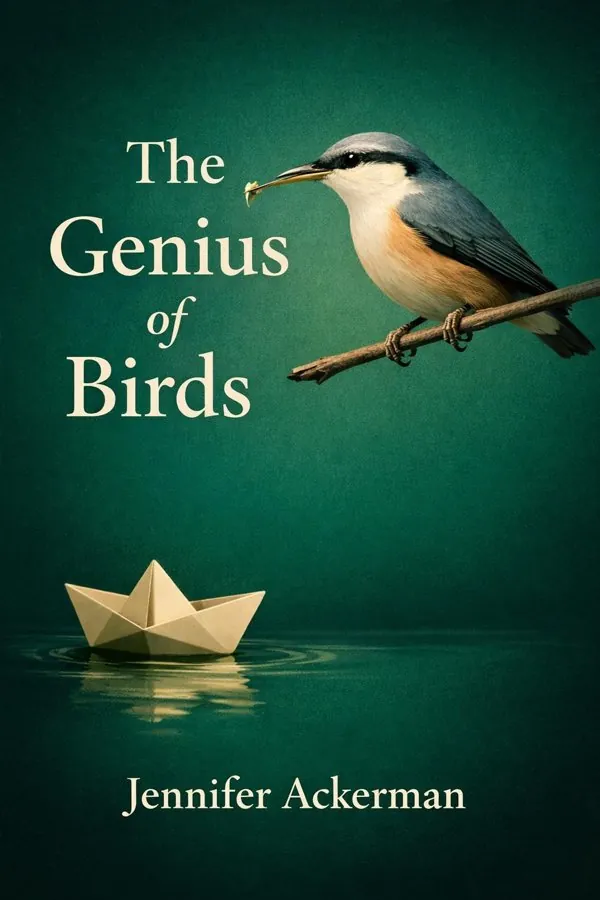
The Genius of Birds: Summary & Key Insights
 10 min10 chaptersAudio available
What Is The Genius of Birds About?
The Genius of Birds by Jennifer Ackerman is a life_science book spanning 10 pages. In this acclaimed work of science writing, Jennifer Ackerman explores the remarkable intelligence, adaptability, and creativity of birds. Drawing on cutting-edge research in ornithology and cognitive science, she reveals how birds use tools, solve problems, communicate, and even exhibit cultural behaviors once thought unique to humans. The book celebrates avian ingenuity and challenges long-held assumptions about the boundaries of animal intelligence.
This FizzRead summary covers all 10 key chapters of The Genius of Birds in approximately 10 minutes, distilling the most important ideas, arguments, and takeaways from Jennifer Ackerman's work. Also available as an audio summary and Key Quotes Podcast.
The Genius of Birds
In this acclaimed work of science writing, Jennifer Ackerman explores the remarkable intelligence, adaptability, and creativity of birds. Drawing on cutting-edge research in ornithology and cognitive science, she reveals how birds use tools, solve problems, communicate, and even exhibit cultural behaviors once thought unique to humans. The book celebrates avian ingenuity and challenges long-held assumptions about the boundaries of animal intelligence.
Who Should Read The Genius of Birds?
This book is perfect for anyone interested in life_science and looking to gain actionable insights in a short read. Whether you're a student, professional, or lifelong learner, the key ideas from The Genius of Birds by Jennifer Ackerman will help you think differently.
- ✓Readers who enjoy life_science and want practical takeaways
- ✓Professionals looking to apply new ideas to their work and life
- ✓Anyone who wants the core insights of The Genius of Birds in just 10 minutes
Want the full summary?
Get instant access to this book summary and 100K+ more with Fizz Moment.
Get Free SummaryAvailable on App Store • Free to download
Key Chapters
When we talk about genius in birds, we must first ask what intelligence really means. For a long time, biologists defined it narrowly—often through qualities we most admire in ourselves: abstract reasoning, tool use, or symbolic communication. But those definitions are being rewritten. Intelligence, it turns out, is not a single, monolithic ability. It is the flexible capacity of an organism to solve the problems its life presents. Birds, in this regard, are masters.
Take adaptability, for instance. When the world changes, birds adjust with creative flair. Pigeons thrive in our concrete jungles, woodpeckers learn to forage from street lamps, and crows master new feeding techniques within days. This responsiveness to challenge—what psychologists might call innovative problem-solving—is now recognized as a true sign of genius. In species after species, researchers discover individuals who invent new methods for getting food, communicating warnings, or navigating landscapes.
Throughout the book, I redefine bird genius as the sum of several intertwined abilities: curiosity, learning, memory, and social cooperation. It’s not raw brainpower alone that matters, but how birds deploy their cognitive resources to meet their ecological needs. Corvids, parrots, and even small songbirds exhibit behaviors once thought to belong only to mammals with large brains. The more we look, the more we see that bird intelligence is not the exception—it’s a vibrant, diverse rule.
Few discoveries have changed our view of birds as profoundly as evidence of tool use. New Caledonian crows, for example, do not merely use twigs to extract insects from crevices—they manufacture tools with precision, shaping leaves and sticks into hooks. In laboratory tests, these crows can solve puzzles that require multiple steps, showing foresight and an understanding of cause and effect that rivals that of human toddlers.
In the field, researchers watch them learn by observation. A young crow watches an elder twist a branch into shape, then imitates and refines the process. This transmission of skill hints at culture—knowledge passed from one generation to another, not through genes but through social learning. The crow is not alone. Rooks, galahs, and some species of parrots demonstrate similar ingenuity, tackling tasks that demand planning and imagination.
Why does this matter? Because these acts of creativity reveal minds attuned to problem solving, not mere instinct. When faced with novel challenges, birds often experiment. They abandon strategies that don’t work and test new ones, a hallmark of flexible thinking. What we’re learning through these studies is that evolution can take many routes to the same cognitive summit. A crow’s brain may look nothing like ours, yet its mental world brims with insight.
+ 8 more chapters — available in the FizzRead app
All Chapters in The Genius of Birds
About the Author
Jennifer Ackerman is an American science writer and author known for her accessible and engaging works on biology and natural history. Her writing has appeared in National Geographic, The New York Times, and Scientific American. She has written several books exploring the wonders of the natural world, including The Bird Way and Sex Sleep Eat Drink Dream.
Get This Summary in Your Preferred Format
Read or listen to the The Genius of Birds summary by Jennifer Ackerman anytime, anywhere. FizzRead offers multiple formats so you can learn on your terms — all free.
Available formats: App · Audio · PDF · EPUB — All included free with FizzRead
Download The Genius of Birds PDF and EPUB Summary
Key Quotes from The Genius of Birds
“When we talk about genius in birds, we must first ask what intelligence really means.”
“Few discoveries have changed our view of birds as profoundly as evidence of tool use.”
Frequently Asked Questions about The Genius of Birds
The Genius of Birds by Jennifer Ackerman is a life_science book that explores key ideas across 10 chapters. In this acclaimed work of science writing, Jennifer Ackerman explores the remarkable intelligence, adaptability, and creativity of birds. Drawing on cutting-edge research in ornithology and cognitive science, she reveals how birds use tools, solve problems, communicate, and even exhibit cultural behaviors once thought unique to humans. The book celebrates avian ingenuity and challenges long-held assumptions about the boundaries of animal intelligence.
More by Jennifer Ackerman
You Might Also Like

The Selfish Gene
Richard Dawkins
10 min
Awakenings
Oliver Sacks
10 min
Parasite Rex: Inside the Bizarre World of Nature's Most Dangerous Creatures
Carl Zimmer
10 min
The Atlas of Life on Earth
Various
10 min
The Book of Humans: The Story of How We Became Us
Adam Rutherford
10 min
The Horse
Wendy Williams
10 minBrowse by Category
Ready to read The Genius of Birds?
Get the full summary and 100K+ more books with Fizz Moment.