
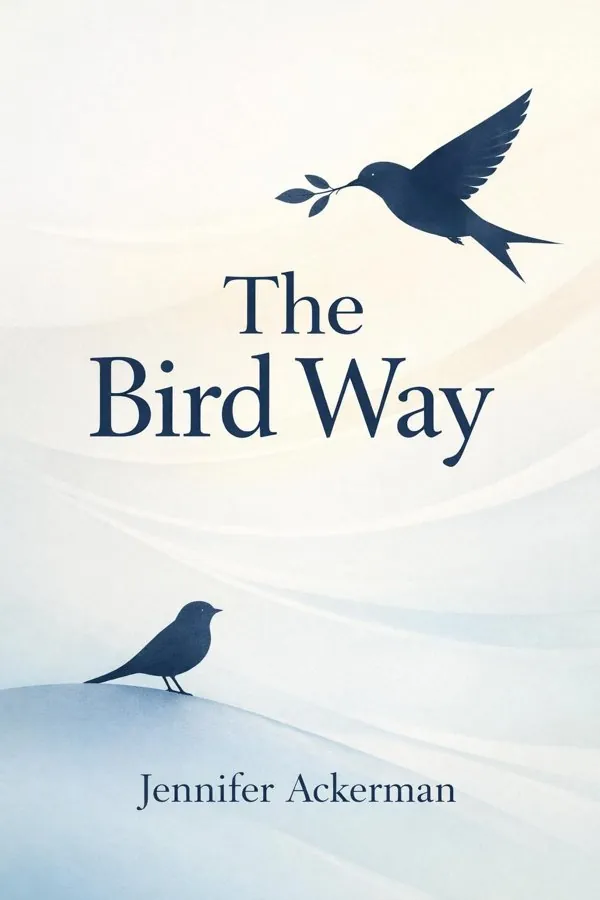
The Bird Way: A New Look at How Birds Talk, Work, Play, Parent, and Think: Summary & Key Insights
 10 min9 chaptersAudio available
Key Takeaways from The Bird Way: A New Look at How Birds Talk, Work, Play, Parent, and Think
What sounds like simple birdsong to us is often a dense stream of information.
Few behaviors shatter stereotypes about birds faster than tool use.
Play seems frivolous until you realize it may be one of nature’s best training grounds.
The image of two parent birds raising helpless chicks in a nest is only one version of avian family life.
Bird societies are not peaceful mini-utopias; they are dynamic worlds where alliance and rivalry coexist.
What Is The Bird Way: A New Look at How Birds Talk, Work, Play, Parent, and Think About?
The Bird Way: A New Look at How Birds Talk, Work, Play, Parent, and Think by Jennifer Ackerman is a life_science book spanning 11 pages. Jennifer Ackerman’s The Bird Way is a vivid, research-driven exploration of how birds live far more complex lives than most people imagine. Moving across continents and habitats, Ackerman gathers insights from field biologists, cognitive scientists, and ornithologists to show that birds are not mere creatures of reflex and routine. They communicate with layered signals, solve problems creatively, build tools, play for pleasure, form intricate family systems, and pass knowledge across generations. The result is a portrait of bird life that feels at once scientifically grounded and genuinely astonishing. What makes this book matter is its challenge to old assumptions. For centuries, intelligence was treated as a largely human or mammalian domain. Ackerman shows that birds, despite their very different brains and bodies, have evolved impressive forms of perception, memory, cooperation, and innovation. Her work expands how we think about minds in nature. Ackerman writes with the authority of a seasoned science journalist and the curiosity of a naturalist in the field. Known for making ornithology accessible without oversimplifying it, she connects cutting-edge research to everyday wonder, inviting readers to see birds not as background wildlife but as active, adaptive, thinking beings.
This FizzRead summary covers all 9 key chapters of The Bird Way: A New Look at How Birds Talk, Work, Play, Parent, and Think in approximately 10 minutes, distilling the most important ideas, arguments, and takeaways from Jennifer Ackerman's work. Also available as an audio summary and Key Quotes Podcast.
The Bird Way: A New Look at How Birds Talk, Work, Play, Parent, and Think
Jennifer Ackerman’s The Bird Way is a vivid, research-driven exploration of how birds live far more complex lives than most people imagine. Moving across continents and habitats, Ackerman gathers insights from field biologists, cognitive scientists, and ornithologists to show that birds are not mere creatures of reflex and routine. They communicate with layered signals, solve problems creatively, build tools, play for pleasure, form intricate family systems, and pass knowledge across generations. The result is a portrait of bird life that feels at once scientifically grounded and genuinely astonishing.
What makes this book matter is its challenge to old assumptions. For centuries, intelligence was treated as a largely human or mammalian domain. Ackerman shows that birds, despite their very different brains and bodies, have evolved impressive forms of perception, memory, cooperation, and innovation. Her work expands how we think about minds in nature.
Ackerman writes with the authority of a seasoned science journalist and the curiosity of a naturalist in the field. Known for making ornithology accessible without oversimplifying it, she connects cutting-edge research to everyday wonder, inviting readers to see birds not as background wildlife but as active, adaptive, thinking beings.
Who Should Read The Bird Way: A New Look at How Birds Talk, Work, Play, Parent, and Think?
This book is perfect for anyone interested in life_science and looking to gain actionable insights in a short read. Whether you're a student, professional, or lifelong learner, the key ideas from The Bird Way: A New Look at How Birds Talk, Work, Play, Parent, and Think by Jennifer Ackerman will help you think differently.
- ✓Readers who enjoy life_science and want practical takeaways
- ✓Professionals looking to apply new ideas to their work and life
- ✓Anyone who wants the core insights of The Bird Way: A New Look at How Birds Talk, Work, Play, Parent, and Think in just 10 minutes
Want the full summary?
Get instant access to this book summary and 100K+ more with Fizz Moment.
Get Free SummaryAvailable on App Store • Free to download
Key Chapters
What sounds like simple birdsong to us is often a dense stream of information. One of Ackerman’s central revelations is that bird communication is far more layered than human ears typically detect. Birds use song, alarm calls, posture, movement, plumage displays, wing noises, and even synchronized behavior to convey different meanings. A call may identify a predator, signal a mate, defend territory, coordinate a group, or warn offspring. In some species, slight shifts in pitch, rhythm, or repetition can completely change the message.
Ackerman highlights how modern acoustic tools and careful field observation have transformed this field. Researchers now record calls in detail, compare vocal patterns across regions, and test how birds respond to specific sounds. Chickadees, for example, can alter the structure of their alarm calls depending on the level of threat. Songbirds may eavesdrop on the warning calls of other species. Some birds learn local dialects, suggesting that communication is partly cultural, not purely instinctive.
This matters because it forces us to rethink animal language. Birds are not simply making noise; they are participating in complex signaling systems shaped by ecology, social life, and learning. For birdwatchers, conservationists, and everyday observers, this means listening more carefully. A backyard feeder can become a place to notice distinct calls tied to weather, rivalry, courtship, or danger.
Actionable takeaway: The next time you observe birds, stop trying to hear “a song” and start asking, “What is this bird trying to communicate right now?” That shift in attention opens a deeper understanding of behavior.
Few behaviors shatter stereotypes about birds faster than tool use. Ackerman shows that some birds do not simply adapt to their environment; they actively manipulate it. New Caledonian crows are the most famous example. They fashion sticks, trim leaves into hooked tools, and select materials suited to specific tasks, such as extracting insects from crevices. This is not random poking. It involves foresight, refinement, and in some cases social learning.
The significance goes beyond novelty. Tool use indicates that birds can connect means to ends, evaluate objects by function, and modify behavior when conditions change. Ackerman describes species that use bait, drop shellfish onto rocks to crack them open, or exploit human-made environments with surprising ingenuity. Such acts suggest technical intelligence emerging in a very different evolutionary line from primates.
Equally important is the role of tradition. In some populations, young birds appear to learn effective techniques by watching older ones. That means practical knowledge can be preserved and transmitted, much like a craft culture. Ackerman invites readers to see bird labor not as repetitive instinct but as skilled work shaped by trial, error, and adaptation.
For humans, this offers a useful perspective on intelligence itself. We often define smart behavior too narrowly, valuing language or abstract reasoning while missing embodied problem solving. Birds remind us that intelligence can be physical, ecological, and situational.
Actionable takeaway: When you notice an animal manipulating an object, do not dismiss it as chance. Ask what problem it is solving, what technique it uses, and whether that behavior may be learned rather than hardwired.
Play seems frivolous until you realize it may be one of nature’s best training grounds. Ackerman explores how birds engage in behaviors that look joyful, experimental, and apparently unnecessary: sliding down snowy roofs, tossing objects, surfing air currents, mock fighting, hanging upside down, and playing with one another or with items in the environment. Ravens, parrots, and crows are especially known for such antics, but playful behavior appears across more species than many people expect.
Why does this matter? Because play suggests cognitive flexibility. A bird at play is not merely reacting to immediate survival needs. It is exploring possibilities, testing movements, rehearsing social interactions, and perhaps learning how objects, bodies, and companions behave. Young birds may build motor skill and confidence through playful chasing or manipulation. Social species may use play to form bonds, negotiate status, or practice reading signals.
Ackerman treats play as evidence that birds possess spare attention and behavioral openness. That is a profound idea. It means some birds have the capacity not only to cope with the world but to experiment within it. Play may also reflect emotional range, though science remains cautious about interpretation. Still, repeated observations of birds engaging in apparently self-motivated fun challenge the view of animals as survival machines.
For human readers, the lesson extends beyond ornithology. Systems that encourage exploration often produce resilience and creativity. In education, child development, and even work design, play is not wasted time; it is often how competence grows.
Actionable takeaway: Treat play, in birds or people, as a form of learning. If a behavior looks purposeless but recurring, ask what skills, relationships, or adaptability it may be building under the surface.
The image of two parent birds raising helpless chicks in a nest is only one version of avian family life. Ackerman reveals an astonishing range of parenting systems, from fiercely devoted monogamous pairs to communal breeders, cooperative helpers, brood parasites, and species in which males, females, or entire groups share care unevenly. Bird parenting is not one model repeated across nature; it is a collection of solutions shaped by risk, food supply, predation, and social structure.
In some species, extended families help raise young. Older siblings or unrelated group members may feed nestlings, defend territory, or assist at the nest. In others, such as brood parasites, parental care is outsourced entirely, with eggs laid in another species’ nest. Some birds invest intensely in a few offspring, while others spread reproductive bets across time and space. These variations reveal that parenting is an adaptive strategy, not a moral ideal.
Ackerman’s broader point is that family structure in nature is flexible. Birds respond to environmental pressures with surprising social inventiveness. Studying them helps us see that successful rearing depends less on one “correct” arrangement than on how care, protection, and learning are organized. This is especially valuable in a world where simplistic assumptions about family roles often distort both science and culture.
Bird parents also demonstrate astonishing labor: feeding nestlings hundreds of times a day, mobbing predators, coordinating incubation shifts, and teaching young where and how to forage.
Actionable takeaway: Replace rigid ideas about parenting with a functional question: what arrangement best supports survival, learning, and stability under current conditions? Birds show that effective care can emerge through many structures.
Bird societies are not peaceful mini-utopias; they are dynamic worlds where alliance and rivalry coexist. Ackerman shows that many species cooperate in highly organized ways, whether mobbing predators, sharing information about food, defending colonies, or raising young together. Yet those same birds may deceive rivals, compete for rank, steal resources, or exploit social trust when it suits them. Their social lives combine mutual benefit with constant negotiation.
This complexity matters because social intelligence often develops in the space between cooperation and conflict. To live in a flock, colony, pair bond, or family group, a bird must track relationships, assess risk, read signals, and adapt behavior to changing circumstances. Some species remember individuals, respond differently to allies and strangers, and alter behavior depending on who is watching. Social life becomes a cognitive challenge.
Ackerman illustrates how birds gain survival advantages from group living. One bird’s alarm can save many. Collective movement can confuse predators. Shared roosting can conserve warmth. At the same time, crowding increases disease risk, status competition, and opportunities for cheating. This tension creates sophisticated behavioral strategies.
The lesson for readers is that intelligence is often social before it is abstract. A creature does not need human-like language to navigate politics. Birds show that practical awareness of others—their intentions, positions, and patterns—can be a potent form of intelligence.
Actionable takeaway: When observing groups, look beyond the flock as a whole and notice interaction patterns. Who leads, who follows, who warns, who challenges, and who benefits? Social structure often explains behavior better than individual instinct alone.
A migrating bird is one of nature’s most extraordinary navigators. Ackerman explores how birds travel thousands of miles across oceans, deserts, mountains, and unfamiliar terrain, often returning to the same breeding or wintering grounds with astonishing accuracy. This feat relies on an array of sensory tools and internal mechanisms: celestial cues, polarized light, landmarks, wind patterns, magnetic sensitivity, timing systems, and memory.
Migration is not just endurance; it is information processing under pressure. Birds must decide when to leave, where to stop, how much fuel to carry, and how to adjust to weather, habitat change, and fatigue. Young birds in some species inherit broad directional programs, while others learn routes socially or refine them through experience. Ackerman makes clear that migration blends instinct with learning in ways scientists are still uncovering.
The practical implications are enormous. Tiny disruptions in habitat, light pollution, climate shifts, or wind conditions can derail these journeys. Because migratory birds depend on chains of suitable stopover sites, conservation must think across regions, not only at breeding grounds. A wetland lost in one place can ripple through an entire migratory system.
For readers, migration also reframes intelligence. We tend to reserve admiration for visible problem solving, but orientation across vast scales may be one of the greatest cognitive achievements in the natural world.
Actionable takeaway: Support bird-friendly habitats not only locally but along migratory pathways. If you care about birds in your area, remember that their survival may depend on distant landscapes you will never see.
One of the book’s most exciting ideas is that birds have culture. Ackerman uses the term carefully, referring to behaviors transmitted socially rather than encoded purely in genes. Song dialects, foraging methods, migration routes, tool traditions, and courtship patterns can all vary by region or group, not because birds are biologically different, but because they learn from one another.
This insight changes the way we understand animal behavior. If a bird population develops a local technique for opening food, selecting nesting sites, or recognizing threats, that tradition can persist and spread. Young birds become inheritors of community knowledge. In some cases, innovations introduced by a few individuals reshape how an entire group behaves. Bird life, then, includes memory outside the individual—stored in the social fabric of the group.
Ackerman shows that culture gives birds flexibility. Genetic evolution is slow, but social learning can change behavior rapidly when environments shift. That helps explain how some species adapt quickly to cities, novel predators, or new food sources. It also means that when populations collapse, something more than numbers may be lost. Cultural knowledge can disappear too.
This has strong conservation implications. Protecting a species may require preserving experienced adults, stable social groups, and habitats where learning can continue. It also speaks to human humility. We are not the only species whose communities carry traditions.
Actionable takeaway: Think of wildlife conservation not just as saving bodies, but as preserving living knowledge systems. A population is more than a headcount; it is also a network of learned behaviors.
If intelligence means solving new problems under changing conditions, many birds clearly qualify. Ackerman surveys a growing body of research showing that birds can plan, infer, remember, imitate, recognize patterns, and sometimes solve multi-step tasks. Corvids and parrots often take center stage, but the broader point is that bird cognition is diverse and distributed across many ecological niches.
Some birds hide food and later recover it, requiring robust spatial memory. Others understand cause and effect well enough to manipulate objects in sequence. Certain species distinguish among human faces, learn from observation, and modify behavior after failure. Ackerman emphasizes that these abilities arise in brains organized very differently from primate brains. Intelligence, then, is not a single blueprint. Evolution can produce sophisticated cognition through multiple routes.
A key contribution of the book is its caution against ranking animals by closeness to humans. Bird intelligence should not be impressive only when it resembles ours. A hummingbird’s spatial precision, a scrub jay’s cache memory, or a crow’s flexible tool use are each forms of cognition tailored to a way of life. The question is not whether birds think like us, but how they think effectively in their own worlds.
For modern readers, this has a useful application: good thinking is often domain-specific. Expertise grows from the fit between brain, body, task, and environment.
Actionable takeaway: Broaden your definition of intelligence. Instead of asking who is smartest in general, ask what kind of problem a mind is adapted to solve exceptionally well.
The deepest argument in The Bird Way is not just that birds are impressive, but that our old mental categories are too narrow. Ackerman uses field stories, experiments, and global case studies to show that birds challenge familiar boundaries between instinct and learning, emotion and function, individual and culture, simple behavior and intelligence. The more closely scientists look, the less adequate simplistic labels become.
This shift has ethical and practical consequences. If birds are communicative, socially complex, inventive, and culturally connected, then habitat destruction, noise pollution, and climate disruption affect far more than anonymous populations. They disrupt relationships, traditions, developmental pathways, and hard-won adaptations. Protecting birds becomes not only a matter of preserving biodiversity but of respecting forms of life with depth and agency.
Ackerman also gives readers a richer way to inhabit the everyday world. Pigeons on a sidewalk, crows at a crosswalk, warblers in migration, gulls at a shoreline—these are no longer background creatures. They become participants in intricate dramas of learning, risk, work, and decision-making. The ordinary outdoors becomes cognitively alive.
The book therefore works on two levels: it updates science and recalibrates perception. It invites us to replace condescension with attention.
Actionable takeaway: Practice observational humility. When you encounter birds, assume complexity before simplicity. That mindset not only improves understanding; it fosters curiosity, respect, and more responsible stewardship of the natural world.
All Chapters in The Bird Way: A New Look at How Birds Talk, Work, Play, Parent, and Think
About the Author
Jennifer Ackerman is an American science writer celebrated for her engaging books on animal behavior, biology, and the natural world. She has built a strong reputation for translating complex scientific research into vivid, accessible narratives for general readers. Best known for her acclaimed books The Genius of Birds and The Bird Way, Ackerman has become one of the most recognizable contemporary voices writing about ornithology and animal cognition. Her work often combines interviews with leading researchers, on-the-ground reporting, and clear explanations of emerging science. What distinguishes her writing is the balance of rigor and wonder: she respects the evidence while preserving the sense of amazement that discovery inspires. Through her books and essays, Ackerman has helped many readers see birds not as familiar background animals, but as intelligent, adaptive, and deeply fascinating creatures.
Get This Summary in Your Preferred Format
Read or listen to the The Bird Way: A New Look at How Birds Talk, Work, Play, Parent, and Think summary by Jennifer Ackerman anytime, anywhere. FizzRead offers multiple formats so you can learn on your terms — all free.
Available formats: App · Audio · PDF · EPUB — All included free with FizzRead
Download The Bird Way: A New Look at How Birds Talk, Work, Play, Parent, and Think PDF and EPUB Summary
Key Quotes from The Bird Way: A New Look at How Birds Talk, Work, Play, Parent, and Think
“What sounds like simple birdsong to us is often a dense stream of information.”
“Few behaviors shatter stereotypes about birds faster than tool use.”
“Play seems frivolous until you realize it may be one of nature’s best training grounds.”
“The image of two parent birds raising helpless chicks in a nest is only one version of avian family life.”
“Bird societies are not peaceful mini-utopias; they are dynamic worlds where alliance and rivalry coexist.”
Frequently Asked Questions about The Bird Way: A New Look at How Birds Talk, Work, Play, Parent, and Think
The Bird Way: A New Look at How Birds Talk, Work, Play, Parent, and Think by Jennifer Ackerman is a life_science book that explores key ideas across 9 chapters. Jennifer Ackerman’s The Bird Way is a vivid, research-driven exploration of how birds live far more complex lives than most people imagine. Moving across continents and habitats, Ackerman gathers insights from field biologists, cognitive scientists, and ornithologists to show that birds are not mere creatures of reflex and routine. They communicate with layered signals, solve problems creatively, build tools, play for pleasure, form intricate family systems, and pass knowledge across generations. The result is a portrait of bird life that feels at once scientifically grounded and genuinely astonishing. What makes this book matter is its challenge to old assumptions. For centuries, intelligence was treated as a largely human or mammalian domain. Ackerman shows that birds, despite their very different brains and bodies, have evolved impressive forms of perception, memory, cooperation, and innovation. Her work expands how we think about minds in nature. Ackerman writes with the authority of a seasoned science journalist and the curiosity of a naturalist in the field. Known for making ornithology accessible without oversimplifying it, she connects cutting-edge research to everyday wonder, inviting readers to see birds not as background wildlife but as active, adaptive, thinking beings.
More by Jennifer Ackerman
You Might Also Like

The Selfish Gene
Richard Dawkins
10 min
Awakenings
Oliver Sacks
10 min
Parasite Rex: Inside the Bizarre World of Nature's Most Dangerous Creatures
Carl Zimmer
10 min
The Atlas of Life on Earth
Various
10 min
The Book of Humans: The Story of How We Became Us
Adam Rutherford
10 min
The Horse
Wendy Williams
10 minBrowse by Category
Ready to read The Bird Way: A New Look at How Birds Talk, Work, Play, Parent, and Think?
Get the full summary and 100K+ more books with Fizz Moment.