
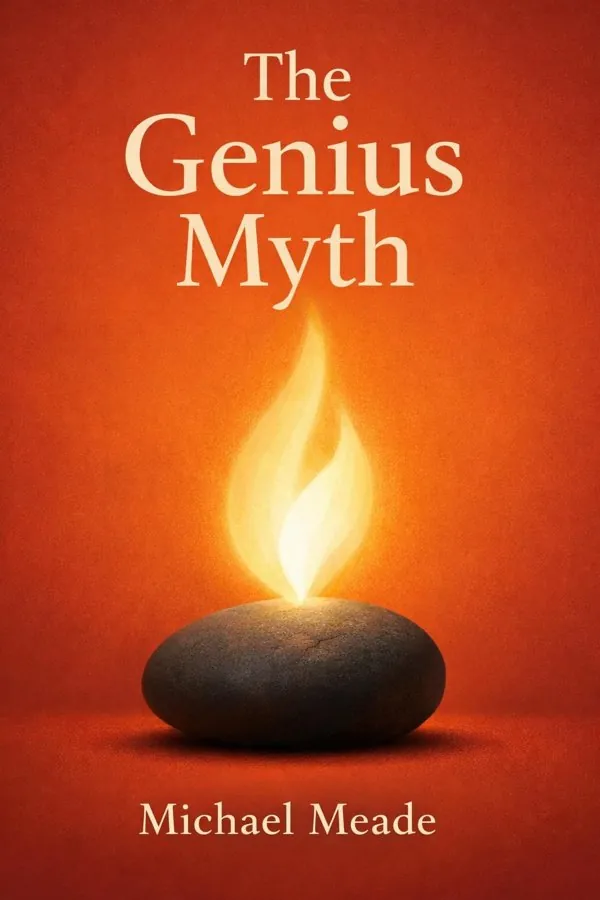
The Genius Myth: Summary & Key Insights
 10 min9 chaptersAudio available
What Is The Genius Myth About?
The Genius Myth by Michael Meade is a eastern_wisdom book spanning 9 pages. In this book, mythologist Michael Meade explores the idea that genius is not a rare gift reserved for a few, but an innate potential within every person. Drawing on mythology, psychology, and storytelling, Meade argues that each individual carries a unique spark of genius that, when awakened, can bring meaning and creativity to life. The work encourages readers to reconnect with their inner calling and to see genius as a vital force for personal and collective transformation.
This FizzRead summary covers all 9 key chapters of The Genius Myth in approximately 10 minutes, distilling the most important ideas, arguments, and takeaways from Michael Meade's work. Also available as an audio summary and Key Quotes Podcast.
The Genius Myth
In this book, mythologist Michael Meade explores the idea that genius is not a rare gift reserved for a few, but an innate potential within every person. Drawing on mythology, psychology, and storytelling, Meade argues that each individual carries a unique spark of genius that, when awakened, can bring meaning and creativity to life. The work encourages readers to reconnect with their inner calling and to see genius as a vital force for personal and collective transformation.
Who Should Read The Genius Myth?
This book is perfect for anyone interested in eastern_wisdom and looking to gain actionable insights in a short read. Whether you're a student, professional, or lifelong learner, the key ideas from The Genius Myth by Michael Meade will help you think differently.
- ✓Readers who enjoy eastern_wisdom and want practical takeaways
- ✓Professionals looking to apply new ideas to their work and life
- ✓Anyone who wants the core insights of The Genius Myth in just 10 minutes
Want the full summary?
Get instant access to this book summary and 100K+ more with Fizz Moment.
Get Free SummaryAvailable on App Store • Free to download
Key Chapters
At the heart of *The Genius Myth* lies the conviction that genius is not bestowed by luck or birthright but embedded within the soul of every person. Ancient cultures understood this intuitively. The Greeks spoke of the *daimon*, the Romans of the *genius*, and indigenous traditions recognized similar guiding spirits that accompany each life from birth to death. These figures are not metaphors but living presences within us—the inner voice of destiny, the subtle magnet drawing us toward what makes us alive.
In my work as a storyteller and mythologist, I have seen again and again that genius reveals itself through our enthusiasms—the things we love instinctively, the pursuits that make time vanish. Children live close to this spark until societal expectations begin to impose uniformity. Education, rather than drawing out the hidden gifts, often presses them into templates of performance. The tragedy is that many people spend decades sensing there is more to their existence but never learning how to listen to that buried call.
To reawaken genius, one must start with remembering. It begins with the question: what moved me deeply before the world told me who to be? Beneath layers of habit and fear lies a thread of authentic desire—the map drawn by the daimon itself. This thread does not lead toward conventional success; it leads toward meaning. Genius seldom arrives through straightforward ambition. More often, it emerges in crisis, through loss or confusion, when the old ways no longer suffice. That is when the daimon knocks hardest, asking us to live not by imitation but by inner necessity.
To recognize genius is also to recognize relationship. The daimon does not serve you like a servant; you serve it through devotion to your true nature. It insists that you live fully, that you honor the gifts given to you not for self-glory but for the enrichment of the whole. This shift—from individual accomplishment to soulful service—is what restores vitality to both life and culture. When we live our genius, we feed the world with the one flavor only our soul knows.
Myth is the language through which genius speaks. In every tradition, stories carry traces of the invisible forces that shape human destiny. The idea of a guiding spirit appears again and again—the Greek *daimon*, the Celtic *anam cara*, the African concept of divine twins. These myths point to an intimate companion that connects each person to the archetypal realm, reminding us that we belong to more than the surface of things.
Take, for example, the story of the birth of Athena. She emerges fully grown from the head of Zeus, a symbol of wisdom born from divine imagination. Athena’s birth mirrors our own inner awakening—genius erupting from the depths of psyche rather than descending from outside. Myths like these show that the process of creativity is sacred and often unpredictable; it is a form of revelation. What rises in us as inspiration is the speech of the daimon, calling us to participate in the ongoing creation of the world.
Modern psychology echoes these themes. The archetypes described by Jung function as the mythic maps of the soul, while James Hillman reminds us that each person should ask not "What do I want from life?" but "What does my soul want from me?" When we treat inspiration as a visitation rather than a possession, we begin to live mythically—to see our struggles and talents as part of a cosmic pattern. This perspective dissolves isolation. No longer are we separated individuals chasing meaning; we are participants in a grand story being told through time.
In practice, this means listening for signs, synchronicities, and inner promptings that point toward the path of genius. The daimon may arrive as a dream, a sudden fascination, or even an obstacle that refuses to let you stay small. The myths remind us that heroism is not conquest, but surrender—to the greater design moving through our lives. Genius, in this sense, is not about knowing but about being known by one’s calling.
+ 7 more chapters — available in the FizzRead app
All Chapters in The Genius Myth
About the Author
Michael Meade is an American mythologist, storyteller, and author known for his work on mythology, psychology, and culture. He is the founder of Mosaic Multicultural Foundation and has written several books exploring mythic imagination and the human soul.
Get This Summary in Your Preferred Format
Read or listen to the The Genius Myth summary by Michael Meade anytime, anywhere. FizzRead offers multiple formats so you can learn on your terms — all free.
Available formats: App · Audio · PDF · EPUB — All included free with FizzRead
Download The Genius Myth PDF and EPUB Summary
Key Quotes from The Genius Myth
“At the heart of *The Genius Myth* lies the conviction that genius is not bestowed by luck or birthright but embedded within the soul of every person.”
“Myth is the language through which genius speaks.”
Frequently Asked Questions about The Genius Myth
The Genius Myth by Michael Meade is a eastern_wisdom book that explores key ideas across 9 chapters. In this book, mythologist Michael Meade explores the idea that genius is not a rare gift reserved for a few, but an innate potential within every person. Drawing on mythology, psychology, and storytelling, Meade argues that each individual carries a unique spark of genius that, when awakened, can bring meaning and creativity to life. The work encourages readers to reconnect with their inner calling and to see genius as a vital force for personal and collective transformation.
You Might Also Like
A New Earth
Eckhart Tolle
10 min
The Daily Stoic
Ryan Holiday, Stephen Hanselman
10 min
Buddhism: Plain and Simple
Steve Hagen
10 min
Enchiridion
Epictetus
10 min
The Book of Tea
Kakuzō Okakura
10 min
The Light We Give: How Sikh Wisdom Can Transform Your Life
Simran Jeet Singh
10 minBrowse by Category
Ready to read The Genius Myth?
Get the full summary and 100K+ more books with Fizz Moment.