
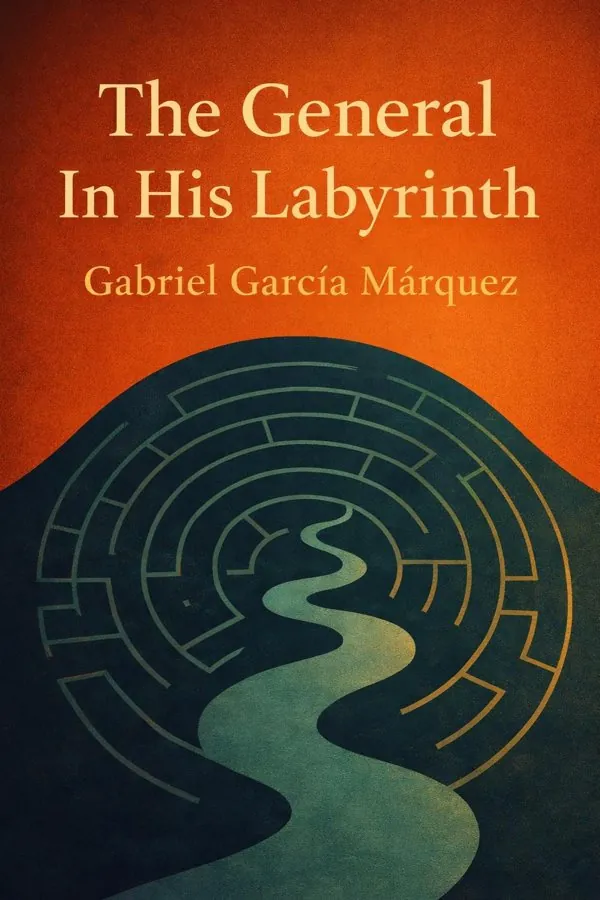
The General In His Labyrinth: Summary & Key Insights
 10 min8 chaptersAudio available
Key Takeaways from The General In His Labyrinth
The fall of a great leader often begins not with a battlefield defeat, but with the quiet moment when he realizes the world no longer believes in what he fought to build.
Power attracts crowds, but downfall reveals who can truly bear to remain nearby.
A man can liberate nations and still fail to command his own ending.
History often turns extraordinary people into statues, but literature can return breath, weakness, and contradiction to them.
Sometimes the fiercest struggle begins after the wars are over, in the unstable territory of memory.
What Is The General In His Labyrinth About?
The General In His Labyrinth by Gabriel García Márquez is a classics book spanning 3 pages. The General In His Labyrinth is Gabriel García Márquez’s haunting reimagining of the final journey of Simón Bolívar, the revolutionary leader who helped liberate much of South America from Spanish rule. Rather than presenting Bolívar as an untouchable monument of history, the novel follows him as a sick, exhausted, politically abandoned man drifting down the Magdalena River toward what may be exile, death, or obscurity. In that shrinking space between greatness and ruin, Márquez finds his true subject: what remains of a leader when power, health, and public devotion begin to vanish. The book matters because it turns history into intimate human drama. It asks how nations remember their heroes, how ideals collapse under ambition and division, and how loneliness often shadows even the most celebrated lives. García Márquez, one of the most important literary voices of the twentieth century and a master of blending political insight with lyrical storytelling, brings extraordinary authority to this portrait. The result is not a conventional historical novel but a meditation on mortality, memory, failed utopias, and the painful distance between revolutionary dreams and political reality.
This FizzRead summary covers all 8 key chapters of The General In His Labyrinth in approximately 10 minutes, distilling the most important ideas, arguments, and takeaways from Gabriel García Márquez's work. Also available as an audio summary and Key Quotes Podcast.
The General In His Labyrinth
The General In His Labyrinth is Gabriel García Márquez’s haunting reimagining of the final journey of Simón Bolívar, the revolutionary leader who helped liberate much of South America from Spanish rule. Rather than presenting Bolívar as an untouchable monument of history, the novel follows him as a sick, exhausted, politically abandoned man drifting down the Magdalena River toward what may be exile, death, or obscurity. In that shrinking space between greatness and ruin, Márquez finds his true subject: what remains of a leader when power, health, and public devotion begin to vanish.
The book matters because it turns history into intimate human drama. It asks how nations remember their heroes, how ideals collapse under ambition and division, and how loneliness often shadows even the most celebrated lives. García Márquez, one of the most important literary voices of the twentieth century and a master of blending political insight with lyrical storytelling, brings extraordinary authority to this portrait. The result is not a conventional historical novel but a meditation on mortality, memory, failed utopias, and the painful distance between revolutionary dreams and political reality.
Who Should Read The General In His Labyrinth?
This book is perfect for anyone interested in classics and looking to gain actionable insights in a short read. Whether you're a student, professional, or lifelong learner, the key ideas from The General In His Labyrinth by Gabriel García Márquez will help you think differently.
- ✓Readers who enjoy classics and want practical takeaways
- ✓Professionals looking to apply new ideas to their work and life
- ✓Anyone who wants the core insights of The General In His Labyrinth in just 10 minutes
Want the full summary?
Get instant access to this book summary and 100K+ more with Fizz Moment.
Get Free SummaryAvailable on App Store • Free to download
Key Chapters
The fall of a great leader often begins not with a battlefield defeat, but with the quiet moment when he realizes the world no longer believes in what he fought to build. That is the emotional starting point of The General In His Labyrinth. Bolívar sets out from Bogotá physically frail and politically isolated, leaving behind not a triumphant republic but a fractured continent. The dream of a united Spanish America, once driven by his force of will, has given way to infighting, regional ambition, suspicion, and resentment.
Márquez uses this departure to show that decline is rarely sudden. Bolívar’s body has been weakening for some time, just as his political project has been eroding beneath the surface. The journey downriver becomes both a literal retreat and a symbolic passage through the ruins of his own ideals. Everywhere he goes, he is confronted by reminders that he is no longer the commanding liberator but a man whose authority has thinned. This shift matters because it transforms the novel from a historical account into a study of disillusionment.
In practical terms, the book offers a timeless lesson about leadership and vision. Founders, reformers, and innovators often imagine that victory secures the future. Márquez suggests otherwise: creating change is one thing; preserving unity afterward is much harder. Modern readers can apply this insight to politics, organizations, and even personal goals. Building something meaningful requires not only passion but structures that can survive disappointment, ego, and conflict.
Actionable takeaway: When pursuing a big dream, ask not only how to achieve it, but how it will endure once the original excitement fades.
Power attracts crowds, but downfall reveals who can truly bear to remain nearby. As Bolívar travels, he meets former allies, anxious officials, loyal servants, and subtle enemies. These encounters give the novel much of its tension. On the surface, they are conversations, ceremonies, memories, and political exchanges. Beneath them lies a deeper truth: every meeting reminds Bolívar that he is increasingly alone.
Márquez portrays solitude not as simple physical isolation, but as the condition of a person whose inner world can no longer be shared by those around him. Bolívar carries memories of campaigns, betrayals, and sacrifices that others either exploit, misunderstand, or wish to forget. The people who once praised him now calculate their own survival. Even acts of loyalty feel fragile because they exist in a climate of suspicion. This makes solitude one of the novel’s central emotional realities. Bolívar is surrounded by attendants and history itself, yet he remains inaccessible and burdened.
The betrayals in the novel are not always dramatic. Often they are disappointments, hesitations, shifts in allegiance, or failures of courage. That subtlety makes them more painful. In real life, disillusionment often comes not from obvious enemies, but from those who gradually withdraw conviction. Readers can recognize this in workplaces, social movements, friendships, or family systems where support weakens when circumstances change.
The practical application is clear: solitude can distort judgment if it goes unacknowledged. Leaders especially need trusted truth-tellers rather than flatterers or fearful followers. Márquez shows the cost of losing that circle.
Actionable takeaway: Identify the people in your life who offer honest loyalty, and invest in those relationships before crisis makes authenticity rare.
A man can liberate nations and still fail to command his own ending. One of the novel’s deepest ironies is that Bolívar, the champion of freedom, is trapped by illness, political collapse, and the unstoppable approach of death. Márquez uses this contradiction to question what power really is. If authority depends on armies, titles, and public devotion, then it is shockingly temporary. If freedom means control over one’s destiny, then even the greatest leader may possess less of it than legend suggests.
Throughout the novel, Bolívar alternates between resolve and resignation. He still thinks strategically, still imagines possibilities, still burns with flashes of old command. Yet fate keeps narrowing his world. His body weakens. His influence shrinks. Events move beyond him. The result is not merely tragedy but philosophical tension: can a person be historically immense and personally powerless at the same time? Márquez’s answer is yes.
This insight extends far beyond Bolívar. Many people spend years chasing status, recognition, or control, believing these will provide security. The novel exposes how fragile such pursuits can be. Careers change, institutions forget, public opinion turns, and health imposes limits no ambition can defeat. That does not make achievement meaningless, but it does force a reassessment of what endures. Character, memory, moral conviction, and the ability to face decline with dignity may matter more than domination.
In practical life, this idea encourages readers to separate influence from identity. If your sense of self depends entirely on a role, title, or reputation, you become vulnerable when that external power fades.
Actionable takeaway: Build a life anchored in values and relationships, not only in status, so that setbacks do not erase your sense of purpose.
History often turns extraordinary people into statues, but literature can return breath, weakness, and contradiction to them. One of Márquez’s greatest achievements in this novel is stripping Simón Bolívar of his mythic polish without diminishing his significance. He presents a man who is feverish, vain, charismatic, impatient, brilliant, sensual, nostalgic, and deeply wounded. This fuller portrait matters because it rescues Bolívar from simplification.
Rather than celebrating him in purely patriotic terms, Márquez asks readers to confront the uncomfortable fact that greatness and frailty frequently coexist. Bolívar is capable of inspiring devotion, yet he is also stubborn and difficult. He possesses political genius, yet he is vulnerable to miscalculation and bitterness. By showing these contradictions, the novel becomes more truthful than a heroic monument ever could. It reminds us that historical change is made by human beings, not flawless symbols.
This has practical relevance in how we judge public figures, founders, and even people close to us. Idealization creates brittle expectations. The moment a leader reveals ordinary flaws, admiration can collapse into cynicism. Márquez offers a better approach: mature respect that allows for complexity. In workplaces, civic life, and personal relationships, this mindset helps us avoid both blind worship and simplistic condemnation.
The novel also invites self-reflection. Many of us hide our vulnerability because we think credibility requires perfection. Bolívar’s portrayal suggests the opposite: acknowledging weakness may lead to a more honest legacy than performing invincibility.
Actionable takeaway: Replace hero worship with complexity—whether you are evaluating others or yourself, look for the full human story rather than a polished myth.
Sometimes the fiercest struggle begins after the wars are over, in the unstable territory of memory. As Bolívar moves toward death, he is haunted not only by physical suffering but by recollections of campaigns, loves, friendships, betrayals, and lost possibilities. Márquez structures the novel so that the past continually interrupts the present. This creates the sense that Bolívar is fighting one final battle: the battle to understand what his life meant.
Memory in the novel is not neat or reliable. It arrives in fragments, surges, and emotional flashes. Triumph blends with regret. Public events mingle with private longing. In this way, Márquez captures how people actually live with the past. We do not remember in chronological order; we remember according to pain, desire, shame, and unfinished business. For Bolívar, memory is both refuge and punishment. It keeps his former grandeur alive while forcing him to confront what was lost.
This idea has practical value because many readers also live inside narratives about their own pasts. We revisit key moments and ask whether the sacrifices were worth it, whether we chose well, whether our efforts changed anything. The novel suggests that such questions cannot always be resolved cleanly. Yet it also implies that reflection is unavoidable and perhaps necessary. Our private histories shape our present identities whether or not we consciously examine them.
For leaders and creators, the lesson is especially important: your legacy will not be determined solely by what you intended, but by how others remember, reinterpret, and contest your actions over time.
Actionable takeaway: Revisit your past honestly—not to become trapped in nostalgia or regret, but to understand the story you are living and the legacy you are actively creating.
Revolutions often promise unity, but once the common enemy disappears, hidden fractures rush to the surface. In The General In His Labyrinth, Bolívar’s personal decline mirrors the political disintegration of Gran Colombia and, more broadly, the unraveling of a continental ideal. The dream of a federated Latin America had once seemed historically possible. By the time of the novel, however, regionalism, ego, class interests, and power struggles have made that vision increasingly unattainable.
Márquez does not treat this as background politics alone. The fragmentation of the continent is woven into the novel’s emotional atmosphere. Bolívar is not simply dying; he is watching the idea that gave meaning to his life die with him. This enlarges the novel from biography into political elegy. It becomes a lament for unrealized unity and a warning about what happens when liberation is not followed by durable shared purpose.
Readers can apply this insight well beyond nineteenth-century Latin America. Teams, communities, and nations often unite around resistance to a problem, only to split once success requires governance, compromise, and restraint. Shared opposition is easier than shared construction. The novel reveals how quickly ideals can decay when individuals begin defending territory instead of common purpose.
For modern organizations and movements, this is a profound lesson. Founding values must be translated into institutions, habits, and clear agreements. Otherwise charisma fills the gap for a while, but conflict eventually wins.
Actionable takeaway: If you are part of any collective effort, define not just what you oppose, but the structures, responsibilities, and shared principles needed to keep the group united after the initial victory.
The body is often the final authority, quietly overruling ambition, ideology, and pride. In Márquez’s novel, Bolívar’s illness is not incidental; it is one of the central forces shaping the narrative. His coughing, fever, exhaustion, and physical decline are constant reminders that no historical greatness can exempt a person from mortality. The Liberator may have altered the fate of nations, but he cannot command his own lungs or halt the wearing down of flesh.
This emphasis gives the novel unusual intimacy. Political discussions and grand memories are repeatedly pulled back into the reality of pain, weakness, rest, appetite, and sleep. Márquez thereby prevents readers from escaping into pure abstraction. History is happening in a body. That body is failing. The effect is humbling and deeply human.
The practical relevance is immediate. Modern culture often encourages denial of physical limits, especially among ambitious people. Productivity, leadership, and achievement can become excuses for neglecting health until the body forces attention. The novel reminds us that embodiment is not a minor detail but the condition within which all plans unfold. Mortality gives urgency to ideals, but it also exposes the arrogance of believing we can postpone vulnerability forever.
On an emotional level, Bolívar’s decline also invites compassion. Illness strips away ceremony and reveals dependence. Readers may recognize similar moments in aging parents, public figures, or themselves. There is dignity in seeing clearly what the body can and cannot do.
Actionable takeaway: Treat your physical limits as meaningful information rather than inconvenience—care for your health now, because no vision or role can survive indefinitely without the body that carries it.
The most difficult maze is often the one inside a person who no longer knows whether he is still himself without the role that defined him. The title’s labyrinth suggests more than a complicated journey downriver. It evokes Bolívar’s confusion about identity, purpose, memory, and how he will be remembered. As his authority dissolves, he must confront a disturbing question: who is the Liberator when liberation no longer grants him power, gratitude, or certainty?
Márquez explores this labyrinth through mood, repetition, and shifting recollection. Bolívar is pulled between former grandeur and present weakness, public legend and private exhaustion, certainty and self-doubt. Legacy becomes a burden rather than a comfort. He cannot fully control how posterity will judge him, nor can he completely escape the myth built around his name. This tension gives the novel existential depth. It is not only about a dying statesman, but about the universal fear that our lives may be misunderstood or reduced after we are gone.
Readers can apply this insight personally. Many people overidentify with one role: career success, parenthood, influence, creative output, or social status. When circumstances change, they feel lost. Márquez’s Bolívar shows how fragile identity becomes when it depends too heavily on external recognition. A wiser self-understanding allows room for transition, aging, and uncertainty.
Legacy, too, is rarely tidy. We may hope to leave behind coherence, but others inherit fragments. What matters most may be less the perfection of our image than the substance of our actions and the integrity with which we lived.
Actionable takeaway: Build an identity larger than any single role, and focus on living truthfully rather than trying to perfectly manage how others will remember you.
All Chapters in The General In His Labyrinth
About the Author
Gabriel García Márquez (1927–2014) was a Colombian novelist, journalist, screenwriter, and one of the defining literary figures of the twentieth century. He won the Nobel Prize in Literature in 1982 and became internationally celebrated for novels such as One Hundred Years of Solitude, Love in the Time of Cholera, and Chronicle of a Death Foretold. Though often linked with magical realism, García Márquez’s work ranges widely across political fiction, romance, journalism, and historical narrative. His writing is known for its lyrical style, emotional depth, and sharp understanding of Latin American history, memory, and power. In The General In His Labyrinth, he brought those gifts to a richly human portrait of Simón Bolívar, blending archival knowledge with imaginative insight to explore the loneliness and fragility behind historical greatness.
Get This Summary in Your Preferred Format
Read or listen to the The General In His Labyrinth summary by Gabriel García Márquez anytime, anywhere. FizzRead offers multiple formats so you can learn on your terms — all free.
Available formats: App · Audio · PDF · EPUB — All included free with FizzRead
Download The General In His Labyrinth PDF and EPUB Summary
Key Quotes from The General In His Labyrinth
“The fall of a great leader often begins not with a battlefield defeat, but with the quiet moment when he realizes the world no longer believes in what he fought to build.”
“Power attracts crowds, but downfall reveals who can truly bear to remain nearby.”
“A man can liberate nations and still fail to command his own ending.”
“History often turns extraordinary people into statues, but literature can return breath, weakness, and contradiction to them.”
“Sometimes the fiercest struggle begins after the wars are over, in the unstable territory of memory.”
Frequently Asked Questions about The General In His Labyrinth
The General In His Labyrinth by Gabriel García Márquez is a classics book that explores key ideas across 8 chapters. The General In His Labyrinth is Gabriel García Márquez’s haunting reimagining of the final journey of Simón Bolívar, the revolutionary leader who helped liberate much of South America from Spanish rule. Rather than presenting Bolívar as an untouchable monument of history, the novel follows him as a sick, exhausted, politically abandoned man drifting down the Magdalena River toward what may be exile, death, or obscurity. In that shrinking space between greatness and ruin, Márquez finds his true subject: what remains of a leader when power, health, and public devotion begin to vanish. The book matters because it turns history into intimate human drama. It asks how nations remember their heroes, how ideals collapse under ambition and division, and how loneliness often shadows even the most celebrated lives. García Márquez, one of the most important literary voices of the twentieth century and a master of blending political insight with lyrical storytelling, brings extraordinary authority to this portrait. The result is not a conventional historical novel but a meditation on mortality, memory, failed utopias, and the painful distance between revolutionary dreams and political reality.
More by Gabriel García Márquez




You Might Also Like






Browse by Category
Ready to read The General In His Labyrinth?
Get the full summary and 100K+ more books with Fizz Moment.