
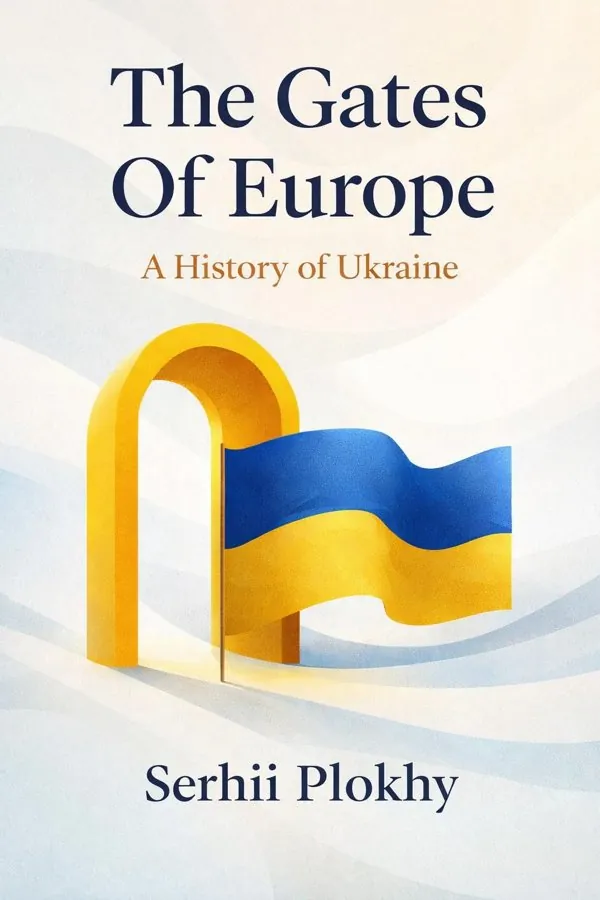
The Gates Of Europe: A History of Ukraine: Summary & Key Insights
 10 min10 chaptersAudio available
Key Takeaways from The Gates Of Europe: A History of Ukraine
A nation’s story rarely begins with the nation itself.
Medieval states often outlive themselves through memory more than institutions.
History often turns not only on what is built, but on what is shattered.
Empires do not simply conquer territories; they rearrange identities.
Freedom on a frontier can become the seed of statehood.
What Is The Gates Of Europe: A History of Ukraine About?
The Gates Of Europe: A History of Ukraine by Serhii Plokhy is a world_history book spanning 10 pages. Ukraine is often discussed only when crisis erupts, yet Serhii Plokhy shows that its story is central to the making of Europe itself. In The Gates Of Europe: A History of Ukraine, he traces the history of the lands between the Carpathians and the Black Sea from ancient steppe civilizations to the modern struggle for sovereignty. Rather than treating Ukraine as a borderland shaped only by stronger neighbors, Plokhy presents it as a historical crossroads where empires, religions, languages, and identities met, fought, and fused. The result is a vivid narrative of state-building, cultural endurance, imperial domination, national awakening, famine, war, and independence. The book matters because it explains why Ukraine has long been contested, why its identity is so resilient, and why its independence has such profound implications for Europe and Eurasia. Plokhy is exceptionally qualified to tell this story: a leading Ukrainian-American historian, Harvard professor, and director of the Harvard Ukrainian Research Institute, he combines deep scholarship with accessible storytelling. This is not just a history of one nation; it is a guide to understanding the fault lines of the modern world.
This FizzRead summary covers all 10 key chapters of The Gates Of Europe: A History of Ukraine in approximately 10 minutes, distilling the most important ideas, arguments, and takeaways from Serhii Plokhy's work. Also available as an audio summary and Key Quotes Podcast.
The Gates Of Europe: A History of Ukraine
Ukraine is often discussed only when crisis erupts, yet Serhii Plokhy shows that its story is central to the making of Europe itself. In The Gates Of Europe: A History of Ukraine, he traces the history of the lands between the Carpathians and the Black Sea from ancient steppe civilizations to the modern struggle for sovereignty. Rather than treating Ukraine as a borderland shaped only by stronger neighbors, Plokhy presents it as a historical crossroads where empires, religions, languages, and identities met, fought, and fused. The result is a vivid narrative of state-building, cultural endurance, imperial domination, national awakening, famine, war, and independence. The book matters because it explains why Ukraine has long been contested, why its identity is so resilient, and why its independence has such profound implications for Europe and Eurasia. Plokhy is exceptionally qualified to tell this story: a leading Ukrainian-American historian, Harvard professor, and director of the Harvard Ukrainian Research Institute, he combines deep scholarship with accessible storytelling. This is not just a history of one nation; it is a guide to understanding the fault lines of the modern world.
Who Should Read The Gates Of Europe: A History of Ukraine?
This book is perfect for anyone interested in world_history and looking to gain actionable insights in a short read. Whether you're a student, professional, or lifelong learner, the key ideas from The Gates Of Europe: A History of Ukraine by Serhii Plokhy will help you think differently.
- ✓Readers who enjoy world_history and want practical takeaways
- ✓Professionals looking to apply new ideas to their work and life
- ✓Anyone who wants the core insights of The Gates Of Europe: A History of Ukraine in just 10 minutes
Want the full summary?
Get instant access to this book summary and 100K+ more with Fizz Moment.
Get Free SummaryAvailable on App Store • Free to download
Key Chapters
A nation’s story rarely begins with the nation itself. Plokhy opens by showing that the territory of present-day Ukraine has been a zone of movement, exchange, and conflict for thousands of years. Long before any modern Ukrainian identity existed, the region hosted Scythians, Sarmatians, Greeks, Goths, Huns, and other peoples who used the steppe as a highway linking Europe and Asia. Greek colonies on the Black Sea coast connected the region to Mediterranean trade, while nomadic confederations demonstrated how power in these lands often depended on mobility rather than fixed borders. This early history matters because it established a recurring pattern: Ukraine’s geography made it both vulnerable and influential. Fertile soil, open plains, and access to major river systems invited settlement, commerce, and invasion in equal measure.
Plokhy’s larger point is that geography is not destiny, but it sets the stage on which history unfolds. Ukraine’s location explains why external powers repeatedly sought to control it, yet it also explains the diversity that became one of its defining features. For modern readers, this early chapter offers a useful lens for understanding why borderlands are rarely empty margins. They are often the places where civilizations meet and future political identities slowly take shape.
A practical way to use this idea is to rethink current events geographically. When assessing Ukraine’s politics, security concerns, or cultural complexity, start by asking how the land itself shaped patterns of migration, trade, and conflict. Actionable takeaway: whenever you study a country in crisis, begin with its geography and deep history before judging its present.
Medieval states often outlive themselves through memory more than institutions. In Plokhy’s account, Kyivan Rus was one such state: a powerful polity centered on Kyiv that emerged from the interaction of Slavic populations and Varangian elites. It became a major political and commercial force between the Baltic and Byzantium, using the Dnipro River system as a strategic artery. The Christianization of Rus in 988 under Volodymyr the Great tied the realm to Byzantine civilization and gave Eastern Slavic lands a lasting religious and cultural framework. Literacy, dynastic politics, ecclesiastical structures, and legal traditions all developed in ways that would echo for centuries.
Yet Plokhy is careful to challenge simplistic ownership of this legacy. Russians, Ukrainians, and Belarusians have all claimed Kyivan Rus as part of their national origin story. The problem is that modern nations did not exist in the medieval period. By recovering the complexity of Rus, Plokhy shows that the past should not be treated as a single inheritance deed for one modern state. Kyiv was not a provincial prelude to someone else’s empire; it was a center in its own right.
This matters today because historical symbols are often weaponized in political narratives. A clearer understanding of Kyivan Rus helps readers recognize how medieval history can be used to justify modern territorial or ideological claims. A practical application is to become more skeptical when politicians invoke ancient history as proof of present entitlement. Actionable takeaway: when you hear competing historical claims, ask not only who owns the past, but how and why that past is being used now.
History often turns not only on what is built, but on what is shattered. The Mongol invasion of the thirteenth century broke the political coherence of Kyivan Rus and transformed Eastern Europe. Kyiv was devastated, trade routes shifted, and regional centers rose or fell under new conditions. In the territories of present-day Ukraine, the principality of Galicia-Volhynia became especially important as a western-oriented successor that sought to preserve elements of Rus political culture while navigating pressure from Mongols, Poles, Lithuanians, and Hungarians. This period of fragmentation did not erase earlier traditions, but it fractured them and opened different historical pathways for various East Slavic lands.
Plokhy uses this turning point to explain one of the book’s central insights: Ukraine’s history cannot be understood as a straight line leading to any single empire. The lands that would become Ukraine were repeatedly pulled westward and eastward, and these competing orientations created durable differences in institutions, religion, and political culture. Mongol domination was heavier in some areas than others, which meant that regional development diverged significantly. That divergence later shaped how Ukrainians experienced rule under Lithuania, Poland, Muscovy, and Russia.
For readers today, this chapter is a reminder that historical disruption can create long-lasting regional distinctions. You can apply this by looking at how wars, occupations, or regime collapses leave institutional fingerprints that survive for centuries. Actionable takeaway: instead of assuming a nation has a single historical path, look for the shocks that split its development into multiple trajectories.
Empires do not simply conquer territories; they rearrange identities. Under the Polish-Lithuanian Commonwealth, much of Ukrainian territory entered a political world shaped by noble privilege, Catholic influence, legal pluralism, and expanding estate agriculture. Plokhy shows that this era was not merely one of oppression or assimilation. It was also a time of cultural exchange, urban development, educational growth, and religious debate. Orthodox elites adapted to Commonwealth structures, while the Union of Brest attempted to bring parts of the Orthodox hierarchy into communion with Rome, creating the Uniate, later Greek Catholic, Church. At the same time, social and confessional tensions deepened, especially among peasants, Orthodox believers, and frontier populations who felt excluded from the political order.
This mixture of integration and resistance is crucial to Plokhy’s interpretation. Ukrainian identity did not emerge in isolation from neighbors; it was shaped through contest with them. The Commonwealth period helped foster a Ruthenian literary and religious culture, but it also sharpened the sense that local traditions and rights needed defense. That tension eventually fed into Cossack mobilization and wider political revolt.
The practical lesson is that cultural pressure can produce both assimilation and backlash. Modern organizations and states often assume that integration will automatically create unity, but unequal status can generate the opposite result. In everyday terms, groups are more likely to embrace larger institutions when they feel respected within them. Actionable takeaway: when evaluating multicultural systems, look beyond formal inclusion and ask whether people have dignity, representation, and protection for their traditions.
Freedom on a frontier can become the seed of statehood. In Plokhy’s telling, the Cossacks were not just romantic horsemen of the steppe; they were a military, social, and political force that transformed Ukrainian history. Emerging in the borderlands south of settled agricultural zones, the Cossacks created self-governing communities shaped by mobility, warfare, and a fierce sense of autonomy. They defended frontiers, raided enemies, and served larger powers when useful, but they also developed institutions and myths that later became central to Ukrainian political imagination.
The great rupture came with the Khmelnytsky uprising of 1648, a revolt against Polish rule fueled by social grievances, religious tensions, and Cossack ambitions. The rebellion led to the formation of the Cossack Hetmanate, an experiment in political autonomy that occupies a foundational place in Ukrainian memory. Yet Plokhy stresses the ambiguity of its legacy. Seeking protection, Bohdan Khmelnytsky entered into alliance with Muscovy at Pereiaslav, a move later interpreted in radically different ways. For Russian imperial tradition, it signified reunion; for many Ukrainians, it became the beginning of constrained autonomy and eventual domination.
This chapter shows how political myths are born from real dilemmas. Leaders often make short-term security choices that shape centuries of interpretation. A modern application is to assess alliances not only by immediate gains but by their long-term effect on sovereignty and narrative. Actionable takeaway: when considering any partnership, ask what autonomy may be traded away, and who will later control the story of that decision.
When a people lives under two empires, comparison becomes destiny. By the late eighteenth century, the lands of present-day Ukraine were divided largely between the Russian Empire and the Habsburg monarchy. Plokhy shows that this partition was one of the most consequential developments in modern Ukrainian history. In the Russian Empire, the remnants of Cossack autonomy were gradually dismantled, local elites were absorbed into imperial structures, and efforts intensified to present Ukrainians as merely a branch of a larger Russian people. Language restrictions and centralization limited public expression of a distinct Ukrainian identity.
In Austrian-ruled Galicia, conditions were far from ideal, but political life offered somewhat more room for cultural organization, clergy-led activism, and later mass politics. The result was not two separate nations, but two distinct environments for the development of national consciousness. One region cultivated literary and cultural revival under heavy imperial suspicion; the other nurtured institutions that could more openly articulate a Ukrainian cause.
Plokhy’s key insight is that regional difference does not disprove national identity. Instead, different imperial experiences can generate varied political cultures within the same nation. This is highly relevant to understanding Ukraine today, where regional memories and historical references often differ. The practical application is to resist simplistic maps of “real” versus “less real” national belonging. Actionable takeaway: when a country seems internally divided, study the institutions and empires that shaped each region before assuming those differences are permanent or incompatible.
Nations are often imagined before they are governed. In the nineteenth century, Ukrainian intellectuals, writers, clergy, and activists began to transform regional traditions and vernacular speech into the basis of modern national consciousness. Plokhy highlights figures such as Taras Shevchenko, whose poetry gave emotional and moral force to the idea that the Ukrainian people possessed a history, dignity, and destiny separate from imperial narratives. Folklore collection, historical writing, linguistic codification, and literary production all helped turn “Little Russian” provinciality into a more assertive Ukrainian identity.
This revival did not start as a mass political movement. It began in classrooms, books, salons, churches, and cultural circles. That is one of Plokhy’s most important contributions: he shows that nationhood is built through institutions of memory and communication before it succeeds in politics. Empires understood this well, which is why tsarist authorities repeatedly restricted the Ukrainian language in print and education. They recognized that language was not just a tool of expression; it was a vessel of collective imagination.
The lesson travels beyond Ukraine. Cultural work is political work when it preserves a community’s ability to name itself. For modern readers, this explains why battles over language policy, school curricula, media, and historical symbols matter so much. They are rarely superficial disputes. A practical application is to pay attention to who controls cultural infrastructure in any society. Actionable takeaway: if you want to understand a nation’s future, look first at its schools, literature, and language debates rather than only its elections and armies.
Empires usually seem permanent until war proves otherwise. World War I and the revolutions of 1917 shattered the Russian and Austro-Hungarian empires, creating a rare opening for Ukrainian statehood. Plokhy describes a chaotic but crucial period in which multiple Ukrainian governments emerged, including the Central Rada in Kyiv and the Western Ukrainian People’s Republic in Galicia. Competing armies, foreign interventions, class conflict, and ideological struggle made survival difficult. Ukrainian leaders faced impossible choices: how to build institutions while fighting Bolsheviks, White forces, Poles, and others across a collapsing imperial landscape.
The tragedy of this moment is that political aspiration outran military and diplomatic capacity. Ukraine’s first major twentieth-century bid for independence failed, and much of its territory was absorbed into the Soviet Union, while western lands fell under Poland, Romania, and Czechoslovakia. Yet Plokhy emphasizes that this was not a historical footnote. The memory of attempted statehood, however brief, mattered enormously. It created precedents, symbols, and political vocabulary that later generations would revive.
This chapter is a reminder that failure can still shape the future. Movements do not need immediate success to leave institutional or emotional legacies. In practical terms, readers can use this insight when evaluating political change: even defeated experiments may define later possibilities. Actionable takeaway: do not judge a national movement only by whether it won at the time; ask what ideas, institutions, and memories it left behind for the next generation.
States can modernize a society while simultaneously wounding it beyond measure. Plokhy presents the Soviet period as one of profound contradiction for Ukraine. On one hand, Soviet rule brought industrialization, urbanization, expanded education, and the formal framework of a Ukrainian republic within the USSR. On the other, it subjected Ukraine to some of the twentieth century’s worst violence. The most devastating episode was the Holodomor, the famine of 1932-1933, which resulted from Stalin’s collectivization policies, grain requisitions, and the crushing of peasant resistance. Millions died, and the social fabric of rural Ukraine was shattered.
The trauma deepened with the Great Terror, Nazi occupation, the Holocaust on Ukrainian soil, wartime devastation, postwar repression, and renewed Soviet control. Yet even in these conditions, Ukrainian identity did not disappear. It adapted within official institutions, dissident circles, private memory, and everyday cultural life. Plokhy resists both Soviet nostalgia and simplistic anti-Soviet narratives, showing instead how power, modernization, violence, and identity interacted in painful ways.
This complexity matters because many societies inherit mixed legacies from authoritarian modernization. Infrastructure and literacy gains do not erase mass suffering, and suffering does not cancel the fact that institutions were built. A practical way to apply this idea is to avoid binary judgments about historical regimes. Actionable takeaway: when assessing any period of state-led progress, ask who paid the cost, whose voices were silenced, and what traumas remain hidden beneath the language of modernization.
Winning a state is not the same as becoming secure in it. Ukraine’s 1991 independence, achieved amid the collapse of the Soviet Union, was a momentous geopolitical event, but Plokhy shows that it was only the beginning of a harder process. The new country inherited Soviet institutions, oligarchic power structures, economic upheaval, regional diversity, and unresolved questions about language, memory, foreign policy, and citizenship. Statehood was now legal, but national consolidation remained incomplete. Over time, however, repeated civic mobilizations revealed a growing commitment to political independence and democratic accountability.
Plokhy traces this through the Orange Revolution, the Euromaidan movement, and the subsequent confrontation with Russia, including the annexation of Crimea and war in the Donbas. These events demonstrated that Ukrainian identity was no longer simply ethnic or regional; it was increasingly civic and political, grounded in the defense of sovereignty and the right to choose the country’s future. Russia’s pressure, rather than dissolving Ukrainian nationhood, often strengthened it.
This final arc gives the book contemporary urgency. Ukraine’s struggles are not marginal episodes but central tests of whether post-imperial sovereignty can endure in Europe. The practical lesson is that nation-building is an ongoing process requiring institutions, public trust, and civic participation. Independence must be defended not only at borders but in courts, media, schools, and elections. Actionable takeaway: treat sovereignty as a daily practice of citizenship, not a one-time declaration preserved automatically by law.
All Chapters in The Gates Of Europe: A History of Ukraine
About the Author
Serhii Plokhy is a Ukrainian-American historian, professor, and one of the leading interpreters of Eastern European history for a global audience. He teaches at Harvard University and serves as director of the Harvard Ukrainian Research Institute, where his work focuses on Ukraine, Russia, the Soviet Union, and the broader history of Eurasia. Plokhy is known for combining deep archival research with clear, engaging prose, making complex historical subjects accessible to non-specialists without sacrificing scholarly rigor. His books cover topics such as the origins of the Eastern Slavic nations, the Cold War, Chernobyl, and the collapse of the Soviet Union. In The Gates Of Europe, he brings that expertise to Ukraine’s long history, explaining how the region’s geography, empires, and cultural traditions shaped one of Europe’s most important and contested nations.
Get This Summary in Your Preferred Format
Read or listen to the The Gates Of Europe: A History of Ukraine summary by Serhii Plokhy anytime, anywhere. FizzRead offers multiple formats so you can learn on your terms — all free.
Available formats: App · Audio · PDF · EPUB — All included free with FizzRead
Download The Gates Of Europe: A History of Ukraine PDF and EPUB Summary
Key Quotes from The Gates Of Europe: A History of Ukraine
“A nation’s story rarely begins with the nation itself.”
“Medieval states often outlive themselves through memory more than institutions.”
“History often turns not only on what is built, but on what is shattered.”
“Empires do not simply conquer territories; they rearrange identities.”
“Freedom on a frontier can become the seed of statehood.”
Frequently Asked Questions about The Gates Of Europe: A History of Ukraine
The Gates Of Europe: A History of Ukraine by Serhii Plokhy is a world_history book that explores key ideas across 10 chapters. Ukraine is often discussed only when crisis erupts, yet Serhii Plokhy shows that its story is central to the making of Europe itself. In The Gates Of Europe: A History of Ukraine, he traces the history of the lands between the Carpathians and the Black Sea from ancient steppe civilizations to the modern struggle for sovereignty. Rather than treating Ukraine as a borderland shaped only by stronger neighbors, Plokhy presents it as a historical crossroads where empires, religions, languages, and identities met, fought, and fused. The result is a vivid narrative of state-building, cultural endurance, imperial domination, national awakening, famine, war, and independence. The book matters because it explains why Ukraine has long been contested, why its identity is so resilient, and why its independence has such profound implications for Europe and Eurasia. Plokhy is exceptionally qualified to tell this story: a leading Ukrainian-American historian, Harvard professor, and director of the Harvard Ukrainian Research Institute, he combines deep scholarship with accessible storytelling. This is not just a history of one nation; it is a guide to understanding the fault lines of the modern world.
You Might Also Like
The Age of Capital
Eric Hobsbawm
10 min
The Gulag Archipelago
Aleksandr Solzhenitsyn
10 min
Jerusalem: The Biography
Simon Sebag Montefiore
10 min
The Anglo-Saxons
James Campbell
10 min
The Boer War
Thomas Pakenham
10 min
The Industrial Revolutionaries: The Making of the Modern World 1776–1914
Gavin Weightman
10 minBrowse by Category
Ready to read The Gates Of Europe: A History of Ukraine?
Get the full summary and 100K+ more books with Fizz Moment.