
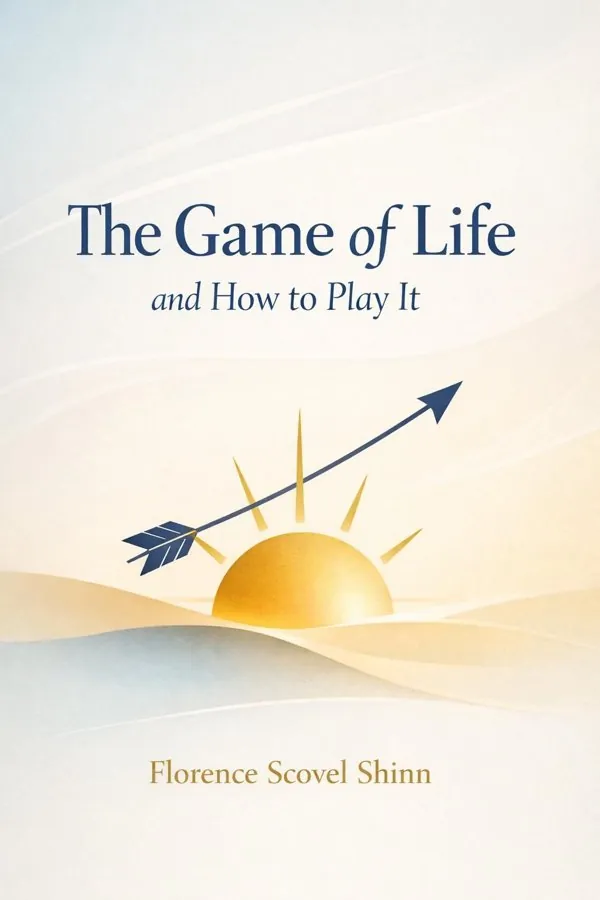
The Game of Life and How to Play It: Summary & Key Insights
 10 min9 chaptersAudio available
Key Takeaways from The Game of Life and How to Play It
Most people chase prosperity as though it lives somewhere outside them, hidden in money, status, or luck.
A careless sentence can become a private prophecy.
What if the thing exhausting you most is not the problem itself, but your resistance to it?
Unforgiveness can feel like protection, but in Shinn’s view it is often a chain that keeps people tied to old injuries.
Many people carry anxiety as if it were proof of responsibility.
What Is The Game of Life and How to Play It About?
The Game of Life and How to Play It by Florence Scovel Shinn is a eastern_wisdom book spanning 11 pages. Originally published in 1925, The Game of Life and How to Play It turns spiritual philosophy into a practical manual for everyday living. Florence Scovel Shinn argues that life is not random, unfair, or chaotic in the deepest sense. Instead, it operates according to spiritual laws, and when people understand those laws, they can begin to experience greater peace, prosperity, health, love, and purpose. Her central claim is simple but radical: thoughts, words, faith, and emotional attitudes do not merely reflect reality, they help create it. What makes the book enduring is its blend of mystical insight and plainspoken instruction. Drawing on biblical language, New Thought principles, and vivid anecdotes from real life, Shinn presents a worldview in which fear, resentment, and doubt block blessings, while faith, nonresistance, forgiveness, and affirmative speech open the way. Whether or not readers accept every metaphysical claim literally, the book remains influential because it speaks to a universal desire: to live with greater alignment, trust, and inner power. Shinn’s authority comes not from academic theory, but from her role as a teacher of practical spirituality who translated abstract ideas into memorable guidance people could actually use.
This FizzRead summary covers all 9 key chapters of The Game of Life and How to Play It in approximately 10 minutes, distilling the most important ideas, arguments, and takeaways from Florence Scovel Shinn's work. Also available as an audio summary and Key Quotes Podcast.
The Game of Life and How to Play It
Originally published in 1925, The Game of Life and How to Play It turns spiritual philosophy into a practical manual for everyday living. Florence Scovel Shinn argues that life is not random, unfair, or chaotic in the deepest sense. Instead, it operates according to spiritual laws, and when people understand those laws, they can begin to experience greater peace, prosperity, health, love, and purpose. Her central claim is simple but radical: thoughts, words, faith, and emotional attitudes do not merely reflect reality, they help create it.
What makes the book enduring is its blend of mystical insight and plainspoken instruction. Drawing on biblical language, New Thought principles, and vivid anecdotes from real life, Shinn presents a worldview in which fear, resentment, and doubt block blessings, while faith, nonresistance, forgiveness, and affirmative speech open the way. Whether or not readers accept every metaphysical claim literally, the book remains influential because it speaks to a universal desire: to live with greater alignment, trust, and inner power. Shinn’s authority comes not from academic theory, but from her role as a teacher of practical spirituality who translated abstract ideas into memorable guidance people could actually use.
Who Should Read The Game of Life and How to Play It?
This book is perfect for anyone interested in eastern_wisdom and looking to gain actionable insights in a short read. Whether you're a student, professional, or lifelong learner, the key ideas from The Game of Life and How to Play It by Florence Scovel Shinn will help you think differently.
- ✓Readers who enjoy eastern_wisdom and want practical takeaways
- ✓Professionals looking to apply new ideas to their work and life
- ✓Anyone who wants the core insights of The Game of Life and How to Play It in just 10 minutes
Want the full summary?
Get instant access to this book summary and 100K+ more with Fizz Moment.
Get Free SummaryAvailable on App Store • Free to download
Key Chapters
Most people chase prosperity as though it lives somewhere outside them, hidden in money, status, or luck. Shinn reverses that assumption. She argues that prosperity begins in consciousness, not in circumstances. According to her, divine abundance is already present as a spiritual reality, but many people block its expression through fear, guilt, envy, and the belief that there is not enough to go around. In her view, scarcity is often first a mental habit before it becomes a material experience.
This does not mean pretending bills do not exist or assuming wealth appears without effort. Rather, Shinn teaches that a person’s inner posture toward life influences what opportunities, relationships, and outcomes become available. Someone who constantly says, "I never get ahead," strengthens the very pattern they want to escape. Someone who expects support, supply, and right opportunities begins to notice possibilities they once overlooked.
In practical terms, this idea can apply to work, finances, health, and even friendship. A person seeking a new job might stop obsessing over rejection and instead affirm that the right position is already making its way toward them. Someone trapped in a scarcity mindset might practice gratitude for what is already working, while taking steady, intelligent action.
Shinn’s prosperity is broader than wealth. It includes peace of mind, vitality, harmonious relationships, and meaningful expression. Her point is that abundance is not merely earned through strain; it is allowed through alignment. Actionable takeaway: replace one recurring scarcity statement with a daily affirmation of sufficiency, such as, "I welcome divine supply in expected and unexpected ways," and let your actions reflect that trust.
A careless sentence can become a private prophecy. One of Shinn’s most famous teachings is that words carry creative power. She treats speech not as empty sound, but as a force that directs energy and informs the subconscious mind. What people repeatedly say about themselves, others, and life tends to become the pattern they live inside.
Her emphasis on the spoken word is rooted in the idea that thought gains strength when voiced. Complaints, self-criticism, and fearful predictions do more than describe a mood; they reinforce it. By contrast, words of faith, gratitude, and expectancy help open the mind to new outcomes. Shinn often frames this in biblical language, but the psychological insight is easy to recognize: language shapes attention, emotion, and behavior.
This principle has obvious modern applications. Someone who constantly says, "I am terrible with money," will likely avoid learning financial skills and overlook signs of progress. A person who keeps repeating, "Nothing ever works out for me," may unconsciously sabotage opportunities because disappointment feels familiar. On the other hand, saying, "I am learning to manage money wisely," or "The right outcome is unfolding," changes the emotional climate in which choices are made.
Shinn is not recommending magical incantations divorced from reality. She is encouraging disciplined speech that aligns with the life one wants to build. The point is not to deny difficulty, but to refuse to enthrone it with language. Speech can either imprison possibility or invite it. Actionable takeaway: for one week, notice every negative prediction you make aloud and consciously replace it with a statement that is both hopeful and constructive.
Unforgiveness can feel like protection, but in Shinn’s view it is often a chain that keeps people tied to old injuries. Her treatment of karma is less about punishment than about energetic return: what we send out in thought, word, or deed tends to come back in some form. Resentment, blame, and hostility therefore become self-defeating, because they keep the mind linked to the very pain it wants to leave behind. Forgiveness breaks that loop.
Shinn presents forgiveness as a practical spiritual act. It does not excuse injustice or require naïve reconciliation. It means releasing the psychic burden of hatred and refusing to keep rehearsing the offense. As long as someone mentally revisits the injury with bitterness, they continue to relive it. Forgiveness clears the inner field so life can move again.
This teaching is especially powerful in relationships. A person betrayed by a friend may hold onto anger for years, telling the story repeatedly and using it to interpret every new connection. The original hurt then multiplies. By choosing forgiveness, they are not declaring the betrayal acceptable; they are refusing to let it define the future. The same principle applies to self-forgiveness. Many people sabotage good things because they still identify with past mistakes.
Shinn links forgiveness with freedom. The mind cannot remain full of grievance and fully receive peace. To forgive is to stop demanding that the past be different before the heart can rest. Actionable takeaway: identify one person or event you still revisit with resentment and create a short release statement, such as, "I free myself from this burden and welcome peace in its place."
Many people carry anxiety as if it were proof of responsibility. Shinn challenges that habit by teaching the practice of "casting the burden." Her idea is that endless worry does not solve problems; it clouds intuition, drains vitality, and signals distrust in a deeper spiritual intelligence. When individuals mentally hand over their fear, they become more available to guidance, timing, and solutions.
Casting the burden is not surrender in the sense of giving up. It is surrender in the sense of ceasing to clutch. Shinn encourages readers to bring a problem to the Divine, affirm that the right outcome already exists, and then stop mentally reworking the issue in panic. This shift often creates relief because it interrupts compulsive rumination.
The principle is highly practical. Imagine someone overwhelmed by debt, family tension, or uncertainty about the future. Their mind loops through worst-case scenarios, but nothing improves. Shinn would advise them to state the problem clearly, affirm that divine order is operating, and then act from calm rather than fear. Once the emotional burden is released, practical steps become easier to see: a conversation that must happen, a budget that must be made, an application that must be sent.
This teaching also helps with smaller daily stresses. Instead of carrying every unresolved detail all day long, a person can pause and inwardly release it. That act changes their state from grasping to trusting.
Actionable takeaway: write down one persistent worry, then consciously say, "I place this in the hands of divine wisdom and accept right guidance now," before taking the next sensible step available.
It is easy to think of love as a feeling reserved for romance or personal warmth. Shinn treats it as a governing law of life. Love, in her philosophy, is a harmonizing force that restores order where fear, judgment, and control have created distortion. To live lovelessly is to create friction; to live lovingly is to move in alignment with a deeper spiritual pattern.
This does not mean sentimental niceness or the inability to say no. Shinn’s idea of love includes goodwill, generosity, blessing, and the refusal to use hatred as a tool. When people act from envy or malice, they poison their own atmosphere. When they choose loving thoughts, even in difficult circumstances, they create conditions more favorable to healing and connection.
In everyday life, love as law can reshape family conflict, professional rivalry, and self-image. A parent who constantly criticizes a child may believe they are helping, but fear-based correction often produces shame. A more loving approach still includes accountability, yet it communicates dignity and possibility. Likewise, a person who speaks harshly to themselves may be blocking growth more than encouraging it. Love is not indulgence; it is the atmosphere in which transformation becomes sustainable.
Shinn consistently suggests that what is blessed increases. To bless another person’s success instead of envying it loosens scarcity and expands one’s own sense of good. Love becomes practical spirituality.
Actionable takeaway: choose one strained relationship and begin silently blessing that person each day, not to control them, but to free your own mind from hostility and invite a healthier pattern.
People often look for guidance by overthinking, comparing opinions, or waiting for certainty that never comes. Shinn emphasizes intuition as the inner faculty through which divine intelligence communicates. For her, true guidance is not frantic, argumentative, or confusing. It often arrives as a quiet conviction, a clear nudge, or a calm sense of what should be done next.
This teaching matters because many people mistake fear for wisdom. Fear sounds urgent and repetitive. Intuition tends to be simple and direct. The challenge is that intuition is easiest to perceive when the mind is not crowded with resentment, worry, and noise. That is why so many of Shinn’s other principles, like non-resistance and casting the burden, prepare the ground for guidance.
Practical application can range from major decisions to daily choices. Someone uncertain about a career move may spend months collecting advice, yet feel more confused. By becoming quiet, releasing fear-based narratives, and asking for right direction, they may suddenly recognize what fits their gifts and values. In relationships, intuition may reveal whether to continue investing, set a boundary, or walk away with peace.
Shinn does not oppose reason; she places intuition above anxious analysis. Reason can organize facts, but intuition often identifies the living truth within them. The ideal is not blind impulse, but spiritually attuned action.
Actionable takeaway: before making an important decision, spend a few minutes in silence, ask for clear guidance, and write down the first calm, uncluttered insight that arises before fear starts debating it.
Many people suffer not only from lack, but from misplacement. Shinn believes each person has a form of "perfect self-expression," a right outlet for their gifts, work, and contribution. Frustration often grows when people force themselves into roles shaped by fear, imitation, or social pressure rather than genuine alignment. Success, in her view, is not merely achieving more; it is finding the place where one’s abilities can flow naturally and usefully.
This idea is deeply encouraging because it reframes comparison. If every person has a right place, then another person’s success does not diminish your own possibility. The task is not to compete for a narrow opening, but to discover where your own life is meant to fit. Shinn often links this with divine appointment: the right position, opportunity, or channel of expression can be drawn in through faith and clarity.
In practical terms, perfect self-expression might mean changing careers, launching a creative project, or simply performing one’s current work in a more authentic way. A talented teacher stuck in a purely administrative role may feel drained for years without understanding why. A person with entrepreneurial energy may struggle in environments that reward only compliance. Once they identify their natural mode of contribution, energy returns.
Shinn’s principle also applies beyond work. Self-expression includes speaking truthfully, living in alignment with one’s values, and refusing to shrink to maintain approval. Fulfillment is not found by becoming someone else.
Actionable takeaway: list the activities that consistently make you feel useful, alive, and absorbed, then ask how you can give those strengths more room in your work and daily life.
A mind left unattended often repeats old conclusions. Shinn teaches denials and affirmations as tools for interrupting harmful patterns and installing new ones. A denial, in her usage, is not the refusal to face reality. It is the conscious rejection of a false belief, such as fear, lack, illness as identity, or unworthiness as truth. An affirmation is the declaration of a higher spiritual reality one chooses to accept instead.
This process matters because many people unconsciously affirm their limitations all day long. They repeat inherited beliefs about money, love, ability, and safety until those beliefs feel like facts. Shinn invites readers to become active participants in mental life. If a thought is destructive, it need not be entertained simply because it appears.
A practical example: someone repeatedly thinks, "I always fail when it matters." Shinn would encourage them first to deny the lie, perhaps by saying, "Failure has no power over me," and then affirm truth, such as, "I am guided, capable, and led to right outcomes." The point is repetition with conviction. Over time, new inner language changes emotional expectancy and behavior.
Modern readers may interpret this as cognitive rehearsal with spiritual force. Whether framed psychologically or metaphysically, the discipline is useful. Mental habits can be trained, and what is repeated sinks deeper.
Shinn’s emphasis is not on mechanical repetition alone, but on speaking from faith. Actionable takeaway: identify one recurring self-defeating belief, write a denial and a corresponding affirmation, and repeat them morning and evening for thirty days.
All Chapters in The Game of Life and How to Play It
About the Author
Florence Scovel Shinn (1871–1940) was an American artist, illustrator, lecturer, and metaphysical writer whose work became a cornerstone of New Thought spirituality. Trained as an artist, she first worked in illustration before turning her attention to spiritual teaching and public speaking. Shinn became known for her ability to express metaphysical ideas in clear, conversational language, often blending biblical references with practical advice on prosperity, health, relationships, and self-expression. Her teachings emphasized the creative power of words, the importance of faith, and the belief that spiritual laws shape everyday life. Though she was not an academic theologian, her accessible style gave her lasting influence. Her best-known book, The Game of Life and How to Play It, remains widely read for its inspiring message that thought, speech, and trust can transform one’s experience.
Get This Summary in Your Preferred Format
Read or listen to the The Game of Life and How to Play It summary by Florence Scovel Shinn anytime, anywhere. FizzRead offers multiple formats so you can learn on your terms — all free.
Available formats: App · Audio · PDF · EPUB — All included free with FizzRead
Download The Game of Life and How to Play It PDF and EPUB Summary
Key Quotes from The Game of Life and How to Play It
“Most people chase prosperity as though it lives somewhere outside them, hidden in money, status, or luck.”
“A careless sentence can become a private prophecy.”
“What if the thing exhausting you most is not the problem itself, but your resistance to it?”
“Unforgiveness can feel like protection, but in Shinn’s view it is often a chain that keeps people tied to old injuries.”
“Many people carry anxiety as if it were proof of responsibility.”
Frequently Asked Questions about The Game of Life and How to Play It
The Game of Life and How to Play It by Florence Scovel Shinn is a eastern_wisdom book that explores key ideas across 9 chapters. Originally published in 1925, The Game of Life and How to Play It turns spiritual philosophy into a practical manual for everyday living. Florence Scovel Shinn argues that life is not random, unfair, or chaotic in the deepest sense. Instead, it operates according to spiritual laws, and when people understand those laws, they can begin to experience greater peace, prosperity, health, love, and purpose. Her central claim is simple but radical: thoughts, words, faith, and emotional attitudes do not merely reflect reality, they help create it. What makes the book enduring is its blend of mystical insight and plainspoken instruction. Drawing on biblical language, New Thought principles, and vivid anecdotes from real life, Shinn presents a worldview in which fear, resentment, and doubt block blessings, while faith, nonresistance, forgiveness, and affirmative speech open the way. Whether or not readers accept every metaphysical claim literally, the book remains influential because it speaks to a universal desire: to live with greater alignment, trust, and inner power. Shinn’s authority comes not from academic theory, but from her role as a teacher of practical spirituality who translated abstract ideas into memorable guidance people could actually use.
You Might Also Like
A New Earth
Eckhart Tolle
10 min
The Daily Stoic
Ryan Holiday, Stephen Hanselman
10 min
Buddhism: Plain and Simple
Steve Hagen
10 min
Enchiridion
Epictetus
10 min
The Book of Tea
Kakuzō Okakura
10 min
The Light We Give: How Sikh Wisdom Can Transform Your Life
Simran Jeet Singh
10 minBrowse by Category
Ready to read The Game of Life and How to Play It?
Get the full summary and 100K+ more books with Fizz Moment.