
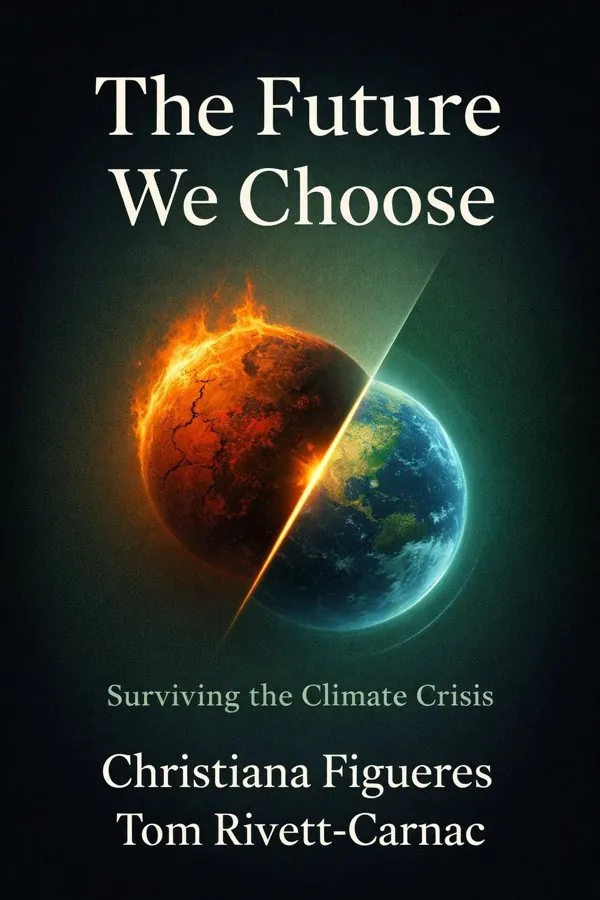
The Future We Choose: Surviving the Climate Crisis: Summary & Key Insights
by Christiana Figueres, Tom Rivett-Carnac
 10 min9 chaptersAudio available
Key Takeaways from The Future We Choose: Surviving the Climate Crisis
The most important insight in this book is unsettling but empowering: the future has not been decided yet.
One of the book’s boldest moves is refusing to soften the consequences of delay.
Hope becomes credible when it is specific.
Before societies change their systems, they often need to change the stories they tell themselves.
The book stands out because it does not leave readers with emotion alone.
What Is The Future We Choose: Surviving the Climate Crisis About?
The Future We Choose: Surviving the Climate Crisis by Christiana Figueres, Tom Rivett-Carnac is a environment book spanning 5 pages. The Future We Choose is both a warning and an invitation. Written by Christiana Figueres and Tom Rivett-Carnac, two of the key figures behind the 2015 Paris Agreement, the book asks readers to confront a defining question: what kind of world are we creating through our response, or failure to respond, to climate change? Rather than treating the climate crisis as a distant scientific issue, the authors present it as a deeply human challenge that will shape food systems, migration, public health, politics, economics, and daily life. They describe two possible futures: one marked by escalating disruption and inequality, and another built on regeneration, resilience, and collective action. What makes the book especially compelling is its combination of global perspective and practical guidance. Figueres and Rivett-Carnac argue that hope is not passive optimism but a discipline rooted in action, courage, and responsibility. Grounded in diplomacy, activism, and decades of climate work, this book matters because it helps readers move from paralysis to participation at a moment when the stakes could not be higher.
This FizzRead summary covers all 9 key chapters of The Future We Choose: Surviving the Climate Crisis in approximately 10 minutes, distilling the most important ideas, arguments, and takeaways from Christiana Figueres, Tom Rivett-Carnac's work. Also available as an audio summary and Key Quotes Podcast.
The Future We Choose: Surviving the Climate Crisis
The Future We Choose is both a warning and an invitation. Written by Christiana Figueres and Tom Rivett-Carnac, two of the key figures behind the 2015 Paris Agreement, the book asks readers to confront a defining question: what kind of world are we creating through our response, or failure to respond, to climate change? Rather than treating the climate crisis as a distant scientific issue, the authors present it as a deeply human challenge that will shape food systems, migration, public health, politics, economics, and daily life. They describe two possible futures: one marked by escalating disruption and inequality, and another built on regeneration, resilience, and collective action. What makes the book especially compelling is its combination of global perspective and practical guidance. Figueres and Rivett-Carnac argue that hope is not passive optimism but a discipline rooted in action, courage, and responsibility. Grounded in diplomacy, activism, and decades of climate work, this book matters because it helps readers move from paralysis to participation at a moment when the stakes could not be higher.
Who Should Read The Future We Choose: Surviving the Climate Crisis?
This book is perfect for anyone interested in environment and looking to gain actionable insights in a short read. Whether you're a student, professional, or lifelong learner, the key ideas from The Future We Choose: Surviving the Climate Crisis by Christiana Figueres, Tom Rivett-Carnac will help you think differently.
- ✓Readers who enjoy environment and want practical takeaways
- ✓Professionals looking to apply new ideas to their work and life
- ✓Anyone who wants the core insights of The Future We Choose: Surviving the Climate Crisis in just 10 minutes
Want the full summary?
Get instant access to this book summary and 100K+ more with Fizz Moment.
Get Free SummaryAvailable on App Store • Free to download
Key Chapters
The most important insight in this book is unsettling but empowering: the future has not been decided yet. Climate change is already underway, but the scale of damage humanity experiences will depend on the choices made now by governments, businesses, communities, and individuals. Figueres and Rivett-Carnac argue that people often think of the future as something that simply happens to us. In reality, the future is being built every day through investments, policies, habits, values, and political will. That means we are not spectators to the climate crisis. We are participants in shaping its outcome.
To make this real, the authors frame the book around two scenarios. In one, humanity delays action, clings to fossil fuels, and allows inequality and ecological breakdown to intensify. In the other, society rapidly reduces emissions, redesigns economies, protects ecosystems, and creates more just and resilient communities. This contrast is not a storytelling device alone. It is meant to cut through abstraction. Carbon concentrations and temperature graphs matter, but they do not move people as deeply as a vivid understanding of how their children might live.
This idea has practical implications. A city deciding whether to expand highways or public transit is choosing between futures. A pension fund investing in oil or clean energy is choosing between futures. A voter supporting leaders who deny climate science or leaders who promote green infrastructure is choosing between futures. Even household decisions around consumption, food, energy use, and civic engagement become part of that larger direction.
The takeaway is simple: stop treating the future as fixed. Ask, in every important decision, which future this choice supports—and intentionally choose the one that strengthens life.
One of the book’s boldest moves is refusing to soften the consequences of delay. The authors ask readers to imagine 2050 in a world where meaningful climate action never happened. This is not science fiction for shock value. It is an extrapolation of trends already visible today: worsening heatwaves, crop failures, mass displacement, water stress, ecosystem collapse, and rising social instability. By painting this dystopian scenario, the authors force us to feel the human cost of political hesitation.
In this future, everyday life becomes more precarious. Food is more expensive and less reliable because agricultural systems are disrupted by drought, floods, and shifting weather patterns. Coastal communities are repeatedly damaged or abandoned due to sea-level rise and extreme storms. Insurance becomes unaffordable or unavailable in vulnerable regions. Governments struggle to manage large-scale migration and public unrest. Inequality widens because wealthy communities can buy protection while poorer populations bear the worst burdens. Climate change stops being an environmental issue and becomes a multiplier of every existing injustice.
The power of this scenario lies in how familiar it already feels. We have seen fires engulf regions once thought safe, deadly heat in major cities, and millions displaced by climate-linked disasters. The dystopian future is not a dramatic leap from the present. It is the present, intensified.
This chapter matters because many people still assume that gradual adaptation will be enough. The authors argue otherwise. Without rapid emissions cuts, adaptation becomes increasingly expensive, unequal, and insufficient. The systems that support modern life begin to fray.
The actionable takeaway is to stop normalizing climate disruption. Treat every warning sign—extreme heat, flooding, crop stress, political backsliding—as evidence that delay has real costs, and use that awareness to support faster systemic action now.
Hope becomes credible when it is specific. After describing the consequences of failure, Figueres and Rivett-Carnac offer a second vision: a regenerative future in which humanity chooses cooperation, innovation, and restoration over extraction and denial. This future is not utopian perfection. Climate impacts still exist, and difficult transitions still happen. But the core difference is that society begins to work with natural systems rather than against them.
In a regenerative world, energy comes largely from renewable sources. Cities are redesigned for efficiency, public transit, walkability, and resilience. Buildings consume less energy and produce fewer emissions. Food systems shift toward healthier soils, less waste, and more plant-forward diets. Forests, wetlands, and oceans are treated not as resources to exploit endlessly but as living systems that stabilize climate and sustain biodiversity. Economies value long-term wellbeing instead of short-term extraction.
Importantly, the authors connect regeneration with justice. A livable future cannot be built by sacrificing vulnerable communities or repeating colonial patterns of exploitation. Clean energy access, climate finance, fair labor transitions, and community participation all matter. Regeneration is not only about technology. It is about repairing relationships: between humans and nature, rich and poor, present and future generations.
Examples of this future already exist. Countries are expanding wind and solar power at scale. Cities are investing in green transport and adaptation infrastructure. Farmers are experimenting with regenerative agriculture. Companies are being pressured to disclose emissions and redesign supply chains. These are not isolated acts of virtue; they are building blocks of a different system.
The takeaway is to replace vague hope with concrete imagination. Identify one area—energy, food, transportation, housing, finance, or local policy—where a regenerative alternative already exists, and support its expansion in your own community.
Before societies change their systems, they often need to change the stories they tell themselves. A central argument of the book is that the climate crisis is not only technological or political; it is also psychological and cultural. People avoid climate action not just because solutions are unavailable, but because fear, denial, helplessness, tribalism, and short-term thinking distort their response. The authors therefore emphasize a mindset shift as a precondition for sustained action.
This shift begins with radical honesty. We must face the scale of the threat without retreating into despair. At the same time, we must reject the false comfort of cynicism, which often disguises itself as realism. Cynicism says nothing can change because humans are too selfish, politics is too broken, and industry is too powerful. But history repeatedly shows that norms, laws, and systems can change quickly when enough pressure builds. A grounded climate mindset holds two truths at once: the danger is severe, and transformation remains possible.
The book encourages qualities such as stubborn optimism, courage, connection, and resilience. Stubborn optimism is not wishful thinking. It is the discipline of acting toward a better outcome even when success is uncertain. This mindset helps individuals avoid paralysis. Instead of asking, “Can I solve climate change?” a better question is, “What role can I play in accelerating the solution?”
In practice, this may mean talking openly about climate with family, joining a local group, voting around climate issues, changing investment choices, or pushing employers to set emissions targets. These acts become easier when people see themselves as agents rather than victims.
The actionable takeaway is to audit your climate mindset. Notice where denial, fatalism, or cynicism shows up in your thinking, and replace it with one concrete commitment that turns concern into participation.
The book stands out because it does not leave readers with emotion alone. After diagnosing the crisis and describing two possible futures, the authors offer a framework of personal and collective actions designed to make climate engagement tangible. Their message is clear: no single act is sufficient, but many reinforcing actions can shift culture, markets, and politics.
These actions include practical steps such as understanding your carbon footprint, moving money away from fossil fuels, reducing unnecessary consumption, rethinking diet and travel, engaging politically, and talking about climate change more openly. Some are directly material, like choosing cleaner transport or supporting renewable energy. Others are social and civic, like using your voice, joining movements, and holding institutions accountable. This balance is important. The authors avoid the trap of implying that climate change can be solved through individual lifestyle purity alone. Instead, they present personal action as a way of aligning values, building momentum, and strengthening broader systemic change.
For example, someone who eats less meat, flies less often, and switches to a green energy provider is reducing emissions. But if that same person also votes for climate-focused leaders, pressures their workplace to adopt science-based targets, and talks about climate in their community, their impact multiplies. Social norms shift when people act publicly, not just privately.
The ten actions are also psychologically useful. Climate change feels overwhelming because it operates on planetary scales. A list of practical commitments helps readers regain agency. It turns “someone should do something” into “here is what I can begin doing this week.”
The takeaway is to choose three actions from three different levels: one personal habit, one financial or consumption choice, and one civic or political step. Small actions matter most when they connect you to larger change.
A useful climate conversation begins when we stop confusing personal virtue with structural transformation. Figueres and Rivett-Carnac recognize that individual responsibility matters, but they place it within a bigger frame: the climate crisis is driven by energy systems, industrial design, infrastructure, policy incentives, and economic models that reward pollution and short-term gain. If action stays at the level of personal guilt, it will remain too small and too fragile.
This matters because many people get trapped in a narrow moral calculus. They worry about every plastic bag or every imperfect purchase while large institutions continue to finance fossil fuels, delay regulation, and externalize environmental costs. The authors do not dismiss lifestyle changes, but they warn against letting them become a substitute for demanding systemic shifts. Real progress requires clean grids, modernized transportation, building standards, industrial decarbonization, land-use reform, and global cooperation.
Examples make the distinction clear. If a city redesigns transit so buses and trains are reliable, affordable, and clean, millions of transport choices change at once. If governments phase out coal and support renewable infrastructure, household emissions drop without requiring heroic effort from each consumer. If banks and pension funds stop financing fossil expansion, entire sectors move. Individual choices can signal demand and shape culture, but policy and institutional design determine the scale and speed of transition.
This perspective is liberating. It means people should not strive for impossible personal perfection. They should strive for effective influence. That may include organizing at work, supporting litigation or advocacy, contacting elected officials, backing local climate initiatives, or moving money into institutions aligned with decarbonization.
The actionable takeaway is to keep your personal habits aligned with your values, but spend equal or greater energy on changing the rules, incentives, and institutions that shape everyone’s choices.
One reason climate action stalls is that it asks people to challenge convenience, comfort, and entrenched power. The authors suggest that responding adequately to the climate crisis is not just a technical task but a moral one. It requires courage: the willingness to tell the truth, accept disruption, and persist even when action is unpopular or uncertain. Without courage, knowledge remains inert.
Moral courage appears in many forms. It can be a political leader willing to support ambitious climate policy despite pressure from powerful industries. It can be a business executive deciding to decarbonize supply chains before regulations force it. It can be a young activist speaking publicly when older generations dismiss the issue. It can also be an ordinary citizen refusing to stay silent in social spaces where climate concern is mocked or minimized.
The book’s authors know from experience that international agreements are built not only through expertise, but through persistence under pressure. The Paris Agreement did not emerge from ideal conditions. It emerged because enough people kept pushing through setbacks, competing interests, and skepticism. That lesson scales down to everyday life. Waiting for certainty or universal approval is a recipe for delay.
Courage also means learning to tolerate imperfection. Climate action often involves tradeoffs, partial wins, and messy transitions. Some technologies are still developing. Some policies need revision. Some alliances are uncomfortable but necessary. The authors encourage readers not to retreat when solutions are incomplete. Progress is built through iteration.
The takeaway is to identify one place where you are currently staying quiet or passive about climate—for example at work, in your investments, or in local politics—and take one visible step that aligns your public behavior with your private concern.
What society calls realistic often depends less on physical possibility than on political imagination. The authors show that large-scale climate progress happens when collective action shifts the boundaries of what governments and institutions believe they can do. Before change happens, ambitious goals often look unrealistic. Afterward, they appear obvious. This is why movements, coalitions, and social tipping points matter so much.
Collective action works by transforming expectations. When enough citizens demand clean air, resilient infrastructure, and climate accountability, politicians begin to respond. When employees push companies to disclose emissions and set reduction targets, corporate priorities change. When investors question stranded assets and climate risk, capital starts moving. When communities build local resilience projects, they create examples others can copy. Momentum is social.
The authors’ own experience with the Paris process reflects this dynamic. Global climate diplomacy seemed stalled for years, yet persistence, coalition-building, and shared narratives eventually created a breakthrough. That history counters the idea that current political constraints are permanent. Systems can move quickly once enough actors align.
For readers, this means climate action should not be approached as a lonely burden. Joining with others increases impact and emotional sustainability. Neighborhood groups can advocate for bike lanes, energy retrofits, or tree cover. Professional networks can push industries to adopt new standards. Parent groups can demand climate education and safer school infrastructure. Even consistent conversations with friends can normalize concern and build civic readiness.
The actionable takeaway is to stop acting as an isolated consumer and start acting as part of a collective. Join or support at least one group—local, professional, political, or community-based—that is already working to accelerate climate solutions.
Perhaps the book’s most memorable contribution is its redefinition of hope. The authors reject both naïve optimism and despair. They argue that hope is not a feeling you wait to have after the evidence becomes reassuring. In a crisis, hope is a practice of choosing action because action itself creates possibility. This is a powerful reframing for anyone who feels emotionally exhausted by climate news.
Despair can seem honest because it acknowledges the seriousness of the threat. But the authors warn that despair often leads to withdrawal, and withdrawal strengthens the very forces causing harm. Passive optimism is no better. It assumes technology, markets, or future leaders will somehow solve the problem without sacrifice or effort. Disciplined hope sits between these extremes. It looks clearly at danger while refusing to surrender agency.
This kind of hope can be cultivated. It grows when people stay informed without drowning in news, celebrate progress without becoming complacent, and act with others rather than alone. It is sustained by examples of change: plummeting renewable energy costs, successful climate lawsuits, stronger youth movements, corporate transitions, and communities restoring ecosystems. None of these guarantees success, but together they show that movement is possible.
At a personal level, disciplined hope may involve setting boundaries around doom-scrolling, creating routines of action, and measuring progress by contribution rather than by immediate victory. For leaders, it means telling the truth about risks while also articulating pathways forward.
The takeaway is to treat hope as something you do. Build a regular climate practice—learning, acting, donating, organizing, or advocating—so that your sense of possibility is rooted in participation rather than emotion alone.
All Chapters in The Future We Choose: Surviving the Climate Crisis
About the Authors
Christiana Figueres is a Costa Rican diplomat and internationally recognized climate leader who served as Executive Secretary of the United Nations Framework Convention on Climate Change from 2010 to 2016. She is widely credited with helping to guide the complex diplomatic process that led to the historic 2015 Paris Agreement. Tom Rivett-Carnac is a British political strategist, climate policy expert, and co-founder of Global Optimism. He worked closely on international climate negotiations and played a significant role in shaping the strategy behind the Paris accord. Together, Figueres and Rivett-Carnac combine deep policy expertise with a strong public voice on climate action, leadership, and collective responsibility, making them influential advocates for a more just and regenerative future.
Get This Summary in Your Preferred Format
Read or listen to the The Future We Choose: Surviving the Climate Crisis summary by Christiana Figueres, Tom Rivett-Carnac anytime, anywhere. FizzRead offers multiple formats so you can learn on your terms — all free.
Available formats: App · Audio · PDF · EPUB — All included free with FizzRead
Download The Future We Choose: Surviving the Climate Crisis PDF and EPUB Summary
Key Quotes from The Future We Choose: Surviving the Climate Crisis
“The most important insight in this book is unsettling but empowering: the future has not been decided yet.”
“One of the book’s boldest moves is refusing to soften the consequences of delay.”
“Hope becomes credible when it is specific.”
“Before societies change their systems, they often need to change the stories they tell themselves.”
“The book stands out because it does not leave readers with emotion alone.”
Frequently Asked Questions about The Future We Choose: Surviving the Climate Crisis
The Future We Choose: Surviving the Climate Crisis by Christiana Figueres, Tom Rivett-Carnac is a environment book that explores key ideas across 9 chapters. The Future We Choose is both a warning and an invitation. Written by Christiana Figueres and Tom Rivett-Carnac, two of the key figures behind the 2015 Paris Agreement, the book asks readers to confront a defining question: what kind of world are we creating through our response, or failure to respond, to climate change? Rather than treating the climate crisis as a distant scientific issue, the authors present it as a deeply human challenge that will shape food systems, migration, public health, politics, economics, and daily life. They describe two possible futures: one marked by escalating disruption and inequality, and another built on regeneration, resilience, and collective action. What makes the book especially compelling is its combination of global perspective and practical guidance. Figueres and Rivett-Carnac argue that hope is not passive optimism but a discipline rooted in action, courage, and responsibility. Grounded in diplomacy, activism, and decades of climate work, this book matters because it helps readers move from paralysis to participation at a moment when the stakes could not be higher.
You Might Also Like

A Life on Our Planet: My Witness Statement and a Vision for the Future
David Attenborough
10 min
A Sky Full Of Birds
Matt Merritt
10 min
Carbon Zero: Imagining Cities That Can Save the Planet
Alex Steffen
10 min
Eaarth: Making a Life on a Tough New Planet
Bill McKibben
10 min
The Social Contract and Environmental Governance
Various Editors
10 min
The Wild Places
Robert Macfarlane
10 minBrowse by Category
Ready to read The Future We Choose: Surviving the Climate Crisis?
Get the full summary and 100K+ more books with Fizz Moment.