
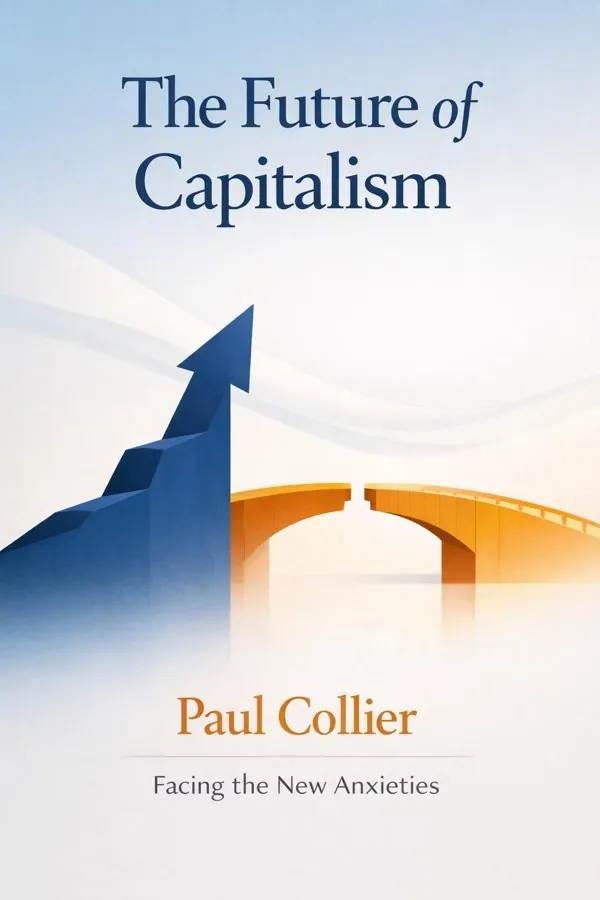
The Future of Capitalism: Facing the New Anxieties: Summary & Key Insights
by Paul Collier
 10 min8 chaptersAudio available
What Is The Future of Capitalism: Facing the New Anxieties About?
The Future of Capitalism: Facing the New Anxieties by Paul Collier is a economics book spanning 8 pages. In this influential work, economist Paul Collier explores the moral and economic crises facing modern capitalism. He argues that the system has lost its ethical foundation, leading to deep divisions between the educated elite and the working class, between prosperous cities and declining regions, and between the global North and South. Collier proposes a pragmatic and ethical renewal of capitalism, grounded in a sense of shared purpose and mutual obligation, to restore trust and social cohesion.
This FizzRead summary covers all 8 key chapters of The Future of Capitalism: Facing the New Anxieties in approximately 10 minutes, distilling the most important ideas, arguments, and takeaways from Paul Collier's work. Also available as an audio summary and Key Quotes Podcast.
The Future of Capitalism: Facing the New Anxieties
In this influential work, economist Paul Collier explores the moral and economic crises facing modern capitalism. He argues that the system has lost its ethical foundation, leading to deep divisions between the educated elite and the working class, between prosperous cities and declining regions, and between the global North and South. Collier proposes a pragmatic and ethical renewal of capitalism, grounded in a sense of shared purpose and mutual obligation, to restore trust and social cohesion.
Who Should Read The Future of Capitalism: Facing the New Anxieties?
This book is perfect for anyone interested in economics and looking to gain actionable insights in a short read. Whether you're a student, professional, or lifelong learner, the key ideas from The Future of Capitalism: Facing the New Anxieties by Paul Collier will help you think differently.
- ✓Readers who enjoy economics and want practical takeaways
- ✓Professionals looking to apply new ideas to their work and life
- ✓Anyone who wants the core insights of The Future of Capitalism: Facing the New Anxieties in just 10 minutes
Want the full summary?
Get instant access to this book summary and 100K+ more with Fizz Moment.
Get Free SummaryAvailable on App Store • Free to download
Key Chapters
We often ask: hasn’t globalization and technological progress made the world wealthier? Why then are we increasingly anxious? The answer lies within the logic of these transformations. Globalization excels at creating winners but leaves its losers behind. Technological change elevates high-skilled workers to new heights of influence while pushing low-skilled labor to the margins. We are witnessing a divided capitalism—on one side, cosmopolitan elites fluent in global mobility; on the other, workers trapped in towns hollowed out by automation and relocation, unable to reimagine their futures.
This is not to deny the benefits of globalization. It has indeed lowered barriers to prosperity and lifted millions in Asia and Africa out of poverty. Yet within Western societies it has entrenched inequality and alienated communities. The vibrancy of London, New York, and Paris contrasts sharply with the stillness of rural regions and former industrial towns. This imbalance cuts deeper than income—it erodes cultural identity. Those who lose economic value lose social respect.
Technological change magnifies this divide. Platform economies, algorithmic management, and remote work are reshaping the meaning of labor. The beneficiaries enjoy autonomy while millions of low-income workers are confined to unstable jobs that offer little dignity. Education has become the new barrier—it determines who joins the global game and who remains trapped at its margins.
The essential message of this section is that we must restore a shared destiny. Market incentives alone cannot substitute moral glue. Societies must find new ways to balance prosperity so that innovation and globalization enhance fairness rather than fuel inequality.
On the map of modern capitalism lies an invisible border—the line separating thriving cities from struggling regions. London, New York, and Berlin have become magnets for innovation, capital, and talent—the very symbols of globalization. Meanwhile, smaller cities once sustained by manufacturing, mining, and local industries face decades of decline. Their schools deteriorate, public services shrink, and their youth flee, leaving behind stagnation and loneliness.
This regional divide is not merely economic; it is moral and emotional. City residents live on the thrill of global connectivity, their identities shaped by international networks. In contrast, those in marginalized regions yearn for the sense of belonging that once came with a rooted community. Such cultural imbalance fuels political polarization. When people feel abandoned by the system, they mistrust the entire social contract and respond to globalization with anger and rejection.
Urban prosperity should not come at the expense of regional decay. A healthy capitalism must promote balance and mutual confidence between places. I argue for policies that empower local communities, rebuilding education, housing, and infrastructure so that every region participates in growth. The brightness of the cities should serve as a guiding light—not a symbol of exclusion.
+ 6 more chapters — available in the FizzRead app
All Chapters in The Future of Capitalism: Facing the New Anxieties
About the Author
Paul Collier is a British economist and professor of economics and public policy at the Blavatnik School of Government, University of Oxford. He is known for his research on development economics, poverty, and global inequality, and is the author of several acclaimed books including 'The Bottom Billion' and 'Exodus'.
Get This Summary in Your Preferred Format
Read or listen to the The Future of Capitalism: Facing the New Anxieties summary by Paul Collier anytime, anywhere. FizzRead offers multiple formats so you can learn on your terms — all free.
Available formats: App · Audio · PDF · EPUB — All included free with FizzRead
Download The Future of Capitalism: Facing the New Anxieties PDF and EPUB Summary
Key Quotes from The Future of Capitalism: Facing the New Anxieties
“We often ask: hasn’t globalization and technological progress made the world wealthier?”
“On the map of modern capitalism lies an invisible border—the line separating thriving cities from struggling regions.”
Frequently Asked Questions about The Future of Capitalism: Facing the New Anxieties
The Future of Capitalism: Facing the New Anxieties by Paul Collier is a economics book that explores key ideas across 8 chapters. In this influential work, economist Paul Collier explores the moral and economic crises facing modern capitalism. He argues that the system has lost its ethical foundation, leading to deep divisions between the educated elite and the working class, between prosperous cities and declining regions, and between the global North and South. Collier proposes a pragmatic and ethical renewal of capitalism, grounded in a sense of shared purpose and mutual obligation, to restore trust and social cohesion.
More by Paul Collier
You Might Also Like

Business Adventures
John Brooks
10 min
Nudge
Richard H. Thaler, Cass R. Sunstein
10 min
The Hitchhiker"s Guide to the Galaxy
Douglas Adams
10 minThe Muqaddimah
Ibn Khaldun
10 minThe Outsiders
William N. Thorndike
10 min
A Little History of Economics
Niall Kishtainy
10 minBrowse by Category
Ready to read The Future of Capitalism: Facing the New Anxieties?
Get the full summary and 100K+ more books with Fizz Moment.