
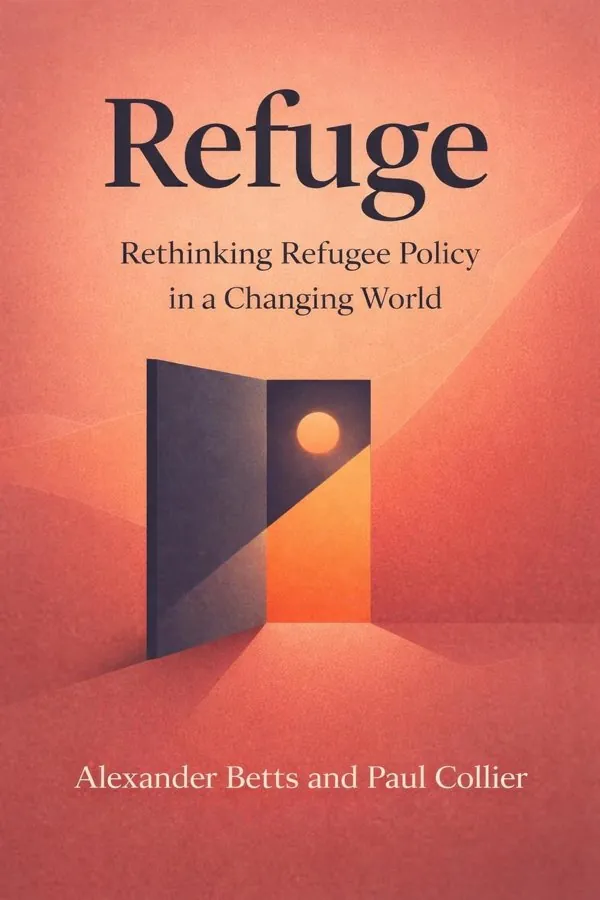
Refuge: Rethinking Refugee Policy in a Changing World: Summary & Key Insights
by Alexander Betts, Paul Collier
 10 min10 chaptersAudio available
What Is Refuge: Rethinking Refugee Policy in a Changing World About?
Refuge: Rethinking Refugee Policy in a Changing World by Alexander Betts and Paul Collier is a politics book spanning 10 pages. Refuge: Rethinking Refugee Policy in a Changing World proposes an innovative approach to refugee crises that focuses on economic integration and self-reliance through job opportunities. The authors, Alexander Betts and Paul Collier, argue that the global refugee system fails to provide sustainable solutions and instead fosters dependency. They advocate for policies that empower refugees to contribute to host societies and rebuild their own countries, restoring moral purpose and clarity to refugee policy.
This FizzRead summary covers all 10 key chapters of Refuge: Rethinking Refugee Policy in a Changing World in approximately 10 minutes, distilling the most important ideas, arguments, and takeaways from Alexander Betts and Paul Collier's work. Also available as an audio summary and Key Quotes Podcast.
Refuge: Rethinking Refugee Policy in a Changing World
Refuge: Rethinking Refugee Policy in a Changing World proposes an innovative approach to refugee crises that focuses on economic integration and self-reliance through job opportunities. The authors, Alexander Betts and Paul Collier, argue that the global refugee system fails to provide sustainable solutions and instead fosters dependency. They advocate for policies that empower refugees to contribute to host societies and rebuild their own countries, restoring moral purpose and clarity to refugee policy.
Who Should Read Refuge: Rethinking Refugee Policy in a Changing World?
This book is perfect for anyone interested in politics and looking to gain actionable insights in a short read. Whether you're a student, professional, or lifelong learner, the key ideas from Refuge: Rethinking Refugee Policy in a Changing World by Alexander Betts and Paul Collier will help you think differently.
- ✓Readers who enjoy politics and want practical takeaways
- ✓Professionals looking to apply new ideas to their work and life
- ✓Anyone who wants the core insights of Refuge: Rethinking Refugee Policy in a Changing World in just 10 minutes
Want the full summary?
Get instant access to this book summary and 100K+ more with Fizz Moment.
Get Free SummaryAvailable on App Store • Free to download
Key Chapters
The existing global refugee system was born from the ashes of the Second World War, a time when displacement was Europe’s most urgent moral and political crisis. The 1951 Refugee Convention, drafted under the auspices of the newly formed United Nations, established protection for those fleeing persecution. Its purpose was noble, but its vision was narrow: it focused on individual rights within a legal framework designed for specific, politically motivated refugees in a divided Europe. Over time, as the locus of displacement shifted from Europe to Africa, the Middle East, and Asia, this system struggled to adapt. The model remained largely legalistic and reactive—providing minimum safety through asylum and camps—but offered little in terms of long-term development or integration.
The rise of protracted refugee situations after the Cold War made these limits painfully evident. The humanitarian architecture, led by agencies such as UNHCR, operated according to an emergency paradigm: refugee camps were meant to be temporary, sustained through aid and external support. However, as conflicts in places like Afghanistan, Sudan, and Syria dragged on, temporary became permanent. Generations grew up in camps without education or employment. The noble ideal of protection became confinement.
From the author’s perspective, understanding this historical evolution is crucial. The institutions we rely upon today were designed for a different era, one when displacement was short-term and politically bounded. In our time—when 65 million people are displaced globally—the same rules no longer yield moral or practical sufficiency. The Convention’s spirit of protection must therefore be reinterpreted for a world of enduring displacement, massive regional interdependence, and complex mobility.
As researchers, we walked through dozens of refugee camps—from Kakuma in Kenya to Zaatari in Jordan—and found a pattern: the humanitarian system excels at survival but fails at life. Refugees receive food, shelter, and safety from violence, yet they are excluded from the means of human development—work, education, and mobility. This exclusion produces dependency, not because refugees are unwilling to take initiative, but because the system renders initiative impossible. Most host governments forbid refugees from working legally, fearing political backlash or job competition. Donors, in turn, fund aid programs rather than investments, perpetuating a cycle of passivity.
We refer to this structure as the ‘care and maintenance’ model—a system that treats refugees as eternal recipients of charity rather than potential economic actors. It is costly, inefficient, and deeply demoralizing. Imagine a young Syrian engineer spending a decade in a camp, surviving on rations, prohibited from using her skills to contribute to the community around her. Such stories are common, and they reveal how a misguided policy transforms human potential into waste.
The failure here is not one of compassion but of design. The humanitarian approach, framed around short-term relief, inadvertently deters self-reliance. Aid agencies compete for visibility, governments compete to minimize their obligations, and refugees are caught in between, denied agency. This model undermines dignity and leaves both refugees and hosts poorer. In *Refuge*, we argue that successful refugee policy must transition from passive humanitarianism to active development—a shift that requires seeing refugees as workers, learners, and builders of futures, not as dependents.
+ 8 more chapters — available in the FizzRead app
All Chapters in Refuge: Rethinking Refugee Policy in a Changing World
About the Authors
Alexander Betts is Professor of Forced Migration and International Affairs at the University of Oxford. Paul Collier is Professor of Economics and Public Policy at the Blavatnik School of Government, University of Oxford, and author of The Bottom Billion. Both are leading scholars in global development and humanitarian policy.
Get This Summary in Your Preferred Format
Read or listen to the Refuge: Rethinking Refugee Policy in a Changing World summary by Alexander Betts and Paul Collier anytime, anywhere. FizzRead offers multiple formats so you can learn on your terms — all free.
Available formats: App · Audio · PDF · EPUB — All included free with FizzRead
Download Refuge: Rethinking Refugee Policy in a Changing World PDF and EPUB Summary
Key Quotes from Refuge: Rethinking Refugee Policy in a Changing World
“The existing global refugee system was born from the ashes of the Second World War, a time when displacement was Europe’s most urgent moral and political crisis.”
“As researchers, we walked through dozens of refugee camps—from Kakuma in Kenya to Zaatari in Jordan—and found a pattern: the humanitarian system excels at survival but fails at life.”
Frequently Asked Questions about Refuge: Rethinking Refugee Policy in a Changing World
Refuge: Rethinking Refugee Policy in a Changing World by Alexander Betts and Paul Collier is a politics book that explores key ideas across 10 chapters. Refuge: Rethinking Refugee Policy in a Changing World proposes an innovative approach to refugee crises that focuses on economic integration and self-reliance through job opportunities. The authors, Alexander Betts and Paul Collier, argue that the global refugee system fails to provide sustainable solutions and instead fosters dependency. They advocate for policies that empower refugees to contribute to host societies and rebuild their own countries, restoring moral purpose and clarity to refugee policy.
You Might Also Like
Antifa: The Anti-Fascist Handbook
Mark Bray
10 min
Attack from Within: How Disinformation Is Sabotaging America
Barbara McQuade
10 min
Coercion, Capital, and European States, AD 990–1992
Charles Tilly
10 min
Digital Democracy: Concepts, Methodologies, Tools, and Applications
Various Authors
10 min
Fascism
Stanley G. Payne
10 min
Fire And Fury: Inside The Trump White House
Michael Wolff
10 minBrowse by Category
Ready to read Refuge: Rethinking Refugee Policy in a Changing World?
Get the full summary and 100K+ more books with Fizz Moment.