
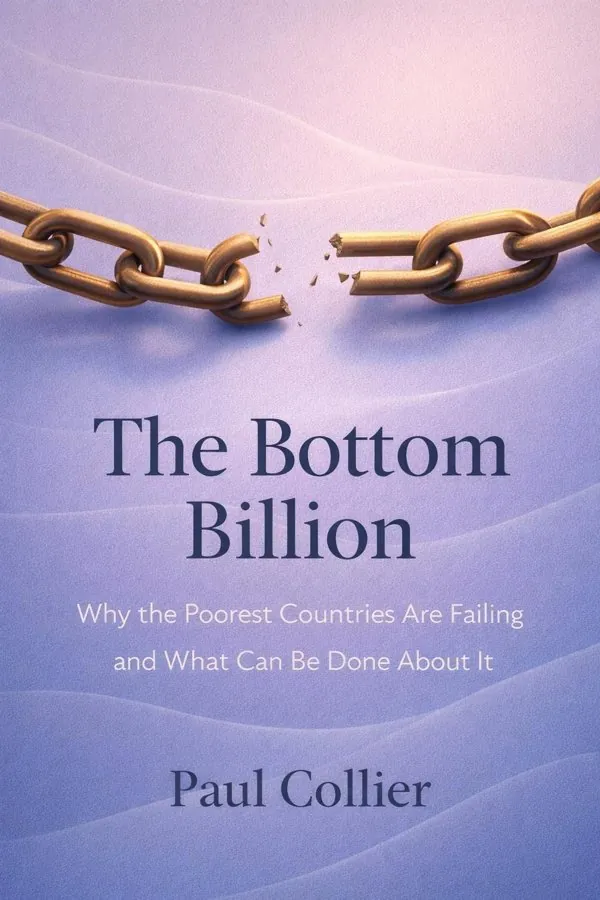
The Bottom Billion: Why the Poorest Countries Are Failing and What Can Be Done About It: Summary & Key Insights
by Paul Collier
 10 min11 chaptersAudio available
What Is The Bottom Billion: Why the Poorest Countries Are Failing and What Can Be Done About It About?
The Bottom Billion: Why the Poorest Countries Are Failing and What Can Be Done About It by Paul Collier is a economics book spanning 11 pages. The Bottom Billion examines why the poorest countries in the world—those home to about one billion people—are failing to develop despite decades of aid and globalization. Paul Collier identifies four key traps that keep these nations stuck in poverty: conflict, natural resources, being landlocked with bad neighbors, and poor governance. Drawing on extensive research and policy experience, Collier proposes practical solutions to help these countries escape the cycle of failure and join the global economy.
This FizzRead summary covers all 11 key chapters of The Bottom Billion: Why the Poorest Countries Are Failing and What Can Be Done About It in approximately 10 minutes, distilling the most important ideas, arguments, and takeaways from Paul Collier's work. Also available as an audio summary and Key Quotes Podcast.
The Bottom Billion: Why the Poorest Countries Are Failing and What Can Be Done About It
The Bottom Billion examines why the poorest countries in the world—those home to about one billion people—are failing to develop despite decades of aid and globalization. Paul Collier identifies four key traps that keep these nations stuck in poverty: conflict, natural resources, being landlocked with bad neighbors, and poor governance. Drawing on extensive research and policy experience, Collier proposes practical solutions to help these countries escape the cycle of failure and join the global economy.
Who Should Read The Bottom Billion: Why the Poorest Countries Are Failing and What Can Be Done About It?
This book is perfect for anyone interested in economics and looking to gain actionable insights in a short read. Whether you're a student, professional, or lifelong learner, the key ideas from The Bottom Billion: Why the Poorest Countries Are Failing and What Can Be Done About It by Paul Collier will help you think differently.
- ✓Readers who enjoy economics and want practical takeaways
- ✓Professionals looking to apply new ideas to their work and life
- ✓Anyone who wants the core insights of The Bottom Billion: Why the Poorest Countries Are Failing and What Can Be Done About It in just 10 minutes
Want the full summary?
Get instant access to this book summary and 100K+ more with Fizz Moment.
Get Free SummaryAvailable on App Store • Free to download
Key Chapters
Civil war, more than anything else, destroys the fabric of a state. When I examined economic growth data for the developing world, one stark pattern emerged: nations that experience civil conflict lose decades of progress. Conflict does not just end with casualties; it erodes trust, deters investors, and detains minds in survival mode rather than productivity. Economically, each year of conflict costs about 2.3% of GDP growth on average. Even after peace resumes, recovery takes an average of fourteen years, often only to relapse into renewed violence.
Why do these wars recur? Because poverty and war are mutually reinforcing. Poor countries are more likely to experience conflict, and conflict deepens poverty. The causes are seldom ideological; they are often economic grievances wrapped in political rhetoric. Rebel movements, initially driven by justice or reform, quickly devolve into competitions over spoils — diamond mines, oilfields, or local taxes. Sierra Leone and Angola, for instance, suffered because the revenues that could have built nations were instead funding warlords.
Yet, military solutions alone do not suffice. Preventing a conflict from reigniting requires external security guarantees and strong postwar governance. This is where the global community must rethink intervention — not as imperial intrusion but as a stabilizing force by invitation and necessity. Military presence, when temporary and jointly sanctioned, can buy time for peace to take root. The challenge is political will in donor nations, many of which tire quickly of 'foreign entanglements'. But as I argue, the cost of disengagement is greater. Preventing one conflict outbreak can save years of aid and countless lives later.
You might assume that resource wealth guarantees prosperity. Paradoxically, it often does the opposite. I call it the natural resource trap — when a country’s dependence on oil, diamonds, or minerals fuels corruption, conflict, and poor governance rather than development. The economics are simple yet insidious. When governments depend on resource rents, they stop depending on citizens for tax revenue. Without taxation, there is no bargaining between rulers and ruled, and without that bargaining, democracy withers.
Nigeria is a classic case. For decades, oil provided vast earnings, yet most Nigerians remained impoverished. The problem wasn’t a lack of resources; it was their mismanagement. Easy money fosters greed and short-termism. Leaders extend public payrolls for loyalty, neglect infrastructure, and allow exchange rates to appreciate, strangling other industries — a phenomenon known as 'Dutch disease'.
The key to escaping this trap lies in institutions. Norway avoided the resource curse by establishing transparent revenue management and long-term savings mechanisms. Poor countries need similar systems — oil funds with public oversight, transparent contracts, and accountability ensured by international standards. This is also why I advocate for global charters of governance and resource management — voluntary but with reputational consequences. If citizens can track where resource money goes, they can reclaim ownership of their nations’ future.
+ 9 more chapters — available in the FizzRead app
All Chapters in The Bottom Billion: Why the Poorest Countries Are Failing and What Can Be Done About It
About the Author
Paul Collier is a British economist and professor of economics and public policy at the Blavatnik School of Government, University of Oxford. He is known for his research on development economics, particularly in Africa, and has served as director of the Centre for the Study of African Economies. Collier has advised numerous international organizations and governments on economic development and poverty reduction.
Get This Summary in Your Preferred Format
Read or listen to the The Bottom Billion: Why the Poorest Countries Are Failing and What Can Be Done About It summary by Paul Collier anytime, anywhere. FizzRead offers multiple formats so you can learn on your terms — all free.
Available formats: App · Audio · PDF · EPUB — All included free with FizzRead
Download The Bottom Billion: Why the Poorest Countries Are Failing and What Can Be Done About It PDF and EPUB Summary
Key Quotes from The Bottom Billion: Why the Poorest Countries Are Failing and What Can Be Done About It
“Civil war, more than anything else, destroys the fabric of a state.”
“You might assume that resource wealth guarantees prosperity.”
Frequently Asked Questions about The Bottom Billion: Why the Poorest Countries Are Failing and What Can Be Done About It
The Bottom Billion: Why the Poorest Countries Are Failing and What Can Be Done About It by Paul Collier is a economics book that explores key ideas across 11 chapters. The Bottom Billion examines why the poorest countries in the world—those home to about one billion people—are failing to develop despite decades of aid and globalization. Paul Collier identifies four key traps that keep these nations stuck in poverty: conflict, natural resources, being landlocked with bad neighbors, and poor governance. Drawing on extensive research and policy experience, Collier proposes practical solutions to help these countries escape the cycle of failure and join the global economy.
More by Paul Collier

You Might Also Like
Business Adventures
John Brooks
10 min
Nudge
Richard H. Thaler, Cass R. Sunstein
10 min
The Hitchhiker"s Guide to the Galaxy
Douglas Adams
10 minThe Muqaddimah
Ibn Khaldun
10 minThe Outsiders
William N. Thorndike
10 min
A Little History of Economics
Niall Kishtainy
10 minBrowse by Category
Ready to read The Bottom Billion: Why the Poorest Countries Are Failing and What Can Be Done About It?
Get the full summary and 100K+ more books with Fizz Moment.