
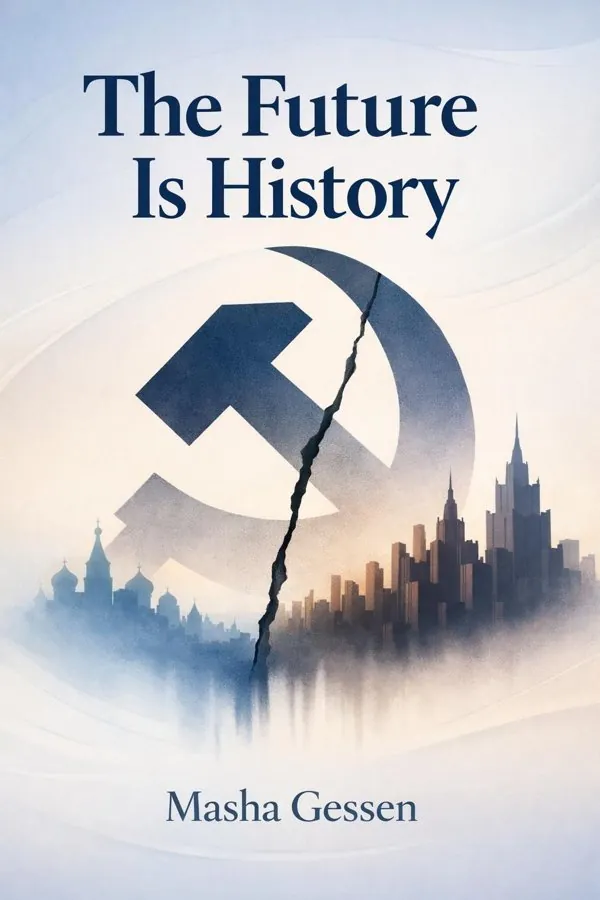
The Future Is History: How Totalitarianism Reclaimed Russia: Summary & Key Insights
by Masha Gessen
 10 min6 chaptersAudio available
About This Book
In this National Book Award–winning work, journalist Masha Gessen traces the lives of four young Russians who came of age during the collapse of the Soviet Union and the rise of Vladimir Putin’s authoritarian regime. Through their personal stories, Gessen explores how the promise of democracy gave way to a return of totalitarianism, revealing the psychological and social forces that shaped modern Russia.
The Future Is History: How Totalitarianism Reclaimed Russia
In this National Book Award–winning work, journalist Masha Gessen traces the lives of four young Russians who came of age during the collapse of the Soviet Union and the rise of Vladimir Putin’s authoritarian regime. Through their personal stories, Gessen explores how the promise of democracy gave way to a return of totalitarianism, revealing the psychological and social forces that shaped modern Russia.
Who Should Read The Future Is History: How Totalitarianism Reclaimed Russia?
This book is perfect for anyone interested in politics and looking to gain actionable insights in a short read. Whether you're a student, professional, or lifelong learner, the key ideas from The Future Is History: How Totalitarianism Reclaimed Russia by Masha Gessen will help you think differently.
- ✓Readers who enjoy politics and want practical takeaways
- ✓Professionals looking to apply new ideas to their work and life
- ✓Anyone who wants the core insights of The Future Is History: How Totalitarianism Reclaimed Russia in just 10 minutes
Want the full summary?
Get instant access to this book summary and 500K+ more with Fizz Moment.
Get Free SummaryAvailable on App Store • Free to download
Key Chapters
The Soviet Union’s fall in 1991 was, for many, both a liberation and a trauma. I was there, watching the statues of Lenin and Dzerzhinsky come down, hearing the chants of freedom, and feeling the dizzying sense that anything was possible. For the first time in seventy years, Russians could speak their minds without fear. But the ground beneath our feet was unsteady; the past had been erased, rewritten, and hidden so many times that no one truly knew who they were.
In these early years, the euphoria of freedom was not supported by institutions or by a shared moral framework. The Soviet project had annihilated civil society, and in its place there was only survival instinct. People celebrated their release from totalitarian control but had no language for citizenship, no experience of trust. Freedom, in that sense, was abstract, almost terrifying.
The four young people I followed were born into that vacuum. They were all too young to remember communism clearly but old enough to feel the residue of fear it had left in their parents. The Soviet collapse offered the appearance of renewal, but within the minds of millions, the mechanisms of obedience remained intact. When a society lacks memory, it cannot build a future. Russia’s democracy, in those first glowing years, was thus built on amnesia. And amnesia, as I came to see, is totalitarianism’s most fertile soil.
The 1990s were Russia’s laboratory of extremes. On paper, the country was becoming a democracy; in reality, it was careening into chaos. The rapid privatization programs of the Yeltsin era dismantled the old command economy but replaced it with a new oligarchy. Wealth became concentrated in the hands of a few, while millions sank into poverty. The social contract was rewritten overnight—from cradle-to-grave security to ruthless competition.
Zhanna, the daughter of Boris Nemtsov—a reformist politician who would become one of Putin’s most visible opponents—grew up believing in the idea of a free, European Russia. Her optimism was inherited from her father’s liberal vision. Masha, whose parents were part of the Soviet intelligentsia, felt both excited and disoriented; they wanted her to believe that every door was open now, yet they themselves were haunted by the silence of their own parents’ generation. Lyosha, who knew from early on that he was gay, faced a society unprepared for any genuine pluralism, while Seryozha, who gravitated toward nationalism, searched for belonging in a world without clear meaning.
Each of their lives revealed a deeper truth: Russia was changing its costume but not its psychology. The reformers spoke of democracy as if it were a software update, not a moral transformation. People adopted the vocabulary of freedom without internalizing its demands. By the end of the 1990s, when Vladimir Putin emerged from the shadows of the security services, the country was tired of confusion. In that exhaustion lay readiness—not for freedom, but for order.
+ 4 more chapters — available in the FizzRead app
All Chapters in The Future Is History: How Totalitarianism Reclaimed Russia
About the Author
Masha Gessen is a Russian-American journalist, author, and activist known for her work on Russian politics, authoritarianism, and LGBTQ+ rights. She has written extensively for publications such as The New Yorker and The New York Times, and her books often examine the intersection of power, truth, and identity in post-Soviet society.
Get This Summary in Your Preferred Format
Read or listen to the The Future Is History: How Totalitarianism Reclaimed Russia summary by Masha Gessen anytime, anywhere. FizzRead offers multiple formats so you can learn on your terms — all free.
Available formats: App · Audio · PDF · EPUB — All included free with FizzRead
Download The Future Is History: How Totalitarianism Reclaimed Russia PDF and EPUB Summary
Key Quotes from The Future Is History: How Totalitarianism Reclaimed Russia
“The Soviet Union’s fall in 1991 was, for many, both a liberation and a trauma.”
“The 1990s were Russia’s laboratory of extremes.”
Frequently Asked Questions about The Future Is History: How Totalitarianism Reclaimed Russia
In this National Book Award–winning work, journalist Masha Gessen traces the lives of four young Russians who came of age during the collapse of the Soviet Union and the rise of Vladimir Putin’s authoritarian regime. Through their personal stories, Gessen explores how the promise of democracy gave way to a return of totalitarianism, revealing the psychological and social forces that shaped modern Russia.
More by Masha Gessen
You Might Also Like

A Short History of Brexit: From Brentry to Backstop
Kevin O'Rourke
10 min
A Very English Scandal
John Preston
10 min
A Very Stable Genius: Donald J. Trump's Testing of America
Philip Rucker and Carol Leonnig
10 min
A Warning
Anonymous (later revealed as Miles Taylor)
10 min
A World in Disarray: American Foreign Policy and the Crisis of the Old Order
Richard N. Haass
10 min
Abundance
Ezra Klein and Derek Thompson
10 minReady to read The Future Is History: How Totalitarianism Reclaimed Russia?
Get the full summary and 500K+ more books with Fizz Moment.