
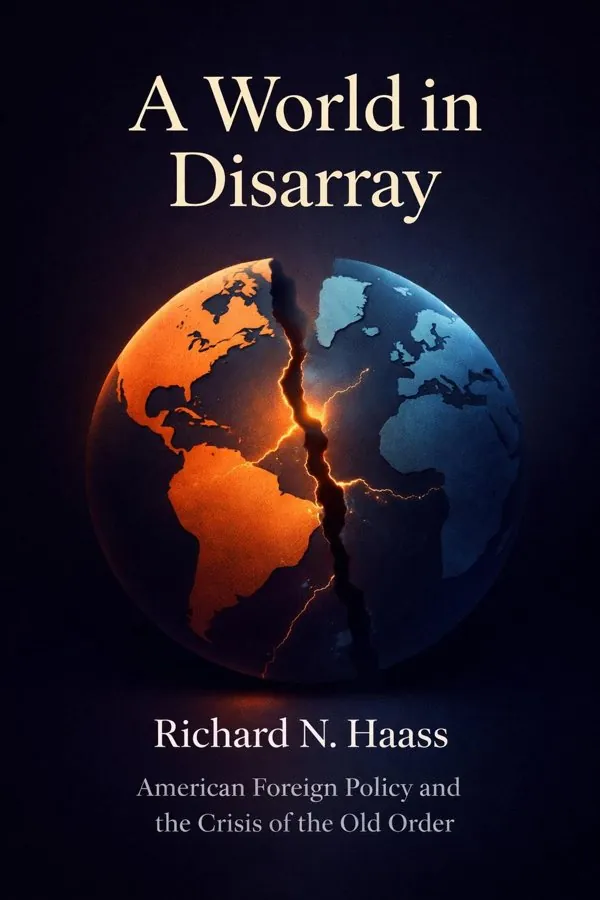
A World in Disarray: American Foreign Policy and the Crisis of the Old Order: Summary & Key Insights
 10 min9 chaptersAudio available
What Is A World in Disarray: American Foreign Policy and the Crisis of the Old Order About?
A World in Disarray: American Foreign Policy and the Crisis of the Old Order by Richard N. Haass is a politics book spanning 9 pages. In this influential work, Richard N. Haass, president of the Council on Foreign Relations, examines the breakdown of the post–World War II international order and the challenges facing U.S. foreign policy in an increasingly multipolar and unstable world. He argues for a new approach to global governance and American engagement that balances national interests with international cooperation.
This FizzRead summary covers all 9 key chapters of A World in Disarray: American Foreign Policy and the Crisis of the Old Order in approximately 10 minutes, distilling the most important ideas, arguments, and takeaways from Richard N. Haass's work. Also available as an audio summary and Key Quotes Podcast.
A World in Disarray: American Foreign Policy and the Crisis of the Old Order
In this influential work, Richard N. Haass, president of the Council on Foreign Relations, examines the breakdown of the post–World War II international order and the challenges facing U.S. foreign policy in an increasingly multipolar and unstable world. He argues for a new approach to global governance and American engagement that balances national interests with international cooperation.
Who Should Read A World in Disarray: American Foreign Policy and the Crisis of the Old Order?
This book is perfect for anyone interested in politics and looking to gain actionable insights in a short read. Whether you're a student, professional, or lifelong learner, the key ideas from A World in Disarray: American Foreign Policy and the Crisis of the Old Order by Richard N. Haass will help you think differently.
- ✓Readers who enjoy politics and want practical takeaways
- ✓Professionals looking to apply new ideas to their work and life
- ✓Anyone who wants the core insights of A World in Disarray: American Foreign Policy and the Crisis of the Old Order in just 10 minutes
Want the full summary?
Get instant access to this book summary and 100K+ more with Fizz Moment.
Get Free SummaryAvailable on App Store • Free to download
Key Chapters
After 1945, the world looked to the United States for stability, and we responded by building a system where alliances, institutions, and shared norms replaced the destructive chaos of global conflict. Out of devastation came design: NATO for security, Bretton Woods for economic coordination, the United Nations for diplomacy, and rules-based trade for prosperity. Each of these reflected a conviction that American leadership was indispensable but should be exercised in service of global public goods. The liberal order was far from perfect—it privileged stability over equality and sometimes imposed Western rules on non-Western realities—but it gave the world a mechanism to prevent major wars and to manage competition.
From my vantage point as a policy planner and later as an observer at the Council on Foreign Relations, I saw how this system worked best when American ideals were married to pragmatic strategy. What made it sustainable was not dominance but credibility—the sense that the United States would act predictably and within frameworks others helped design. But the conditions that created that world—clear victories, shared threats, and relative economic uniformity—began to dissipate over time. As memories of the war faded and new states emerged, consensus fractured. The postwar order, once sturdy, became increasingly brittle.
The fall of the Soviet Union was a moment of triumph that paradoxically sowed future uncertainty. For four decades, global policy had revolved around a bipolar logic: two superpowers, two ideologies, two competing systems. When the Soviet bloc collapsed, the United States found itself alone at the pinnacle—a condition I have described as the 'unipolar moment.' It was exhilarating but dangerous. Without an organizing rival, strategy turned instinctively outward. Humanitarian interventions, democratic expansion, and globalization surged forward, often without sufficient grounding in local realities.
In those years, the notion took hold that history itself had ended—that liberal democracy and open markets would spread inexorably. But unipolarity is not permanence; it is a transition. Other powers began to reassert themselves, and globalization accelerated both integration and imbalance. The euphoria of victory masked the fact that the institutions built for Cold War stability were ill-equipped for an era of asymmetric threats and diffused power. The challenge was not victory but adjustment—to find a new equilibrium after the certainties of bipolarity had vanished.
+ 7 more chapters — available in the FizzRead app
All Chapters in A World in Disarray: American Foreign Policy and the Crisis of the Old Order
About the Author
Richard N. Haass is an American diplomat and foreign policy expert who has served in multiple U.S. administrations, including as Director of Policy Planning at the U.S. Department of State. He has been president of the Council on Foreign Relations since 2003 and is a leading voice on international relations and global strategy.
Get This Summary in Your Preferred Format
Read or listen to the A World in Disarray: American Foreign Policy and the Crisis of the Old Order summary by Richard N. Haass anytime, anywhere. FizzRead offers multiple formats so you can learn on your terms — all free.
Available formats: App · Audio · PDF · EPUB — All included free with FizzRead
Download A World in Disarray: American Foreign Policy and the Crisis of the Old Order PDF and EPUB Summary
Key Quotes from A World in Disarray: American Foreign Policy and the Crisis of the Old Order
“Out of devastation came design: NATO for security, Bretton Woods for economic coordination, the United Nations for diplomacy, and rules-based trade for prosperity.”
“The fall of the Soviet Union was a moment of triumph that paradoxically sowed future uncertainty.”
Frequently Asked Questions about A World in Disarray: American Foreign Policy and the Crisis of the Old Order
A World in Disarray: American Foreign Policy and the Crisis of the Old Order by Richard N. Haass is a politics book that explores key ideas across 9 chapters. In this influential work, Richard N. Haass, president of the Council on Foreign Relations, examines the breakdown of the post–World War II international order and the challenges facing U.S. foreign policy in an increasingly multipolar and unstable world. He argues for a new approach to global governance and American engagement that balances national interests with international cooperation.
You Might Also Like
Antifa: The Anti-Fascist Handbook
Mark Bray
10 min
Attack from Within: How Disinformation Is Sabotaging America
Barbara McQuade
10 min
Coercion, Capital, and European States, AD 990–1992
Charles Tilly
10 min
Digital Democracy: Concepts, Methodologies, Tools, and Applications
Various Authors
10 min
Fascism
Stanley G. Payne
10 min
Fire And Fury: Inside The Trump White House
Michael Wolff
10 minBrowse by Category
Ready to read A World in Disarray: American Foreign Policy and the Crisis of the Old Order?
Get the full summary and 100K+ more books with Fizz Moment.