
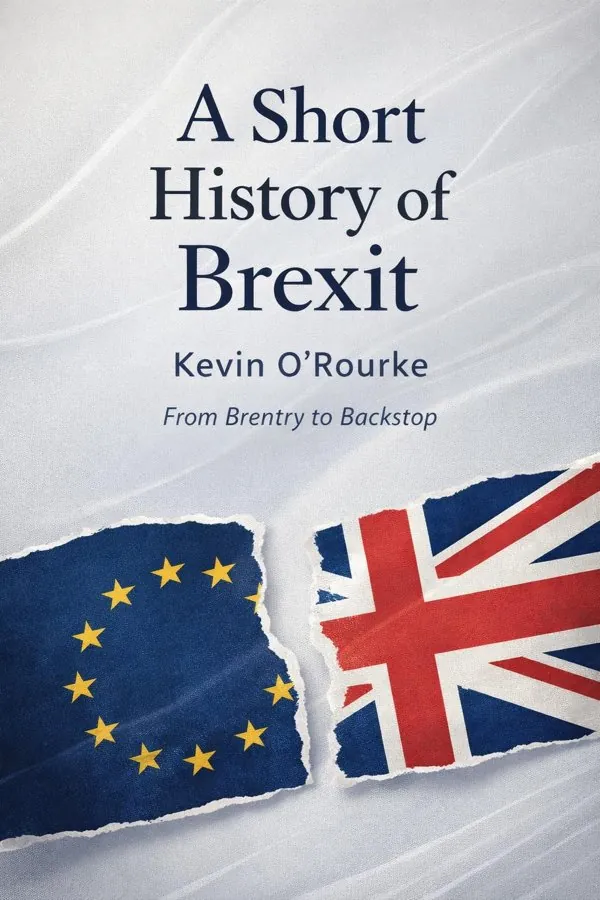
A Short History of Brexit: From Brentry to Backstop: Summary & Key Insights
 10 min8 chaptersAudio available
What Is A Short History of Brexit: From Brentry to Backstop About?
A Short History of Brexit: From Brentry to Backstop by Kevin O'Rourke is a politics book spanning 8 pages. This book offers a concise and authoritative account of the United Kingdom’s relationship with the European Union, tracing the historical, political, and economic forces that led to Brexit. Kevin O'Rourke examines how Britain’s integration into Europe evolved from postwar reconstruction to the 2016 referendum, explaining the interplay between national identity, globalization, and economic policy. The work provides a balanced analysis of the causes and consequences of Brexit, situating it within the broader context of European integration and disintegration.
This FizzRead summary covers all 8 key chapters of A Short History of Brexit: From Brentry to Backstop in approximately 10 minutes, distilling the most important ideas, arguments, and takeaways from Kevin O'Rourke's work. Also available as an audio summary and Key Quotes Podcast.
A Short History of Brexit: From Brentry to Backstop
This book offers a concise and authoritative account of the United Kingdom’s relationship with the European Union, tracing the historical, political, and economic forces that led to Brexit. Kevin O'Rourke examines how Britain’s integration into Europe evolved from postwar reconstruction to the 2016 referendum, explaining the interplay between national identity, globalization, and economic policy. The work provides a balanced analysis of the causes and consequences of Brexit, situating it within the broader context of European integration and disintegration.
Who Should Read A Short History of Brexit: From Brentry to Backstop?
This book is perfect for anyone interested in politics and looking to gain actionable insights in a short read. Whether you're a student, professional, or lifelong learner, the key ideas from A Short History of Brexit: From Brentry to Backstop by Kevin O'Rourke will help you think differently.
- ✓Readers who enjoy politics and want practical takeaways
- ✓Professionals looking to apply new ideas to their work and life
- ✓Anyone who wants the core insights of A Short History of Brexit: From Brentry to Backstop in just 10 minutes
Want the full summary?
Get instant access to this book summary and 100K+ more with Fizz Moment.
Get Free SummaryAvailable on App Store • Free to download
Key Chapters
The story properly begins in postwar Europe, when the devastation of two world wars led continental leaders to construct a new framework of cooperation. The European Coal and Steel Community, founded in 1951, was the first tentative structure of integration—designed to make war materially impossible by locking key industries under a supranational authority. Britain supported the project rhetorically but declined to join. Its reasoning was both strategic and emotional. The British elite regarded itself as a world power, its gaze cast beyond Europe. The Commonwealth and the special relationship with the United States seemed more natural extensions of its identity than participation in a continental experiment led by France and Germany. Economic historians have often pointed out that Britain’s global trade patterns still reflected imperial linkages far more than intra-European exchange. Thus, when the European Economic Community (EEC) was formally launched in 1957, Britain stood outside, preferring to sponsor a looser arrangement—the European Free Trade Association (EFTA). Yet as the EEC economies began to grow faster, it became impossible to ignore that Britain was falling behind. What the country had perceived as independence began to look increasingly like isolation.
By the early 1960s, British policymakers realized that their earlier calculations were flawed. Economic pragmatism forced a reconsideration. Twice, under Harold Macmillan and later Harold Wilson, Britain applied to join the EEC. Both attempts were rejected by France, chiefly due to Charles de Gaulle’s conviction that Britain was too close to the United States and insufficiently ‘European.’ The rejections were humiliating but revealing—they underscored how Britain’s ambivalence appeared from the outside. When at last Britain gained entry in 1973 under Edward Heath, it did so not out of love but necessity. The accession was justified largely in economic terms: access to European markets, shared prosperity, modernization for British industry. Yet even at this moment of entry, opposition was evident. A substantial portion of public and political opinion felt uneasy about sovereignty being transferred to European institutions. Two years later, the 1975 referendum confirmed membership but revealed persistent divisions. Campaigners presented Europe either as a pragmatic partnership or a bureaucratic threat to British democracy. I saw this early referendum as foreshadowing 2016—the same vocabulary of control, identity, and autonomy already echoed across decades.
+ 6 more chapters — available in the FizzRead app
All Chapters in A Short History of Brexit: From Brentry to Backstop
About the Author
Kevin O'Rourke is an Irish economic historian and professor known for his research on globalization and European economic history. He has taught at Oxford University and Trinity College Dublin, and his work often explores the intersection of economics and political change in modern Europe.
Get This Summary in Your Preferred Format
Read or listen to the A Short History of Brexit: From Brentry to Backstop summary by Kevin O'Rourke anytime, anywhere. FizzRead offers multiple formats so you can learn on your terms — all free.
Available formats: App · Audio · PDF · EPUB — All included free with FizzRead
Download A Short History of Brexit: From Brentry to Backstop PDF and EPUB Summary
Key Quotes from A Short History of Brexit: From Brentry to Backstop
“The story properly begins in postwar Europe, when the devastation of two world wars led continental leaders to construct a new framework of cooperation.”
“By the early 1960s, British policymakers realized that their earlier calculations were flawed.”
Frequently Asked Questions about A Short History of Brexit: From Brentry to Backstop
A Short History of Brexit: From Brentry to Backstop by Kevin O'Rourke is a politics book that explores key ideas across 8 chapters. This book offers a concise and authoritative account of the United Kingdom’s relationship with the European Union, tracing the historical, political, and economic forces that led to Brexit. Kevin O'Rourke examines how Britain’s integration into Europe evolved from postwar reconstruction to the 2016 referendum, explaining the interplay between national identity, globalization, and economic policy. The work provides a balanced analysis of the causes and consequences of Brexit, situating it within the broader context of European integration and disintegration.
You Might Also Like
Antifa: The Anti-Fascist Handbook
Mark Bray
10 min
Attack from Within: How Disinformation Is Sabotaging America
Barbara McQuade
10 min
Coercion, Capital, and European States, AD 990–1992
Charles Tilly
10 min
Digital Democracy: Concepts, Methodologies, Tools, and Applications
Various Authors
10 min
Fascism
Stanley G. Payne
10 min
Fire And Fury: Inside The Trump White House
Michael Wolff
10 minBrowse by Category
Ready to read A Short History of Brexit: From Brentry to Backstop?
Get the full summary and 100K+ more books with Fizz Moment.