
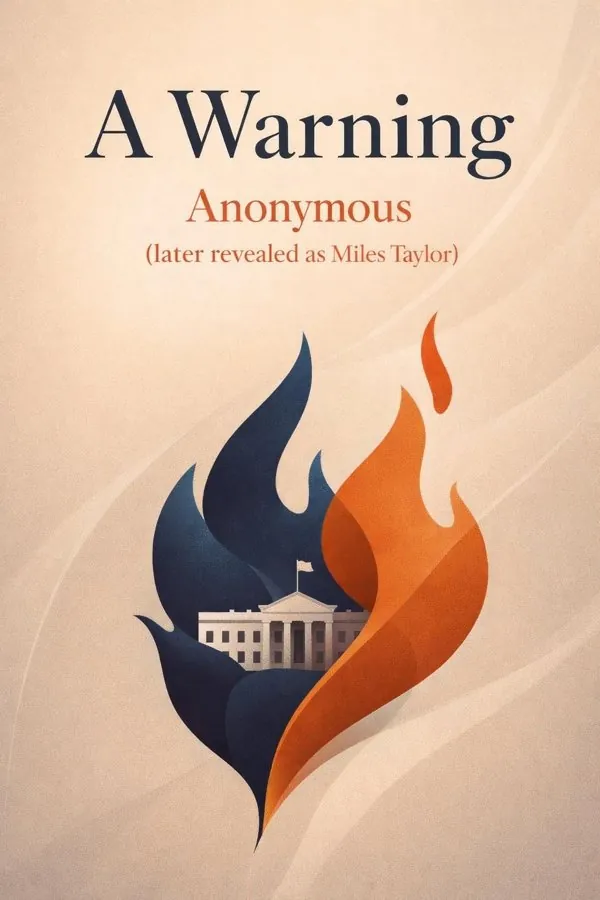
A Warning: Summary & Key Insights
by Anonymous (later revealed as Miles Taylor)
 10 min9 chaptersAudio available
Key Takeaways from A Warning
Public service begins with a simple but demanding principle: loyalty belongs to the Constitution, not to the personality occupying high office.
A presidency is not just a policy platform; it is a daily expression of the leader’s character.
Some leaders like to present disorder as energy, disruption as strength, and unpredictability as tactical genius.
A Warning portrays these figures not as ideological rebels but as reluctant stabilizers who believed they could reduce harm by staying in place.
In national security, impulsiveness is not authenticity; it is a liability.
What Is A Warning About?
A Warning by Anonymous (later revealed as Miles Taylor) is a politics book spanning 9 pages. A Warning is a rare kind of political book: part insider memoir, part institutional alarm bell, and part civic argument about the fragility of democratic leadership. First published anonymously in 2019 and later revealed to be written by Miles Taylor, a former senior official in the Trump administration, the book expands on the now-famous New York Times op-ed describing an internal "resistance" among government officials who believed they were containing the president’s worst impulses from within. Rather than offering a detached ideological critique, the book presents itself as a firsthand account of what it felt like to work inside a presidency the author considered unpredictable, impulsive, and dangerous to constitutional norms. Its importance lies not only in its portrait of one administration, but in its larger warning about character, executive power, and the limits of informal guardrails. Taylor writes with the authority of someone who participated in national security and domestic policy discussions at senior levels, and who claims to have watched capable officials struggle to preserve stability while serving a volatile president. Whether readers agree with its conclusions or not, A Warning matters because it asks a hard democratic question: what happens when institutions rely too heavily on unelected individuals to contain elected power?
This FizzRead summary covers all 9 key chapters of A Warning in approximately 10 minutes, distilling the most important ideas, arguments, and takeaways from Anonymous (later revealed as Miles Taylor)'s work. Also available as an audio summary and Key Quotes Podcast.
A Warning
A Warning is a rare kind of political book: part insider memoir, part institutional alarm bell, and part civic argument about the fragility of democratic leadership. First published anonymously in 2019 and later revealed to be written by Miles Taylor, a former senior official in the Trump administration, the book expands on the now-famous New York Times op-ed describing an internal "resistance" among government officials who believed they were containing the president’s worst impulses from within. Rather than offering a detached ideological critique, the book presents itself as a firsthand account of what it felt like to work inside a presidency the author considered unpredictable, impulsive, and dangerous to constitutional norms. Its importance lies not only in its portrait of one administration, but in its larger warning about character, executive power, and the limits of informal guardrails. Taylor writes with the authority of someone who participated in national security and domestic policy discussions at senior levels, and who claims to have watched capable officials struggle to preserve stability while serving a volatile president. Whether readers agree with its conclusions or not, A Warning matters because it asks a hard democratic question: what happens when institutions rely too heavily on unelected individuals to contain elected power?
Who Should Read A Warning?
This book is perfect for anyone interested in politics and looking to gain actionable insights in a short read. Whether you're a student, professional, or lifelong learner, the key ideas from A Warning by Anonymous (later revealed as Miles Taylor) will help you think differently.
- ✓Readers who enjoy politics and want practical takeaways
- ✓Professionals looking to apply new ideas to their work and life
- ✓Anyone who wants the core insights of A Warning in just 10 minutes
Want the full summary?
Get instant access to this book summary and 100K+ more with Fizz Moment.
Get Free SummaryAvailable on App Store • Free to download
Key Chapters
Public service begins with a simple but demanding principle: loyalty belongs to the Constitution, not to the personality occupying high office. One of the central ideas in A Warning is that this distinction stopped being theoretical inside the Trump administration and became a daily moral test. The author argues that many officials entered government with ordinary partisan commitments, but found themselves repeatedly asking whether serving the president also meant protecting the country from the president’s own impulses. That tension lies at the heart of the book.
Taylor presents the oath of office as a practical compass. In his view, the oath requires public servants to defend institutions, lawful process, and national interests even when doing so frustrates a president’s personal preferences. That does not mean bureaucrats should sabotage elections or substitute their judgment for policy outcomes they merely dislike. Instead, it means they must resist conduct they believe threatens constitutional governance, national security, or the integrity of public administration.
This idea has applications far beyond politics. In any institution, professionals are often tempted to confuse loyalty to a boss with loyalty to a mission. A doctor serves patient welfare before hospital politics. A lawyer serves the law before a powerful client’s whims. A civil servant serves the republic before partisan pressure.
The author’s challenge is uncomfortable because it raises questions about when internal dissent is duty and when it becomes unaccountable resistance. Readers may debate his answer, but the principle remains powerful: in a constitutional system, no leader is above the framework that grants authority in the first place.
Actionable takeaway: define the core mission of any role you hold and decide in advance what values or rules you will not compromise, even under pressure from powerful people.
A presidency is not just a policy platform; it is a daily expression of the leader’s character. A Warning insists that temperament, judgment, discipline, empathy, and honesty matter as much as formal ideology because they shape how decisions are made under stress. The book argues that inside the White House, President Trump’s management style often reflected impulsiveness, insecurity, and a craving for personal validation, and that these traits had real policy consequences.
Taylor’s core point is that flaws of character do not stay private. They spill into hiring choices, diplomatic relationships, crisis response, and the government’s ability to focus. An erratic leader may reverse positions suddenly, elevate flattery over competence, or frame national decisions through personal grievance. In that environment, even good policies can become unstable because they are disconnected from consistent reasoning. Staff spend less time solving public problems and more time anticipating mood swings, preventing self-inflicted crises, and translating improvised presidential declarations into workable governance.
This is why the book treats leadership character as a civic issue rather than a moralistic side topic. A president oversees military force, economic policy, intelligence, emergency management, and international alliances. Poor impulse control at that level is not just unpleasant; it can become hazardous.
The lesson applies to organizations everywhere. Teams often tolerate toxic behavior when a leader delivers short-term wins, but over time volatility erodes trust, clarity, and execution. People stop sharing bad news, decision-making narrows, and institutional quality declines.
Actionable takeaway: when evaluating leaders, look beyond slogans and policy promises; assess how they handle criticism, uncertainty, and power, because character predicts performance when stakes are highest.
Some leaders like to present disorder as energy, disruption as strength, and unpredictability as tactical genius. A Warning argues that this romantic view of chaos collapses when applied to actual governance. The author describes an administration where abrupt reversals, contradictory instructions, and impulsive public statements made it difficult for agencies to execute policy coherently. In his telling, confusion did not produce innovation; it produced exhaustion, delay, and risk.
Government depends on process not because process is glamorous, but because it helps large institutions make decisions with legal review, expert input, and measurable consequences. When leaders bypass those channels repeatedly, the result is not freedom from bureaucracy but more hidden bureaucracy: staff scramble to reinterpret directives, patch over inconsistencies, and avert preventable fallout. Meetings become less about deliberation and more about deciphering presidential intent. Long-term planning gives way to short-term containment.
Taylor suggests that the Trump White House often functioned in this reactive mode. That dynamic mattered especially in areas like homeland security, international relations, and interagency coordination, where confusion can create vulnerabilities. A single off-the-cuff statement may unsettle allies, markets, or agency priorities. Staff can absorb occasional turbulence, but if volatility becomes the operating system, institutional performance deteriorates.
This idea carries lessons for business, nonprofits, and public organizations. Fast decision-making is useful, but speed without structure punishes the people responsible for implementation. If your team constantly revisits settled decisions because the leader changes course impulsively, the organization is not agile; it is unstable.
Actionable takeaway: build systems that separate brainstorming from decision-making, document key choices clearly, and judge leaders by whether their style improves execution rather than merely generating attention.
One of the book’s most debated claims is that an informal internal resistance existed inside the administration: officials who tried to steer the government away from what they saw as reckless presidential behavior. A Warning portrays these figures not as ideological rebels but as reluctant stabilizers who believed they could reduce harm by staying in place. They slowed bad ideas, redirected conversations, elevated legal objections, and tried to ensure that agencies followed established process.
The book presents this resistance as both necessary and deeply flawed. Necessary, because the author believed some proposals or impulses posed genuine danger. Flawed, because unelected officials cannot be a permanent substitute for democratic accountability. Internal guardrails may buy time, but they also conceal the severity of dysfunction from the public. Citizens may assume institutions are working normally when, behind the scenes, people are simply preventing breakage.
Taylor’s argument is morally complex. Leaving on principle may preserve personal integrity, but staying may protect the country in the short term. Yet staying also risks normalizing unacceptable conduct and making the administration appear more competent than it is. This tension gives the book much of its urgency and controversy.
The broader lesson is that informal heroics are never enough. Every institution develops unofficial fixes when formal systems fail: trusted deputies compensate for absent leadership, senior staff quietly ignore destructive orders, professionals improvise around dysfunction. These measures can keep things afloat, but they are unstable and invisible.
Actionable takeaway: do not mistake emergency workarounds for healthy governance. If an organization depends on insiders privately neutralizing a leader’s worst decisions, the real solution is structural accountability, transparency, and reform.
In national security, impulsiveness is not authenticity; it is a liability. A Warning emphasizes that presidential instability becomes especially dangerous when applied to military affairs, intelligence, diplomacy, and homeland protection. The author argues that allies, adversaries, and career officials all rely on signals from the White House. If those signals are inconsistent, emotionally driven, or disconnected from established review processes, the consequences can extend far beyond Washington.
Taylor describes a system in which officials worried that casual presidential remarks could unsettle international relationships or create uncertainty about U.S. commitments. In security matters, ambiguity sometimes has strategic value, but uncontrolled ambiguity does not. It can encourage rivals to test boundaries, force allies to hedge their bets, and make agencies uncertain about what policy they are supposed to carry out.
The book also highlights the burden placed on senior staff when presidential direction appears unstable. Instead of concentrating fully on external threats, they must spend energy clarifying positions, correcting misunderstandings, and building buffers against erratic decision-making. This weakens the government’s strategic capacity. National security works best when decisions are deliberate, informed by expertise, and communicated with precision.
Outside government, the principle remains relevant in any high-stakes environment. In aviation, emergency medicine, cybersecurity, or finance, leaders do not earn trust by being dramatic. They earn it by being calm, informed, and predictable under pressure.
Actionable takeaway: in any role involving serious risk, create disciplined decision routines, include qualified experts early, and never confuse spur-of-the-moment confidence with sound judgment.
Few policy areas exposed the administration’s internal conflicts more starkly than immigration. A Warning suggests that immigration debates were not merely about border management or legal enforcement; they reflected competing understandings of national identity, executive power, and human dignity. The author portrays some officials as committed to border security within lawful and humane limits, while others pushed for measures shaped more by political symbolism and deterrence than by coherent policy design.
Taylor frames the issue as a test of whether government can pursue hardline objectives without sacrificing moral judgment. He argues that in practice, rhetoric often outran planning. Public declarations demanded maximum toughness, while agencies were left to deal with legal constraints, humanitarian realities, and operational consequences. This gap between message and implementation produced confusion and, at times, intensified harm.
The immigration chapters also demonstrate one of the book’s recurring themes: policy cannot be separated from process and character. A leader who sees every issue through conflict, image, and loyalty will tend to reward performative severity over competent administration. That does not mean all restrictive immigration policies are illegitimate. Rather, Taylor argues that serious policy requires evidence, legal scrutiny, and attention to second-order effects on families, asylum systems, law enforcement, and America’s global reputation.
Readers can apply this lens to many contentious issues. The question is not only whether a goal sounds strong, but whether it is workable, lawful, and ethically defensible in real-world administration.
Actionable takeaway: when assessing controversial policy, ask three questions before choosing sides: Is it legal? Is it practical? And does it preserve basic human dignity while achieving its stated aim?
Institutions rarely collapse because everyone suddenly abandons principle at once. More often, decline comes through ethical drift: a gradual process in which behavior once considered unacceptable becomes routine because people keep rationalizing exceptions. A Warning captures this dynamic inside a turbulent administration. The author suggests that many officials did not begin by expecting to compromise deeply held norms. Instead, they adjusted incrementally, telling themselves they were staying to help, to moderate, or to get through one more crisis.
This is one of the book’s most valuable insights. Ethical failure often feels practical in the moment. People excuse small distortions of truth because the larger battle seems urgent. They tolerate demeaning behavior because the policy stakes feel high. They accept procedural shortcuts because proper channels seem too slow. Over time, those choices alter the moral baseline of the institution.
Taylor does not present himself as outside this problem. The book carries an undercurrent of self-justification, but also self-implication. By remaining inside, even critics of the president became part of a system they considered dangerous. That tension gives the narrative more depth than a simple whistleblower account.
The broader application is clear. In workplaces, civic life, and personal relationships, people often wait for a dramatic red line before acting. But cultures are shaped by repeated toleration of smaller breaches. If you consistently explain away misconduct because the person is powerful or useful, you are helping build the environment you privately criticize.
Actionable takeaway: identify your non-negotiables early and monitor the small compromises, because sustained integrity is usually lost gradually long before it is lost publicly.
A constitutional republic weakens when too much responsibility shifts from formal oversight to private acts of containment. A Warning argues that one of the gravest dangers of the Trump era was the temptation to let unnamed insiders, cabinet officials, or civil servants quietly manage presidential dysfunction instead of forcing open political accountability. The author’s appeal is ultimately not just to bureaucrats, but to Congress, voters, and civic institutions.
Taylor contends that the separation of powers only works when each branch uses the authority it already has. Congress cannot simply complain about executive excess while avoiding politically costly oversight. Lawmakers are supposed to investigate, legislate, constrain, and communicate clearly to the public when presidential conduct threatens norms or lawful process. Likewise, citizens cannot outsource democratic responsibility to newspapers, whistleblowers, or anonymous officials. A republic depends on informed participation, not spectator outrage.
The book therefore frames the crisis as broader than one personality. If institutions become dependent on individuals of unusual courage rather than ordinary rules and oversight, the system is more fragile than it appears. Democracies decay not only through active abuse, but through passive accommodation.
This lesson matters beyond Washington. Boards must supervise CEOs. Journalists must verify and persist. Employees must report misconduct through proper channels. Communities must not confuse cynicism with vigilance. Accountability is rarely convenient, but institutions fail when responsible actors treat it as optional.
Actionable takeaway: support systems of oversight before a crisis arrives, and when warning signs appear, insist on transparent accountability rather than hoping private insiders will solve public problems for you.
The deepest warning in A Warning is not that one administration was chaotic, but that democratic systems can become dangerously reliant on norms that are neither automatic nor self-enforcing. Taylor argues that constitutional government survives not just through written rules, but through habits of restraint, truthfulness, professionalism, and public engagement. When those habits erode, the formal machinery may still exist while trust and legitimacy weaken underneath.
This final idea lifts the book from insider chronicle to civic caution. The author worries that Americans have grown too accustomed to treating politics as spectacle. In that environment, scandal becomes entertainment, norm-breaking becomes branding, and institutional strain becomes background noise. Citizens may adapt emotionally to behavior that would once have provoked sustained resistance. That normalization is precisely what the title points to.
The book does not claim the United States is uniquely doomed or that one election determines history forever. Its message is subtler and more demanding: republics endure when citizens, officials, media organizations, courts, and legislators continuously renew the culture of self-government. No constitutional order can thrive if people stop caring about truth, process, and the responsible use of power.
For readers, this means the book is less a final judgment than a call to attention. You do not have to agree with every claim to accept the broader lesson that democratic resilience requires active maintenance.
Actionable takeaway: practice citizenship as an ongoing discipline by following credible information, rewarding integrity over spectacle, and participating in institutions that strengthen accountability at the local as well as national level.
All Chapters in A Warning
About the Author
Miles Taylor is an American former government official, writer, and political commentator best known for revealing himself as the anonymous author of the 2018 New York Times op-ed "I Am Part of the Resistance Inside the Trump Administration" and the 2019 book A Warning. During the Trump administration, he served at the Department of Homeland Security, including as chief of staff to Secretary Kirstjen Nielsen. His government experience gave him a close view of executive decision-making, homeland security policy, and the internal tensions within the administration. After leaving public office, Taylor became a prominent critic of President Trump and a public voice on issues of leadership, democratic norms, and institutional accountability. His authorship of A Warning made him a controversial figure in American political debate.
Get This Summary in Your Preferred Format
Read or listen to the A Warning summary by Anonymous (later revealed as Miles Taylor) anytime, anywhere. FizzRead offers multiple formats so you can learn on your terms — all free.
Available formats: App · Audio · PDF · EPUB — All included free with FizzRead
Download A Warning PDF and EPUB Summary
Key Quotes from A Warning
“Public service begins with a simple but demanding principle: loyalty belongs to the Constitution, not to the personality occupying high office.”
“A presidency is not just a policy platform; it is a daily expression of the leader’s character.”
“Some leaders like to present disorder as energy, disruption as strength, and unpredictability as tactical genius.”
“A Warning portrays these figures not as ideological rebels but as reluctant stabilizers who believed they could reduce harm by staying in place.”
“In national security, impulsiveness is not authenticity; it is a liability.”
Frequently Asked Questions about A Warning
A Warning by Anonymous (later revealed as Miles Taylor) is a politics book that explores key ideas across 9 chapters. A Warning is a rare kind of political book: part insider memoir, part institutional alarm bell, and part civic argument about the fragility of democratic leadership. First published anonymously in 2019 and later revealed to be written by Miles Taylor, a former senior official in the Trump administration, the book expands on the now-famous New York Times op-ed describing an internal "resistance" among government officials who believed they were containing the president’s worst impulses from within. Rather than offering a detached ideological critique, the book presents itself as a firsthand account of what it felt like to work inside a presidency the author considered unpredictable, impulsive, and dangerous to constitutional norms. Its importance lies not only in its portrait of one administration, but in its larger warning about character, executive power, and the limits of informal guardrails. Taylor writes with the authority of someone who participated in national security and domestic policy discussions at senior levels, and who claims to have watched capable officials struggle to preserve stability while serving a volatile president. Whether readers agree with its conclusions or not, A Warning matters because it asks a hard democratic question: what happens when institutions rely too heavily on unelected individuals to contain elected power?
You Might Also Like
Antifa: The Anti-Fascist Handbook
Mark Bray
10 min
Attack from Within: How Disinformation Is Sabotaging America
Barbara McQuade
10 min
Coercion, Capital, and European States, AD 990–1992
Charles Tilly
10 min
Digital Democracy: Concepts, Methodologies, Tools, and Applications
Various Authors
10 min
Fascism
Stanley G. Payne
10 min
Fire And Fury: Inside The Trump White House
Michael Wolff
10 minBrowse by Category
Ready to read A Warning?
Get the full summary and 100K+ more books with Fizz Moment.