
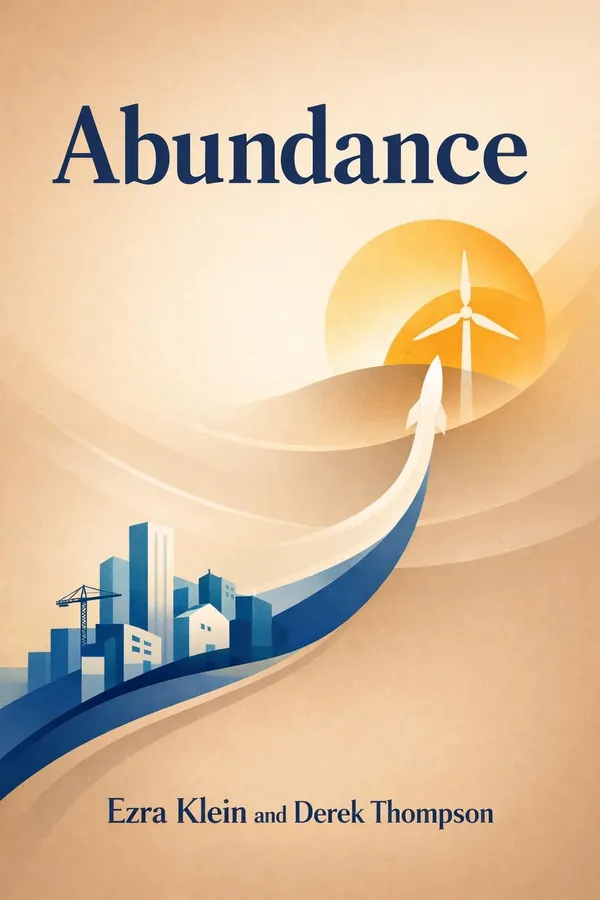
Abundance: Summary & Key Insights
 10 min12 chaptersAudio available
What Is Abundance About?
Abundance by Ezra Klein and Derek Thompson is a politics book spanning 12 pages. This book argues that many of America's most pressing crises—from housing shortages and high costs of living to climate change and slow scientific progress—are the result of "chosen scarcities." The authors contend that a shift in political philosophy is needed, moving away from a liberalism focused on procedure and demand-side subsidies toward a "politics of abundance" or "supply-side progressivism." Through an analysis of housing policy, energy infrastructure, government capacity, and scientific funding, the book outlines a vision for a government that prioritizes building, inventing, and deploying the resources necessary for a flourishing future.
This FizzRead summary covers all 12 key chapters of Abundance in approximately 10 minutes, distilling the most important ideas, arguments, and takeaways from Ezra Klein and Derek Thompson's work. Also available as an audio summary and Key Quotes Podcast.
Abundance
This book argues that many of America's most pressing crises—from housing shortages and high costs of living to climate change and slow scientific progress—are the result of "chosen scarcities." The authors contend that a shift in political philosophy is needed, moving away from a liberalism focused on procedure and demand-side subsidies toward a "politics of abundance" or "supply-side progressivism." Through an analysis of housing policy, energy infrastructure, government capacity, and scientific funding, the book outlines a vision for a government that prioritizes building, inventing, and deploying the resources necessary for a flourishing future.
Who Should Read Abundance?
This book is perfect for anyone interested in politics and looking to gain actionable insights in a short read. Whether you're a student, professional, or lifelong learner, the key ideas from Abundance by Ezra Klein and Derek Thompson will help you think differently.
- ✓Readers who enjoy politics and want practical takeaways
- ✓Professionals looking to apply new ideas to their work and life
- ✓Anyone who wants the core insights of Abundance in just 10 minutes
Want the full summary?
Get instant access to this book summary and 100K+ more with Fizz Moment.
Get Free SummaryAvailable on App Store • Free to download
Key Chapters
The central economic error of modern American politics has been the decoupling of supply and demand. In the real world, these forces are inextricably linked; in our politics, they have been divvied up between the parties. The Republican Party claimed the mantle of the "supply side," but their version of supply-side economics was narrow and often destructive. It became synonymous with the Laffer curve and the relentless pursuit of tax cuts for the wealthy, predicated on the dubious theory that such cuts would automatically unleash a torrent of work and revenue. While tax cuts can be a useful tool, the GOP's dogmatic adherence to them, regardless of the economic context, made the very concept of "supply-side" policy seem disreputable to liberals.
Furthermore, the conservative agenda cast production solely as a function of unfettered markets. Their solution to every problem was to get the government out of the way. This left a gaping void in our political imagination: what happens when society needs a supply of something that the market cannot or will not provide on its own? This is where Democrats should have stepped in. Instead, cowed by the Reagan revolution and fearful of being labeled socialists, liberals retreated to the demand side of the ledger. From the Great Society to the Obama era, progressive policy was largely built around subsidizing the purchase of goods rather than ensuring their production. We created housing vouchers, Pell Grants, and health insurance subsidies, assuming that if we gave people the money, the market would provide the goods.
This assumption was a mistake. It reflected a naivete about the workings of the market and a disinterest in the mechanics of production. When you subsidize demand for a scarce good without expanding its supply, you do not help the poor; you merely raise prices. This is the story of the American affordability crisis. We have poured trillions of dollars into housing, education, and health care, yet these services have become more expensive, not less. In 1950, the median home price was roughly double the average annual income; by 2020, it was six times the average income. The cost of college and health insurance has skyrocketed similarly. We created an "uncanny economy" where flat-screen TVs are cheap, but a middle-class life is increasingly out of reach.
The inflation that followed the COVID-19 pandemic forced a reckoning. For years, the primary economic problem had been insufficient demand. But the post-pandemic economy was defined by supply shocks and shortages. Suddenly, the problem wasn't that people didn't have money to spend; it was that there weren't enough cars, chips, or homes to buy. This shift has begun to reshape our politics. We are seeing the emergence of a "supply-side progressivism" that recognizes we cannot subsidize our way to prosperity. We must build. We must confront the reality that scarcity is often a policy choice, maintained by regulations and laws that prioritize stasis over growth. To have the future we want, we must choose to build it.
There is a profound irony in the American mythos: we lionize the frontier, yet our prosperity has always been forged in our cities. Horace Greeley famously advised, "Go West, young man," but he himself went to New York City to make his fortune. Cities are the engines of our economy, the places where human capital clusters to create new ideas and technologies. This is the phenomenon of agglomeration. Despite the technological conquest of distance—through the telegraph, the telephone, and the internet—place matters more than ever. Innovation thrives on proximity. It is no accident that the generative AI revolution is concentrated in a few square miles of San Francisco, or that finance remains anchored in New York. We create in community, spurred by the friction and collaboration that only density can provide.
However, we have broken the urban engine. In the mid-twentieth century, moving to a productive city like New York or San Francisco was a reliable ticket to the middle class. Wages were higher, and housing was abundant enough that a worker could capture that wage premium. Today, that promise has been inverted. Moving to a superstar city often means taking an effective pay cut because housing costs consume so much of a paycheck. We have turned our most productive places into gated communities for the rich. The result is a "Great Divergence" in regional wealth and a stalling of social mobility. A child born in a high-opportunity city has a much better shot at success than one born elsewhere, but if their parents cannot afford to move there, that opportunity is lost.
This crisis is entirely man-made. We stopped building homes. In the mid-twentieth century, America was a home-building juggernaut. But starting in the 1970s, we allowed a web of regulations and zoning laws to strangle construction. We downzoned our cities, banned apartment buildings, and empowered local homeowners to veto new development. We did this to protect the character of neighborhoods and the value of existing homes, but the cost has been the closing of the American frontier. We have made mobility an engine of inequality rather than opportunity. The housing crisis is not a result of the market failing to work; it is a result of the market being forbidden to work. We have legislated scarcity, and in doing so, we have severed the link between economic growth and broad-based prosperity.
+ 10 more chapters — available in the FizzRead app
All Chapters in Abundance
About the Authors
Ezra Klein is an opinion columnist and host of the award-winning Ezra Klein Show podcast at the New York Times. He is the author of Why We’re Polarized. Derek Thompson is a staff writer at the Atlantic and the host of the podcast Plain English. He is the author of Hit Makers and On Work.
Get This Summary in Your Preferred Format
Read or listen to the Abundance summary by Ezra Klein and Derek Thompson anytime, anywhere. FizzRead offers multiple formats so you can learn on your terms — all free.
Available formats: App · Audio · PDF · EPUB — All included free with FizzRead
Download Abundance PDF and EPUB Summary
Key Quotes from Abundance
“The central economic error of modern American politics has been the decoupling of supply and demand.”
“There is a profound irony in the American mythos: we lionize the frontier, yet our prosperity has always been forged in our cities.”
Frequently Asked Questions about Abundance
Abundance by Ezra Klein and Derek Thompson is a politics book that explores key ideas across 12 chapters. This book argues that many of America's most pressing crises—from housing shortages and high costs of living to climate change and slow scientific progress—are the result of "chosen scarcities." The authors contend that a shift in political philosophy is needed, moving away from a liberalism focused on procedure and demand-side subsidies toward a "politics of abundance" or "supply-side progressivism." Through an analysis of housing policy, energy infrastructure, government capacity, and scientific funding, the book outlines a vision for a government that prioritizes building, inventing, and deploying the resources necessary for a flourishing future.
You Might Also Like

Antifa: The Anti-Fascist Handbook
Mark Bray
10 min
Attack from Within: How Disinformation Is Sabotaging America
Barbara McQuade
10 min
Coercion, Capital, and European States, AD 990–1992
Charles Tilly
10 min
Digital Democracy: Concepts, Methodologies, Tools, and Applications
Various Authors
10 min
Fascism
Stanley G. Payne
10 min
Fire And Fury: Inside The Trump White House
Michael Wolff
10 minBrowse by Category
Ready to read Abundance?
Get the full summary and 100K+ more books with Fizz Moment.