
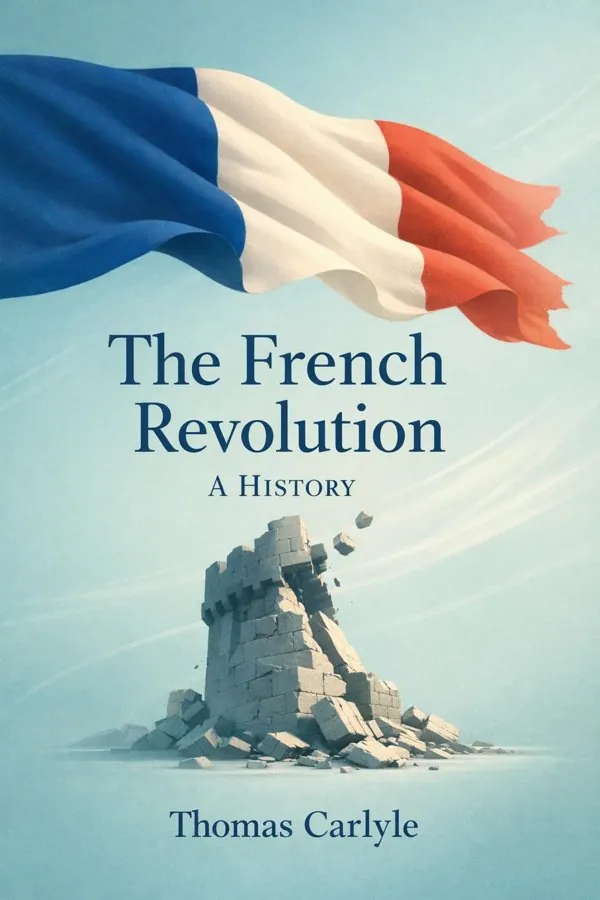
The French Revolution: A History: Summary & Key Insights
 10 min4 chaptersAudio available
What Is The French Revolution: A History About?
The French Revolution: A History by Thomas Carlyle is a world_history book spanning 4 pages. The French Revolution: A History is a historical narrative written by Scottish historian and philosopher Thomas Carlyle. First published in 1837, it vividly recounts the events of the French Revolution from 1789 to 1795, blending dramatic prose with deep philosophical reflection. Carlyle’s work is renowned for its literary style and its portrayal of the Revolution as a profound moral and spiritual upheaval rather than merely a political event.
This FizzRead summary covers all 4 key chapters of The French Revolution: A History in approximately 10 minutes, distilling the most important ideas, arguments, and takeaways from Thomas Carlyle's work. Also available as an audio summary and Key Quotes Podcast.
The French Revolution: A History
The French Revolution: A History is a historical narrative written by Scottish historian and philosopher Thomas Carlyle. First published in 1837, it vividly recounts the events of the French Revolution from 1789 to 1795, blending dramatic prose with deep philosophical reflection. Carlyle’s work is renowned for its literary style and its portrayal of the Revolution as a profound moral and spiritual upheaval rather than merely a political event.
Who Should Read The French Revolution: A History?
This book is perfect for anyone interested in world_history and looking to gain actionable insights in a short read. Whether you're a student, professional, or lifelong learner, the key ideas from The French Revolution: A History by Thomas Carlyle will help you think differently.
- ✓Readers who enjoy world_history and want practical takeaways
- ✓Professionals looking to apply new ideas to their work and life
- ✓Anyone who wants the core insights of The French Revolution: A History in just 10 minutes
Want the full summary?
Get instant access to this book summary and 100K+ more with Fizz Moment.
Get Free SummaryAvailable on App Store • Free to download
Key Chapters
We begin amid the grandeur and emptiness of pre-revolutionary France. Versailles glitters; its mirrors reflect a world divorced from reality. The monarchy of Louis XVI, earnest but irresolute, stands on foundations eaten away by privilege and indifference. Marie Antoinette smiles through her masquerades, unaware—or unwilling to believe—that outside her gardens hunger gnaws at millions. The nobility has grown ornamental, the clergy complacent. A nation of philosophers and writers produces cries for liberty, yet none foresees the abyss about to open under their feet.
I paint this scene because the Revolution’s origin lies in the moral bankruptcy of its rulers. The financial crises, deficits, and endless taxes are symptoms only; the disease is spiritual decay. Nobles forget duty; kings forget mercy. France groans beneath its feudal burdens as enlightenment ideals spread among the Third Estate. Here I show how thought itself becomes weapon and prophecy. When a people begins to think that authority must justify its existence, old orders tremble. Louis XVI’s court cannot read the writing on the wall. They debate reforms as if eternity were theirs, while famine whispers in every village. The disconnection between palace and populace breeds inevitability: history itself demands redress.
As I escort you through these chapters, you sense destiny gathering momentum. My words burn with compassion for the oppressed and scorn for those who sleep amid splendor. This was humanity’s breaking point, not of politics but of conscience. The Revolution’s seeds sprouted from the soil of neglect, fertilized by pride and hypocrisy. And thus the stage is set for the first act of retribution—the convocation of the Estates-General.
In 1789, the Estates-General convenes, ostensibly to repair the finances of the crown. Yet in that assembly room a greater repair begins—the restoration of human dignity. I weave my narrative around this sudden clarity born in the minds of common men, the Third Estate, whose very designation marks centuries of exclusion. These deputies step forward not as petitioners but as voices of a nation. They proclaim that life cannot be divided into estates forever.
The transformation from submission to self-recognition unfolds with nearly religious fervor. The Tennis Court Oath becomes my symbol of awakening—an event not merely political but spiritual. In that cramped hall where deputies swear never to disband until France is reborn, you can feel the heartbeat of a world changing. The oath is a sacrament of solidarity, and I render it in the tone of revelation. It is humanity affirming its right to exist as free conscience, asserting sovereignty against command.
The storming of the Bastille follows like thunder after lightning. I narrate it as the fear and fury of a populace long restrained—Paris rising to tear down stone walls symbolic of all prisons of the mind. The Bastille’s fall is the Revolution’s baptism of fire. No longer pleading, the people act, and their action sends tremors through every heart in Europe. Through this upheaval, I seek to show that revolution is both noble and tragic: the joy of liberation intertwined with the birth of chaos.
What follows—the Great Fear, rural uprisings, and the abolition of feudal privileges—is the countryside’s answer to the Bastille. It is France awakening in every hamlet. The peasant razes the manor; the city tears the symbols of servitude. Yet amid the dust, I remind you, truth flickers in uncertainty. Freedom, gained through tumult, must now learn governance, else liberty will dissolve into anarchy.
+ 2 more chapters — available in the FizzRead app
All Chapters in The French Revolution: A History
About the Author
Thomas Carlyle (1795–1881) was a Scottish historian, essayist, and philosopher known for his influential works on history and social criticism. His writings, including Sartor Resartus and The French Revolution: A History, established him as one of the leading intellectual figures of the Victorian era.
Get This Summary in Your Preferred Format
Read or listen to the The French Revolution: A History summary by Thomas Carlyle anytime, anywhere. FizzRead offers multiple formats so you can learn on your terms — all free.
Available formats: App · Audio · PDF · EPUB — All included free with FizzRead
Download The French Revolution: A History PDF and EPUB Summary
Key Quotes from The French Revolution: A History
“We begin amid the grandeur and emptiness of pre-revolutionary France.”
“In 1789, the Estates-General convenes, ostensibly to repair the finances of the crown.”
Frequently Asked Questions about The French Revolution: A History
The French Revolution: A History by Thomas Carlyle is a world_history book that explores key ideas across 4 chapters. The French Revolution: A History is a historical narrative written by Scottish historian and philosopher Thomas Carlyle. First published in 1837, it vividly recounts the events of the French Revolution from 1789 to 1795, blending dramatic prose with deep philosophical reflection. Carlyle’s work is renowned for its literary style and its portrayal of the Revolution as a profound moral and spiritual upheaval rather than merely a political event.
You Might Also Like
The Age of Capital
Eric Hobsbawm
10 min
The Gulag Archipelago
Aleksandr Solzhenitsyn
10 min
Jerusalem: The Biography
Simon Sebag Montefiore
10 min
The Anglo-Saxons
James Campbell
10 min
The Boer War
Thomas Pakenham
10 min
The Industrial Revolutionaries: The Making of the Modern World 1776–1914
Gavin Weightman
10 minBrowse by Category
Ready to read The French Revolution: A History?
Get the full summary and 100K+ more books with Fizz Moment.