
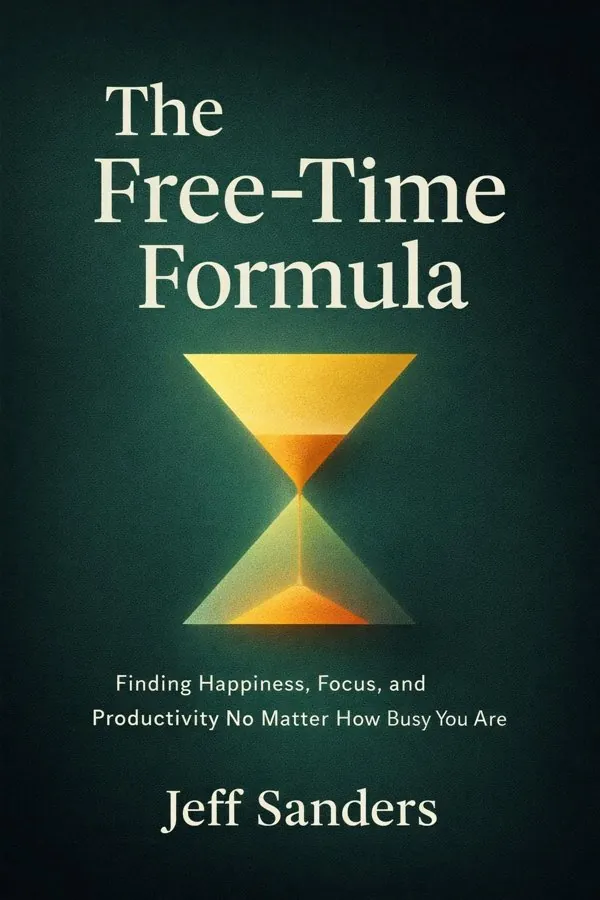
The Free-Time Formula: Finding Happiness, Focus, and Productivity No Matter How Busy You Are: Summary & Key Insights
by Jeff Sanders
 10 min9 chaptersAudio available
Key Takeaways from The Free-Time Formula: Finding Happiness, Focus, and Productivity No Matter How Busy You Are
A full calendar means very little if it is filled with activities that do not reflect what matters most.
Most people are not nearly as aware of their days as they think they are.
Free time does not appear by accident.
One of the biggest obstacles to freedom is not a crowded calendar but a crowded belief system.
Two people can have the same number of hours and achieve radically different results because time is fixed but energy is variable.
What Is The Free-Time Formula: Finding Happiness, Focus, and Productivity No Matter How Busy You Are About?
The Free-Time Formula: Finding Happiness, Focus, and Productivity No Matter How Busy You Are by Jeff Sanders is a productivity book spanning 12 pages. In The Free-Time Formula, Jeff Sanders challenges one of modern life’s most damaging assumptions: that being busy is the same as being productive. Instead of glorifying packed schedules and constant hustle, he offers a practical framework for creating more space, more focus, and more satisfaction without sacrificing ambition. The book is not about escaping responsibility or magically finding extra hours in the day. It is about making smarter choices with attention, energy, and time so that work supports a meaningful life rather than consuming it. Sanders writes from the perspective of a productivity coach who has spent years helping high performers overcome overwhelm, sharpen habits, and build routines that actually last. As the host of The 5 AM Miracle podcast, he is known for translating lofty self-improvement ideas into concrete daily practices. That practical strength shows throughout this book. He connects values, scheduling, deep work, energy management, and reflection into a usable system for busy professionals, parents, creators, and anyone tired of feeling behind. The result is a grounded guide to reclaiming control and building a life with more intention, happiness, and sustainable productivity.
This FizzRead summary covers all 9 key chapters of The Free-Time Formula: Finding Happiness, Focus, and Productivity No Matter How Busy You Are in approximately 10 minutes, distilling the most important ideas, arguments, and takeaways from Jeff Sanders's work. Also available as an audio summary and Key Quotes Podcast.
The Free-Time Formula: Finding Happiness, Focus, and Productivity No Matter How Busy You Are
In The Free-Time Formula, Jeff Sanders challenges one of modern life’s most damaging assumptions: that being busy is the same as being productive. Instead of glorifying packed schedules and constant hustle, he offers a practical framework for creating more space, more focus, and more satisfaction without sacrificing ambition. The book is not about escaping responsibility or magically finding extra hours in the day. It is about making smarter choices with attention, energy, and time so that work supports a meaningful life rather than consuming it.
Sanders writes from the perspective of a productivity coach who has spent years helping high performers overcome overwhelm, sharpen habits, and build routines that actually last. As the host of The 5 AM Miracle podcast, he is known for translating lofty self-improvement ideas into concrete daily practices. That practical strength shows throughout this book. He connects values, scheduling, deep work, energy management, and reflection into a usable system for busy professionals, parents, creators, and anyone tired of feeling behind. The result is a grounded guide to reclaiming control and building a life with more intention, happiness, and sustainable productivity.
Who Should Read The Free-Time Formula: Finding Happiness, Focus, and Productivity No Matter How Busy You Are?
This book is perfect for anyone interested in productivity and looking to gain actionable insights in a short read. Whether you're a student, professional, or lifelong learner, the key ideas from The Free-Time Formula: Finding Happiness, Focus, and Productivity No Matter How Busy You Are by Jeff Sanders will help you think differently.
- ✓Readers who enjoy productivity and want practical takeaways
- ✓Professionals looking to apply new ideas to their work and life
- ✓Anyone who wants the core insights of The Free-Time Formula: Finding Happiness, Focus, and Productivity No Matter How Busy You Are in just 10 minutes
Want the full summary?
Get instant access to this book summary and 100K+ more with Fizz Moment.
Get Free SummaryAvailable on App Store • Free to download
Key Chapters
A full calendar means very little if it is filled with activities that do not reflect what matters most. Sanders begins with a simple but powerful idea: time management only works when it is built on value clarity. Many people try to optimize schedules before deciding what deserves their best attention. As a result, they become more efficient at living someone else’s priorities, responding to external demands, or chasing goals that leave them depleted.
The book encourages readers to identify core values across major life domains such as health, relationships, work, contribution, growth, and rest. This process is not abstract philosophy. It becomes the filter through which every commitment is evaluated. If family connection is a core value, your schedule should visibly reflect it. If creative work matters, it should be protected rather than squeezed into leftover time. If health is nonnegotiable, sleep, movement, and recovery cannot remain optional.
Sanders also points out that conflict often comes not from lack of time, but from misalignment. People feel guilty, scattered, or chronically behind because their days are disconnected from what they say is important. A values-first approach reduces that tension. It gives permission to say no, simplify obligations, and stop treating every request as equally urgent.
A practical application is to write down your top five values, then review your weekly calendar beside them. Circle anything that directly supports those values and question anything that does not. This simple exercise reveals whether your time is being invested or merely consumed.
Actionable takeaway: Define your top core values this week and use them as your primary decision-making filter before adding, accepting, or keeping any commitment.
Most people are not nearly as aware of their days as they think they are. Sanders argues that busyness often survives because it is vague. We feel overwhelmed, but we cannot clearly explain where the hours went. That is why a time audit is one of the most revealing steps in the Free-Time Formula. By tracking how time is actually spent, readers move from assumptions to evidence.
The audit goes beyond meetings and to-do lists. Sanders emphasizes attention, energy, and context switching. A person may only spend 20 minutes checking social media, but if that habit fragments concentration ten times a day, its true cost is much higher. Likewise, a calendar may show eight hours of work, while the reality includes long stretches of low-value activity, interruptions, and reactive communication.
This chapter helps readers categorize time into meaningful buckets: essential work, maintenance tasks, recovery, relationships, distractions, and wasted effort. The goal is not self-judgment. It is diagnosis. Once patterns become visible, improvement becomes possible. For example, someone may discover that email dominates their mornings, leaving no room for strategic thinking. Another may realize that household errands are scattered inefficiently across the week. A parent may notice that the most emotionally important moments with family are being crowded out by digital noise.
Sanders suggests using a notebook, spreadsheet, or time-tracking app for several days to capture reality in detail. Readers should note not only what they were doing, but how focused and energized they felt while doing it. This transforms time management into a more human system that accounts for quality, not just quantity.
Actionable takeaway: Track your time in 30-minute blocks for at least three days, then identify the three biggest drains on your attention and redesign next week to reduce them.
Free time does not appear by accident. Sanders presents it as the output of a repeatable system rather than a lucky break between responsibilities. The Free-Time Formula connects clarity, elimination, prioritization, scheduling, and habit consistency into one integrated approach. In other words, if you want more margin, you cannot rely on isolated tricks. You need a structure that reduces chaos and channels effort toward what matters most.
At the heart of the framework is the belief that free time is created before it is enjoyed. It comes from proactively deciding what to do less of, what to automate, what to batch, what to ignore, and what to protect. Sanders reframes productivity as strategic subtraction. Instead of stuffing more into each day, readers learn to build systems that reduce friction and waste. This can include planning the week in advance, setting themes for specific days, grouping similar tasks together, preparing for transitions, and turning recurring activities into routines.
The framework also emphasizes alignment. A productive week is not simply one where many tasks are completed. It is one where time was spent in accordance with values, priorities, and realistic capacity. This prevents the common cycle of overcommitting, under-recovering, and feeling chronically behind.
Consider a professional who spends every day reacting to messages, juggling projects, and handling administrative clutter. By applying the framework, they might reserve mornings for deep work, batch meetings into afternoons, automate bill payments, reduce unnecessary appointments, and keep one evening entirely unscheduled. None of those changes are dramatic alone, but together they generate usable space.
Actionable takeaway: Build your own free-time system by identifying one activity to eliminate, one to automate, one to batch, and one block of time to protect every week.
One of the biggest obstacles to freedom is not a crowded calendar but a crowded belief system. Sanders argues that many people unconsciously equate busyness with importance, exhaustion with virtue, and constant availability with responsibility. These assumptions make overwork feel normal and rest feel selfish. As long as that mindset remains intact, even the best productivity tactics will eventually collapse.
The book invites readers to challenge the emotional drivers of overcommitment. Sometimes people say yes because they fear disappointing others. Sometimes they keep checking messages because being needed feels validating. Sometimes they work longer because slowing down would force them to confront whether their efforts are truly meaningful. Sanders does not treat productivity as merely operational. He recognizes that time decisions are deeply tied to identity, approval, fear, and self-worth.
A healthier mindset sees time as finite, attention as sacred, and rest as productive in the long run. This shift allows readers to stop chasing the impossible goal of doing everything. Instead, they focus on doing the right things well. The result is not laziness but intention. A person with strong boundaries may appear less busy while accomplishing more of what counts.
For example, a manager who stops replying instantly to every message can train others to respect response windows. A freelancer who sets office hours may initially worry about losing clients, but often gains better focus and stronger output. A parent who schedules personal recovery time may become more patient and engaged with family rather than more selfish.
Actionable takeaway: Write down three beliefs you hold about productivity, work, and rest, then replace any belief that glorifies constant busyness with one that supports focused, purposeful effort.
Two people can have the same number of hours and achieve radically different results because time is fixed but energy is variable. Sanders emphasizes that productivity is not simply about how long you work; it is about when you work, how you recover, and whether your mind and body can support sustained focus. This is why energy management becomes central to creating free time. When energy is low, everything takes longer, distractions become more appealing, and important work gets postponed.
The book encourages readers to identify when they naturally feel strongest during the day and reserve those periods for high-value tasks. For some, that means early mornings. For others, it may be late morning or early evening. Sanders also highlights foundational behaviors such as sleep, hydration, movement, nutrition, and breaks. These are often dismissed as basic, but they determine cognitive sharpness, mood, and consistency.
Energy management also involves task matching. Administrative work, email, and routine errands can be done during lower-energy windows. Strategy, writing, problem-solving, and difficult conversations should happen when your mind is clearer. This simple distinction helps readers stop wasting prime hours on shallow tasks.
Imagine someone who starts every morning by checking news, email, and chat messages, then wonders why creative work keeps slipping into the evening. By shifting those reactive tasks later and using the first 90 minutes for focused output, they may finish critical work faster and experience more control over the rest of the day.
Actionable takeaway: Identify your highest-energy 90-minute block tomorrow and dedicate it to your most meaningful task before touching low-value, reactive work.
Attention is one of the most valuable resources in modern life, yet it is routinely scattered across notifications, open tabs, interruptions, and fragmented priorities. Sanders makes the case that free time expands when focus improves. When you can complete important work in concentrated blocks, tasks no longer stretch endlessly across the day. In contrast, shallow multitasking creates the illusion of effort while extending completion time and increasing mental fatigue.
Deep work, in Sanders’s approach, means creating conditions where meaningful tasks can be pursued without distraction for a sustained period. That may involve turning off notifications, closing communication channels, setting a visible boundary with coworkers or family, or choosing a physical environment that supports concentration. The key is intentionality. Focus rarely happens by default in a reactive environment.
He also addresses the hidden cost of context switching. Every time attention jumps between email, messages, meetings, and priority work, the brain pays a reset penalty. The result is lower quality thinking and slower progress. Readers are encouraged to batch communication and create distinct windows for collaborative and solo work. This is especially useful for knowledge workers, writers, entrepreneurs, and students whose best output depends on mental immersion.
A practical example is using a 60- to 90-minute focus block each morning with one clearly defined outcome, such as drafting a report, outlining a presentation, or solving a key problem. After that block, lower-cognitive tasks can be handled more efficiently because the most important work is already moving forward.
Actionable takeaway: Schedule at least one distraction-free deep work session this week, define the single result you want from it, and protect that block as if it were an unmissable appointment.
A schedule is not just a list of obligations; it is a visible expression of priorities. Sanders argues that many people live inside default calendars filled by habit, other people’s demands, and recurring commitments they have never seriously questioned. Intentional scheduling changes that by turning the calendar into a proactive design tool. Instead of fitting life around random demands, readers learn to shape days around purpose, capacity, and margin.
This includes assigning specific times to important activities before the week begins, rather than hoping they somehow happen. Planning workouts, family dinners, focused project work, errands, and recovery time in advance reduces decision fatigue and lowers the odds that urgent but unimportant tasks will take over. Sanders also recommends building buffers between commitments. Without transition space, delays stack up, stress rises, and the whole day becomes reactive.
At the same time, intentional scheduling requires elimination. Time wasters come in many forms: excessive meetings, repetitive admin, unclear priorities, overlong commutes, unbounded phone use, and obligations accepted out of guilt. Sanders encourages readers to identify what can be removed, shortened, delegated, automated, or declined. Free time is often hiding inside unnecessary complexity.
For example, someone might consolidate errands into one weekly block, replace daily decision-making with meal prep, reduce social media to a timed window, and cap meetings at 25 minutes instead of 60. These are modest shifts, but together they create breathing room and reduce mental clutter.
Actionable takeaway: Review next week’s calendar and remove, shorten, or consolidate at least three low-value commitments while adding one protected block for something personally meaningful.
Motivation is unreliable, but systems can carry you through busy seasons. Sanders stresses that free time is not created once and then permanently secured. It must be maintained through habits that reduce chaos and make good choices easier by default. This is where productivity becomes less about heroic effort and more about repeatable structure.
The book recommends starting small and building routines around existing cues. A consistent evening shutdown ritual can prevent work from bleeding into personal time. A weekly review can stop responsibilities from piling up unnoticed. A morning routine can reduce frantic starts and create a calm launch into important work. Sanders prefers practical sustainability over dramatic reinvention. Habits that fit real life are more valuable than ideal routines that collapse after a week.
Systems also matter because they lower cognitive load. When bills are automated, meals are planned, gym clothes are prepared, and recurring tasks have designated times, fewer decisions drain your mental energy. This creates space for better thinking and more intentional living. In this sense, systems do not make life rigid; they make flexibility possible by reducing preventable friction.
Sanders also acknowledges that habits should be reviewed, not worshipped. A system that once worked may stop serving your current season. Parents of young children, people in demanding jobs, and those facing health or caregiving challenges may need simpler routines. The goal is not perfection but dependable support.
Actionable takeaway: Choose one recurring stress point in your week and build a simple system around it, such as a shutdown checklist, Sunday planning session, or automated reminder sequence.
Productivity reaches its highest form when it serves a well-lived life rather than replacing one. Sanders closes the loop by emphasizing balance, reflection, and ongoing adjustment. A system that increases output but destroys relationships, health, or joy is not true success. Free time matters not only because it allows rest, but because it creates room for presence, thoughtfulness, and experiences that make hard work worthwhile.
Balancing work and life does not mean dividing hours equally. It means making sure your actual schedule reflects your whole humanity. That may include quality time with a partner, intentional parenting, exercise, hobbies, spiritual practices, reading, solitude, or simply unstructured recovery. Sanders encourages readers to stop treating these activities as rewards to be earned after all work is done, because all work is never done.
Reflection is what keeps the system honest. Through regular reviews, readers can ask: What gave me energy this week? What drained me? Which commitments felt meaningful? Where did my schedule drift from my values? This process allows for correction before overload becomes chronic. It also helps distinguish temporary busy seasons from permanent dysfunction.
For instance, someone may discover during a weekly review that they completed many tasks but felt disconnected from family and physically exhausted. Rather than accepting that as normal, they can adjust the next week by reducing evening work, planning one social commitment less, and protecting sleep. Reflection turns productivity into a living practice rather than a static plan.
Actionable takeaway: Set aside 20 minutes at the end of each week to review what worked, what felt misaligned, and one change you will make next week to restore balance and focus.
All Chapters in The Free-Time Formula: Finding Happiness, Focus, and Productivity No Matter How Busy You Are
About the Author
Jeff Sanders is a productivity coach, author, keynote speaker, and host of The 5 AM Miracle podcast, a long-running show focused on goal achievement, healthy habits, and intentional living. His work centers on helping busy professionals improve focus, build sustainable routines, and perform at a high level without burning out. Known for his practical, action-oriented style, Sanders combines personal development principles with concrete systems for managing time, energy, and priorities. Through his writing, speaking, and coaching, he has developed a reputation for making productivity feel both ambitious and realistic. In The Free-Time Formula, he draws on that experience to show readers how to reclaim control of their schedules and create lives that are not only productive, but also balanced and deeply fulfilling.
Get This Summary in Your Preferred Format
Read or listen to the The Free-Time Formula: Finding Happiness, Focus, and Productivity No Matter How Busy You Are summary by Jeff Sanders anytime, anywhere. FizzRead offers multiple formats so you can learn on your terms — all free.
Available formats: App · Audio · PDF · EPUB — All included free with FizzRead
Download The Free-Time Formula: Finding Happiness, Focus, and Productivity No Matter How Busy You Are PDF and EPUB Summary
Key Quotes from The Free-Time Formula: Finding Happiness, Focus, and Productivity No Matter How Busy You Are
“A full calendar means very little if it is filled with activities that do not reflect what matters most.”
“Most people are not nearly as aware of their days as they think they are.”
“Sanders presents it as the output of a repeatable system rather than a lucky break between responsibilities.”
“One of the biggest obstacles to freedom is not a crowded calendar but a crowded belief system.”
“Two people can have the same number of hours and achieve radically different results because time is fixed but energy is variable.”
Frequently Asked Questions about The Free-Time Formula: Finding Happiness, Focus, and Productivity No Matter How Busy You Are
The Free-Time Formula: Finding Happiness, Focus, and Productivity No Matter How Busy You Are by Jeff Sanders is a productivity book that explores key ideas across 9 chapters. In The Free-Time Formula, Jeff Sanders challenges one of modern life’s most damaging assumptions: that being busy is the same as being productive. Instead of glorifying packed schedules and constant hustle, he offers a practical framework for creating more space, more focus, and more satisfaction without sacrificing ambition. The book is not about escaping responsibility or magically finding extra hours in the day. It is about making smarter choices with attention, energy, and time so that work supports a meaningful life rather than consuming it. Sanders writes from the perspective of a productivity coach who has spent years helping high performers overcome overwhelm, sharpen habits, and build routines that actually last. As the host of The 5 AM Miracle podcast, he is known for translating lofty self-improvement ideas into concrete daily practices. That practical strength shows throughout this book. He connects values, scheduling, deep work, energy management, and reflection into a usable system for busy professionals, parents, creators, and anyone tired of feeling behind. The result is a grounded guide to reclaiming control and building a life with more intention, happiness, and sustainable productivity.
More by Jeff Sanders

You Might Also Like

Browse by Category
Ready to read The Free-Time Formula: Finding Happiness, Focus, and Productivity No Matter How Busy You Are?
Get the full summary and 100K+ more books with Fizz Moment.