
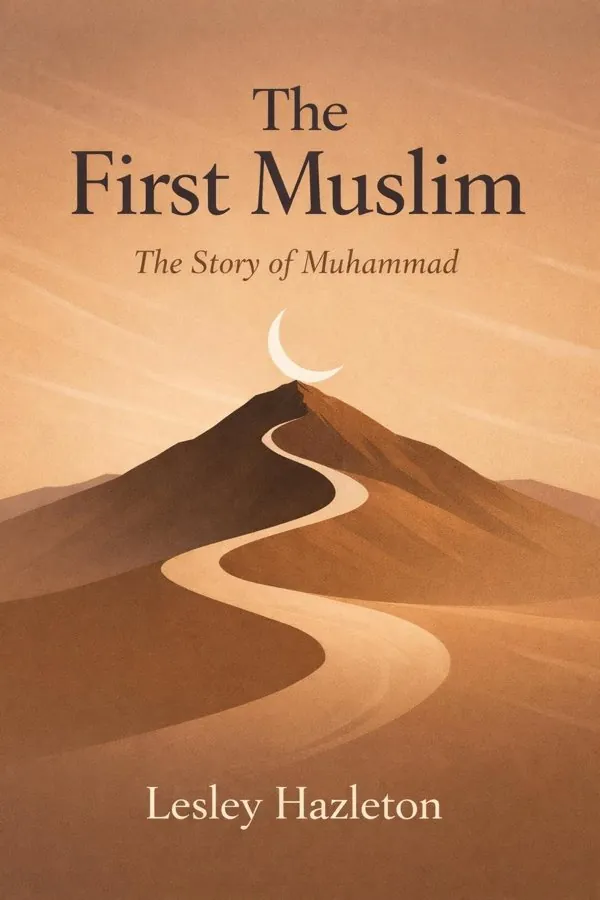
The First Muslim: The Story of Muhammad: Summary & Key Insights
 10 min13 chaptersAudio available
What Is The First Muslim: The Story of Muhammad About?
The First Muslim: The Story of Muhammad by Lesley Hazleton is a world_history book spanning 13 pages. This book presents a vivid and deeply researched narrative of the life of Muhammad, the founder of Islam. Lesley Hazleton explores his journey from obscurity to leadership, portraying him as a complex and human figure navigating faith, politics, and personal struggle. The work situates Muhammad within his historical and cultural context, offering readers a balanced and accessible account of his life and legacy.
This FizzRead summary covers all 13 key chapters of The First Muslim: The Story of Muhammad in approximately 10 minutes, distilling the most important ideas, arguments, and takeaways from Lesley Hazleton's work. Also available as an audio summary and Key Quotes Podcast.
The First Muslim: The Story of Muhammad
This book presents a vivid and deeply researched narrative of the life of Muhammad, the founder of Islam. Lesley Hazleton explores his journey from obscurity to leadership, portraying him as a complex and human figure navigating faith, politics, and personal struggle. The work situates Muhammad within his historical and cultural context, offering readers a balanced and accessible account of his life and legacy.
Who Should Read The First Muslim: The Story of Muhammad?
This book is perfect for anyone interested in world_history and looking to gain actionable insights in a short read. Whether you're a student, professional, or lifelong learner, the key ideas from The First Muslim: The Story of Muhammad by Lesley Hazleton will help you think differently.
- ✓Readers who enjoy world_history and want practical takeaways
- ✓Professionals looking to apply new ideas to their work and life
- ✓Anyone who wants the core insights of The First Muslim: The Story of Muhammad in just 10 minutes
Want the full summary?
Get instant access to this book summary and 100K+ more with Fizz Moment.
Get Free SummaryAvailable on App Store • Free to download
Key Chapters
Before Muhammad first uttered the name of God as revealed to him, Arabia was a mosaic of tribes tied together by fragile alliances and fierce enmities. The Mecca of the sixth century was not merely a desert outpost—it was a hub of trade connecting the rich spice routes from Yemen to the Byzantine and Persian empires. Yet beneath that wealth lay a social fabric woven by hierarchy and honor. Each tribe pledged loyalty to its own lineage. Justice was tied to vengeance, and morality to reputation.
The Kaaba, the cubic shrine at the heart of Mecca, symbolized unity in diversity—it housed idols from dozens of tribes, each representing its own god. Religion was polytheistic, but not without an awareness of a single, distant creator—a god acknowledged as remote and unknowable. It was a world in which the sacred and the pragmatic intertwined, where clan protection determined survival, and superstition dictated much of daily life.
Into this setting, Muhammad would later introduce a message that seemed almost incomprehensible: a God beyond tribe, beyond idol, beyond the transactional rules of Meccan society. But to comprehend the magnitude of his revolution, one must see how completely his world was defined by the opposite. Mecca was built on trade and tribal pride; Muhammad’s revelation would challenge both, demanding integrity over profit, divine accountability over inherited status. This was the soil in which the seed of Islam would take root, and it was anything but easy ground.
Muhammad was born into the Hashim clan of the Quraysh tribe around 570 CE, a child already touched by loss. His father Abdullah had died before his birth, and his mother Amina passed away when he was only six. Orphanhood meant vulnerability, but it also bred a deep sense of independence. Taken in by his grandfather and later by his uncle Abu Talib, Muhammad grew up amid the caravans that carried Mecca’s fortunes across the desert.
From these early years came his reputation as al-Amin—the trustworthy one. He was not distinguished by wealth or physical dominance but by a quiet integrity that earned the respect of those around him. Hazleton frames these formative years as essential to understanding his later resilience: a boy deprived of security learns early to find stability within himself; a young man who witnesses inequality learns the ache for justice.
In his travels as a merchant, Muhammad encountered diverse faiths—Judaism, Christianity, and Zoroastrianism—each carrying echoes of monotheism that would later resonate in his own revelation. But those influences were not direct transmissions; rather, they formed a backdrop, shaping his awareness that the divine could be both transcendent and imminent. He was, above all, a seeker without a name for what he sought.
+ 11 more chapters — available in the FizzRead app
All Chapters in The First Muslim: The Story of Muhammad
About the Author
Lesley Hazleton is a British-American writer known for her works on religion, politics, and history. A former psychologist and journalist, she has written several acclaimed books exploring the intersections of faith and human experience, including 'After the Prophet' and 'Agnostic: A Spirited Manifesto'.
Get This Summary in Your Preferred Format
Read or listen to the The First Muslim: The Story of Muhammad summary by Lesley Hazleton anytime, anywhere. FizzRead offers multiple formats so you can learn on your terms — all free.
Available formats: App · Audio · PDF · EPUB — All included free with FizzRead
Download The First Muslim: The Story of Muhammad PDF and EPUB Summary
Key Quotes from The First Muslim: The Story of Muhammad
“Before Muhammad first uttered the name of God as revealed to him, Arabia was a mosaic of tribes tied together by fragile alliances and fierce enmities.”
“Muhammad was born into the Hashim clan of the Quraysh tribe around 570 CE, a child already touched by loss.”
Frequently Asked Questions about The First Muslim: The Story of Muhammad
The First Muslim: The Story of Muhammad by Lesley Hazleton is a world_history book that explores key ideas across 13 chapters. This book presents a vivid and deeply researched narrative of the life of Muhammad, the founder of Islam. Lesley Hazleton explores his journey from obscurity to leadership, portraying him as a complex and human figure navigating faith, politics, and personal struggle. The work situates Muhammad within his historical and cultural context, offering readers a balanced and accessible account of his life and legacy.
You Might Also Like
The Age of Capital
Eric Hobsbawm
10 min
The Gulag Archipelago
Aleksandr Solzhenitsyn
10 min
Jerusalem: The Biography
Simon Sebag Montefiore
10 min
The Anglo-Saxons
James Campbell
10 min
The Boer War
Thomas Pakenham
10 min
The Industrial Revolutionaries: The Making of the Modern World 1776–1914
Gavin Weightman
10 minBrowse by Category
Ready to read The First Muslim: The Story of Muhammad?
Get the full summary and 100K+ more books with Fizz Moment.