
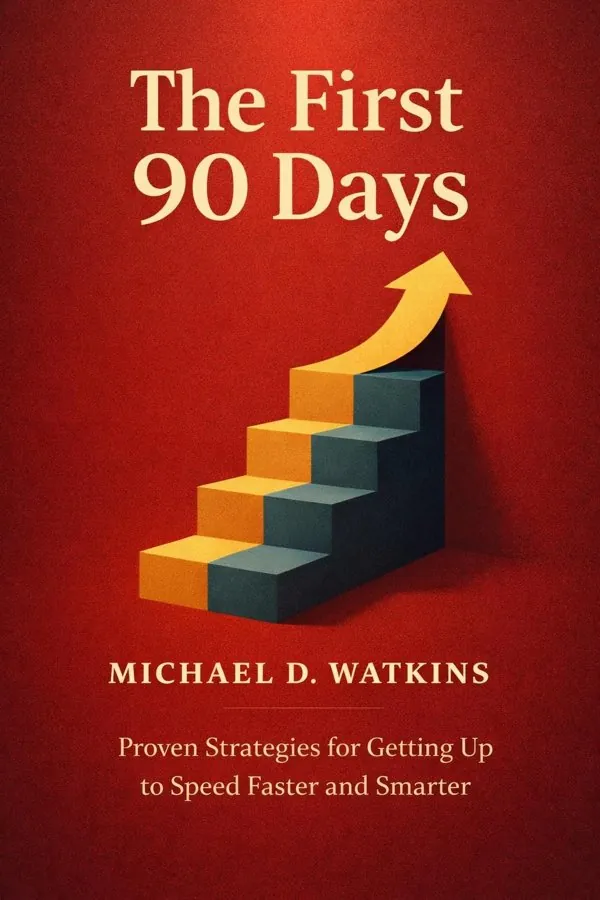
The First 90 Days: Summary & Key Insights
 10 min10 chaptersAudio available
Key Takeaways from The First 90 Days
A new role does not just change your responsibilities; it demands a new identity.
In transitions, the leaders who look decisive too early often become decisively wrong.
Not all transitions are created equal.
Early wins matter because organizations are always judging whether a new leader can deliver.
Few factors influence transition success more than the relationship with your boss.
What Is The First 90 Days About?
The First 90 Days by Michael Watkins is a business book published in 2013 spanning 10 pages. The First 90 Days is a practical leadership guide about one of the most dangerous and decisive moments in any career: stepping into a new role. Michael Watkins argues that transitions are not passive events to be endured but strategic opportunities to be managed. Whether you are becoming a first-time manager, taking over a struggling team, moving into a bigger executive role, or joining a new company, your earliest choices shape your credibility, momentum, and long-term results. The book shows how to learn faster, avoid predictable mistakes, build trust with your boss and team, and deliver early progress without rushing blindly into action. Its central insight is simple but powerful: leaders who approach transitions systematically dramatically improve their odds of success. Watkins writes with unusual authority. As a professor of leadership and organizational change and a trusted adviser to senior executives, he combines research, real-world cases, and highly actionable frameworks. That is why this book has become a modern classic for managers and executives who want to lead well from day one.
This FizzRead summary covers all 10 key chapters of The First 90 Days in approximately 10 minutes, distilling the most important ideas, arguments, and takeaways from Michael Watkins's work. Also available as an audio summary and Key Quotes Podcast.
The First 90 Days
The First 90 Days is a practical leadership guide about one of the most dangerous and decisive moments in any career: stepping into a new role. Michael Watkins argues that transitions are not passive events to be endured but strategic opportunities to be managed. Whether you are becoming a first-time manager, taking over a struggling team, moving into a bigger executive role, or joining a new company, your earliest choices shape your credibility, momentum, and long-term results. The book shows how to learn faster, avoid predictable mistakes, build trust with your boss and team, and deliver early progress without rushing blindly into action. Its central insight is simple but powerful: leaders who approach transitions systematically dramatically improve their odds of success. Watkins writes with unusual authority. As a professor of leadership and organizational change and a trusted adviser to senior executives, he combines research, real-world cases, and highly actionable frameworks. That is why this book has become a modern classic for managers and executives who want to lead well from day one.
Who Should Read The First 90 Days?
This book is perfect for anyone interested in business and looking to gain actionable insights in a short read. Whether you're a student, professional, or lifelong learner, the key ideas from The First 90 Days by Michael Watkins will help you think differently.
- ✓Readers who enjoy business and want practical takeaways
- ✓Professionals looking to apply new ideas to their work and life
- ✓Anyone who wants the core insights of The First 90 Days in just 10 minutes
Want the full summary?
Get instant access to this book summary and 100K+ more with Fizz Moment.
Get Free SummaryAvailable on App Store • Free to download
Key Chapters
A new role does not just change your responsibilities; it demands a new identity. One of Watkins’s most important insights is that many capable professionals fail in transitions because they keep solving the wrong problem. They continue to act like star individual contributors when the job now requires them to create results through others. This is the internal promotion that matters most: promoting yourself psychologically from expert to leader.
That shift includes several changes. You must stop measuring your value only by personal output and start measuring it by team performance. You must spend less time diving into every detail and more time setting direction, clarifying priorities, coaching people, and creating accountability. You also need to become comfortable making decisions with incomplete information, because leadership rarely gives you the certainty that technical work once did.
Imagine a top salesperson promoted to sales manager. If she keeps closing all the major deals herself, the team may still underperform because she is not building capability, refining process, or creating consistency. Likewise, a brilliant engineer turned department head can stall if he keeps solving technical problems personally instead of aligning people and removing barriers.
This shift can feel uncomfortable because it requires letting go of what made you successful before. Yet clinging to old habits is often what causes new leaders to fail. The discipline is to ask, every week, “What can only I do in this role?” Then spend more time there.
Actionable takeaway: Write two lists: tasks that reflect your old role and responsibilities that define your new one. Consciously delegate, drop, or reduce the first list so you can lead from the second.
In transitions, the leaders who look decisive too early often become decisively wrong. Watkins emphasizes that learning is your first strategic responsibility. Before you can improve performance, you need a fast, structured understanding of the organization’s business, culture, systems, and politics. Speed matters, but so does humility.
Accelerated learning means gathering insight from multiple angles. Study the formal side: goals, metrics, processes, organizational charts, budgets, and strategy documents. Then study the informal side: who influences decisions, where trust is strong or weak, how conflict is handled, and which unwritten rules really govern behavior. Ask people what is working, what is broken, what they would change, and what they wish newcomers understood sooner.
A useful approach is to divide your questions into technical, cultural, and political categories. Technical questions clarify how work gets done. Cultural questions reveal values and norms. Political questions show where power sits and how decisions move. For example, a newly hired operations leader may discover that official processes say one thing, but real approvals depend on a long-tenured informal gatekeeper. Without that knowledge, even good plans can stall.
Learning also requires listening strategically. Meet customers, peers, direct reports, support functions, and your boss. Patterns matter more than isolated comments. When several people describe the same bottleneck differently, you are getting close to the truth.
Actionable takeaway: Build a 30-day learning agenda with a standard set of interview questions, a stakeholder map, and a short weekly memo capturing what you are learning about strategy, culture, and power.
Not all transitions are created equal. A leader entering a thriving business needs a different playbook than one inheriting a crisis. Watkins’s STARS model helps diagnose the situation so you can match your actions to reality rather than to your preferences. The five situations are Startup, Turnaround, Accelerated Growth, Realignment, and Sustaining Success.
In a Startup, the challenge is building from scratch: defining structure, hiring fast, and creating early discipline without crushing agility. In a Turnaround, urgency dominates. Cash, morale, credibility, and hard decisions usually come first. In Accelerated Growth, demand may be strong but systems, people, and processes are lagging behind. In Realignment, the organization may appear healthy on the surface, yet hidden misalignment or complacency threatens future performance. In Sustaining Success, the task is to preserve what works while spotting threats and avoiding arrogance.
Misdiagnosis is costly. If you treat a Turnaround like a Sustaining Success situation, you move too slowly. If you treat Sustaining Success like a Turnaround, you can break what is already working and alienate people unnecessarily. Consider a new division head who announces sweeping restructuring before understanding whether the unit is truly failing or simply misaligned. That kind of overreaction can destroy trust.
The STARS model also helps you set expectations with your boss and team. It gives language to discuss pace, priorities, and likely resistance. Most roles include elements of more than one STARS category, but clarifying the dominant one sharpens decision-making.
Actionable takeaway: Diagnose your role using STARS, identify the risks specific to that situation, and adjust your first-90-day priorities, communication style, and appetite for change accordingly.
Early wins matter because organizations are always judging whether a new leader can deliver. But Watkins makes an important distinction: not every quick result is a meaningful win. Smart early wins are visible, relevant, and connected to the broader business challenge. They build credibility, create momentum, and signal how you lead.
A strong early win solves a real problem that people care about. It should be difficult enough to matter but achievable enough to produce progress in the near term. It should also reinforce your long-term agenda rather than distract from it. For example, a customer support leader might quickly reduce backlog by redesigning handoffs and clarifying escalation rules. That improves service, boosts morale, and demonstrates operational discipline. By contrast, changing office layouts or launching a cosmetic initiative may generate activity without trust.
Early wins are also social achievements. People support leaders who help them succeed. If your early actions make key stakeholders look better, remove friction for the team, or resolve a known pain point, you earn political capital. However, early wins become dangerous when they are achieved by blaming predecessors, making flashy announcements, or forcing reckless change before understanding root causes.
The best early wins are chosen deliberately. Watkins suggests thinking in waves: stabilize where needed, solve a few visible issues, and connect those results to a coherent story about the future. The message should be, “We understand the challenge, we can make progress, and there is a plan.”
Actionable takeaway: Identify two to three early-win opportunities that are highly visible, aligned with your mandate, and realistically achievable within 60 to 90 days, then communicate both the result and the larger logic behind it.
Few factors influence transition success more than the relationship with your boss. Watkins argues that new leaders often assume expectations are obvious when in fact they are vague, conflicting, or incomplete. The result is avoidable disappointment. To succeed, you must actively negotiate success rather than passively hope to discover it.
This starts with understanding your boss’s priorities, pressures, communication style, and decision preferences. What does success look like in the first 30, 60, and 90 days? Which problems feel urgent? How much detail does your boss want? What political constraints exist? Are there sacred cows you need to understand before acting? New leaders should seek clarity not only on objectives but also on process: how often to meet, what information to provide, and how disagreements should be handled.
Different bosses require different management approaches. Some are hands-on and data-driven. Others want synthesis, not detail. Some value loyalty and caution; others reward speed and experimentation. Imagine a manager who gives her boss long analytical updates when the boss really wants concise options and recommendations. Misalignment like this can create frustration even when the underlying work is strong.
The relationship is not about pleasing the boss at all costs. It is about building a productive partnership. That includes bringing problems early, avoiding surprises, and framing requests in terms of business impact. It also means testing assumptions rather than guessing.
Actionable takeaway: Schedule regular check-ins with your boss, agree on top priorities and success metrics, ask how they prefer to receive information, and revisit expectations after your first month as your understanding deepens.
Leadership transitions are not only about people; they are also about fit. Watkins stresses that performance depends on alignment among strategy, structure, systems, skills, and culture. When these elements pull in different directions, even talented teams struggle. New leaders must therefore look beyond symptoms and assess whether the organization is truly set up to execute.
Suppose a company says innovation is a top priority, but its budgeting process punishes experimentation, its incentives reward short-term efficiency, and decision-making is centralized in ways that slow new ideas. The issue is not a lack of motivational speeches. The issue is misalignment. Or imagine a service organization that promises fast response times while staffing models and handoff systems make speed impossible. In such cases, coaching individuals will not solve a structural problem.
Watkins encourages leaders to diagnose alignment across several dimensions. Is the strategy clear and shared? Does the structure support that strategy? Do systems such as planning, reporting, incentives, and talent processes reinforce desired behavior? Does the team have the right capabilities? Are cultural norms helping or hindering execution? Often, one or two leverage points create outsized impact.
New leaders sometimes rush to reorganize because it feels decisive. But structural change should serve strategic clarity, not substitute for it. The better sequence is to understand the core mission, identify where friction lives, and make targeted adjustments that help the organization do its most important work better.
Actionable takeaway: Conduct an alignment audit by reviewing strategy, roles, incentives, processes, and capabilities, then identify the two biggest mismatches blocking performance and address those first.
A transition is ultimately a test of collective capability. Watkins highlights that new leaders inherit teams they did not choose, and one of their earliest responsibilities is to assess whether the existing group can execute the mission ahead. This requires judgment, fairness, and speed. Waiting too long to address serious talent gaps can damage your credibility and delay progress.
Team assessment is more than asking who seems smart or supportive. You need to evaluate competence, judgment, energy, reliability, cultural influence, and fit with the future direction. Some people are strong performers in stable environments but struggle in growth or turnaround settings. Others may have hidden potential that previous leaders overlooked. Distinguishing between performance issues, role misfit, and weak management is crucial.
Watkins advises leaders to make personnel decisions based on evidence, not first impressions alone. Structured conversations, performance history, peer input, and observed behavior all matter. A useful framework is to ask: keep in role, move to a better-fit role, develop aggressively, or exit. For example, a finance leader entering a scaling business may discover that a long-trusted controller is dependable but overwhelmed by the complexity of growth. The right answer might be support or reassignment, not immediate removal.
The team you build also signals what you value. If you tolerate chronic underperformance, people notice. If you reward candor, accountability, and collaboration, people notice that too. Team decisions shape culture quickly.
Actionable takeaway: In your first 60 days, assess each direct report against future needs, document your conclusions, and make at least one clear decision to strengthen the team where the gap is most consequential.
No leader succeeds alone, especially in complex organizations. Watkins reminds readers that authority on paper is never enough. Real influence depends on coalitions: the network of peers, sponsors, informal influencers, and cross-functional allies who help ideas move and resistance soften. New leaders who ignore this political reality often discover that good plans die in silence.
Building coalitions begins with mapping stakeholders. Who must agree, support, or at least not obstruct your agenda? Who controls resources, information, expertise, or access? Who has informal credibility with the people you need to influence? Political skill here does not mean manipulation. It means understanding interests, cultivating trust, and creating mutually beneficial alignment.
For example, a new product leader may need support from engineering, finance, marketing, legal, and sales. If she only builds a relationship with her own team, the initiative may fail in execution. But if she learns each function’s concerns, addresses trade-offs openly, and finds areas of shared gain, she can turn fragmented interests into coordinated action.
Coalitions are built through consistency and reciprocity. Help others solve problems. Share credit. Avoid surprising people whose support you need. Listen before selling. Also identify likely resistors early. Opposition is often rooted not in bad intent but in risk, status concerns, or competing incentives. When you understand the source, you can respond more intelligently.
Actionable takeaway: Create a stakeholder influence map with supporters, neutrals, and resistors, then invest each week in strengthening relationships with the three people outside your team whose backing matters most.
Transitions are dangerous not only because of external complexity but because they distort the leader internally. Watkins notes that new roles often bring overload, uncertainty, visibility, and isolation all at once. Under that pressure, leaders become reactive, narrow their perspective, and make worse decisions. Sustained effectiveness therefore depends on maintaining personal balance.
Balance has practical dimensions. You need disciplined time management so urgent requests do not crowd out strategic thinking. You need emotional regulation so anxiety does not leak into your communication. You need trusted advisers who can challenge your assumptions, because transition stress can make you overconfident or overly cautious. You also need recovery: sleep, exercise, reflection, and boundaries that preserve judgment.
A common trap is trying to prove yourself by saying yes to everything. A newly promoted executive may fill every hour with meetings, answer every email instantly, and personally intervene in every issue. The result is exhaustion and poor prioritization. Another trap is social isolation. Because leaders fear appearing uncertain, they stop asking for help precisely when they need perspective most.
Watkins argues that managing yourself is part of managing the transition. The more pressure you face, the more intentional your routines must become. Even brief habits matter: reviewing priorities every morning, scheduling thinking time, debriefing difficult meetings, and maintaining a support network.
Actionable takeaway: Protect one weekly block for reflection and planning, establish two trusted sounding boards, and identify one habit of overextension you will deliberately stop during your first 90 days.
One of the book’s most forward-looking ideas is that transition management should become an organizational capability, not just a personal survival skill. Once leaders understand how fragile role changes can be, they should help others transition more effectively. Doing so multiplies performance and reduces the costly failures that often follow promotions, restructurings, and new hires.
Every time someone moves into a new role, the same risks appear: unclear expectations, slow learning, weak stakeholder relationships, and inherited assumptions from the previous job. Managers can reduce these risks by offering structured onboarding, clarifying priorities early, identifying key relationships, and coaching people through the mindset shifts their new role requires.
Consider a fast-growing company that promotes high performers into management without support. Some will succeed by instinct, but many will struggle with delegation, conflict, and strategic focus. If senior leaders use Watkins’s principles to guide these promotions, they can shorten learning curves and build a stronger leadership bench. The same applies to mergers, reorganizations, and international assignments.
This final idea broadens the message of the book. The first 90 days are not only about individual success; they are about institutionalizing better leadership transitions across the organization. Companies that do this create continuity, reduce disruption, and develop leaders faster.
Actionable takeaway: Use the book’s frameworks to create a transition playbook for your team or company, including role expectations, stakeholder maps, learning plans, and milestone check-ins for every major new assignment.
All Chapters in The First 90 Days
About the Author
Michael D. Watkins is a leading expert on leadership transitions, organizational change, and executive onboarding. He is a professor of leadership and organizational change at IMD Business School and a co-founder of Genesis Advisers, a consultancy that helps senior leaders and organizations manage critical career transitions. Over the course of his career, Watkins has advised executives across industries on how to enter new roles, lead change, and avoid the common mistakes that derail performance early. His work is known for combining academic rigor with practical, field-tested frameworks that leaders can use immediately. Through his writing, teaching, and consulting, he has become one of the most trusted voices on how managers and executives can accelerate their success during high-stakes professional transitions.
Get This Summary in Your Preferred Format
Read or listen to the The First 90 Days summary by Michael Watkins anytime, anywhere. FizzRead offers multiple formats so you can learn on your terms — all free.
Available formats: App · Audio · PDF · EPUB — All included free with FizzRead
Download The First 90 Days PDF and EPUB Summary
Key Quotes from The First 90 Days
“A new role does not just change your responsibilities; it demands a new identity.”
“In transitions, the leaders who look decisive too early often become decisively wrong.”
“A leader entering a thriving business needs a different playbook than one inheriting a crisis.”
“Early wins matter because organizations are always judging whether a new leader can deliver.”
“Few factors influence transition success more than the relationship with your boss.”
Frequently Asked Questions about The First 90 Days
The First 90 Days by Michael Watkins is a business book that explores key ideas across 10 chapters. The First 90 Days is a practical leadership guide about one of the most dangerous and decisive moments in any career: stepping into a new role. Michael Watkins argues that transitions are not passive events to be endured but strategic opportunities to be managed. Whether you are becoming a first-time manager, taking over a struggling team, moving into a bigger executive role, or joining a new company, your earliest choices shape your credibility, momentum, and long-term results. The book shows how to learn faster, avoid predictable mistakes, build trust with your boss and team, and deliver early progress without rushing blindly into action. Its central insight is simple but powerful: leaders who approach transitions systematically dramatically improve their odds of success. Watkins writes with unusual authority. As a professor of leadership and organizational change and a trusted adviser to senior executives, he combines research, real-world cases, and highly actionable frameworks. That is why this book has become a modern classic for managers and executives who want to lead well from day one.
Compare The First 90 Days

You Might Also Like





Featured In
Browse by Category
Ready to read The First 90 Days?
Get the full summary and 100K+ more books with Fizz Moment.