
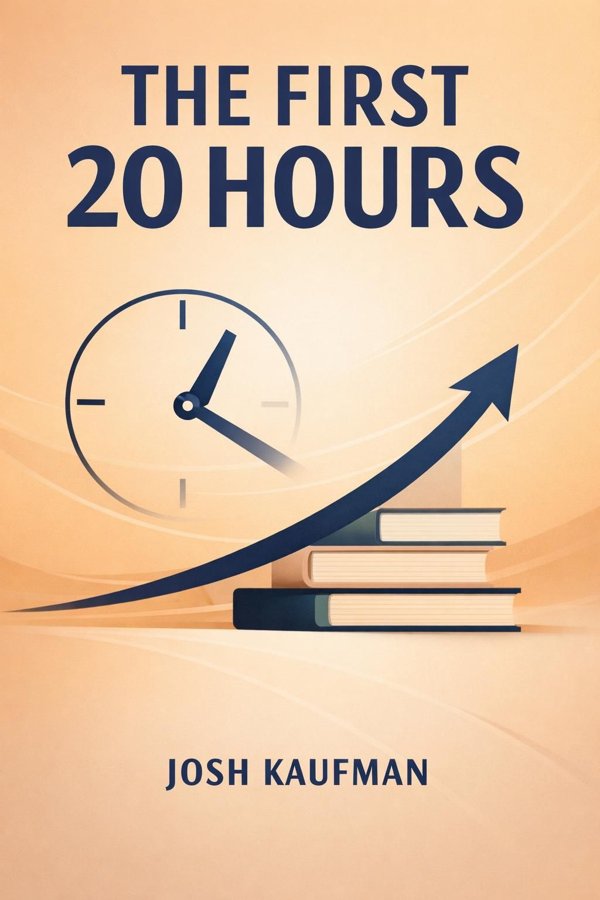
The First 20 Hours: How to Learn Anything... Fast!: Summary & Key Insights
by Josh Kaufman
 10 min9 chaptersAudio available
Key Takeaways from The First 20 Hours: How to Learn Anything... Fast!
The hardest part of learning is not advanced performance; it is surviving the beginning.
Mastery takes a long time, but usefulness arrives much earlier.
Learning becomes faster when the goal is specific.
Every impressive skill looks mysterious until you break it apart.
Research can help you learn, but too much research can become a sophisticated form of procrastination.
What Is The First 20 Hours: How to Learn Anything... Fast! About?
The First 20 Hours: How to Learn Anything... Fast! by Josh Kaufman is a productivity book spanning 12 pages. What if the biggest obstacle to learning something new is not lack of talent, time, or intelligence, but simply our willingness to endure the awkward beginning? In The First 20 Hours, Josh Kaufman argues that most people give up on new skills not because they are incapable, but because the earliest phase of learning feels painfully inefficient. His solution is refreshingly practical: instead of chasing mastery, aim for rapid skill acquisition. With about twenty hours of focused, deliberate effort, Kaufman claims, you can move from complete incompetence to surprisingly solid performance in almost any skill. The book matters because modern life rewards adaptability. Whether you want to learn a language, code, play an instrument, cook better meals, or pick up a sport, the ability to learn quickly has become a competitive advantage. Kaufman blends cognitive psychology, productivity thinking, and personal experimentation to create a clear, usable system. Best known for The Personal MBA, he brings the same research-driven, no-nonsense style here. The result is a motivating guide for anyone who wants to stop postponing learning and start making real progress now.
This FizzRead summary covers all 9 key chapters of The First 20 Hours: How to Learn Anything... Fast! in approximately 10 minutes, distilling the most important ideas, arguments, and takeaways from Josh Kaufman's work. Also available as an audio summary and Key Quotes Podcast.
The First 20 Hours: How to Learn Anything... Fast!
What if the biggest obstacle to learning something new is not lack of talent, time, or intelligence, but simply our willingness to endure the awkward beginning? In The First 20 Hours, Josh Kaufman argues that most people give up on new skills not because they are incapable, but because the earliest phase of learning feels painfully inefficient. His solution is refreshingly practical: instead of chasing mastery, aim for rapid skill acquisition. With about twenty hours of focused, deliberate effort, Kaufman claims, you can move from complete incompetence to surprisingly solid performance in almost any skill.
The book matters because modern life rewards adaptability. Whether you want to learn a language, code, play an instrument, cook better meals, or pick up a sport, the ability to learn quickly has become a competitive advantage. Kaufman blends cognitive psychology, productivity thinking, and personal experimentation to create a clear, usable system. Best known for The Personal MBA, he brings the same research-driven, no-nonsense style here. The result is a motivating guide for anyone who wants to stop postponing learning and start making real progress now.
Who Should Read The First 20 Hours: How to Learn Anything... Fast!?
This book is perfect for anyone interested in productivity and looking to gain actionable insights in a short read. Whether you're a student, professional, or lifelong learner, the key ideas from The First 20 Hours: How to Learn Anything... Fast! by Josh Kaufman will help you think differently.
- ✓Readers who enjoy productivity and want practical takeaways
- ✓Professionals looking to apply new ideas to their work and life
- ✓Anyone who wants the core insights of The First 20 Hours: How to Learn Anything... Fast! in just 10 minutes
Want the full summary?
Get instant access to this book summary and 100K+ more with Fizz Moment.
Get Free SummaryAvailable on App Store • Free to download
Key Chapters
The hardest part of learning is not advanced performance; it is surviving the beginning. Kaufman emphasizes that the first few hours of any new skill feel clumsy, slow, and emotionally uncomfortable. This is the frustration barrier, the psychological wall that appears when your expectations are high but your ability is still low. Many people interpret this discomfort as evidence that they lack talent, when in reality it is a normal stage of the process.
This insight matters because it reframes early struggle. If you expect instant competence, every mistake feels like failure. But if you understand that confusion and awkwardness are built into learning, you stop taking those moments personally. Think of a beginner learning yoga, guitar, or programming. The poses feel unnatural, the fingers hurt, the code breaks. None of that means the person is bad at the skill. It means they are exactly where beginners are supposed to be.
Kaufman’s larger point is that emotional resistance, not intellectual difficulty, is often what stops progress. That is why motivation alone is unreliable. You need a structure that gets you through the ugly early phase before improvement becomes rewarding. Once you cross that threshold, learning tends to feel more engaging because your efforts start producing visible results.
A practical way to use this idea is to plan for frustration instead of hoping to avoid it. Tell yourself in advance that the first sessions will be messy. Lower the emotional stakes. Focus on showing up, making mistakes, and logging practice time rather than judging performance too soon. Actionable takeaway: when you begin any new skill, expect discomfort for the first few hours and treat it as proof that learning has started, not as a sign to quit.
Mastery takes a long time, but usefulness arrives much earlier. One of Kaufman’s most powerful distinctions is between mastering a skill and becoming good enough to enjoy and use it. The popular idea that expertise requires ten thousand hours can discourage people from starting at all. Kaufman is not arguing against mastery; he is arguing that most real-life goals do not require it. If your aim is to cook edible meals, hold a basic conversation, play simple songs, or build a small website, you do not need years of work before you can benefit.
His core claim is that around twenty hours of deliberate practice is often enough to reach a level of competence that feels rewarding. This estimate works because the biggest gains usually happen early. In many skills, improvement is steep at the beginning: each hour teaches you techniques, patterns, and corrections that dramatically raise your performance. The point is not perfection; the point is functional ability.
Consider someone who wants to learn touch typing. In the first twenty hours, they may not become exceptionally fast, but they can become much more accurate and comfortable, which already transforms daily work. Or take drawing: after twenty focused hours, a beginner may not produce gallery-worthy art, but can understand proportion, shading, and observation well enough to make visible progress.
This perspective is liberating because it makes learning approachable. You do not have to commit your life to a skill before getting value from it. You only have to commit to a manageable starter investment. Actionable takeaway: choose a skill you want to use, not master, and schedule your first twenty hours as a concrete experiment in becoming good enough rather than perfect.
Learning becomes faster when the goal is specific. Kaufman warns that vague ambitions such as “learn music,” “get fit,” or “study coding” create confusion because they hide what success actually looks like. Rapid skill acquisition works best when you define a target performance. The clearer the target, the easier it is to decide what to practice, what to ignore, and how to measure progress.
This is why selecting a skill is more than picking a broad interest. You need a concrete project connected to something you genuinely care about. Instead of “learn Spanish,” a better goal might be “hold a ten-minute conversation during my trip.” Instead of “learn photography,” it could be “take strong portraits in natural light.” The project gives the learning process emotional energy and strategic focus.
Kaufman also argues that enthusiasm matters. The more meaningful the skill feels, the easier it is to return to practice when motivation dips. A parent may stay committed to cooking because it improves family health. A freelancer may learn Excel because it saves hours at work. A musician may learn music theory because it unlocks better songwriting. Purpose turns effort into investment.
This principle also prevents overwhelm. Once a skill is defined narrowly, the number of relevant subskills shrinks. You stop drowning in information and start building exactly what the project requires. That is one reason rapid learning feels possible: you are not learning everything about a field, only what supports a particular result.
Actionable takeaway: before starting, write one sentence that defines the exact skill and the result you want, such as “I want to learn basic video editing well enough to publish short YouTube videos within one month.”
Every impressive skill looks mysterious until you break it apart. Kaufman insists that most complex abilities are bundles of smaller, learnable components. When people say a skill feels overwhelming, they are often trying to absorb the whole thing at once. Deconstruction solves that problem by identifying the subskills, techniques, and decisions that actually drive performance.
For example, “playing the guitar” includes tuning, chord transitions, strumming rhythm, hand positioning, reading simple diagrams, and maintaining timing. “Public speaking” includes structuring ideas, vocal delivery, body language, pacing, and audience awareness. Once these pieces are visible, the skill becomes less intimidating and much easier to practice intelligently.
This approach also helps you find the critical few elements that matter most at the beginning. Not every subskill deserves equal attention. A beginner cook may benefit more from knife safety, heat control, and seasoning than from complicated plating techniques. A beginner coder may need variables, loops, debugging, and basic logic before learning advanced frameworks. By identifying what creates the biggest payoff, you make the first twenty hours count.
Deconstruction turns learning from a foggy aspiration into a practical map. It reveals where to start, what sequence makes sense, and which parts can safely wait. It also gives you a more accurate way to track progress because improvement becomes visible in specific components.
A useful method is to list the major parts of the skill, then mark which ones are essential for your target performance. Focus your early practice on those high-leverage subskills. Actionable takeaway: spend thirty minutes breaking your chosen skill into parts, then choose the three to five subskills most likely to produce quick, meaningful gains.
Research can help you learn, but too much research can become a sophisticated form of procrastination. Kaufman distinguishes between effective learning and endless preparation. Before practice begins, you do need enough background knowledge to avoid confusion and major mistakes. But after that point, continuing to consume books, videos, and tutorials often creates the illusion of progress without the reality of skill.
The goal of early learning is to identify mental models, tools, and methods that make practice productive. This might mean watching a concise tutorial, reading a beginner guide, or asking an expert for common pitfalls. If you are learning chess, you may need to understand how pieces move and a few simple principles. If you are learning meditation, you may need basic posture, breathing, and attention instructions. If you are learning spreadsheets, you may need formulas, formatting, and navigation shortcuts.
What matters is stopping information intake once you can begin. Many learners never cross that line. They keep collecting resources because it feels safer than trying. But skill depends on performance, not familiarity. You do not learn swimming from studying water physics, and you do not learn design by endlessly admiring other people’s work. You learn by trying, adjusting, and repeating.
Kaufman’s advice is to gather just enough knowledge to self-correct during practice. This balance prevents costly errors while preserving momentum. It also keeps the process grounded in outcomes. Actionable takeaway: limit your initial research to a small set of high-quality resources, extract the basics you need to begin, and start practicing as soon as you can perform the simplest version of the skill.
Good intentions fail in bad systems. Kaufman shows that one of the fastest ways to improve learning is to reduce the friction between deciding to practice and actually practicing. If your tools are scattered, your setup is inconvenient, or distractions are everywhere, each session requires extra willpower. Over time, that friction kills consistency.
This is why obtaining tools and resources matters, but only in the right way. You do not need premium equipment to begin; you need enough equipment to practice reliably. A beginner runner needs shoes and a route, not elite gear. A beginner artist needs paper, pencils, and a place to work. A language learner needs a speaking partner, flashcards, and regular listening practice, not an expensive library of courses. The objective is readiness, not perfection.
Kaufman also emphasizes eliminating barriers to practice. That can mean turning off notifications, blocking social media, laying out your materials in advance, or choosing a regular time when your energy is highest. It may also mean dealing with internal barriers such as fear of embarrassment, perfectionism, or unrealistic expectations. A person learning to sing might practice privately first. A person learning to code may choose tiny exercises to reduce the fear of failure.
Environment design is powerful because it makes the desired behavior easier than avoidance. When your guitar is visible, your software is installed, your calendar is reserved, and your phone is away, practice becomes the path of least resistance.
Actionable takeaway: create a practice setup before you begin your twenty hours by gathering only essential tools, removing likely distractions, and making the first five minutes of each session effortless.
Time alone does not guarantee improvement; the quality of attention matters. Kaufman defines practice as focused effort aimed at improving performance. That sounds obvious, but many learners confuse repetition with progress. Simply doing something again and again without feedback, challenge, or awareness can reinforce mistakes just as easily as it builds skill.
Deliberate practice requires several ingredients. First, you must know what you are trying to improve. Second, the task must be difficult enough to stretch you without being impossible. Third, you must receive information about what worked and what did not. Finally, you need repetition with adjustment, not repetition on autopilot.
Take typing as an example. Mindlessly typing emails will not increase speed as quickly as working on targeted drills for common letter combinations and posture. In tennis, casual play may be enjoyable, but focused work on serving mechanics and footwork creates faster gains. In writing, drafting alone helps, yet deliberately revising sentence clarity, structure, and transitions accelerates progress much more.
Kaufman also recommends precommitment, which means deciding in advance when and how you will practice. This matters because deliberate practice is mentally demanding. If you leave it to mood or spare time, it often does not happen. A precommitted plan such as one hour every weekday at 7 p.m. turns intention into behavior.
The larger lesson is that improvement is engineered, not wished into existence. Actionable takeaway: define a regular practice schedule, choose one specific aspect of the skill to improve in each session, and end by noting one correction to apply next time.
What gets noticed gets improved. Kaufman encourages learners to monitor progress because measurement transforms learning from a vague hope into a feedback system. Tracking does not need to be complex. In fact, simple metrics are often best because they are easy to maintain and directly tied to performance.
If you are learning a language, you might track minutes of conversation, number of new phrases used correctly, or your ability to understand short audio clips. If you are learning to cook, you could rate meals on taste, timing, and confidence with techniques. If you are learning coding, you might count solved exercises, completed features, or debugging time. The point is to observe reality so you can make better decisions.
Tracking serves two functions. First, it makes progress visible, which is motivating during the awkward middle period when improvement can feel slow. Second, it reveals where to adjust. Maybe your guitar practice is not working because you spend too much time reading about chords and too little time changing between them. Maybe your workout plan is inconsistent because your practice blocks are too long. Data exposes friction, weakness, and wasted effort.
Kaufman’s method is experimental rather than perfectionistic. You try, observe, and refine. This attitude keeps the process resilient. Instead of concluding “I am bad at this,” you ask “What variable should I change?” That shift protects motivation and speeds learning.
Actionable takeaway: pick one or two simple metrics for your skill, review them after each practice session, and make a small adjustment every few days based on what the evidence shows rather than how you feel.
People keep learning when progress feels real. Kaufman’s case studies throughout the book show that rapid skill acquisition is not just a theory but a process that becomes self-reinforcing once learners experience early success. Small wins matter because they reduce fear, increase confidence, and create the emotional reward needed to continue.
This is especially important after the initial excitement fades. In many projects, the first spark of motivation lasts only briefly. What sustains effort is momentum, and momentum usually grows from visible competence. When a ukulele beginner can play a recognizable song, when a yoga beginner can complete a sequence without confusion, or when a programmer can build a small working tool, the skill becomes personally meaningful. It shifts from abstract aspiration to lived capability.
Kaufman also demonstrates that adjustment is part of momentum. If a method is too hard, too boring, or too scattered, you revise it. Learning is not about rigidly following a perfect plan; it is about maintaining forward motion. Breaking sessions into shorter blocks, changing drills, seeking quick feedback, or revisiting fundamentals can all restore traction.
The deeper message is encouraging: competence is more accessible than people assume. The real challenge is not being gifted, but persisting long enough to get evidence that your effort is working. Once that evidence appears, motivation often follows naturally.
Actionable takeaway: design your first week of practice around quick, visible wins by choosing exercises that produce an obvious result, and celebrate those gains as proof that the process is working.
All Chapters in The First 20 Hours: How to Learn Anything... Fast!
About the Author
Josh Kaufman is an American author, researcher, and educator known for making complex subjects practical and accessible. He first became widely known through The Personal MBA, a bestselling book that helps readers build business knowledge through self-education rather than formal academic programs. Kaufman’s work focuses on skill acquisition, productivity, decision-making, and applied learning. Rather than emphasizing credentials or theory alone, he is known for testing ideas in real life and turning research into clear systems people can use immediately. In The First 20 Hours, he combines insights from psychology, behavior change, and personal experimentation to show how beginners can learn new skills quickly and effectively. His writing appeals to ambitious, self-directed readers who want practical frameworks for improving their work and everyday lives.
Get This Summary in Your Preferred Format
Read or listen to the The First 20 Hours: How to Learn Anything... Fast! summary by Josh Kaufman anytime, anywhere. FizzRead offers multiple formats so you can learn on your terms — all free.
Available formats: App · Audio · PDF · EPUB — All included free with FizzRead
Download The First 20 Hours: How to Learn Anything... Fast! PDF and EPUB Summary
Key Quotes from The First 20 Hours: How to Learn Anything... Fast!
“The hardest part of learning is not advanced performance; it is surviving the beginning.”
“Mastery takes a long time, but usefulness arrives much earlier.”
“Learning becomes faster when the goal is specific.”
“Every impressive skill looks mysterious until you break it apart.”
“Research can help you learn, but too much research can become a sophisticated form of procrastination.”
Frequently Asked Questions about The First 20 Hours: How to Learn Anything... Fast!
The First 20 Hours: How to Learn Anything... Fast! by Josh Kaufman is a productivity book that explores key ideas across 9 chapters. What if the biggest obstacle to learning something new is not lack of talent, time, or intelligence, but simply our willingness to endure the awkward beginning? In The First 20 Hours, Josh Kaufman argues that most people give up on new skills not because they are incapable, but because the earliest phase of learning feels painfully inefficient. His solution is refreshingly practical: instead of chasing mastery, aim for rapid skill acquisition. With about twenty hours of focused, deliberate effort, Kaufman claims, you can move from complete incompetence to surprisingly solid performance in almost any skill. The book matters because modern life rewards adaptability. Whether you want to learn a language, code, play an instrument, cook better meals, or pick up a sport, the ability to learn quickly has become a competitive advantage. Kaufman blends cognitive psychology, productivity thinking, and personal experimentation to create a clear, usable system. Best known for The Personal MBA, he brings the same research-driven, no-nonsense style here. The result is a motivating guide for anyone who wants to stop postponing learning and start making real progress now.
More by Josh Kaufman
You Might Also Like

Browse by Category
Ready to read The First 20 Hours: How to Learn Anything... Fast!?
Get the full summary and 100K+ more books with Fizz Moment.