
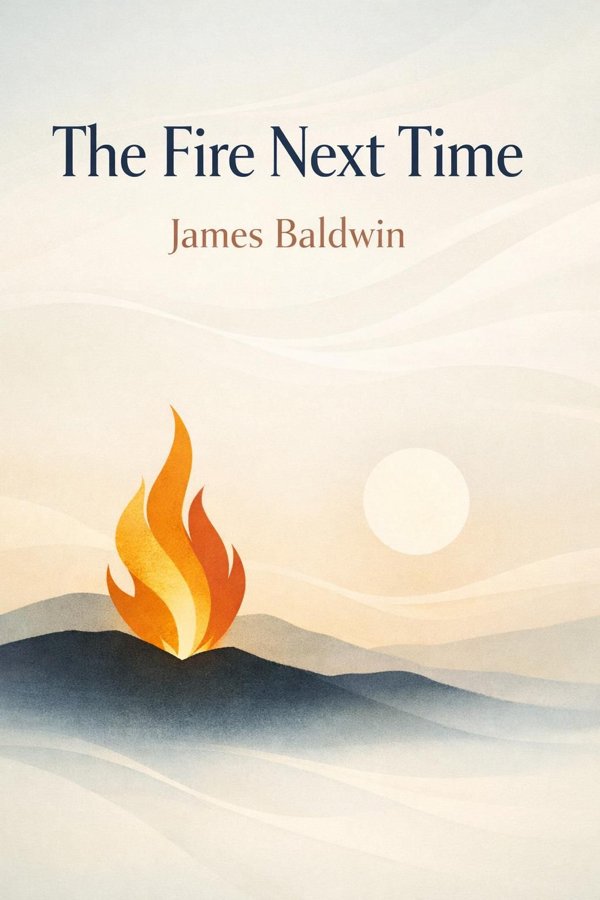
The Fire Next Time: Summary & Key Insights
 10 min11 chaptersAudio available
What Is The Fire Next Time About?
The Fire Next Time by James Baldwin is a civilization book spanning 11 pages. The Fire Next Time is a powerful collection of two essays by James Baldwin that confronts the realities of race relations in America. Written as a letter to his nephew and a reflection on his own experiences, Baldwin explores the deep roots of racial injustice, the role of religion, and the urgent need for love and understanding to overcome hatred and division.
This FizzRead summary covers all 11 key chapters of The Fire Next Time in approximately 10 minutes, distilling the most important ideas, arguments, and takeaways from James Baldwin's work. Also available as an audio summary and Key Quotes Podcast.
The Fire Next Time
The Fire Next Time is a powerful collection of two essays by James Baldwin that confronts the realities of race relations in America. Written as a letter to his nephew and a reflection on his own experiences, Baldwin explores the deep roots of racial injustice, the role of religion, and the urgent need for love and understanding to overcome hatred and division.
Who Should Read The Fire Next Time?
This book is perfect for anyone interested in civilization and looking to gain actionable insights in a short read. Whether you're a student, professional, or lifelong learner, the key ideas from The Fire Next Time by James Baldwin will help you think differently.
- ✓Readers who enjoy civilization and want practical takeaways
- ✓Professionals looking to apply new ideas to their work and life
- ✓Anyone who wants the core insights of The Fire Next Time in just 10 minutes
Want the full summary?
Get instant access to this book summary and 100K+ more with Fizz Moment.
Get Free SummaryAvailable on App Store • Free to download
Key Chapters
When I addressed my nephew, James, I wanted him to understand that the world he inherited was dangerous not because of his own faults but because of the lies that America tells itself. The centennial of emancipation was not a celebration, but a reminder that freedom remained unrealized. I warned him that the most destructive poison in the world is the belief in inferiority—the story white America tells to justify its own fear. I urged him never to accept that lie, for doing so would mean surrendering his own soul.
Yet my warning came wrapped in love. I wanted him to remember that his elders had survived a century of humiliation not by hating but by loving themselves fiercely enough to endure. Hatred, I told him, is a trap—a mirror that turns the oppressed into a reflection of the oppressor. To love, then, is both rebellion and survival. My task was not merely to defend him against a hostile world but to prepare him to see clearly: that white people’s delusion of superiority had already wounded them more deeply than they realized; that his duty was to preserve his integrity and humanity even while confronting injustice. In that letter lies the foundation of the entire book—the refusal to be defined by anyone else’s distorted vision.
The shadow of slavery stretches into every American morning. Even after emancipation and the civil rights struggles, the nation’s self-understanding remained bound to that history. I explored how racial injustice did not only deform black identity—it disfigured white identity too. The illusion of superiority, of control, had long concealed a terror of equality. Beneath the calm surface of American order still lay the plantation’s logic: some must dominate, others must be contained.
When I looked at America, I saw a country terrified of awakening. Its wealth was built on suffering, and to admit that truth would mean dismantling the architecture of excuse that sustained it. But historical memory cannot be evaded forever. The legacy of segregation, the walls of the ghetto, and the silent wounds of humiliation—they all live in the air we breathe. A white child, taught implicitly that he is better, and a black child, taught to beware—both inherit the same sickness. My aim was to expose how these corrupted notions of identity chained us to a past we pretend to have outgrown. True emancipation begins only when we recognize that freedom cannot belong to one race without destroying another.
+ 9 more chapters — available in the FizzRead app
All Chapters in The Fire Next Time
About the Author
James Baldwin (1924–1987) was an American novelist, essayist, and social critic. His works, including Go Tell It on the Mountain and Notes of a Native Son, examine issues of race, sexuality, and identity in mid-20th-century America. Baldwin’s eloquent voice and moral clarity made him one of the most important writers and thinkers of his generation.
Get This Summary in Your Preferred Format
Read or listen to the The Fire Next Time summary by James Baldwin anytime, anywhere. FizzRead offers multiple formats so you can learn on your terms — all free.
Available formats: App · Audio · PDF · EPUB — All included free with FizzRead
Download The Fire Next Time PDF and EPUB Summary
Key Quotes from The Fire Next Time
“When I addressed my nephew, James, I wanted him to understand that the world he inherited was dangerous not because of his own faults but because of the lies that America tells itself.”
“The shadow of slavery stretches into every American morning.”
Frequently Asked Questions about The Fire Next Time
The Fire Next Time by James Baldwin is a civilization book that explores key ideas across 11 chapters. The Fire Next Time is a powerful collection of two essays by James Baldwin that confronts the realities of race relations in America. Written as a letter to his nephew and a reflection on his own experiences, Baldwin explores the deep roots of racial injustice, the role of religion, and the urgent need for love and understanding to overcome hatred and division.
You Might Also Like
The Structure of Scientific Revolutions
Thomas S. Kuhn
10 min
Genius
Harold Bloom
10 min
A Cultural History of the Medieval Age
Various Editors
10 min
A History of God: The 4,000-Year Quest of Judaism, Christianity and Islam
Karen Armstrong
10 min
A History of the World in 10½ Chapters
Julian Barnes
10 min
A Short History of Progress
Ronald Wright
10 minBrowse by Category
Ready to read The Fire Next Time?
Get the full summary and 100K+ more books with Fizz Moment.