
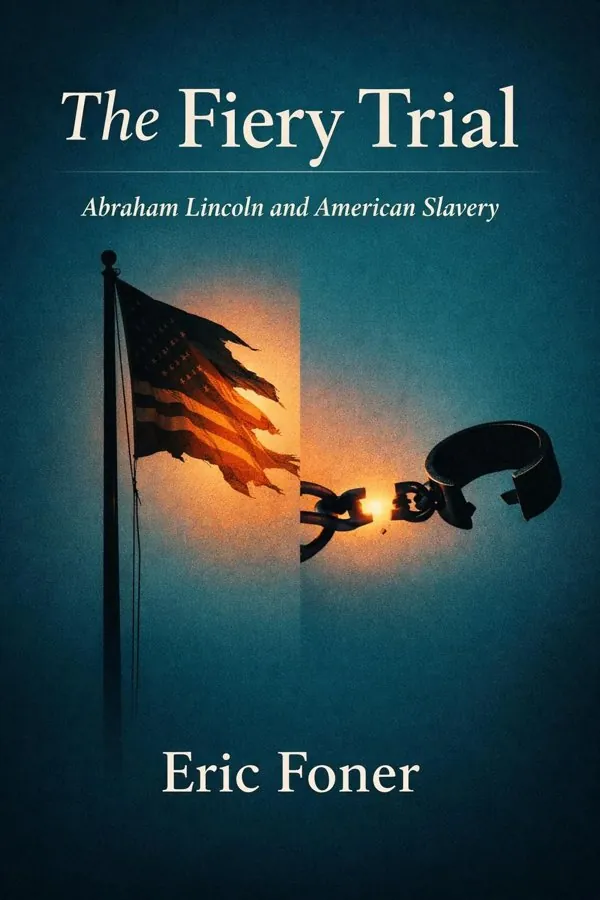
The Fiery Trial: Abraham Lincoln and American Slavery: Summary & Key Insights
by Eric Foner
 10 min10 chaptersAudio available
What Is The Fiery Trial: Abraham Lincoln and American Slavery About?
The Fiery Trial: Abraham Lincoln and American Slavery by Eric Foner is a world_history book spanning 10 pages. In this Pulitzer Prize–winning work, historian Eric Foner traces Abraham Lincoln’s evolving views on slavery and race, exploring how his moral and political thinking developed in response to the turbulent events of the Civil War era. Drawing on extensive archival research, Foner portrays Lincoln as a pragmatic yet principled leader whose understanding of freedom and equality deepened over time, culminating in his decisive role in the abolition of slavery.
This FizzRead summary covers all 10 key chapters of The Fiery Trial: Abraham Lincoln and American Slavery in approximately 10 minutes, distilling the most important ideas, arguments, and takeaways from Eric Foner's work. Also available as an audio summary and Key Quotes Podcast.
The Fiery Trial: Abraham Lincoln and American Slavery
In this Pulitzer Prize–winning work, historian Eric Foner traces Abraham Lincoln’s evolving views on slavery and race, exploring how his moral and political thinking developed in response to the turbulent events of the Civil War era. Drawing on extensive archival research, Foner portrays Lincoln as a pragmatic yet principled leader whose understanding of freedom and equality deepened over time, culminating in his decisive role in the abolition of slavery.
Who Should Read The Fiery Trial: Abraham Lincoln and American Slavery?
This book is perfect for anyone interested in world_history and looking to gain actionable insights in a short read. Whether you're a student, professional, or lifelong learner, the key ideas from The Fiery Trial: Abraham Lincoln and American Slavery by Eric Foner will help you think differently.
- ✓Readers who enjoy world_history and want practical takeaways
- ✓Professionals looking to apply new ideas to their work and life
- ✓Anyone who wants the core insights of The Fiery Trial: Abraham Lincoln and American Slavery in just 10 minutes
Want the full summary?
Get instant access to this book summary and 100K+ more with Fizz Moment.
Get Free SummaryAvailable on App Store • Free to download
Key Chapters
Lincoln’s youth in Kentucky, Indiana, and Illinois formed the soil from which his early ideas about slavery sprouted. Born into poverty in a region where slavery’s shadow was ever-present, he saw its effects not as an abstract moral problem but as a social reality that distorted the promise of opportunity. His family’s moves kept him on the edge of slave territory, and he encountered enslaved people—sometimes as laborers hired out, sometimes as human property sold. These impressions left lasting marks but did not immediately make him an abolitionist. Instead, they fostered an instinctive dislike of bondage and a firm belief in self-labor.
When Lincoln entered politics in Illinois, he aligned with a political climate that valued economic progress and personal advancement—the central promises of a society built on free labor. His opposition to slavery, at this point, was more pragmatic than humanitarian: slavery, he argued, hindered national growth, corrupted democratic values, and violated the principle that every person should rise through his own effort. The politics of his early years were shaped not by agitation for immediate emancipation but by resistance to slavery’s expansion into new territories. Lincoln saw the diffusion of slavery as the greatest danger to the nation’s free institutions, a threat to the ideal of mobility and equality of opportunity that the Whigs cherished.
His earliest speeches and campaigns reveal a man navigating between conviction and caution. He did not challenge the legality of slavery where it already existed, nor did he campaign for racial equality. Yet even then, he spoke of the Declaration of Independence as a living promise, not a relic—a standard by which the nation must constantly measure itself. That was Lincoln’s distinctive moral starting point: a belief that freedom must be preserved and extended, but always through constitutional means. It was a philosophy that left much unsaid but contained a seed of transformation.
Lincoln’s deep affiliation with the Whig Party shaped his worldview profoundly. The Whig ideology rested on the faith that material and moral progress could go hand in hand, that society advanced through industry, education, and civic virtue. Lincoln absorbed these beliefs wholeheartedly. He saw labor as the foundation of liberty. A person’s right to reap the fruits of one’s own work defined the essence of freedom. From that principle arose his lifelong devotion to the free labor doctrine—a belief that contrasted diametrically with the slave system’s degradation.
As a Whig, Lincoln envisioned emancipation as part of national modernization. He admired gradualist approaches—schemes for compensated emancipation or colonization of freed people—that reflected the Whigs’ moral caution in confronting entrenched injustice. His faith in progress was steady but restrained: he believed that with time, reason, and education, slavery might fade away. Yet history would demand more urgency than that.
Within the Whig framework, Lincoln also cultivated a pragmatic respect for the Constitution. He accepted its compromises but believed they could serve freedom’s gradual expansion rather than perpetual bondage. His commitment to legality and moderation allowed him to appeal broadly, though it also bounded his imagination in this early phase.
Lincoln’s Whig years reveal a politician of principle who still trusted in the slow march of improvement. The coming storm—the radicalization of antislavery politics—would test whether that faith could survive under the pressures of history.
+ 8 more chapters — available in the FizzRead app
All Chapters in The Fiery Trial: Abraham Lincoln and American Slavery
About the Author
Eric Foner is an American historian and professor emeritus at Columbia University, renowned for his scholarship on the Civil War, Reconstruction, and American political history. He has received numerous awards, including the Pulitzer Prize, the Bancroft Prize, and the Lincoln Prize, and is widely regarded as one of the foremost authorities on nineteenth-century America.
Get This Summary in Your Preferred Format
Read or listen to the The Fiery Trial: Abraham Lincoln and American Slavery summary by Eric Foner anytime, anywhere. FizzRead offers multiple formats so you can learn on your terms — all free.
Available formats: App · Audio · PDF · EPUB — All included free with FizzRead
Download The Fiery Trial: Abraham Lincoln and American Slavery PDF and EPUB Summary
Key Quotes from The Fiery Trial: Abraham Lincoln and American Slavery
“Lincoln’s youth in Kentucky, Indiana, and Illinois formed the soil from which his early ideas about slavery sprouted.”
“Lincoln’s deep affiliation with the Whig Party shaped his worldview profoundly.”
Frequently Asked Questions about The Fiery Trial: Abraham Lincoln and American Slavery
The Fiery Trial: Abraham Lincoln and American Slavery by Eric Foner is a world_history book that explores key ideas across 10 chapters. In this Pulitzer Prize–winning work, historian Eric Foner traces Abraham Lincoln’s evolving views on slavery and race, exploring how his moral and political thinking developed in response to the turbulent events of the Civil War era. Drawing on extensive archival research, Foner portrays Lincoln as a pragmatic yet principled leader whose understanding of freedom and equality deepened over time, culminating in his decisive role in the abolition of slavery.
You Might Also Like
The Age of Capital
Eric Hobsbawm
10 min
The Gulag Archipelago
Aleksandr Solzhenitsyn
10 min
Jerusalem: The Biography
Simon Sebag Montefiore
10 min
The Anglo-Saxons
James Campbell
10 min
The Boer War
Thomas Pakenham
10 min
The Industrial Revolutionaries: The Making of the Modern World 1776–1914
Gavin Weightman
10 minBrowse by Category
Ready to read The Fiery Trial: Abraham Lincoln and American Slavery?
Get the full summary and 100K+ more books with Fizz Moment.