
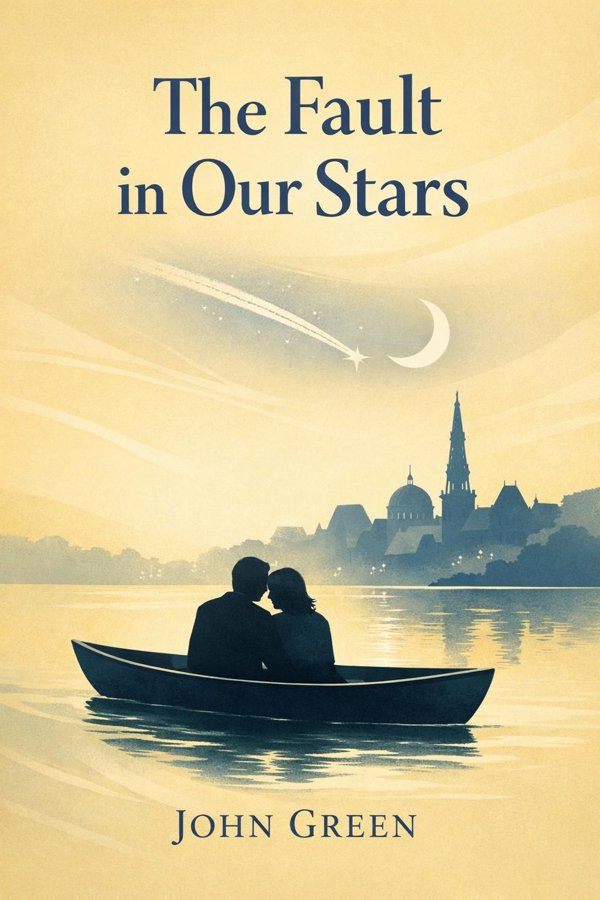
The Fault in Our Stars: Summary & Key Insights
by John Green
 10 min9 chaptersAudio available
Key Takeaways from The Fault in Our Stars
Sometimes the most life-changing relationships begin when we least want to be seen.
One of the novel’s quietest insights is that humor is not the opposite of pain—it is often one of pain’s most dignified responses.
We often chase answers in the hope that they will give our pain a clean shape.
Love becomes most visible when it must coexist with the certainty of loss.
Grief is not a final chapter that closes cleanly; it is a new way of carrying what remains.
What Is The Fault in Our Stars About?
The Fault in Our Stars by John Green is a bestsellers book spanning 4 pages. The Fault in Our Stars is a bestselling young adult novel by John Green that turns a familiar premise—a love story between two teenagers—into a profound meditation on mortality, identity, suffering, and what it means to live meaningfully in the face of limited time. The novel follows Hazel Grace Lancaster, a sharp, introspective sixteen-year-old living with cancer, and Augustus Waters, a charismatic survivor whose confidence, humor, and vulnerability gradually pull Hazel out of emotional isolation. Together, they navigate not just illness, but the larger questions illness forces into the open: How do we matter? What do we owe the people we love? And how do we keep going when we know loss is inevitable? What makes the book so enduring is its refusal to become sentimental. Green combines wit, emotional honesty, and philosophical depth to portray teenagers who are neither inspirational symbols nor tragic clichés, but fully human people trying to make sense of pain, love, and uncertainty. As one of the most influential contemporary voices in young adult fiction, Green brings empathy, intelligence, and emotional precision to the story. The result is a novel that resonates far beyond its genre—a moving, thoughtful work for anyone who has ever loved deeply while knowing nothing lasts forever.
This FizzRead summary covers all 9 key chapters of The Fault in Our Stars in approximately 10 minutes, distilling the most important ideas, arguments, and takeaways from John Green's work. Also available as an audio summary and Key Quotes Podcast.
The Fault in Our Stars
The Fault in Our Stars is a bestselling young adult novel by John Green that turns a familiar premise—a love story between two teenagers—into a profound meditation on mortality, identity, suffering, and what it means to live meaningfully in the face of limited time. The novel follows Hazel Grace Lancaster, a sharp, introspective sixteen-year-old living with cancer, and Augustus Waters, a charismatic survivor whose confidence, humor, and vulnerability gradually pull Hazel out of emotional isolation. Together, they navigate not just illness, but the larger questions illness forces into the open: How do we matter? What do we owe the people we love? And how do we keep going when we know loss is inevitable?
What makes the book so enduring is its refusal to become sentimental. Green combines wit, emotional honesty, and philosophical depth to portray teenagers who are neither inspirational symbols nor tragic clichés, but fully human people trying to make sense of pain, love, and uncertainty. As one of the most influential contemporary voices in young adult fiction, Green brings empathy, intelligence, and emotional precision to the story. The result is a novel that resonates far beyond its genre—a moving, thoughtful work for anyone who has ever loved deeply while knowing nothing lasts forever.
Who Should Read The Fault in Our Stars?
This book is perfect for anyone interested in bestsellers and looking to gain actionable insights in a short read. Whether you're a student, professional, or lifelong learner, the key ideas from The Fault in Our Stars by John Green will help you think differently.
- ✓Readers who enjoy bestsellers and want practical takeaways
- ✓Professionals looking to apply new ideas to their work and life
- ✓Anyone who wants the core insights of The Fault in Our Stars in just 10 minutes
Want the full summary?
Get instant access to this book summary and 100K+ more with Fizz Moment.
Get Free SummaryAvailable on App Store • Free to download
Key Chapters
Sometimes the most life-changing relationships begin when we least want to be seen. Hazel Grace Lancaster attends a cancer support group not because she believes in it, but because her mother worries that she is retreating too deeply into herself. Hazel has grown used to protecting her energy, her emotions, and even her expectations. Living with cancer has taught her to treat hope carefully. Then she meets Augustus Waters, a confident, intelligent, and disarmingly attentive boy who looks directly at her instead of through her.
Their connection matters because it is built on mutual recognition rather than fantasy. Augustus is drawn not only to Hazel’s beauty, but to her mind, her sarcasm, and her refusal to perform cheerfulness. Hazel, in turn, is unsettled by Augustus because he seems to live with deliberate intensity. He does not ignore death; he challenges it by insisting on meaning, style, and emotional risk. What begins as curiosity becomes intimacy through shared books, conversations, jokes, and acts of care.
This relationship illustrates an important truth: real connection often begins when people feel safe enough to stop pretending. Hazel and Augustus do not bond because they are both sick; they bond because they understand loneliness, fear, and the desire to matter. In everyday life, this applies to friendships, family, and romance alike. We form stronger relationships when we listen deeply, ask real questions, and respond to people as they are, not as we wish them to be.
Actionable takeaway: Let one important relationship become more honest this week by replacing small talk with one sincere question and giving the answer your full attention.
One of the novel’s quietest insights is that humor is not the opposite of pain—it is often one of pain’s most dignified responses. Hazel and Augustus joke about support group clichés, illness rituals, and the absurdity of being young while living under the shadow of death. Their humor does not erase suffering, but it gives them language, rhythm, and agency in a life where so much is beyond their control.
John Green uses wit to show that people facing serious hardship are not always solemn. In fact, humor can be a way of preserving identity when illness threatens to reduce a person to symptoms, treatments, and prognosis. Augustus’s theatrical confidence and Hazel’s dry, cutting observations allow them to reclaim the narrative. Instead of becoming symbols of tragedy, they remain teenagers—funny, contradictory, perceptive, and alive.
This has practical relevance far beyond the novel. In hospitals, families, workplaces, and moments of private grief, carefully used humor can release tension and restore humanity. It can remind us that a person is more than what has happened to them. At the same time, the book also shows that humor works best when it comes from intimacy and trust, not avoidance. The jokes between Hazel and Augustus carry weight because they arise from honesty rather than denial.
For readers, this idea becomes a reminder that emotional resilience does not always look noble or dramatic. Sometimes it looks like sarcasm, laughter in the wrong room, or a ridiculous metaphor that keeps fear from becoming total. Actionable takeaway: When facing stress or supporting someone through difficulty, allow room for gentle humor that affirms humanity rather than dismissing the seriousness of the moment.
We often chase answers in the hope that they will give our pain a clean shape. Hazel’s devotion to An Imperial Affliction, a novel by the reclusive writer Peter Van Houten, reflects this longing. She is obsessed with the book because it feels truthful in a way most stories do not. It stops abruptly, without resolving what happens to the characters, and Hazel wants to know what comes next. That need is not merely literary curiosity; it is existential. If the story can continue, perhaps life can feel less unfinished.
Augustus uses his wish foundation opportunity to take Hazel to Amsterdam so they can meet Van Houten. The trip represents romance, adventure, and hope, but it also symbolizes a deeper search for certainty. Hazel wants answers about endings, survival, and the people left behind. Augustus wants to give her something meaningful, something bigger than flowers or declarations.
The meeting itself is devastating because Van Houten fails to provide wisdom. He is bitter, drunk, and evasive. Yet that disappointment is precisely the point. The world rarely supplies the neat explanations we think we need. Meaning cannot always be received from authority; it must often be made in relationship, memory, and choice.
In practical terms, many people make similar journeys—toward mentors, books, achievements, or milestones—expecting clarity. Sometimes the experience disappoints, but the journey still changes them. Hazel and Augustus do not find definitive answers in Amsterdam. They find each other more deeply. Actionable takeaway: Pursue the questions that matter to you, but do not confuse answers with transformation; often the real value lies in who you become while searching.
Love becomes most visible when it must coexist with the certainty of loss. The emotional center of The Fault in Our Stars lies in the painful reversal that follows Amsterdam: Augustus, once the more seemingly invincible of the two, reveals that his cancer has returned aggressively. Hazel, who has spent much of the novel trying to avoid hurting others by limiting attachment, is forced to confront the truth that love never guarantees safety. It guarantees vulnerability.
Their relationship deepens in this period because romance gives way to care in its most difficult form. Hospital visits, fear, physical decline, embarrassment, helplessness, and anticipatory grief replace idealized visions of young love. Yet Green presents this not as the collapse of love, but as its proving ground. Augustus is no longer simply charming and grand; he is frightened, needy, and mortal. Hazel’s devotion becomes less about being swept away and more about staying present.
This is one of the book’s most mature insights. Many stories celebrate love at the point of beginning, when desire and possibility are strongest. This novel asks what love looks like when someone becomes less radiant, less composed, less able to protect their own image. It argues that tenderness is not separate from suffering; often it grows through it.
In real life, every meaningful bond contains this risk. Parents age. Partners get sick. Friends move away or die. To love is to accept eventual grief. But the novel insists that this does not make love foolish. It makes it real. Actionable takeaway: Do not measure the value of a relationship by how painlessly it ends; measure it by the depth of presence, honesty, and care it creates while it lasts.
Grief is not a final chapter that closes cleanly; it is a new way of carrying what remains. After Augustus dies, Hazel must learn how to live in the altered emotional landscape his absence creates. This portion of the novel is especially powerful because it resists melodrama. Hazel does not suddenly gain complete wisdom, nor does she collapse into permanent despair. Instead, she experiences grief as most people do: unevenly, physically, intellectually, and relationally.
She revisits memories, conversations, and fragments of meaning. She thinks about the dead in relation to the living. She considers what it means to have been changed by someone whose life was short. In doing so, she begins to understand grace not as a religious abstraction, but as the capacity to receive love and continue despite its ending. Augustus does not remain alive through fantasy; he remains significant through impact.
The book also shows that grief often includes guilt and reinterpretation. Hazel wonders what she gave Augustus, what he gave her, and whether temporary joy justifies future pain. Her answer gradually becomes yes—not because pain is desirable, but because connection itself is worth the cost. This is a psychologically honest portrait of mourning: healing does not mean forgetting or moving on in the shallow sense. It means integrating loss into one’s ongoing life.
For readers experiencing grief of any kind, this part of the novel offers recognition. We honor people not only through memorials, but by allowing their influence to remain active in how we think, love, and choose. Actionable takeaway: When grieving someone important, create one deliberate ritual—writing a letter, revisiting a shared place, or speaking their name—that helps transform absence into meaningful remembrance.
Hazel repeatedly describes herself as a grenade—a person whose death will inevitably wound everyone close to her. This metaphor captures one of the novel’s most piercing psychological themes: when people feel fragile, they often try to protect others by withholding themselves. Hazel limits intimacy not because she lacks feeling, but because she feels too responsible for the future pain of those who love her.
This fear is understandable. Chronic illness, trauma, depression, and instability can all make people believe they are burdens rather than companions. Hazel’s emotional caution reflects a larger human impulse: if attachment may lead to pain, perhaps distance is kinder. But the novel steadily challenges this logic. By trying to reduce future suffering, Hazel risks reducing present life. She may avoid some damage, but she also denies others the chance to love her freely and denies herself the nourishment of being known.
Augustus does not erase this fear, but he exposes its limitations. Love is not a contract guaranteeing no harm. Every close relationship contains the possibility of loss. The ethical question is not whether we can prevent all pain; we cannot. The question is whether we can love in a way that makes the inevitable pain meaningful rather than empty.
This idea applies broadly. People who fear becoming burdens may avoid asking for help, initiating relationships, or revealing need. Yet care is one of the ways human beings participate in each other’s lives. To receive love is not selfish; it is part of connection. Actionable takeaway: Notice one place where fear of burdening others is making you withdraw, and experiment with a small act of openness—asking for support, sharing honestly, or accepting care without apology.
Many people fear not death itself, but insignificance. Augustus embodies this fear more explicitly than Hazel. He is preoccupied with heroism, legacy, and the idea of leaving an enduring mark on the world. His anxiety reveals a common modern pressure: the belief that a meaningful life must be extraordinary, visible, or historically remembered.
The novel complicates this idea by contrasting grand ambition with intimate impact. Augustus initially imagines significance in dramatic terms, but his illness strips away the fantasy of a monumental future. What remains is a quieter question: can a life matter deeply even if it changes only a few people? Through Hazel, his parents, Isaac, and the memories he leaves behind, the novel answers yes.
This is one of the story’s most valuable contributions. In a culture obsessed with public success, measurable achievement, and lasting recognition, The Fault in Our Stars reminds us that significance is often relational. A conversation can matter. So can loyalty, humor, presence, courage under humiliation, or love offered at the right time. Not every meaningful life becomes widely known. Most do not. But that does not diminish their worth.
Practically, this idea can relieve the pressure to perform importance. Teachers, caregivers, friends, siblings, and partners often shape lives in ways that will never be publicly celebrated. Yet their influence is real. Augustus’s arc teaches that being remembered by the people one has genuinely loved may be a more human form of legacy than fame. Actionable takeaway: Redefine impact for yourself by identifying one person or community you can meaningfully influence now, instead of postponing significance until some imagined future achievement.
Human beings use stories not just for entertainment, but for survival. Hazel’s attachment to An Imperial Affliction and the many literary references throughout the novel highlight how language helps people organize chaos. Books give Hazel a mirror for her own fears, especially the fear of unfinished stories. She wants fiction to tell her what life often will not: what happens next, what suffering means, and whether endings can ever feel complete.
John Green also emphasizes that the words we use shape the emotional reality we inhabit. Metaphors, jokes, letters, eulogies, and remembered phrases all become tools for making experience bearable. Augustus’s unlit cigarette metaphor, for example, is a performance of control; he places the killing thing between his teeth but does not give it the power to kill him. Whether or not the metaphor is fully convincing, it shows how people use language to claim agency.
This matters in everyday life because interpretation influences endurance. The stories we tell ourselves about illness, heartbreak, failure, and uncertainty affect how we respond to them. Language cannot remove pain, but it can help transform raw experience into something communicable, shareable, and meaningful. Writing, reading, and honest conversation become forms of emotional architecture.
The novel does not claim that stories solve suffering. Van Houten’s failure proves they can also disappoint. Still, Green insists that words remain essential because they help us accompany one another through confusion. Actionable takeaway: When facing a difficult experience, write a short personal narrative or journal entry about it; shaping events into words can reveal meaning, emotion, and choices that feel invisible in the moment.
The deepest power of The Fault in Our Stars is its insistence that mortality is not a side issue of life—it is the condition that gives life urgency. Hazel and Augustus are unusually conscious of death because of cancer, but the novel’s broader claim is universal: all lives are finite, even when most people are allowed the luxury of forgetting it. Their situation simply makes visible what is true for everyone.
This awareness changes how the book defines maturity. Maturity is not pretending death is far away, nor obsessing over it endlessly. It is learning to love, choose, and hope without demanding permanence. Hazel and Augustus do not discover a way to defeat finitude. Instead, they create moments of joy, honesty, and intimacy within it. A picnic, a conversation, a trip, a letter, a shared book—these become meaningful not because they last forever, but because they do not.
There is a practical philosophy here. Many people postpone living while waiting for certainty, health, success, or emotional safety. The novel challenges that delay. None of us receives guarantees. Meaningful life is made under conditions of uncertainty, not after uncertainty disappears. To know life is limited can sharpen gratitude, clarify values, and strip away trivial performances.
Rather than turning mortality into despair, Green turns it into attention. What matters now? Who matters now? What kind of presence do we want to offer before time runs out? Actionable takeaway: Choose one finite, ordinary moment today—a meal, a walk, a conversation—and treat it as worthy of full presence, because the quality of attention we give to life is part of what makes it meaningful.
All Chapters in The Fault in Our Stars
About the Author
John Green is an American novelist, essayist, and digital educator whose work has had a major impact on contemporary young adult literature. He was born in 1977 and rose to prominence with novels such as Looking for Alaska, Paper Towns, and The Fault in Our Stars, all known for their emotionally intelligent characters, sharp dialogue, and exploration of love, grief, identity, and mortality. Green has a distinctive ability to combine humor with philosophical reflection, making his books resonate with both teen and adult readers. Beyond publishing, he is also widely known for his online educational work with his brother Hank Green, particularly through Vlogbrothers and CrashCourse. His influence extends across literature, internet culture, and public conversations about mental health, learning, and the meaning of modern life.
Get This Summary in Your Preferred Format
Read or listen to the The Fault in Our Stars summary by John Green anytime, anywhere. FizzRead offers multiple formats so you can learn on your terms — all free.
Available formats: App · Audio · PDF · EPUB — All included free with FizzRead
Download The Fault in Our Stars PDF and EPUB Summary
Key Quotes from The Fault in Our Stars
“Sometimes the most life-changing relationships begin when we least want to be seen.”
“One of the novel’s quietest insights is that humor is not the opposite of pain—it is often one of pain’s most dignified responses.”
“We often chase answers in the hope that they will give our pain a clean shape.”
“Love becomes most visible when it must coexist with the certainty of loss.”
“Grief is not a final chapter that closes cleanly; it is a new way of carrying what remains.”
Frequently Asked Questions about The Fault in Our Stars
The Fault in Our Stars by John Green is a bestsellers book that explores key ideas across 9 chapters. The Fault in Our Stars is a bestselling young adult novel by John Green that turns a familiar premise—a love story between two teenagers—into a profound meditation on mortality, identity, suffering, and what it means to live meaningfully in the face of limited time. The novel follows Hazel Grace Lancaster, a sharp, introspective sixteen-year-old living with cancer, and Augustus Waters, a charismatic survivor whose confidence, humor, and vulnerability gradually pull Hazel out of emotional isolation. Together, they navigate not just illness, but the larger questions illness forces into the open: How do we matter? What do we owe the people we love? And how do we keep going when we know loss is inevitable? What makes the book so enduring is its refusal to become sentimental. Green combines wit, emotional honesty, and philosophical depth to portray teenagers who are neither inspirational symbols nor tragic clichés, but fully human people trying to make sense of pain, love, and uncertainty. As one of the most influential contemporary voices in young adult fiction, Green brings empathy, intelligence, and emotional precision to the story. The result is a novel that resonates far beyond its genre—a moving, thoughtful work for anyone who has ever loved deeply while knowing nothing lasts forever.
More by John Green
You Might Also Like
The Godfather
Mario Puzo
10 min
The Handmaid's Tale
Margaret Atwood
10 min
The Hunger Games
Suzanne Collins
10 min
The Nightingale
Kristin Hannah
10 min
The Seven Husbands of Evelyn Hugo
Taylor Jenkins Reid
10 min
Backwater Justice
Fern Michaels
10 minBrowse by Category
Ready to read The Fault in Our Stars?
Get the full summary and 100K+ more books with Fizz Moment.