
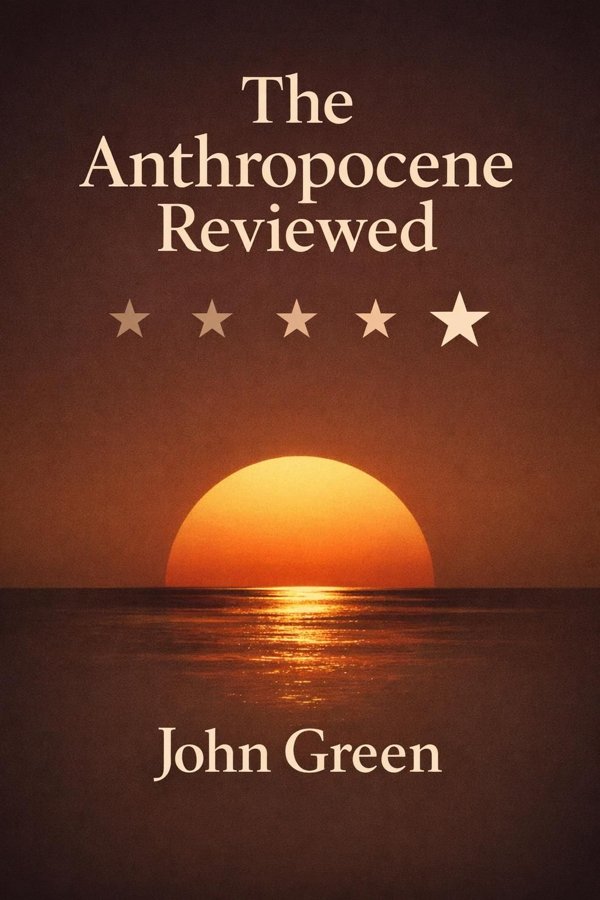
The Anthropocene Reviewed: Essays on a Human-Centered Planet: Summary & Key Insights
by John Green
 10 min9 chaptersAudio available
Key Takeaways from The Anthropocene Reviewed: Essays on a Human-Centered Planet
Every rating we give the world says as much about us as it does about the thing being rated.
Some experiences remain magnificent even after being overphotographed, overdescribed, and overshared.
Meaning is not found only in grand experiences; it often hides inside small, repeatable comforts.
The body can force clarity on a life built around illusion.
The internet is one of humanity’s most astonishing tools, and one of its most destabilizing mirrors.
What Is The Anthropocene Reviewed: Essays on a Human-Centered Planet About?
The Anthropocene Reviewed: Essays on a Human-Centered Planet by John Green is a essays book spanning 6 pages. The Anthropocene Reviewed is John Green’s deeply personal and intellectually curious collection of essays about living in a world profoundly shaped by human beings. Framed as reviews of ordinary and extraordinary aspects of modern life—such as sunsets, Diet Dr Pepper, the internet, viral meningitis, and even our patterns of hope and grief—the book uses a five-star rating system to explore how humans make meaning out of existence. What begins as a clever premise becomes something richer: a meditation on beauty, loneliness, illness, climate, memory, and the fragile miracle of being alive at this moment in history. The book matters because it captures a distinctly modern tension: we are capable of immense destruction, yet also of astonishing tenderness, creativity, and connection. Green writes not as a detached critic, but as a novelist, essayist, and longtime educator whose work has helped millions think more deeply about history, science, and human emotion. His authority comes less from expertise alone than from his rare ability to braid research, vulnerability, and moral reflection into prose that feels both intimate and universal. This is a book about reviewing the world, but ultimately it is about learning how to live in it.
This FizzRead summary covers all 9 key chapters of The Anthropocene Reviewed: Essays on a Human-Centered Planet in approximately 10 minutes, distilling the most important ideas, arguments, and takeaways from John Green's work. Also available as an audio summary and Key Quotes Podcast.
The Anthropocene Reviewed: Essays on a Human-Centered Planet
The Anthropocene Reviewed is John Green’s deeply personal and intellectually curious collection of essays about living in a world profoundly shaped by human beings. Framed as reviews of ordinary and extraordinary aspects of modern life—such as sunsets, Diet Dr Pepper, the internet, viral meningitis, and even our patterns of hope and grief—the book uses a five-star rating system to explore how humans make meaning out of existence. What begins as a clever premise becomes something richer: a meditation on beauty, loneliness, illness, climate, memory, and the fragile miracle of being alive at this moment in history.
The book matters because it captures a distinctly modern tension: we are capable of immense destruction, yet also of astonishing tenderness, creativity, and connection. Green writes not as a detached critic, but as a novelist, essayist, and longtime educator whose work has helped millions think more deeply about history, science, and human emotion. His authority comes less from expertise alone than from his rare ability to braid research, vulnerability, and moral reflection into prose that feels both intimate and universal. This is a book about reviewing the world, but ultimately it is about learning how to live in it.
Who Should Read The Anthropocene Reviewed: Essays on a Human-Centered Planet?
This book is perfect for anyone interested in essays and looking to gain actionable insights in a short read. Whether you're a student, professional, or lifelong learner, the key ideas from The Anthropocene Reviewed: Essays on a Human-Centered Planet by John Green will help you think differently.
- ✓Readers who enjoy essays and want practical takeaways
- ✓Professionals looking to apply new ideas to their work and life
- ✓Anyone who wants the core insights of The Anthropocene Reviewed: Essays on a Human-Centered Planet in just 10 minutes
Want the full summary?
Get instant access to this book summary and 100K+ more with Fizz Moment.
Get Free SummaryAvailable on App Store • Free to download
Key Chapters
Every rating we give the world says as much about us as it does about the thing being rated. That is the animating idea behind The Anthropocene Reviewed. John Green takes a recognizably modern habit—assigning stars, scores, and judgments—and transforms it into a philosophical tool. In reviewing everything from natural wonders to consumer products, he suggests that humans are meaning-making creatures. We do not simply live on the planet; we interpret it, narrate it, and constantly decide what matters.
This perspective is especially powerful in the Anthropocene, an age defined by human influence. Our roads, emissions, technologies, language, and stories have changed the planet so extensively that even our categories for understanding reality are human-shaped. Green’s review format exposes both the absurdity and the poignancy of that fact. Of course sunsets do not need our approval. Of course a disease, a song, or a snack cannot be reduced to stars. And yet trying to evaluate them becomes a way of revealing our loves, fears, contradictions, and values.
In practical terms, this idea invites readers to examine their own habits of judgment. What do you praise automatically? What do you dismiss? How do your preferences reflect your history, privilege, pain, or longing? A movie review, a restaurant complaint, or even a social media reaction may be less about the object itself than about the reviewer’s internal world.
Green’s broader point is not that judgment is futile, but that it should be humble. We are always reviewing from partial knowledge. If we can recognize that, our opinions become less performative and more honest.
Actionable takeaway: The next time you strongly like or dislike something, pause and ask: what does this reaction reveal about me, not just about the thing I’m judging?
Meaning is not found only in grand experiences; it often hides inside small, repeatable comforts. Green’s review of Diet Dr Pepper may seem playful, but it opens into a serious reflection on routine, pleasure, and coping. Consumer products are easy to mock as shallow or trivial, yet many of them become woven into the emotional architecture of our lives. A familiar drink, a repeated meal, or a preferred brand can provide continuity in a world that often feels unstable.
Green treats this preference with both humor and seriousness. He recognizes the absurdity of becoming attached to a soda, but he also refuses to dismiss what such attachments do for us. They can mark time, offer predictability, and create a sense of identity. In moments of stress, small rituals matter disproportionately. They tell us that not everything has changed.
This idea has practical relevance because many people underestimate the role of minor comforts in resilience. We tend to think coping must be profound: therapy, radical transformation, major life decisions. Those are important. But so are tiny, manageable sources of stability—tea in the morning, a walk after lunch, music during a commute, a drink associated with safety or home. These rituals are not solutions to suffering, but they can make suffering more survivable.
At the same time, Green’s essay avoids turning comfort into consumer worship. The point is not that products save us, but that human beings are skilled at investing ordinary things with personal meaning. The can on the desk is never just a can; it may be a memory, a pattern, a bit of reassurance.
Actionable takeaway: Identify one small daily ritual that genuinely steadies you, and protect it intentionally as part of your emotional well-being rather than dismissing it as insignificant.
The body can force clarity on a life built around illusion. In Green’s essay on viral meningitis, illness becomes more than a medical event; it becomes an encounter with dependence, fragility, and fear. Sickness strips away the fantasy of total self-sufficiency. It reminds us that our minds are housed in vulnerable bodies, and that those bodies are always, to some degree, contingent.
Green writes about illness with unusual honesty, not to dramatize suffering but to show how disorienting it is to lose control over one’s own physical reality. When health is stable, many people imagine themselves as autonomous agents moving through the world by will and planning. Illness interrupts that story. It makes clear how much we rely on caretakers, doctors, infrastructure, luck, and biology.
This recognition has ethical implications. If vulnerability is universal, then compassion should not be optional. The sick are not a separate category of people; they are us, at a different moment in the cycle of dependence. Green’s reflections push readers to think beyond individual experience toward public health, caregiving, and the moral importance of systems that protect people when they cannot protect themselves.
In everyday life, this insight can change how we respond to others’ limitations. Instead of treating weakness as failure, we can see it as part of being human. It can also encourage better self-care. Rest, treatment, and asking for help are not signs of inadequacy; they are realistic responses to embodied life.
Green’s essay reminds us that suffering often isolates people not only physically but narratively. The healthy continue their routines while the ill inhabit a different sense of time. Paying attention to that gap is itself an act of care.
Actionable takeaway: The next time you or someone else is struggling physically, resist the instinct to minimize it; ask directly what support is needed, and treat vulnerability as a shared human condition rather than a personal defect.
The internet is one of humanity’s most astonishing tools, and one of its most destabilizing mirrors. Green has lived much of his public life online, so his reflections carry lived authority. He understands the internet not only as technology but as habitat: a place where friendship, education, performance, intimacy, outrage, and commerce all collide.
His review holds two truths together. First, the internet has enabled extraordinary connection. It has allowed marginalized people to find one another, creators to reach audiences, and knowledge to spread at unprecedented speed. Green’s own career—as an educator and communicator—is partly a product of this possibility. The web can shrink loneliness and expand access.
Second, the internet amplifies some of our worst instincts. It rewards simplification, outrage, comparison, and constant evaluation. It can make people feel hypervisible and unseen at the same time. When every thought can be reacted to instantly, nuance becomes harder to sustain. When identity is mediated through platforms, selfhood can become performative.
The practical lesson is not to reject digital life but to engage it with intentionality. Readers can ask: does this online space increase my understanding, or only my reactivity? Does it deepen relationships, or fragment attention? Do I feel more human after using it, or more depleted? These questions matter because digital environments shape emotion as much as information.
Green’s broader insight is that the internet, like all human systems, reflects us. Its beauty and toxicity are both ours. That means we are not powerless before it. We can cultivate healthier norms, better boundaries, and more generous forms of participation.
Actionable takeaway: Audit your online habits for one week and deliberately spend more time in digital spaces that foster learning or genuine connection, while reducing time in spaces that reward outrage or numb scrolling.
A pandemic makes one fact unavoidable: your life is tied to the lives of strangers. In The Anthropocene Reviewed, Green reflects on disease not only as a biological phenomenon but as a moral revelation. Widespread illness shows how interconnected modern societies truly are. Viruses travel through networks of labor, travel, family, and inequality. They reveal that personal choices are never purely personal when health is shared.
Green’s approach is especially compelling because he balances grief with perspective. He does not flatten suffering into a lesson, but he does ask what pandemics teach us about the world we have built. They expose weaknesses in healthcare systems, social safety nets, and public trust. They also reveal human courage: caregivers, researchers, teachers, neighbors, and ordinary people improvising acts of solidarity under pressure.
This idea matters far beyond one historical crisis. Pandemics are an extreme example of a broader truth: we live in systems. Our well-being depends on institutions, public goods, and collective behavior. Individualism can be emotionally satisfying, but it is often factually false. Clean water, vaccines, transit, schools, and reliable information are communal achievements.
In personal life, this insight encourages a more civic understanding of ethics. Responsibility is not only about private virtue; it is about participating in practices that protect the vulnerable. That may include staying informed, supporting public health measures, being careful with misinformation, or advocating for equitable care.
Green insists, implicitly and explicitly, that tenderness is practical. Caring for one another is not sentimental excess; it is a survival skill in a shared world.
Actionable takeaway: Choose one concrete way to strengthen collective well-being—support local public health efforts, verify information before sharing it, or help someone in your community navigate care more easily.
One of Green’s great strengths is his refusal to choose between seriousness and wit. The Anthropocene Reviewed is filled with grief, illness, ecological anxiety, and philosophical uncertainty, yet it is also funny. That combination is not decorative; it is essential. Humor becomes a way of enduring truths that might otherwise feel unbearable.
This does not mean joking away pain. Green’s humor often heightens rather than diminishes seriousness because it acknowledges absurdity without denying stakes. There is something inherently comic about humans assigning star ratings to sunsets or diseases. But the comedy reveals a deeper truth: our efforts to understand life are both noble and ridiculous. We are tiny creatures making lists in a vast universe, and somehow that is moving.
In practical terms, humor can create emotional room. When people laugh, they often become more open, less defensive, and more able to face complexity. A gentle joke can make conversation about mortality, illness, or anxiety possible where solemnity alone might shut it down. Green’s essays model this balance. He demonstrates that intelligence does not require detachment and that sincerity does not require heaviness.
For readers, the lesson is especially relevant in times of stress. The goal is not forced positivity but resilient perspective. Humor can interrupt catastrophic thinking, restore proportion, and reconnect us with others. Shared laughter says, in effect, that we are still here together.
Green’s use of comedy also serves as a critique of cynicism. Cynicism often pretends to be sophistication, but humor joined to care is wiser. It sees absurdity and still chooses love.
Actionable takeaway: When facing something overwhelming, try pairing honesty with lightness—name the difficulty clearly, then allow room for humor that connects rather than dismisses.
Most of life is not made of dramatic turning points; it is made of repeated, often overlooked moments. Green’s essays insist that attention can elevate those moments into significance. By reviewing everything from mundane objects to vast historical forces, he shows that the border between trivial and profound is often created by how carefully we look.
This is a subtle but radical claim. In a culture saturated with spectacle, many people assume that meaning arrives from major achievements, extreme experiences, or public visibility. Green suggests otherwise. Meaning is often discovered through sustained noticing: the taste of a drink, the shape of a memory, the way a song lingers, the feeling of a place, the emotional residue of a minor encounter. Attention does not invent value from nothing, but it uncovers layers of value that busyness hides.
This idea has immediate application. Journaling, deliberate observation, long walks, rereading, and conversation can all deepen experience by slowing it down enough to become legible. Even frustration can be transformed when examined with curiosity. Instead of asking whether a moment is impressive, Green asks whether it is revealing.
There is also an ethical dimension. To attend carefully is to resist the disposable logic of modern life. People, places, and experiences become less interchangeable when we notice their texture. Attention can therefore lead to gratitude, patience, and stronger relationships.
The book’s review structure enacts this lesson. To assign stars responsibly, you must first linger. You must ask what something means and why. In that sense, reviewing is a disciplined form of noticing.
Actionable takeaway: Pick one ordinary part of your day—breakfast, a commute, a conversation—and spend a week observing it more closely, writing down what you usually miss.
Hope is often mistaken for naivete, but Green presents it as a disciplined response to reality. The Anthropocene Reviewed does not ignore climate anxiety, illness, loneliness, or historical violence. It sits with them. Yet the book repeatedly returns to the possibility that, despite everything, human life contains repair, care, and beauty worth defending.
This form of hope is not optimism detached from evidence. It is rooted in specific realities: medical advances that save lives, friendships that sustain people, art that enlarges understanding, and collective efforts that reduce suffering. Green acknowledges that the Anthropocene is an age of damage, but he refuses to let damage be the whole story. Humans are capable of extraction and cruelty; we are also capable of tenderness, cooperation, and wonder.
Why does this matter practically? Because despair can become self-fulfilling. If people believe nothing can improve, they withdraw from action. Hope, by contrast, creates the psychological conditions for engagement. It does not guarantee success, but it makes meaningful effort possible. In this way, hope is less a mood than a commitment.
Readers can apply this by grounding hope in practice rather than abstraction. Instead of asking whether humanity in general deserves confidence, ask where repair is already happening and how you can contribute. Hope grows when tied to concrete relationships and responsibilities.
Green’s final reflections suggest that to love the world honestly is to see both its brokenness and its splendor. Mature hope does not erase grief. It carries grief and keeps going.
Actionable takeaway: When you feel overwhelmed by the state of the world, identify one local, specific place where care is already making a difference, and participate in it rather than waiting to feel certain or inspired.
All Chapters in The Anthropocene Reviewed: Essays on a Human-Centered Planet
About the Author
John Green is an American author, essayist, and digital educator known for combining emotional depth with intellectual curiosity. He rose to international prominence through bestselling young adult novels including Looking for Alaska, Paper Towns, The Fault in Our Stars, and Turtles All the Way Down. Beyond fiction, Green has played a major role in online education and media. With his brother Hank Green, he co-created the Vlogbrothers channel and helped launch Crash Course, an influential educational series covering literature, history, science, and more. His nonfiction often reflects the same qualities that define his novels: empathy, humor, vulnerability, and a fascination with how people find meaning in a complicated world. The Anthropocene Reviewed showcases Green at his most personal and reflective.
Get This Summary in Your Preferred Format
Read or listen to the The Anthropocene Reviewed: Essays on a Human-Centered Planet summary by John Green anytime, anywhere. FizzRead offers multiple formats so you can learn on your terms — all free.
Available formats: App · Audio · PDF · EPUB — All included free with FizzRead
Download The Anthropocene Reviewed: Essays on a Human-Centered Planet PDF and EPUB Summary
Key Quotes from The Anthropocene Reviewed: Essays on a Human-Centered Planet
“Every rating we give the world says as much about us as it does about the thing being rated.”
“Some experiences remain magnificent even after being overphotographed, overdescribed, and overshared.”
“Meaning is not found only in grand experiences; it often hides inside small, repeatable comforts.”
“The body can force clarity on a life built around illusion.”
“The internet is one of humanity’s most astonishing tools, and one of its most destabilizing mirrors.”
Frequently Asked Questions about The Anthropocene Reviewed: Essays on a Human-Centered Planet
The Anthropocene Reviewed: Essays on a Human-Centered Planet by John Green is a essays book that explores key ideas across 9 chapters. The Anthropocene Reviewed is John Green’s deeply personal and intellectually curious collection of essays about living in a world profoundly shaped by human beings. Framed as reviews of ordinary and extraordinary aspects of modern life—such as sunsets, Diet Dr Pepper, the internet, viral meningitis, and even our patterns of hope and grief—the book uses a five-star rating system to explore how humans make meaning out of existence. What begins as a clever premise becomes something richer: a meditation on beauty, loneliness, illness, climate, memory, and the fragile miracle of being alive at this moment in history. The book matters because it captures a distinctly modern tension: we are capable of immense destruction, yet also of astonishing tenderness, creativity, and connection. Green writes not as a detached critic, but as a novelist, essayist, and longtime educator whose work has helped millions think more deeply about history, science, and human emotion. His authority comes less from expertise alone than from his rare ability to braid research, vulnerability, and moral reflection into prose that feels both intimate and universal. This is a book about reviewing the world, but ultimately it is about learning how to live in it.
More by John Green
You Might Also Like
Browse by Category
Ready to read The Anthropocene Reviewed: Essays on a Human-Centered Planet?
Get the full summary and 100K+ more books with Fizz Moment.