
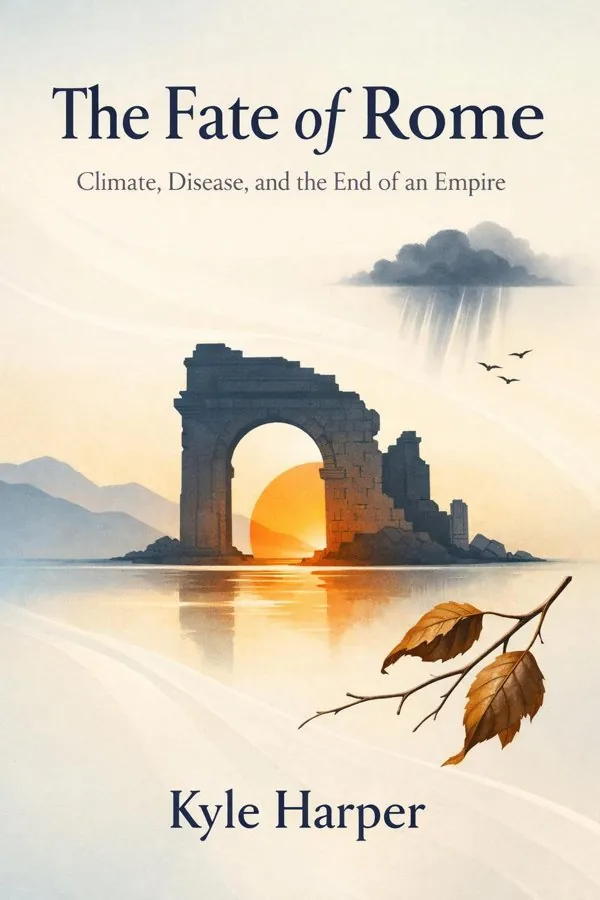
The Fate of Rome: Climate, Disease, and the End of an Empire: Summary & Key Insights
by Kyle Harper
 10 min8 chaptersAudio available
What Is The Fate of Rome: Climate, Disease, and the End of an Empire About?
The Fate of Rome: Climate, Disease, and the End of an Empire by Kyle Harper is a world_history book spanning 8 pages. This book explores how climate change and infectious diseases shaped the decline and fall of the Roman Empire. Drawing on recent advances in climate science, genetics, and archaeology, Harper argues that environmental and biological forces played a decisive role in transforming the ancient world, challenging traditional narratives focused solely on politics and economics.
This FizzRead summary covers all 8 key chapters of The Fate of Rome: Climate, Disease, and the End of an Empire in approximately 10 minutes, distilling the most important ideas, arguments, and takeaways from Kyle Harper's work. Also available as an audio summary and Key Quotes Podcast.
The Fate of Rome: Climate, Disease, and the End of an Empire
This book explores how climate change and infectious diseases shaped the decline and fall of the Roman Empire. Drawing on recent advances in climate science, genetics, and archaeology, Harper argues that environmental and biological forces played a decisive role in transforming the ancient world, challenging traditional narratives focused solely on politics and economics.
Who Should Read The Fate of Rome: Climate, Disease, and the End of an Empire?
This book is perfect for anyone interested in world_history and looking to gain actionable insights in a short read. Whether you're a student, professional, or lifelong learner, the key ideas from The Fate of Rome: Climate, Disease, and the End of an Empire by Kyle Harper will help you think differently.
- ✓Readers who enjoy world_history and want practical takeaways
- ✓Professionals looking to apply new ideas to their work and life
- ✓Anyone who wants the core insights of The Fate of Rome: Climate, Disease, and the End of an Empire in just 10 minutes
Want the full summary?
Get instant access to this book summary and 100K+ more with Fizz Moment.
Get Free SummaryAvailable on App Store • Free to download
Key Chapters
At the height of Rome’s power, roughly between 200 BCE and 150 CE, the empire enjoyed what scientists now call the Roman Climate Optimum—a period of unusually stable, warm, and humid conditions across the Mediterranean. This was not mere background noise; it was the ecological foundation on which Roman civilization expanded. Reliable rainfall sustained bumper agricultural yields; river flows enabled trade and transport; mild winters reduced the risk of famine and disease. From the Tiber to the Nile, Rome’s prosperity was literally rooted in the soil and the sky.
In those centuries, the Mediterranean basin experienced a climatic sweet spot that allowed Rome’s agrarian economy to flourish. Grain from Egypt and North Africa fed the cities; vineyards and olive groves extended into hillsides once thought marginal. The empire’s expansion coincided with this favorable climate—Rome’s legions conquered lands that were agriculturally abundant, and its population grew to unprecedented levels. Climatic stability reinforced social stability. The Roman peace, or *Pax Romana*, was underpinned by environmental peace.
But climate is never static. Underneath this apparent equilibrium, subtle changes in temperature and rainfall occurred, and these would later affect the empire’s ecological balance. The favorable climate encouraged population density and urbanization—conditions that seemed like triumphs of human engineering but would one day create pathways for epidemic disease. The same roads and aqueducts that unified the world also linked its pathogens. Thus, the Roman Climate Optimum was not only a golden age but the setting of deep ecological vulnerability.
Rome was more than a political entity—it was an ecological empire. Its infrastructure and trade networks formed arteries through which both wealth and disease flowed. Cities were hubs of human density, animated by constant movement of people, goods, and animals. Livestock carried zoonotic pathogens; sailors brought foreign microbes; and the empire’s waste systems, though innovative, concentrated exposure.
From my perspective as a historian examining environmental evidence, it’s clear that the empire’s ecological footprint was immense. Deforestation for agriculture altered local climates and disrupted watersheds. Mining and urban growth consumed resources at a pace that strained the land’s capacity to recover. This interconnectedness created resilience but also fragility: when food systems faltered or disease struck one region, the ripple effects spread across provinces.
The Roman ecological system was both marvel and menace—a network that fostered human flourishing but amplified the consequences of environmental shocks. Every aqueduct and market was a triumph of civilization and a channel for contagion. The empire’s cohesion made it more susceptible to systemic crisis. As I argue throughout the book, understanding this ecological interdependence is essential to grasp why the same structures that built Rome also became the conduits of its undoing.
+ 6 more chapters — available in the FizzRead app
All Chapters in The Fate of Rome: Climate, Disease, and the End of an Empire
About the Author
Kyle Harper is an American historian and professor at the University of Oklahoma. His research focuses on the history of the Roman world, environmental history, and the intersection of human societies with natural forces.
Get This Summary in Your Preferred Format
Read or listen to the The Fate of Rome: Climate, Disease, and the End of an Empire summary by Kyle Harper anytime, anywhere. FizzRead offers multiple formats so you can learn on your terms — all free.
Available formats: App · Audio · PDF · EPUB — All included free with FizzRead
Download The Fate of Rome: Climate, Disease, and the End of an Empire PDF and EPUB Summary
Key Quotes from The Fate of Rome: Climate, Disease, and the End of an Empire
“This was not mere background noise; it was the ecological foundation on which Roman civilization expanded.”
“Rome was more than a political entity—it was an ecological empire.”
Frequently Asked Questions about The Fate of Rome: Climate, Disease, and the End of an Empire
The Fate of Rome: Climate, Disease, and the End of an Empire by Kyle Harper is a world_history book that explores key ideas across 8 chapters. This book explores how climate change and infectious diseases shaped the decline and fall of the Roman Empire. Drawing on recent advances in climate science, genetics, and archaeology, Harper argues that environmental and biological forces played a decisive role in transforming the ancient world, challenging traditional narratives focused solely on politics and economics.
You Might Also Like
The Age of Capital
Eric Hobsbawm
10 min
The Gulag Archipelago
Aleksandr Solzhenitsyn
10 min
Jerusalem: The Biography
Simon Sebag Montefiore
10 min
The Anglo-Saxons
James Campbell
10 min
The Boer War
Thomas Pakenham
10 min
The Industrial Revolutionaries: The Making of the Modern World 1776–1914
Gavin Weightman
10 minBrowse by Category
Ready to read The Fate of Rome: Climate, Disease, and the End of an Empire?
Get the full summary and 100K+ more books with Fizz Moment.