
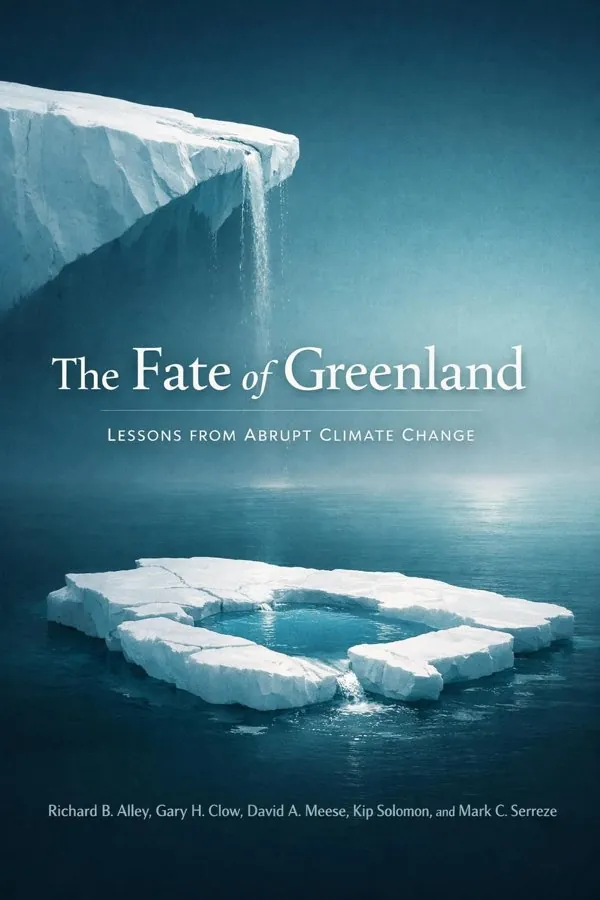
The Fate of Greenland: Lessons from Abrupt Climate Change: Summary & Key Insights
by Richard B. Alley, Gary H. Clow, David A. Meese, Kip Solomon, and Mark C. Serreze
 10 min4 chaptersAudio available
What Is The Fate of Greenland: Lessons from Abrupt Climate Change About?
The Fate of Greenland: Lessons from Abrupt Climate Change by Richard B. Alley, Gary H. Clow, David A. Meese, Kip Solomon, and Mark C. Serreze is a environment book spanning 4 pages. This book explores Greenland’s rapidly changing climate and its global implications. Through vivid photography and scientific analysis, the authors document the melting of Greenland’s ice sheets and investigate abrupt climate changes revealed in ice cores. The work provides insights into how Greenland’s climate history can inform our understanding of future environmental shifts.
This FizzRead summary covers all 4 key chapters of The Fate of Greenland: Lessons from Abrupt Climate Change in approximately 10 minutes, distilling the most important ideas, arguments, and takeaways from Richard B. Alley, Gary H. Clow, David A. Meese, Kip Solomon, and Mark C. Serreze's work. Also available as an audio summary and Key Quotes Podcast.
The Fate of Greenland: Lessons from Abrupt Climate Change
This book explores Greenland’s rapidly changing climate and its global implications. Through vivid photography and scientific analysis, the authors document the melting of Greenland’s ice sheets and investigate abrupt climate changes revealed in ice cores. The work provides insights into how Greenland’s climate history can inform our understanding of future environmental shifts.
Who Should Read The Fate of Greenland: Lessons from Abrupt Climate Change?
This book is perfect for anyone interested in environment and looking to gain actionable insights in a short read. Whether you're a student, professional, or lifelong learner, the key ideas from The Fate of Greenland: Lessons from Abrupt Climate Change by Richard B. Alley, Gary H. Clow, David A. Meese, Kip Solomon, and Mark C. Serreze will help you think differently.
- ✓Readers who enjoy environment and want practical takeaways
- ✓Professionals looking to apply new ideas to their work and life
- ✓Anyone who wants the core insights of The Fate of Greenland: Lessons from Abrupt Climate Change in just 10 minutes
Want the full summary?
Get instant access to this book summary and 100K+ more with Fizz Moment.
Get Free SummaryAvailable on App Store • Free to download
Key Chapters
Every scientific expedition to Greenland starts with one astonishing fact: the ice sheet here is not just frozen water; it is frozen time. As we drill into layers sometimes exceeding 3000 meters in depth, each segment reveals a chapter of climate history, a rhythm of snowfalls and melts stretching back more than 100,000 years. The principle is elegant — snow falls, compresses, and turns to ice, trapping tiny bubbles of air and minute traces of dust and chemicals. Studying these layers allows us to reconstruct the atmosphere of the past.
Ice cores turned out to be one of the most powerful tools we have for decoding climate change. They show how temperature varied, how CO₂ and methane concentrations shifted, and how volcanic eruptions or ocean circulation upheavals influenced global patterns. During our work with cores from central Greenland’s Summit station and the GRIP and GISP2 projects, we discovered abrupt, step-like changes in isotopic ratios—evidence that temperature could leap by several degrees within mere decades.
The ice archive humbled us: climate stability, often taken for granted, proved a fleeting illusion. Greenland recorded not only cold glacial periods but warm intervals that interrupted them. Dust concentrations told us about wind patterns and continental dryness; sulfate traces revealed massive eruptions that cooled the Earth temporarily. Through this frozen repository, we could weave together a global narrative — a world where oceans, atmosphere, and ice are inseparably intertwined.
Standing beside the drilling rig with the wind biting our faces, we felt the weight of what this data meant. In these cores, Earth itself whispered its warnings. The story of Greenland’s ice sheet is not a distant curiosity; it’s an archive of human relevance — reminding us that climate history is dynamic, unpredictable, and deeply dependent on our planet’s delicate feedback systems.
When scientists first examined the isotopic data from Greenland’s deep ice cores, something extraordinary emerged. The climate did not merely drift between cold and warm phases over millennia; sometimes it flipped — suddenly. These abrupt changes, often referred to as Dansgaard–Oeschger events, showed warming of up to 10°C in Greenland occurring within decades. Such rapid shifts contradict the old idea that Earth’s climate evolves slowly.
We traced these events to intricate interactions between ocean currents, atmospheric circulation, and ice feedbacks. The North Atlantic, vital for transporting heat northward through the Gulf Stream, appeared to be a key player. When freshwater pulses from melting ice disrupted this system, circulation could stall, quickly plunging regions into cold. When the flow recovered, temperatures rebounded with stunning pace.
One historic example, the Younger Dryas, is etched clearly in Greenland’s core record — a cold snap around 12,800 years ago that interrupted post-glacial warming. Within a human lifetime, temperatures dropped dramatically across the Northern Hemisphere. Earth’s climate, it seemed, could react faster than civilizations could adapt. These transitions illuminate how interconnected systems like sea ice, ocean salinity, and atmospheric pressure amplify small triggers into global consequences.
As we interpreted these abrupt changes, the image of stability faded entirely. Climate, we recognized, behaves like a system poised on thresholds. When tips are reached, the reaction is swift. Greenland taught us that abrupt change is not an exception but a recurring theme in Earth’s climate narrative. The implication is profound: today’s rising greenhouse gases may once again push the system toward a tipping point. Understanding the subtle signals embedded in ice is our best hope to anticipate and mitigate the next leap.
+ 2 more chapters — available in the FizzRead app
All Chapters in The Fate of Greenland: Lessons from Abrupt Climate Change
About the Authors
Richard B. Alley is a geoscientist known for his research on ice cores and climate change. Gary H. Clow, David A. Meese, Kip Solomon, and Mark C. Serreze are climate scientists specializing in glaciology, hydrology, and Arctic systems. Together, they contribute decades of expertise to understanding Earth's climate dynamics.
Get This Summary in Your Preferred Format
Read or listen to the The Fate of Greenland: Lessons from Abrupt Climate Change summary by Richard B. Alley, Gary H. Clow, David A. Meese, Kip Solomon, and Mark C. Serreze anytime, anywhere. FizzRead offers multiple formats so you can learn on your terms — all free.
Available formats: App · Audio · PDF · EPUB — All included free with FizzRead
Download The Fate of Greenland: Lessons from Abrupt Climate Change PDF and EPUB Summary
Key Quotes from The Fate of Greenland: Lessons from Abrupt Climate Change
“Every scientific expedition to Greenland starts with one astonishing fact: the ice sheet here is not just frozen water; it is frozen time.”
“When scientists first examined the isotopic data from Greenland’s deep ice cores, something extraordinary emerged.”
Frequently Asked Questions about The Fate of Greenland: Lessons from Abrupt Climate Change
The Fate of Greenland: Lessons from Abrupt Climate Change by Richard B. Alley, Gary H. Clow, David A. Meese, Kip Solomon, and Mark C. Serreze is a environment book that explores key ideas across 4 chapters. This book explores Greenland’s rapidly changing climate and its global implications. Through vivid photography and scientific analysis, the authors document the melting of Greenland’s ice sheets and investigate abrupt climate changes revealed in ice cores. The work provides insights into how Greenland’s climate history can inform our understanding of future environmental shifts.
You Might Also Like
A Life on Our Planet: My Witness Statement and a Vision for the Future
David Attenborough
10 min
A Sky Full Of Birds
Matt Merritt
10 min
Carbon Zero: Imagining Cities That Can Save the Planet
Alex Steffen
10 min
Eaarth: Making a Life on a Tough New Planet
Bill McKibben
10 min
The Social Contract and Environmental Governance
Various Editors
10 min
The Wild Places
Robert Macfarlane
10 minBrowse by Category
Ready to read The Fate of Greenland: Lessons from Abrupt Climate Change?
Get the full summary and 100K+ more books with Fizz Moment.