
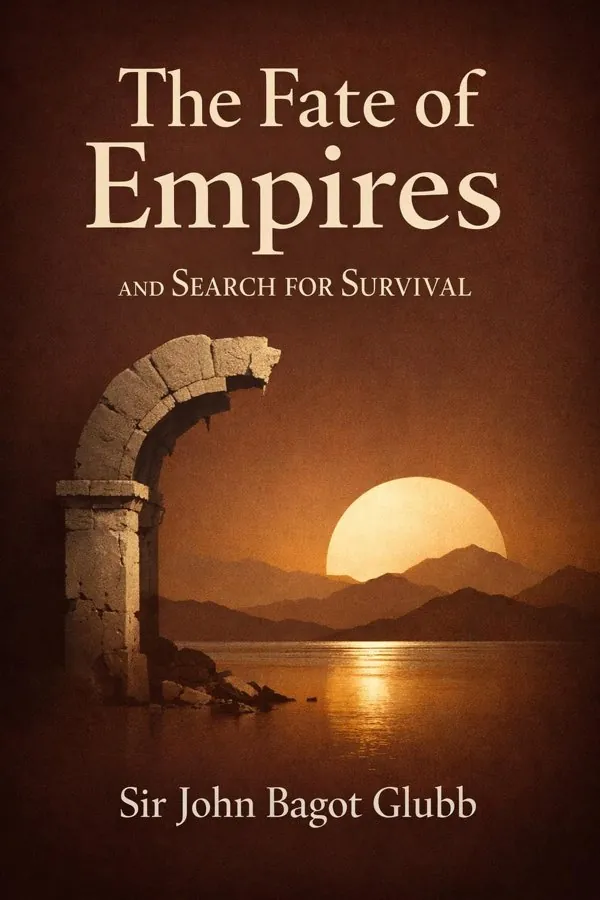
The Fate of Empires and Search for Survival: Summary & Key Insights
 10 min11 chaptersAudio available
What Is The Fate of Empires and Search for Survival About?
The Fate of Empires and Search for Survival by Sir John Bagot Glubb is a civilization book spanning 11 pages. In this influential essay, Sir John Bagot Glubb examines the recurring patterns in the rise and fall of empires throughout history. Drawing on examples from ancient to modern civilizations, he identifies common stages of growth, expansion, decadence, and decline, arguing that empires tend to follow a predictable life cycle lasting roughly 250 years. The work reflects on the moral, cultural, and social factors that contribute to both the flourishing and eventual decay of great powers.
This FizzRead summary covers all 11 key chapters of The Fate of Empires and Search for Survival in approximately 10 minutes, distilling the most important ideas, arguments, and takeaways from Sir John Bagot Glubb's work. Also available as an audio summary and Key Quotes Podcast.
The Fate of Empires and Search for Survival
In this influential essay, Sir John Bagot Glubb examines the recurring patterns in the rise and fall of empires throughout history. Drawing on examples from ancient to modern civilizations, he identifies common stages of growth, expansion, decadence, and decline, arguing that empires tend to follow a predictable life cycle lasting roughly 250 years. The work reflects on the moral, cultural, and social factors that contribute to both the flourishing and eventual decay of great powers.
Who Should Read The Fate of Empires and Search for Survival?
This book is perfect for anyone interested in civilization and looking to gain actionable insights in a short read. Whether you're a student, professional, or lifelong learner, the key ideas from The Fate of Empires and Search for Survival by Sir John Bagot Glubb will help you think differently.
- ✓Readers who enjoy civilization and want practical takeaways
- ✓Professionals looking to apply new ideas to their work and life
- ✓Anyone who wants the core insights of The Fate of Empires and Search for Survival in just 10 minutes
Want the full summary?
Get instant access to this book summary and 100K+ more with Fizz Moment.
Get Free SummaryAvailable on App Store • Free to download
Key Chapters
As I sifted through centuries of recorded history, the evidence became overwhelming. Civilizations as diverse as Assyria, Persia, Greece, Rome, the Arab Empire, and later Britain all rose through remarkably similar processes. At first, a small, vigorous people emerge — often hardened by struggle and scarcity. Driven by faith and courage, they expand their rule, guided by visionary leadership. Early Rome was not Rome the ruler of the Mediterranean, but a stoic agrarian republic fighting for its survival. Early Britain, before its empire, was a trading island of restless adventurers and naval pioneers.
Each of these societies began with moral purpose. They believed in something beyond comfort — duty, honor, faith, discovery. But as they succeeded, their priorities shifted. Wealth replaced virtue as the measure of greatness; leisure replaced labor as the mark of refinement. The story of the Arab Empire exemplifies this: beginning as a desert community united by spiritual fervor, it spread across vast lands, creating a civilization unsurpassed in science, art, and philosophy. Yet when intellectual pride overshadowed spiritual humility, decline inevitably followed.
What fascinates me is not the uniqueness of each empire’s story, but the universality of their pattern. The succession of ages that I outline — from pioneers to decadents — repeats with such regularity that one cannot escape the impression of a shared human rhythm. It is as if, in building empires, mankind repeatedly builds its own moral test and, tragically, repeatedly fails it.
Every empire’s birth begins with an age of pioneers — men and women who defy conditions, explore unknown lands, and carve the foundations of a new order. These early generations are marked above all by courage. They live simply, endure hardship, and believe fiercely in the rightness of their cause. In early Rome, the citizen-farmer stood ready to defend his patch of land. In the beginnings of the British Empire, sailors and adventurers crossed oceans with little more than faith and determination.
This pioneering stage is the crucible of virtue. The empire’s strength arises not from wealth, but from character. The sense of community is strong; leaders and followers share a common purpose and sacrifice. These are not times of perfection — there is cruelty, struggle, and error — but they are times of life. Each hardship builds moral fiber, tempering the culture for the greatness to come.
An age of pioneers teaches us a vital truth: all lasting power is born out of belief. When exploration ends and comfort begins, the spirit that first animated a people may begin to fade. Only by sustaining that early courage and moral simplicity can societies resist the seeds of decay already planted in success.
+ 9 more chapters — available in the FizzRead app
All Chapters in The Fate of Empires and Search for Survival
About the Author
Sir John Bagot Glubb (1897–1986), also known as Glubb Pasha, was a British soldier, scholar, and author. He served in the British Army and later commanded the Arab Legion in Transjordan. Glubb wrote extensively on Middle Eastern history, military affairs, and the philosophy of empire, combining his practical experience with a deep interest in historical patterns and human behavior.
Get This Summary in Your Preferred Format
Read or listen to the The Fate of Empires and Search for Survival summary by Sir John Bagot Glubb anytime, anywhere. FizzRead offers multiple formats so you can learn on your terms — all free.
Available formats: App · Audio · PDF · EPUB — All included free with FizzRead
Download The Fate of Empires and Search for Survival PDF and EPUB Summary
Key Quotes from The Fate of Empires and Search for Survival
“As I sifted through centuries of recorded history, the evidence became overwhelming.”
“Every empire’s birth begins with an age of pioneers — men and women who defy conditions, explore unknown lands, and carve the foundations of a new order.”
Frequently Asked Questions about The Fate of Empires and Search for Survival
The Fate of Empires and Search for Survival by Sir John Bagot Glubb is a civilization book that explores key ideas across 11 chapters. In this influential essay, Sir John Bagot Glubb examines the recurring patterns in the rise and fall of empires throughout history. Drawing on examples from ancient to modern civilizations, he identifies common stages of growth, expansion, decadence, and decline, arguing that empires tend to follow a predictable life cycle lasting roughly 250 years. The work reflects on the moral, cultural, and social factors that contribute to both the flourishing and eventual decay of great powers.
You Might Also Like
The Structure of Scientific Revolutions
Thomas S. Kuhn
10 min
Genius
Harold Bloom
10 min
A Cultural History of the Medieval Age
Various Editors
10 min
A History of God: The 4,000-Year Quest of Judaism, Christianity and Islam
Karen Armstrong
10 min
A History of the World in 10½ Chapters
Julian Barnes
10 min
A Short History of Progress
Ronald Wright
10 minBrowse by Category
Ready to read The Fate of Empires and Search for Survival?
Get the full summary and 100K+ more books with Fizz Moment.