
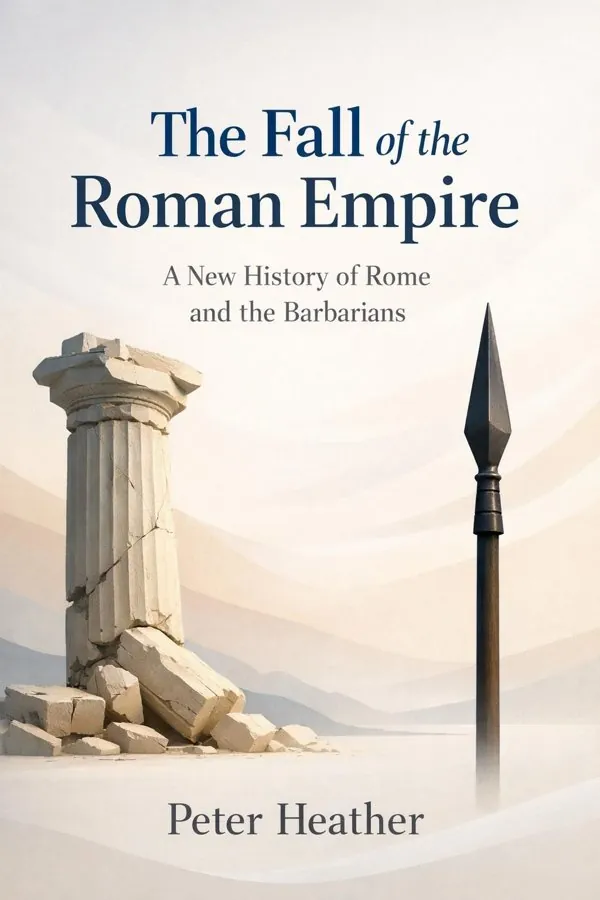
The Fall of the Roman Empire: A New History of Rome and the Barbarians: Summary & Key Insights
 10 min9 chaptersAudio available
What Is The Fall of the Roman Empire: A New History of Rome and the Barbarians About?
The Fall of the Roman Empire: A New History of Rome and the Barbarians by Peter Heather is a world_history book spanning 9 pages. This book offers a comprehensive reinterpretation of the decline and fall of the Western Roman Empire. Peter Heather argues that the empire’s collapse was not due to internal decay but rather to the growing power and organization of barbarian groups such as the Goths and Huns. Drawing on archaeological and textual evidence, Heather presents a dynamic picture of late antiquity, emphasizing the complex interactions between Rome and its neighbors that ultimately reshaped Europe.
This FizzRead summary covers all 9 key chapters of The Fall of the Roman Empire: A New History of Rome and the Barbarians in approximately 10 minutes, distilling the most important ideas, arguments, and takeaways from Peter Heather's work. Also available as an audio summary and Key Quotes Podcast.
The Fall of the Roman Empire: A New History of Rome and the Barbarians
This book offers a comprehensive reinterpretation of the decline and fall of the Western Roman Empire. Peter Heather argues that the empire’s collapse was not due to internal decay but rather to the growing power and organization of barbarian groups such as the Goths and Huns. Drawing on archaeological and textual evidence, Heather presents a dynamic picture of late antiquity, emphasizing the complex interactions between Rome and its neighbors that ultimately reshaped Europe.
Who Should Read The Fall of the Roman Empire: A New History of Rome and the Barbarians?
This book is perfect for anyone interested in world_history and looking to gain actionable insights in a short read. Whether you're a student, professional, or lifelong learner, the key ideas from The Fall of the Roman Empire: A New History of Rome and the Barbarians by Peter Heather will help you think differently.
- ✓Readers who enjoy world_history and want practical takeaways
- ✓Professionals looking to apply new ideas to their work and life
- ✓Anyone who wants the core insights of The Fall of the Roman Empire: A New History of Rome and the Barbarians in just 10 minutes
Want the full summary?
Get instant access to this book summary and 100K+ more with Fizz Moment.
Get Free SummaryAvailable on App Store • Free to download
Key Chapters
It’s easy to imagine that, by the fourth century CE, the Roman Empire was already crumbling. But the truth is more complex, and more fascinating. Far from being an exhausted relic of past grandeur, the Empire of the fourth century was, in many respects, robust, adaptive, and wealthier than before. The reforms of Diocletian and Constantine had stabilized finances, improved governance, and streamlined military organization. Taxation was harsh, but it provided the state with the means to field large professional armies and maintain a sophisticated bureaucracy that reached the far corners of its vast territory.
Politically, the empire had become a finely tuned machine for power. The administrative division into eastern and western halves was not, as some claim, a sign of weakness — it was an acknowledgment of scale and complexity, a realistic adaptation to governing an enormous dominion. Militarily, Rome remained formidable. Its legions were disciplined, its frontier defenses sophisticated, and its capacity for projection of power across the Mediterranean extraordinary by ancient standards.
What fascinates me most about this era is its energy. The Christians, once persecuted, were now shaping imperial ideology. Cities still thrived as centers of administration and culture. Despite occasional crises, society had found a balance between tradition and change. In short, Rome’s house was not collapsing — it was simply surrounded by neighbors whose ambitions were growing faster than ever before.
Rome’s borders were never walls — they were zones of contact, exchange, and absorption. Along the Rhine and Danube, the empire interacted with a constellation of peoples: Franks, Alamanni, Goths, and countless others who traded, served as mercenaries, and sometimes raided across the frontiers. For centuries, this ebb and flow was stable. Rome had the upper hand, and barbarians sought entry more than confrontation.
But by the fourth century, the relationship had evolved. Rome’s military needs meant that barbarian recruits were increasingly common in imperial armies. With pay and land as rewards, many barbarian leaders became loyal servants of Rome. Yet this dependence also carried risk: entire groups were now being settled within the empire’s territories, their autonomy gradually solidifying.
The frontier was thus a living organism — porous, dynamic, and constantly redefined. This is where the long story of transformation begins: the barbarians learning Roman ways, adopting Roman weapons, titles, and sometimes Christianity itself. Far from being static outsiders, they were participants in the late Roman world, poised to become heirs when imperial authority waned.
+ 7 more chapters — available in the FizzRead app
All Chapters in The Fall of the Roman Empire: A New History of Rome and the Barbarians
About the Author
Peter Heather is a British historian and professor of medieval history at King’s College London. He specializes in the late Roman Empire and early medieval Europe, with particular focus on the Goths and the transformation of the Roman world.
Get This Summary in Your Preferred Format
Read or listen to the The Fall of the Roman Empire: A New History of Rome and the Barbarians summary by Peter Heather anytime, anywhere. FizzRead offers multiple formats so you can learn on your terms — all free.
Available formats: App · Audio · PDF · EPUB — All included free with FizzRead
Download The Fall of the Roman Empire: A New History of Rome and the Barbarians PDF and EPUB Summary
Key Quotes from The Fall of the Roman Empire: A New History of Rome and the Barbarians
“It’s easy to imagine that, by the fourth century CE, the Roman Empire was already crumbling.”
“Rome’s borders were never walls — they were zones of contact, exchange, and absorption.”
Frequently Asked Questions about The Fall of the Roman Empire: A New History of Rome and the Barbarians
The Fall of the Roman Empire: A New History of Rome and the Barbarians by Peter Heather is a world_history book that explores key ideas across 9 chapters. This book offers a comprehensive reinterpretation of the decline and fall of the Western Roman Empire. Peter Heather argues that the empire’s collapse was not due to internal decay but rather to the growing power and organization of barbarian groups such as the Goths and Huns. Drawing on archaeological and textual evidence, Heather presents a dynamic picture of late antiquity, emphasizing the complex interactions between Rome and its neighbors that ultimately reshaped Europe.
You Might Also Like
The Age of Capital
Eric Hobsbawm
10 min
The Gulag Archipelago
Aleksandr Solzhenitsyn
10 min
Jerusalem: The Biography
Simon Sebag Montefiore
10 min
The Anglo-Saxons
James Campbell
10 min
The Boer War
Thomas Pakenham
10 min
The Industrial Revolutionaries: The Making of the Modern World 1776–1914
Gavin Weightman
10 minBrowse by Category
Ready to read The Fall of the Roman Empire: A New History of Rome and the Barbarians?
Get the full summary and 100K+ more books with Fizz Moment.