
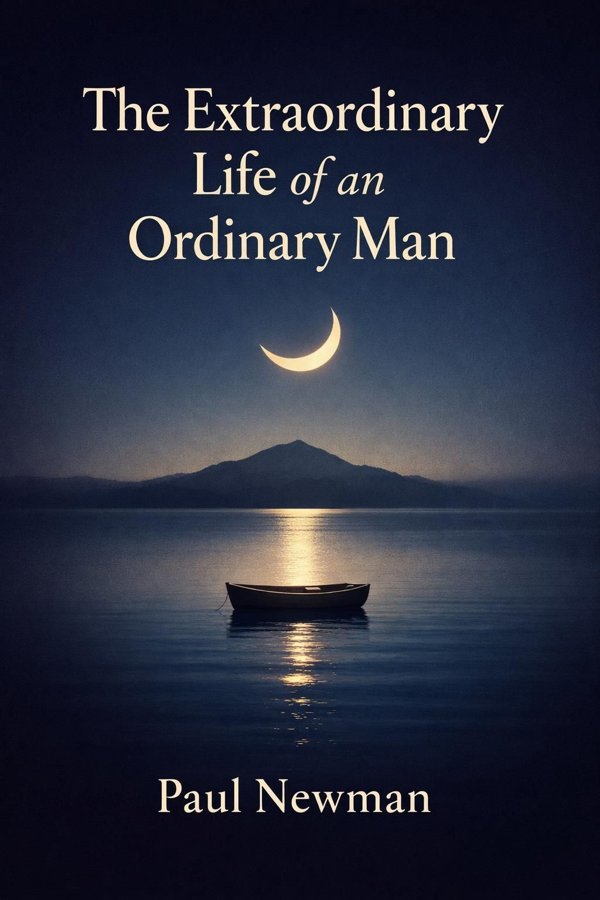
The Extraordinary Life of an Ordinary Man: A Memoir: Summary & Key Insights
by Paul Newman
 10 min10 chaptersAudio available
Key Takeaways from The Extraordinary Life of an Ordinary Man: A Memoir
A secure childhood can still leave a person emotionally unsteady.
One of the hardest truths to accept is that survival is not always earned.
Sometimes we enter a profession not because we know ourselves, but because we are trying to find a self worth inhabiting.
Public admiration does not cure private doubt.
Great love stories are rarely free of damage, sacrifice, or contradiction.
What Is The Extraordinary Life of an Ordinary Man: A Memoir About?
The Extraordinary Life of an Ordinary Man: A Memoir by Paul Newman is a biographies book spanning 10 pages. The Extraordinary Life of an Ordinary Man is not a standard celebrity memoir built around polished anecdotes and career triumphs. Instead, it is a candid self-examination assembled from Paul Newman’s recorded reflections, along with memories from family, friends, and colleagues. The result is a portrait of a man who was celebrated by the world yet often unconvinced by his own image. Newman writes about his childhood in Ohio, his wartime service, his uneven path into acting, his rise to stardom, his marriage to Joanne Woodward, his struggles with guilt and self-doubt, and the quiet search for meaning that shaped his later life. What makes this memoir matter is its unusual honesty. Newman does not use fame to shield himself; he uses it as a lens through which to question identity, masculinity, ambition, and love. He is interested less in preserving his legend than in exposing the contradictions behind it. As one of the most admired actors of his generation, as well as a racer, director, husband, father, and philanthropist, Newman brings rare authority to questions about success and character. This book reveals how a public icon spent much of his life trying to become a private truth.
This FizzRead summary covers all 10 key chapters of The Extraordinary Life of an Ordinary Man: A Memoir in approximately 10 minutes, distilling the most important ideas, arguments, and takeaways from Paul Newman's work. Also available as an audio summary and Key Quotes Podcast.
The Extraordinary Life of an Ordinary Man: A Memoir
The Extraordinary Life of an Ordinary Man is not a standard celebrity memoir built around polished anecdotes and career triumphs. Instead, it is a candid self-examination assembled from Paul Newman’s recorded reflections, along with memories from family, friends, and colleagues. The result is a portrait of a man who was celebrated by the world yet often unconvinced by his own image. Newman writes about his childhood in Ohio, his wartime service, his uneven path into acting, his rise to stardom, his marriage to Joanne Woodward, his struggles with guilt and self-doubt, and the quiet search for meaning that shaped his later life.
What makes this memoir matter is its unusual honesty. Newman does not use fame to shield himself; he uses it as a lens through which to question identity, masculinity, ambition, and love. He is interested less in preserving his legend than in exposing the contradictions behind it. As one of the most admired actors of his generation, as well as a racer, director, husband, father, and philanthropist, Newman brings rare authority to questions about success and character. This book reveals how a public icon spent much of his life trying to become a private truth.
Who Should Read The Extraordinary Life of an Ordinary Man: A Memoir?
This book is perfect for anyone interested in biographies and looking to gain actionable insights in a short read. Whether you're a student, professional, or lifelong learner, the key ideas from The Extraordinary Life of an Ordinary Man: A Memoir by Paul Newman will help you think differently.
- ✓Readers who enjoy biographies and want practical takeaways
- ✓Professionals looking to apply new ideas to their work and life
- ✓Anyone who wants the core insights of The Extraordinary Life of an Ordinary Man: A Memoir in just 10 minutes
Want the full summary?
Get instant access to this book summary and 100K+ more with Fizz Moment.
Get Free SummaryAvailable on App Store • Free to download
Key Chapters
A secure childhood can still leave a person emotionally unsteady. Newman grew up in Shaker Heights, Ohio, in material comfort, with a family business that provided stability and structure. From the outside, it was the kind of upbringing that should have produced confidence. But the memoir makes clear that inner security does not automatically grow from external privilege. His father was reliable and industrious, yet emotionally distant, while his mother was passionate, theatrical, and demanding. Between those two poles, Newman developed a deep uncertainty about who he was supposed to be.
This tension mattered because it shaped his entire adult life. He learned early how to perform versions of himself for different people. That skill later helped him as an actor, but it also made authenticity harder to reach. He could charm, please, and adapt, yet still feel emotionally unfixed. In many ways, his famous blue-eyed confidence was built over a nervous inner core.
The memoir invites readers to reconsider the common assumption that privilege eliminates struggle. A person may grow up with money, education, and opportunity, and still wrestle with shame, confusion, or emotional hunger. In everyday life, this shows up when high-achieving adults remain driven by the need for approval long after they have objectively succeeded.
Newman’s early years remind us to look beneath appearances. Stability is useful, but emotional attunement matters just as much. If you want to understand your present behavior, start by identifying the roles you learned in your family and asking whether they still serve you.
One of the hardest truths to accept is that survival is not always earned. Newman’s account of college and Navy service during World War II shows how deeply chance shaped his understanding of life. Military training brought discipline and exposure to danger, but it also forced him to confront the randomness behind who lives, who dies, and who gets another chance. The war did not simply make him tougher; it made him more aware of human fragility.
That awareness had a lasting impact. Rather than seeing success as pure merit, Newman came to recognize the role of timing, accident, and circumstance. This perspective gave him a complicated relationship with his own later fame. He worked hard, certainly, but he never fully believed that achievement alone explained where he ended up. Luck had intervened too often for that illusion to hold.
For readers, this is a powerful corrective to the mythology of total self-creation. We often tell stories about grit and determination while ignoring contingency. Newman does not deny effort, but he insists that humility must accompany ambition. In practical terms, this can change how we assess our lives. It can make us more grateful in success and more compassionate toward others in failure.
War also sharpened his awareness that life can pivot abruptly. That realization can sound bleak, but it can also be clarifying. It encourages people to stop postponing honest conversations, creative risks, or expressions of love.
The actionable lesson is simple: work seriously, but hold your achievements lightly. Recognize the role of luck in your life, and let that awareness make you humbler, kinder, and more present.
Sometimes we enter a profession not because we know ourselves, but because we are trying to find a self worth inhabiting. Newman’s path into acting was hesitant, imperfect, and deeply tied to insecurity. After the war, college did not provide a clear identity, and the family business did not feel like home. Acting emerged partly as refuge, partly as experiment. It gave him a place to channel emotion, inhabit confidence, and convert uncertainty into craft.
The memoir shows that he was not born with effortless artistic certainty. He worked, doubted, failed, and learned. Training at Yale Drama School and later at the Actors Studio exposed him to discipline and artistic seriousness, but also to comparison and self-consciousness. He often felt that others possessed a depth or legitimacy he lacked. Yet those very doubts pushed him to keep refining his work.
This idea reaches beyond acting. Many people begin careers through mixed motives: insecurity, curiosity, necessity, admiration, or accident. We like neat origin stories, but real vocations are often messy. What matters is whether a person stays long enough to develop skill and self-understanding. Newman did exactly that. Acting became not just a performance but an instrument for examining emotion, masculinity, and truth.
In practical life, this means you do not need pure certainty to begin meaningful work. A shaky start does not disqualify you. The key is to distinguish between impostor feelings and actual incapacity. Most growth happens after the glamorous fantasy fades and the craft begins.
Takeaway: if a pursuit keeps calling to you, do not wait to feel fully legitimate. Start where you are, accept the awkwardness, and let disciplined practice turn uncertainty into identity.
Public admiration does not cure private doubt. Newman’s rise in Hollywood brought prestige, money, and intense visibility, but it did not settle the questions he carried from earlier life. If anything, fame complicated them. The world projected confidence, beauty, and charisma onto him, while he remained painfully aware of his insecurities, his artistic anxieties, and the gap between image and experience.
This is one of the memoir’s most important insights. Success often looks like an answer from the outside, but from the inside it can become another layer of performance. Newman became a movie star in an industry built on surfaces, yet he was preoccupied with substance. He wanted to do good work, not just be admired. He worried about whether his looks overshadowed his talent. He sensed that fame could trap a person inside a marketable version of themselves.
That tension is still relevant today, especially in a culture shaped by social media, branding, and constant self-display. People often assume that visibility leads to validation and validation leads to peace. Newman’s life argues otherwise. Recognition can amplify scrutiny, distort intimacy, and make authenticity more difficult.
The practical application is not to reject ambition, but to define success more carefully. External rewards are unstable measures of inner worth. Careers, audiences, and reputations shift. Character and meaningful relationships matter more because they survive fluctuations in public attention.
Newman’s example suggests a grounded discipline: separate your work from your image. Focus on what you are making, contributing, or learning rather than how you are being perceived. The actionable takeaway is to build a life that would still feel coherent even if applause disappeared.
Great love stories are rarely free of damage, sacrifice, or contradiction. Newman’s relationship with Joanne Woodward stands at the emotional center of the memoir, but he does not romanticize it into a simple tale of devotion. Their marriage was deep, enduring, and creatively rich, yet it existed alongside guilt, family strain, competing demands, and the lingering consequences of choices made earlier in life. Love, in this memoir, is powerful but never neat.
Newman admired Woodward profoundly. She challenged him intellectually and artistically, and their connection offered a kind of home he had long been seeking. At the same time, he acknowledges the costs attached to their life together, particularly the pain surrounding divorce, blended family realities, and the way career pressures affected domestic life. The memoir’s honesty lies in its refusal to separate joy from responsibility.
This makes the book especially useful for readers who want a mature picture of partnership. Long marriages do not endure because two people feel intensely forever. They endure because both people continue choosing the relationship amid imperfection, work, resentment, admiration, fatigue, and change. Newman and Woodward’s bond was strengthened not by fantasy, but by shared purpose, humor, mutual respect, and persistence.
In daily life, this means relationships should be judged not only by passion but by the quality of attention and accountability within them. Love needs maintenance. It also requires confronting the harm one brings into a partnership instead of hiding behind sentiment.
Actionable takeaway: if you value a relationship, speak honestly about both gratitude and regret. Lasting intimacy grows when admiration is paired with responsibility, and when love is treated as a practice, not just a feeling.
The most admired people are often still arguing with themselves in private. Throughout the memoir, Newman returns to themes of insecurity, shame, and fractured self-image. He doubted his talent, questioned his seriousness, worried about being valued mainly for his appearance, and carried painful forms of guilt, especially around family and fatherhood. His life demonstrates that success can expand opportunities without eliminating inner conflict.
This matters because many readers assume that confidence is a prerequisite for accomplishment. Newman’s life suggests the opposite: many people achieve at high levels while still feeling incomplete or uncertain. The danger comes when those internal battles are ignored. Untended self-doubt can distort choices, fuel overwork, encourage emotional distance, or lead people to seek relief through distraction and excess.
Newman does not offer easy therapeutic slogans. Instead, he shows how a person can function brilliantly while remaining emotionally unresolved. That realism gives the memoir its force. He is not presenting a clean arc from insecurity to self-acceptance. He is showing the ongoing work of living with contradiction.
For modern readers, this is liberating. You do not need to solve every internal wound before becoming effective, creative, or generous. But you do need enough awareness to keep your wounds from governing your life. Reflection, trusted relationships, honest feedback, and meaningful work can all serve as stabilizing forces.
The practical takeaway is to stop treating self-doubt as proof that you are fraudulent. Instead, examine what the doubt is trying to tell you. Some of it may be noise; some may point toward growth, healing, or a need for deeper honesty. Use self-awareness as a tool, not a sentence.
People sometimes discover themselves most clearly outside the field that made them famous. For Newman, auto racing became far more than a hobby. It offered concentration, danger, measurable skill, and a world in which glamour meant nothing. On the track, reputation could not substitute for performance. That reality was deeply attractive to him. Racing gave him a form of renewal because it demanded total presence and delivered honest feedback.
The memoir presents racing as both passion and corrective. Hollywood could be flattering, artificial, and image-driven; racing was unforgiving and concrete. You either handled the machine well or you did not. This appealed to Newman’s need for seriousness and earned competence. It also gave him joy later in life, proving that identity does not have to harden around one career.
There is a broader lesson here about adult vitality. Many people become trapped inside the role for which they are best known. Newman resisted that trap. By committing to a demanding pursuit outside acting, he created space for growth, humility, and exhilaration. He became a beginner again, and that beginnerhood kept him alive in a different way.
In practical terms, this suggests the value of pursuing a discipline that strips away status and reconnects you to effort. It might be sport, music, woodworking, language study, or another craft where results depend on attention and practice. The point is not novelty alone, but meaningful engagement.
Actionable takeaway: choose one serious activity that challenges your ego and sharpens your focus. A well-chosen passion can restore energy, broaden identity, and remind you that life remains expandable even after success.
Good intentions matter less than systems that reliably do good. Newman’s philanthropic legacy, especially through Newman's Own, shows how generosity becomes transformative when it is organized, scalable, and sustained. Rather than treating charity as a side gesture attached to fame, he helped build a model in which commercial success directly funded social impact. This allowed philanthropy to become not just personal kindness but institutional practice.
The memoir makes clear that giving was tied to meaning. Newman had long wrestled with guilt, privilege, and the unease of public adoration. Philanthropy did not erase those tensions, but it gave him a practical way to convert success into service. Importantly, this was not merely image management. The structure of the enterprise ensured that the giving had continuity and reach.
This idea is useful for readers because it reframes generosity from mood to method. Many people want to contribute but treat giving as occasional and reactive. Newman’s example suggests asking different questions: How can I make generosity regular? What systems can I build so that my values survive beyond my impulses? Even ordinary households can apply this logic through automated donations, volunteer routines, mentorship commitments, or business models that include social contribution.
Philanthropy here is not about moral perfection. It is about reducing the gap between values and action. By embedding contribution into the structure of life and work, a person makes generosity less dependent on emotion, convenience, or public recognition.
Takeaway: do not wait to feel extraordinary before giving. Create a repeatable system, however small, that turns your values into ongoing action. Consistency often matters more than spectacle.
As life narrows, the questions become simpler and harder: What mattered, whom did I love well, and what remains when identity sheds its titles? In the later reflections of the memoir, Newman turns toward aging, mortality, and the search for meaning with a quiet sobriety. The glamour of earlier decades recedes, and what comes forward are regrets, gratitudes, unfinished reckonings, and the need to make peace with impermanence.
What is striking is that he does not pretend old age grants instant wisdom. Instead, it strips away distractions. Physical decline, loss, and time’s visible limits force a more honest inventory. Achievements remain real, but they no longer answer the deepest questions. Stardom, acclaim, and productivity cannot replace reconciliation, affection, or self-knowledge.
This makes the memoir especially resonant for readers thinking about legacy. Newman’s reflections suggest that legacy is not mainly what the public remembers. It is the moral and emotional residue left in other people’s lives. Did you offer steadiness? Did you repair what you could? Did you use your gifts well enough? These are more demanding standards than prestige.
In practical life, mortality can be used not as a source of panic but of prioritization. Awareness of endings can help people reorder commitments, stop postponing difficult conversations, and invest more deliberately in relationships and contribution.
The actionable takeaway is to conduct a living inventory now rather than at the end. Ask what in your current life would still matter if status disappeared and time shortened. Then give more attention to those things while you still can.
Sometimes the most revealing autobiography is the one that refuses to become self-protection. Because this memoir was assembled after Newman’s death from recorded reflections and interviews with people who knew him, it carries a distinctive texture. It is personal but not fully controlled, intimate but not overly polished. That posthumous structure allows readers to encounter both Newman’s own voice and the corrective presence of others.
This matters because memory is never singular. Public figures often produce memoirs that consolidate a preferred narrative, smoothing contradictions into coherence. Here, coherence is less important than honesty. Newman’s self-questioning remains intact, and the supporting voices add dimension, context, and friction. The result is a fuller portrait of a man who was generous and flawed, charismatic and uncertain, loving and at times difficult or absent.
For readers, this offers a lesson about truth-telling. A meaningful life story is not one in which every event supports a heroic identity. It is one in which contradictions are allowed to stand. In our own lives, we often curate ourselves too aggressively, especially in public or professional settings. Newman’s memoir demonstrates the dignity of complexity.
Practically, this can influence how we speak about our own past. Rather than reducing ourselves to triumphs or wounds, we can hold multiple truths at once. We can admit both gratitude and regret, strength and limitation.
Takeaway: leave room in your self-understanding for contradiction. A credible legacy is not built by appearing flawless, but by being honest enough that others can recognize themselves in your struggle.
All Chapters in The Extraordinary Life of an Ordinary Man: A Memoir
About the Author
Paul Newman (1925–2008) was an American actor, director, race car driver, entrepreneur, and philanthropist whose career spanned more than five decades. He rose to prominence through acclaimed performances in films such as Cat on a Hot Tin Roof, The Hustler, Cool Hand Luke, Butch Cassidy and the Sundance Kid, and The Color of Money, for which he won an Academy Award. Beyond cinema, Newman built a respected second career in auto racing and became widely admired for his humanitarian work. He co-founded Newman's Own, a food company that donated all profits to charity, generating hundreds of millions of dollars for good causes. Married to actress Joanne Woodward, Newman remained a major cultural figure not only for his talent and charisma, but also for his integrity, generosity, and enduring self-questioning.
Get This Summary in Your Preferred Format
Read or listen to the The Extraordinary Life of an Ordinary Man: A Memoir summary by Paul Newman anytime, anywhere. FizzRead offers multiple formats so you can learn on your terms — all free.
Available formats: App · Audio · PDF · EPUB — All included free with FizzRead
Download The Extraordinary Life of an Ordinary Man: A Memoir PDF and EPUB Summary
Key Quotes from The Extraordinary Life of an Ordinary Man: A Memoir
“A secure childhood can still leave a person emotionally unsteady.”
“One of the hardest truths to accept is that survival is not always earned.”
“Sometimes we enter a profession not because we know ourselves, but because we are trying to find a self worth inhabiting.”
“Public admiration does not cure private doubt.”
“Great love stories are rarely free of damage, sacrifice, or contradiction.”
Frequently Asked Questions about The Extraordinary Life of an Ordinary Man: A Memoir
The Extraordinary Life of an Ordinary Man: A Memoir by Paul Newman is a biographies book that explores key ideas across 10 chapters. The Extraordinary Life of an Ordinary Man is not a standard celebrity memoir built around polished anecdotes and career triumphs. Instead, it is a candid self-examination assembled from Paul Newman’s recorded reflections, along with memories from family, friends, and colleagues. The result is a portrait of a man who was celebrated by the world yet often unconvinced by his own image. Newman writes about his childhood in Ohio, his wartime service, his uneven path into acting, his rise to stardom, his marriage to Joanne Woodward, his struggles with guilt and self-doubt, and the quiet search for meaning that shaped his later life. What makes this memoir matter is its unusual honesty. Newman does not use fame to shield himself; he uses it as a lens through which to question identity, masculinity, ambition, and love. He is interested less in preserving his legend than in exposing the contradictions behind it. As one of the most admired actors of his generation, as well as a racer, director, husband, father, and philanthropist, Newman brings rare authority to questions about success and character. This book reveals how a public icon spent much of his life trying to become a private truth.
You Might Also Like

An American Marriage
Tayari Jones
10 min
Benjamin Franklin: An American Life
Walter Isaacson
10 min
I Know Why The Caged Bird Sings
Maya Angelou
10 min
Long Walk to Freedom
Nelson Mandela
10 min
Persepolis
Marjane Satrapi
10 min
Surely You're Joking, Mr. Feynman!
Richard P. Feynman
10 minBrowse by Category
Ready to read The Extraordinary Life of an Ordinary Man: A Memoir?
Get the full summary and 100K+ more books with Fizz Moment.