
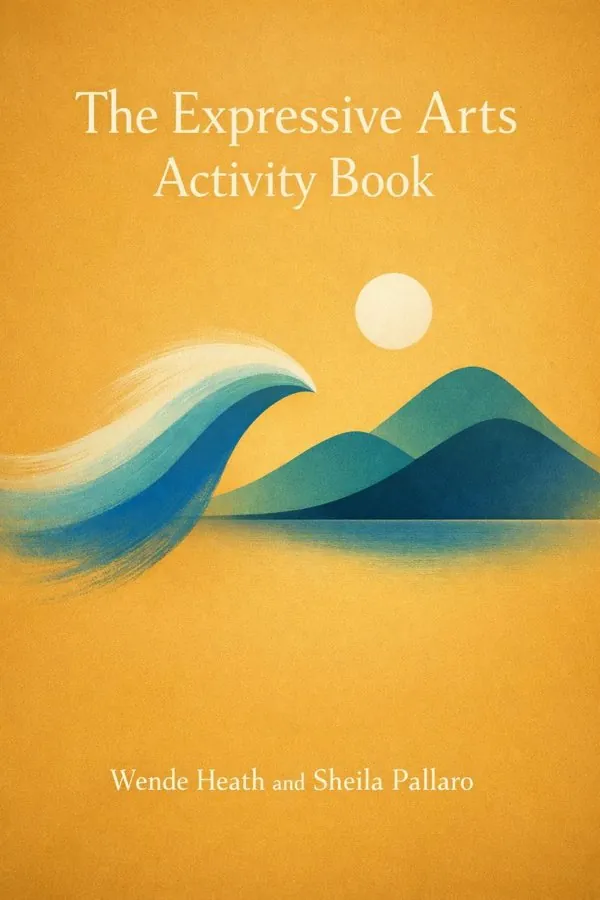
The Expressive Arts Activity Book: Group Creativity for Mental Health and Wellbeing: Summary & Key Insights
by Wende Heath, Sheila Pallaro
 10 min9 chaptersAudio available
Key Takeaways from The Expressive Arts Activity Book: Group Creativity for Mental Health and Wellbeing
One of the book’s central insights is that healing often begins in forms of expression that come before explanation.
Creativity does not flourish in a vacuum; it flourishes in safety.
A powerful group does not depend on a charismatic leader with all the answers; it depends on a facilitator who can hold process with sensitivity.
Not all emotions want to be painted, and not all insights want to be spoken.
Creative expression alone can be powerful, but without reflection it may remain fleeting.
What Is The Expressive Arts Activity Book: Group Creativity for Mental Health and Wellbeing About?
The Expressive Arts Activity Book: Group Creativity for Mental Health and Wellbeing by Wende Heath and Sheila Pallaro is a mental_health book spanning 6 pages. Some experiences are too layered, too tender, or too confusing to fit neatly into words. That is where expressive arts can become transformational. The Expressive Arts Activity Book: Group Creativity for Mental Health and Wellbeing is a practical, compassionate guide for using creativity in groups to support emotional expression, connection, resilience, and healing. Rather than treating art, movement, drama, and music as performance, Wende Heath and Sheila Pallaro present them as accessible tools for exploration and wellbeing. The book matters because many people in therapeutic, educational, and community settings need ways to process emotion that do not rely solely on talking. Through structured activities and thoughtful facilitation guidance, the authors show how creative practice can help participants externalize inner experience, regulate feelings, build trust, and discover new perspectives. Their approach is grounded in expressive arts therapy and shaped by real-world group work, making the material both inspiring and highly usable. Heath brings expertise in art therapy and clinical supervision, while Pallaro contributes deep knowledge of dance and movement-based therapeutic practice. Together, they offer a grounded, humane resource for facilitators who want to make group spaces more imaginative, embodied, and emotionally restorative.
This FizzRead summary covers all 9 key chapters of The Expressive Arts Activity Book: Group Creativity for Mental Health and Wellbeing in approximately 10 minutes, distilling the most important ideas, arguments, and takeaways from Wende Heath and Sheila Pallaro's work. Also available as an audio summary and Key Quotes Podcast.
The Expressive Arts Activity Book: Group Creativity for Mental Health and Wellbeing
Some experiences are too layered, too tender, or too confusing to fit neatly into words. That is where expressive arts can become transformational. The Expressive Arts Activity Book: Group Creativity for Mental Health and Wellbeing is a practical, compassionate guide for using creativity in groups to support emotional expression, connection, resilience, and healing. Rather than treating art, movement, drama, and music as performance, Wende Heath and Sheila Pallaro present them as accessible tools for exploration and wellbeing.
The book matters because many people in therapeutic, educational, and community settings need ways to process emotion that do not rely solely on talking. Through structured activities and thoughtful facilitation guidance, the authors show how creative practice can help participants externalize inner experience, regulate feelings, build trust, and discover new perspectives. Their approach is grounded in expressive arts therapy and shaped by real-world group work, making the material both inspiring and highly usable.
Heath brings expertise in art therapy and clinical supervision, while Pallaro contributes deep knowledge of dance and movement-based therapeutic practice. Together, they offer a grounded, humane resource for facilitators who want to make group spaces more imaginative, embodied, and emotionally restorative.
Who Should Read The Expressive Arts Activity Book: Group Creativity for Mental Health and Wellbeing?
This book is perfect for anyone interested in mental_health and looking to gain actionable insights in a short read. Whether you're a student, professional, or lifelong learner, the key ideas from The Expressive Arts Activity Book: Group Creativity for Mental Health and Wellbeing by Wende Heath and Sheila Pallaro will help you think differently.
- ✓Readers who enjoy mental_health and want practical takeaways
- ✓Professionals looking to apply new ideas to their work and life
- ✓Anyone who wants the core insights of The Expressive Arts Activity Book: Group Creativity for Mental Health and Wellbeing in just 10 minutes
Want the full summary?
Get instant access to this book summary and 100K+ more with Fizz Moment.
Get Free SummaryAvailable on App Store • Free to download
Key Chapters
One of the book’s central insights is that healing often begins in forms of expression that come before explanation. Many people cannot immediately name what they feel, especially when they are overwhelmed, traumatized, ashamed, or simply disconnected from themselves. Expressive arts therapy recognizes that image, movement, sound, rhythm, and symbolic action can reveal truths that ordinary conversation cannot reach.
Heath and Pallaro ground their approach in traditions that respect the depth of inner life. Jungian psychology contributes the importance of symbol and image. Gestalt practice emphasizes direct, present-moment experience. Phenomenology reminds facilitators to attend to what appears without rushing to interpret or fix it. Together, these influences support a therapeutic stance that values curiosity over judgment and process over performance.
In practical terms, this means a participant does not need artistic skill to benefit. A rough collage can express fragmentation. A repeated gesture can communicate grief. A group drumming pattern can reveal tension, cohesion, or release. The point is not to create polished work but to engage in a process that allows feeling to move, take form, and be witnessed.
This foundation also changes the role of the facilitator. Instead of decoding art like a puzzle, the facilitator invites participants to explore what their creation means to them. A simple prompt such as “What do you notice?” can be more therapeutic than an elaborate analysis.
Actionable takeaway: Treat creative expression as a way of knowing, not just a technique. In any group, begin with the assumption that art, movement, and sound can carry emotions that words have not yet caught up with.
Creativity does not flourish in a vacuum; it flourishes in safety. The book repeatedly stresses that before any meaningful expressive work can happen, the group must feel contained, respectful, and emotionally manageable. Without that foundation, activities can feel exposing rather than freeing.
Heath and Pallaro show that safety is built through structure as much as warmth. Clear agreements about confidentiality, consent, respectful witnessing, and the right to pass help participants understand the boundaries of the space. Predictable openings and closings create rhythm. Gentle introductions reduce anxiety. Even practical factors such as room layout, access to materials, and how facilitators handle transitions affect emotional security.
A supportive group environment also requires pacing. Not every group is ready to begin with deeply personal themes. The authors encourage facilitators to start with lower-risk activities, such as collaborative mark-making, movement mirroring, or sound-based warm-ups, before moving toward more emotionally charged work. This gradual build allows trust to develop over time.
Importantly, safety does not mean comfort at all times. Creative growth may involve uncertainty, vulnerability, or surprise. But participants should feel held, not pushed. For example, a facilitator might offer multiple ways to engage in an exercise: drawing, writing, shaping clay, or simply observing. Choice preserves dignity and increases participation.
Actionable takeaway: Before selecting any activity, ask yourself what conditions participants need to feel safe enough to engage. Build those conditions intentionally through agreements, pacing, choice, and clear boundaries.
A powerful group does not depend on a charismatic leader with all the answers; it depends on a facilitator who can hold process with sensitivity. The book portrays facilitation as a relational art. The facilitator is not there to impress, interpret everything, or steer people toward predetermined outcomes. Instead, the role is to create a container in which authentic expression can emerge.
This requires several capacities at once. Facilitators must observe group energy, notice individual needs, introduce activities clearly, and respond flexibly when unexpected emotions arise. They must know when to encourage depth and when to simplify. They must also be comfortable with silence, ambiguity, and symbolic expression. In expressive arts work, meaning often unfolds slowly.
The authors emphasize presence over technique. A calm, grounded facilitator can regulate the room more effectively than a perfectly designed exercise delivered without attunement. For instance, if a movement activity begins to overwhelm some participants, a good facilitator may pause, invite everyone to notice their breath, and offer options to continue seated or with smaller gestures. That adjustment preserves safety while respecting the group’s reality.
The facilitator’s language also matters. Open-ended questions such as “What stood out in your process?” or “What changed as you worked?” support reflection without imposing interpretation. This stance empowers participants to become the experts of their own experience.
Actionable takeaway: Lead with attunement rather than control. In your next group, focus less on delivering the activity perfectly and more on noticing how participants are responding moment by moment.
Not all emotions want to be painted, and not all insights want to be spoken. One of the book’s most practical contributions is its demonstration that different creative modalities access different dimensions of experience. Art, movement, drama, and music each open unique pathways into emotion, memory, imagination, and relationship.
Visual art allows inner states to become visible. Through drawing, collage, painting, or sculpture, participants can externalize what feels vague or overwhelming. Movement engages the body directly and can reveal patterns of tension, strength, hesitation, or desire that words often miss. Drama introduces role, story, and distance, making it easier to explore conflict or possibility through enactment. Music and sound can regulate energy, build cohesion, and create immediate emotional resonance.
The book encourages facilitators to think carefully about what each modality offers. If a group feels verbally stuck, rhythm or movement may break the impasse. If emotions feel chaotic, image-making may provide containment. If participants need to rehearse new behaviors, drama can create a safe experimental space.
For example, a facilitator working with a stress management group might begin with drumming to discharge tension, shift to drawing body maps of stress sensations, and then invite short reflective sharing. A grief group might use movement to embody connection and loss, followed by collage to create visual memorials.
Actionable takeaway: Match the modality to the group’s needs rather than defaulting to your personal preference. Ask what form of expression would best support regulation, reflection, or connection in this moment.
Creative expression alone can be powerful, but without reflection it may remain fleeting. The book highlights integration as the bridge between experience and meaning. After participants make art, move, perform, or create sound, they need opportunities to notice what happened, what it stirred, and how it connects to their lives.
Integration does not mean overanalyzing or reducing creativity to neat conclusions. Instead, it means giving participants ways to digest their experience. This might include verbal processing, journaling, paired sharing, movement repetition, group witnessing, or returning to an image and adding to it. The goal is to help the creative act become a source of awareness rather than a disconnected exercise.
Heath and Pallaro also show the value of moving between modalities. A participant may draw a chaotic image, then choose a gesture that matches it, then speak from that gesture in a dramatic monologue. Each transition deepens contact with the material. This intermodal approach can reveal connections that would not surface through one art form alone.
In group settings, integration also builds community. When participants share what they discovered, they realize that while each person’s expression is unique, many emotional themes are shared: longing, fear, hope, frustration, resilience. This reduces isolation.
A useful processing sequence might be: create, observe, name, connect, choose. What did I make? What do I notice? What feels important? Where does this show up in my life? What small step do I want to take next?
Actionable takeaway: Never end with the activity alone. Always include a structured reflection phase that helps participants connect creative experience to personal meaning and future action.
An expressive arts activity is only as effective as its fit with the people in the room. The book is especially helpful in showing that good facilitation is adaptive. Age, culture, trauma history, physical ability, cognitive needs, language comfort, and setting all shape how activities should be offered.
Heath and Pallaro resist one-size-fits-all methods. An exercise that energizes one group may dysregulate another. A movement prompt that feels liberating to some may feel too exposed for participants with trauma histories. A dramatic role-play might be engaging in a school setting but inappropriate in a highly acute clinical environment. Skillful facilitators therefore adjust intensity, complexity, pace, and modality without losing the spirit of the work.
Examples are easy to imagine. With children, activities may need more play, metaphor, and shorter timeframes. With older adults, facilitators may place greater emphasis on memory, sensory prompts, and accessible movement options. In cross-cultural groups, prompts should remain open enough to welcome different meanings rather than assume one emotional vocabulary or artistic norm. In trauma-informed contexts, choice and grounding are essential, and participants should never be pressured into disclosure.
Ethics are part of adaptation too. Facilitators must know their scope, respect confidentiality, gain informed consent, and distinguish between therapeutic support and treatment beyond their competence. Creative work can evoke strong emotions, so referral pathways and containment practices matter.
Actionable takeaway: Before leading any activity, adapt it for the specific population in front of you. Design for accessibility, cultural humility, and emotional safety rather than assuming the original exercise should be used unchanged.
Many people mistakenly assume that healing must look solemn to be real. This book challenges that assumption by showing how playfulness, imagination, and experimentation can support deeply meaningful therapeutic work. In expressive arts groups, laughter, spontaneity, and surprise are not distractions from growth; they are often pathways into it.
Play reduces defensiveness. When participants are invited to improvise a sound, pass a gesture around a circle, or build a collective image from found materials, they often become less preoccupied with getting it right. That shift matters. Perfectionism, shame, and self-consciousness can block insight. Play opens room for discovery.
The authors’ activity-based approach reflects this principle. A warm-up game may seem simple, but it can increase attunement, awaken the senses, and build trust. A dramatic improvisation can help participants try out new identities or responses. A playful movement exchange may reveal relational dynamics that serious discussion leaves hidden.
This does not mean facilitators should force cheerfulness or ignore pain. Playfulness works best when it is respectful and well-timed. In fact, one of its strengths is that it can help participants move in and out of difficult material without becoming stuck. A group processing loss might alternate between heavy reflection and lighter image-making or rhythmic activity to maintain regulation.
Actionable takeaway: Do not underestimate gentle play. In your next session, include one low-pressure, imaginative exercise that invites experimentation rather than performance, and notice how it affects participation, openness, and group energy.
Mental wellbeing is not just a matter of thoughts; it is also a matter of how people inhabit their bodies. A recurring strength of the book is its respect for embodiment. Through movement, breath, posture, gesture, and sensory awareness, participants can reconnect with parts of themselves that have become numb, tense, guarded, or ignored.
This is especially important because distress often lives physically. Anxiety may show up as shallow breathing or restlessness. Depression can feel heavy and collapsed. Trauma can create disconnection from bodily sensation altogether. Expressive arts approaches, particularly movement-based ones, offer ways to notice and gently shift these patterns.
The authors do not frame embodiment as demanding or technical. Simple practices can be effective: walking with awareness, tracing shapes in space, mirroring a partner’s movement, creating a group sculpture with body positions, or using breath with sound. These experiences help participants sense themselves from the inside rather than discuss themselves from a distance.
Embodiment also supports relational awareness. A person may notice how close they prefer to stand, how they respond to synchrony, or how it feels to lead and follow. Such discoveries can translate into broader insights about boundaries, trust, and agency.
Crucially, embodied work should always include choice. Participants may adapt movements, remain seated, or engage through observation if needed. Respecting autonomy is what makes body-based exploration therapeutic rather than intrusive.
Actionable takeaway: Add one simple body-awareness element to your group work, such as breath, posture check-ins, or small gestures. Use it to help participants notice how emotion and meaning are carried physically.
Healing is often described as an individual journey, but this book reminds us that many breakthroughs happen in relationship. Group creativity offers something uniquely powerful: the experience of being seen without needing to explain everything perfectly. When people make, move, or improvise together, they often discover belonging before they discover full clarity.
Shared creative processes reduce isolation. Participants realize that others also struggle with fear, grief, identity, anger, or uncertainty. Even when the content of their work differs, the act of witnessing one another creates solidarity. A collaborative mural, call-and-response rhythm, or ensemble improvisation can foster a felt sense of connection that ordinary discussion may not produce.
The group itself becomes a therapeutic medium. Members learn by observing differences in style, pacing, and expression. They practice listening, witnessing, responding, and respecting boundaries. They discover that there are many valid ways to feel and create. This broadens empathy and reduces shame.
Collective creativity can also generate hope. When a group transforms scattered materials into something coherent, or chaos into shared rhythm, participants experience possibility in real time. They do not just talk about resilience; they enact it. This is especially valuable in mental health and community settings where people may feel defeated or disconnected.
A facilitator might harness this by including collaborative tasks alongside individual expression: group poems, shared movement sequences, collective soundscapes, or community installations.
Actionable takeaway: Use at least one collaborative activity in each series of sessions. Group-created work can deepen connection, normalize vulnerability, and help participants experience hope as something made together.
All Chapters in The Expressive Arts Activity Book: Group Creativity for Mental Health and Wellbeing
About the Authors
Wende Heath and Sheila Pallaro are respected contributors to the field of expressive arts and creative therapies. Heath is an art therapist and clinical supervisor whose work focuses on the therapeutic potential of visual expression, reflective practice, and emotionally safe facilitation. Sheila Pallaro is a dance and movement therapist, educator, and group facilitator known for her expertise in embodied approaches to healing and creative process. Together, they bring complementary perspectives that span image-making, movement, group dynamics, and therapeutic application. Their collaboration reflects substantial hands-on experience in helping people use creativity to process emotion, develop self-awareness, and build connection. In The Expressive Arts Activity Book, they translate that professional knowledge into practical guidance for therapists, educators, and facilitators seeking effective, humane, arts-based tools for mental health and wellbeing.
Get This Summary in Your Preferred Format
Read or listen to the The Expressive Arts Activity Book: Group Creativity for Mental Health and Wellbeing summary by Wende Heath and Sheila Pallaro anytime, anywhere. FizzRead offers multiple formats so you can learn on your terms — all free.
Available formats: App · Audio · PDF · EPUB — All included free with FizzRead
Download The Expressive Arts Activity Book: Group Creativity for Mental Health and Wellbeing PDF and EPUB Summary
Key Quotes from The Expressive Arts Activity Book: Group Creativity for Mental Health and Wellbeing
“One of the book’s central insights is that healing often begins in forms of expression that come before explanation.”
“Creativity does not flourish in a vacuum; it flourishes in safety.”
“A powerful group does not depend on a charismatic leader with all the answers; it depends on a facilitator who can hold process with sensitivity.”
“Not all emotions want to be painted, and not all insights want to be spoken.”
“Creative expression alone can be powerful, but without reflection it may remain fleeting.”
Frequently Asked Questions about The Expressive Arts Activity Book: Group Creativity for Mental Health and Wellbeing
The Expressive Arts Activity Book: Group Creativity for Mental Health and Wellbeing by Wende Heath and Sheila Pallaro is a mental_health book that explores key ideas across 9 chapters. Some experiences are too layered, too tender, or too confusing to fit neatly into words. That is where expressive arts can become transformational. The Expressive Arts Activity Book: Group Creativity for Mental Health and Wellbeing is a practical, compassionate guide for using creativity in groups to support emotional expression, connection, resilience, and healing. Rather than treating art, movement, drama, and music as performance, Wende Heath and Sheila Pallaro present them as accessible tools for exploration and wellbeing. The book matters because many people in therapeutic, educational, and community settings need ways to process emotion that do not rely solely on talking. Through structured activities and thoughtful facilitation guidance, the authors show how creative practice can help participants externalize inner experience, regulate feelings, build trust, and discover new perspectives. Their approach is grounded in expressive arts therapy and shaped by real-world group work, making the material both inspiring and highly usable. Heath brings expertise in art therapy and clinical supervision, while Pallaro contributes deep knowledge of dance and movement-based therapeutic practice. Together, they offer a grounded, humane resource for facilitators who want to make group spaces more imaginative, embodied, and emotionally restorative.
You Might Also Like
Big Feelings: How to Be Okay When Things Are Not Okay
Liz Fosslien, Mollie West Duffy
10 min
Creative Arts Therapies Handbook: Art, Music and Dance Therapy Practices for Wellbeing
Susan I. Buchalter
10 min
Emotional First Aid: Healing Rejection, Guilt, Failure, and Other Everyday Hurts
Guy Winch
10 min
Lost Connections: Why You're Depressed and How to Find Hope
Johann Hari
10 min
No Time to Panic: How to Stop Worrying and Embrace Life
Matt Gutman
10 min
Overcoming Mobbing: A Recovery Guide for Workplace Aggression and Bullying
Maureen Duffy, Len Sperry
10 minBrowse by Category
Ready to read The Expressive Arts Activity Book: Group Creativity for Mental Health and Wellbeing?
Get the full summary and 100K+ more books with Fizz Moment.