
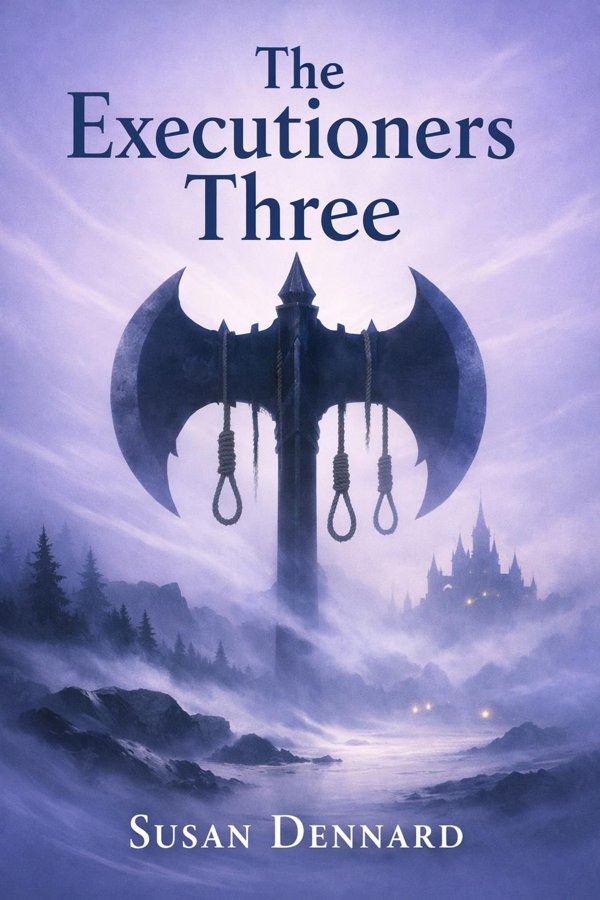
The Executioners Three: Summary & Key Insights
 10 min8 chaptersAudio available
Key Takeaways from The Executioners Three
Sometimes a title tells you almost everything about a book’s emotional terrain before the first page even begins.
The most gripping fantasy novels do not rely on a single engine; they combine atmosphere, questions, and movement.
Epic settings may draw readers in, but it is relationships that make fantasy memorable.
The best fantasy worlds are not just visually inventive; they are morally structured.
In lesser fantasy, violence is a spectacle.
What Is The Executioners Three About?
The Executioners Three by Susan Dennard is a scifi_fantasy book spanning 5 pages. Susan Dennard’s The Executioners Three is a forthcoming fantasy novel that promises the qualities readers already associate with her work: vivid world-building, emotionally charged character arcs, supernatural danger, and a plot that moves with urgency. While full publication details and plot specifics remain limited, the book is widely anticipated as a dark fantasy adventure shaped by mystery, tension, and the fragile alliances that emerge when survival is at stake. Even at this early stage, the title alone suggests a story concerned with judgment, power, and the moral cost of violence. What makes the novel noteworthy is not only its premise, but Dennard’s reputation for crafting imaginative settings that feel both epic and intimate. In series such as Witchlands and The Luminaries, she has shown a gift for balancing fast-paced storytelling with layered emotional stakes, especially among young people confronting forces larger than themselves. That background gives readers good reason to expect The Executioners Three to deliver more than spectacle. It is likely to explore loyalty, fear, sacrifice, and identity through a sharply atmospheric fantasy lens, making it a promising read for fans of character-driven speculative fiction.
This FizzRead summary covers all 8 key chapters of The Executioners Three in approximately 10 minutes, distilling the most important ideas, arguments, and takeaways from Susan Dennard's work. Also available as an audio summary and Key Quotes Podcast.
The Executioners Three
Susan Dennard’s The Executioners Three is a forthcoming fantasy novel that promises the qualities readers already associate with her work: vivid world-building, emotionally charged character arcs, supernatural danger, and a plot that moves with urgency. While full publication details and plot specifics remain limited, the book is widely anticipated as a dark fantasy adventure shaped by mystery, tension, and the fragile alliances that emerge when survival is at stake. Even at this early stage, the title alone suggests a story concerned with judgment, power, and the moral cost of violence.
What makes the novel noteworthy is not only its premise, but Dennard’s reputation for crafting imaginative settings that feel both epic and intimate. In series such as Witchlands and The Luminaries, she has shown a gift for balancing fast-paced storytelling with layered emotional stakes, especially among young people confronting forces larger than themselves. That background gives readers good reason to expect The Executioners Three to deliver more than spectacle. It is likely to explore loyalty, fear, sacrifice, and identity through a sharply atmospheric fantasy lens, making it a promising read for fans of character-driven speculative fiction.
Who Should Read The Executioners Three?
This book is perfect for anyone interested in scifi_fantasy and looking to gain actionable insights in a short read. Whether you're a student, professional, or lifelong learner, the key ideas from The Executioners Three by Susan Dennard will help you think differently.
- ✓Readers who enjoy scifi_fantasy and want practical takeaways
- ✓Professionals looking to apply new ideas to their work and life
- ✓Anyone who wants the core insights of The Executioners Three in just 10 minutes
Want the full summary?
Get instant access to this book summary and 100K+ more with Fizz Moment.
Get Free SummaryAvailable on App Store • Free to download
Key Chapters
Sometimes a title tells you almost everything about a book’s emotional terrain before the first page even begins. The Executioners Three immediately evokes punishment, judgment, and a trio bound together by violence, duty, or fate. Even without a fully revealed plot, the title frames the novel as a dark fantasy concerned not simply with external danger, but with moral burden: who has the right to decide life and death, and what happens to the people forced into that role?
That matters because Susan Dennard’s fiction often uses high-stakes fantasy setups to examine deeply human questions. In her previous work, power is rarely clean. Characters carry wounds, secrets, and conflicting loyalties, and their choices shape not only the world around them but also their own identities. If The Executioners Three follows that pattern, the “executioners” are likely not just enforcers of law or death, but symbols of difficult responsibility. They may represent institutions, ancient obligations, or personal guilt translated into mythic form.
Readers can approach the book with this lens in mind: dark fantasy works best when it treats violence as meaningful rather than decorative. A story about executioners naturally raises questions about justice, fear, corruption, and survival. Is punishment a tool of order, a disguise for cruelty, or a sacrifice demanded by a broken world? Those are the kinds of tensions that can elevate the novel from entertaining fantasy to memorable storytelling.
As you read, pay close attention to how the book defines guilt, authority, and mercy. The most useful takeaway is simple: treat the title as a key to the story’s central moral conflict, not just its aesthetic mood.
The most gripping fantasy novels do not rely on a single engine; they combine atmosphere, questions, and movement. Early expectations around The Executioners Three suggest exactly that blend: dark fantasy infused with mystery and adventure. That combination is especially powerful because each element strengthens the others. Darkness gives emotional weight, mystery creates momentum, and adventure keeps the story alive with discovery and risk.
In practical terms, this means readers should expect more than a battle between good and evil. A mystery-driven fantasy often begins with missing knowledge: an unexplained death, an ancient curse, a hidden identity, a conspiracy, or a truth buried in history. Adventure then expands the story outward, sending characters across dangerous terrain, into hostile systems, or toward revelations they may not be ready to face. Dark fantasy ensures that every answer comes with a cost.
Susan Dennard has repeatedly shown that she understands pacing. Her stories tend to move quickly, but they do not feel empty because the action is anchored in emotional and relational stakes. In a novel like this, the mystery may not only concern the world; it may concern the characters themselves. Who can be trusted? What past event created the present danger? Why are these three figures tied together? Those questions are often what transform page-turning fantasy into immersive fantasy.
Readers can apply this insight by tracking three threads while reading: what is hidden, what is at risk, and what changes through the journey. That simple framework clarifies the book’s architecture and enriches the reading experience. The actionable takeaway: whenever a major scene unfolds, ask yourself whether it advances the mystery, raises the stakes, or deepens the world—because in a strong fantasy novel, it usually does all three at once.
Epic settings may draw readers in, but it is relationships that make fantasy memorable. One of Susan Dennard’s clearest strengths as a writer is her ability to build large-scale worlds without losing sight of intimate character dynamics. That is why The Executioners Three is likely to matter not only for its premise, but for the people at its center. A fantasy novel built around a trio almost automatically creates space for tension, contrast, and transformation.
Three-character structures are especially effective because they allow shifting loyalties and competing values. One character can represent duty, another doubt, and another rebellion. One can act as the emotional center while the others challenge or destabilize that balance. In dark fantasy, such a trio can become a crucible in which trust is repeatedly tested. The story’s emotional power may depend less on whether the characters defeat an enemy and more on whether they can remain connected while confronting fear, guilt, and impossible choices.
Dennard has often excelled at portraying friendship, conflict, and loyalty under pressure. Readers familiar with her work know that alliances are rarely static. Characters misunderstand one another, grow apart, reconnect, and discover that affection does not erase ideological differences. That complexity is likely to be central here, especially if the protagonists share a deadly role or a burdened destiny.
A useful way to read the book is to treat each relationship as a map of the larger themes. When two characters clash, ask what larger conflict that disagreement reflects: justice versus mercy, fate versus free will, obedience versus conscience. The actionable takeaway is to note how every shift in trust changes the meaning of the quest. In fantasy, relationships are not side material—they are often the real battlefield.
The best fantasy worlds are not just visually inventive; they are morally structured. Susan Dennard’s appeal as a fantasy author rests in part on her ability to create settings that feel alive through systems, histories, and consequences. With The Executioners Three, readers can reasonably expect world-building that does more than supply magical scenery. The setting will likely shape the novel’s core ethical problems and determine what kinds of choices are even possible.
In dark fantasy, institutions matter. Laws, curses, rituals, bloodlines, magical orders, religious systems, and political hierarchies all influence how characters understand themselves. If a world creates executioners, then the world also creates the need, justification, or mythology around execution. That means the setting itself may function as an argument: perhaps violence is normalized, perhaps justice is ritualized, or perhaps ancient threats have made brutality seem necessary. Whatever form it takes, the world is not neutral.
This is where Dennard’s storytelling often stands out. Her worlds tend to have rules that matter emotionally. Magic is not only power; it is identity, obligation, and danger. Geography is not only backdrop; it creates pressure, isolation, and collision. Social structures are not decorative; they produce conflict that characters must navigate personally.
Readers can get more from the novel by paying attention to recurring systems rather than isolated details. What rules keep appearing? Who benefits from them? Who suffers under them? Practical reading questions like these turn world-building from passive absorption into active interpretation. The actionable takeaway: when a fantasy setting introduces a law, ritual, or magical mechanism, ask what kind of human behavior it rewards and punishes. That is often where the real meaning of the world resides.
In lesser fantasy, violence is a spectacle. In stronger fantasy, it leaves scars. The premise and title of The Executioners Three suggest a narrative in which killing, punishment, or sanctioned force is central. That creates an opportunity for Susan Dennard to explore one of dark fantasy’s richest themes: the cost of survival when violence becomes routine, necessary, or institutionalized.
This matters because stories about executioners can become morally simplistic if they reduce conflict to enemies who simply deserve death. But fantasy becomes more resonant when it asks what repeated violence does to the people who carry it out. Does it numb them? Corrupt them? Make them protective, ashamed, defiant, fragmented? If the protagonists are enforcers, avengers, or unwilling participants in a larger system, their interior lives may become the novel’s most important terrain.
Dennard’s writing often gives emotional consequence to action. Her characters are shaped by what they endure and what they choose, not just by what they can do. In that context, violence is likely to function as both plot and pressure. Each confrontation may force characters to define what they still believe, whom they are willing to protect, and what line they refuse to cross.
Readers can apply this idea by tracking aftermath rather than only climactic scenes. Look at silence after conflict, changed behavior, damaged trust, and the emotional residue of hard choices. Those quieter moments often reveal the book’s real argument about power. The actionable takeaway is this: do not ask only who wins a violent encounter. Ask what the encounter costs each character, because that cost is often the story’s deepest truth.
Fantasy frequently uses magic and danger to dramatize a question every reader recognizes: who do you become when circumstances strip away comfort and certainty? The Executioners Three is poised to explore identity through precisely that kind of pressure. A story involving dark obligations, mystery, and peril naturally places characters in situations where labels begin to crack. Hero, villain, chosen one, outlaw, protector, monster—these categories often collapse when survival demands compromise.
Susan Dennard’s fiction has long been interested in becoming rather than being. Her protagonists are rarely finished versions of themselves. They are in motion, testing loyalties, making mistakes, and discovering that identity is not a stable essence but a sequence of choices made under stress. If this novel follows that pattern, the three central figures may each embody a different response to pressure: compliance, resistance, concealment, ambition, or self-sacrifice.
What makes this compelling is that fantasy externalizes inner conflict. A curse can represent inherited trauma. A role such as “executioner” can symbolize a social identity imposed from outside. A dangerous quest can reflect the effort to reclaim agency. In this way, even a highly imaginative story can feel psychologically immediate.
Readers can make the book more meaningful by noticing when a character’s self-description changes. What do they call themselves at the beginning, and what do others call them later? When do they reject a role, and when do they accept one? Those shifts often signal the novel’s core emotional arc. The actionable takeaway: read every major decision as an identity decision. In a dark fantasy, plot twists matter—but they matter most because they reveal who each character is becoming.
Mood is not merely decoration in dark fantasy; it is a form of meaning. The likely appeal of The Executioners Three lies partly in its atmosphere: ominous, tense, and charged with the sense that danger may be woven into the world itself. Susan Dennard has a track record of writing immersive speculative fiction, and if this novel succeeds, its atmosphere will do more than make scenes feel vivid. It will shape how readers interpret every character choice.
Atmosphere works when it reinforces theme. Gloomy landscapes, haunted settings, brittle rituals, or shadowed cities can suggest that the world is morally unstable. Claustrophobic spaces can emphasize trapped identities. Harsh wilderness can mirror emotional isolation. In a mystery-inflected fantasy, atmosphere also intensifies uncertainty. Readers feel that something is wrong before they fully understand what it is.
This kind of storytelling has practical value for readers, too. It invites slower attention. Instead of treating setting details as filler between plot points, readers can ask why particular imagery keeps recurring. Are there repeated references to blood, ash, iron, silence, cold, bells, masks, or thresholds? Those patterns are rarely accidental. They often reveal the emotional logic of the novel.
Dennard’s likely use of atmosphere may be especially effective for readers who enjoy fantasy that feels cinematic but also intimate. The world should not just be seen; it should be felt.
The actionable takeaway is simple: when the book lingers on a place, object, or sensory detail, do not skim past it. Ask what emotional condition it creates. In dark fantasy, atmosphere often tells you what the characters cannot yet say aloud.
Not every fantasy novel serves the same reader need. Some readers want intricate lore, others crave romance, and others want relentless action. The Executioners Three appears positioned to satisfy readers who want a blend of narrative momentum and emotional intensity. That makes it especially promising within contemporary fantasy, where audiences increasingly look for books that deliver both immersive stakes and psychologically layered characters.
Susan Dennard’s existing readership provides an important clue. Fans of her previous series often value her accessible prose, energetic plotting, and emphasis on connection under pressure. Those strengths make her work particularly appealing to readers who enjoy fantasy that is substantial without becoming inaccessible. If The Executioners Three follows suit, it may work well for both established fantasy readers and newer readers searching for a darker, more suspenseful entry point into the genre.
This also explains why the novel matters beyond simple anticipation. In a crowded market, books stand out when they offer a recognizable voice. Dennard’s voice tends to combine urgency with heart. Even when worlds are complex, the emotional lines remain clear enough to keep readers invested. That balance is difficult and valuable.
To decide whether the book is right for you, consider your own preferences. Do you enjoy morally gray characters, ominous fantasy settings, mystery-driven plots, and stories built around trust and betrayal? If so, this novel is likely a strong match. The actionable takeaway: use the book’s apparent blend of dark atmosphere, character tension, and adventure as your guide. If you want fantasy with both speed and emotional weight, put this title on your reading list.
All Chapters in The Executioners Three
About the Author
Susan Dennard is an American author celebrated for her imaginative fantasy fiction, including the bestselling Witchlands series and The Luminaries. Before turning to writing full-time, she studied marine biology, an experience that helped shape her fascination with complex systems, strange worlds, and the hidden rules that govern them. Her novels are known for combining brisk pacing, emotional intensity, and memorable character dynamics with immersive speculative settings. Dennard has earned a loyal readership among young adult and crossover fantasy fans who appreciate stories that balance adventure with personal stakes. In addition to her fiction, she is widely recognized in the writing community for her approachable voice and strong engagement with readers. With The Executioners Three, she continues to build her reputation as a compelling storyteller in contemporary fantasy.
Get This Summary in Your Preferred Format
Read or listen to the The Executioners Three summary by Susan Dennard anytime, anywhere. FizzRead offers multiple formats so you can learn on your terms — all free.
Available formats: App · Audio · PDF · EPUB — All included free with FizzRead
Download The Executioners Three PDF and EPUB Summary
Key Quotes from The Executioners Three
“Sometimes a title tells you almost everything about a book’s emotional terrain before the first page even begins.”
“The most gripping fantasy novels do not rely on a single engine; they combine atmosphere, questions, and movement.”
“Epic settings may draw readers in, but it is relationships that make fantasy memorable.”
“The best fantasy worlds are not just visually inventive; they are morally structured.”
“In lesser fantasy, violence is a spectacle.”
Frequently Asked Questions about The Executioners Three
The Executioners Three by Susan Dennard is a scifi_fantasy book that explores key ideas across 8 chapters. Susan Dennard’s The Executioners Three is a forthcoming fantasy novel that promises the qualities readers already associate with her work: vivid world-building, emotionally charged character arcs, supernatural danger, and a plot that moves with urgency. While full publication details and plot specifics remain limited, the book is widely anticipated as a dark fantasy adventure shaped by mystery, tension, and the fragile alliances that emerge when survival is at stake. Even at this early stage, the title alone suggests a story concerned with judgment, power, and the moral cost of violence. What makes the novel noteworthy is not only its premise, but Dennard’s reputation for crafting imaginative settings that feel both epic and intimate. In series such as Witchlands and The Luminaries, she has shown a gift for balancing fast-paced storytelling with layered emotional stakes, especially among young people confronting forces larger than themselves. That background gives readers good reason to expect The Executioners Three to deliver more than spectacle. It is likely to explore loyalty, fear, sacrifice, and identity through a sharply atmospheric fantasy lens, making it a promising read for fans of character-driven speculative fiction.
More by Susan Dennard
You Might Also Like
Red Rising
Pierce Brown
10 min
Stranger in a Strange Land
Robert A. Heinlein
10 min
AI Valley
Chen Qiufan
10 min
Bloodchild
Octavia E. Butler
10 min
Do Androids Dream of Electric Sheep?
Philip K. Dick
10 min
Jujutsu Kaisen, Vol. 24
Gege Akutami
10 minBrowse by Category
Ready to read The Executioners Three?
Get the full summary and 100K+ more books with Fizz Moment.