
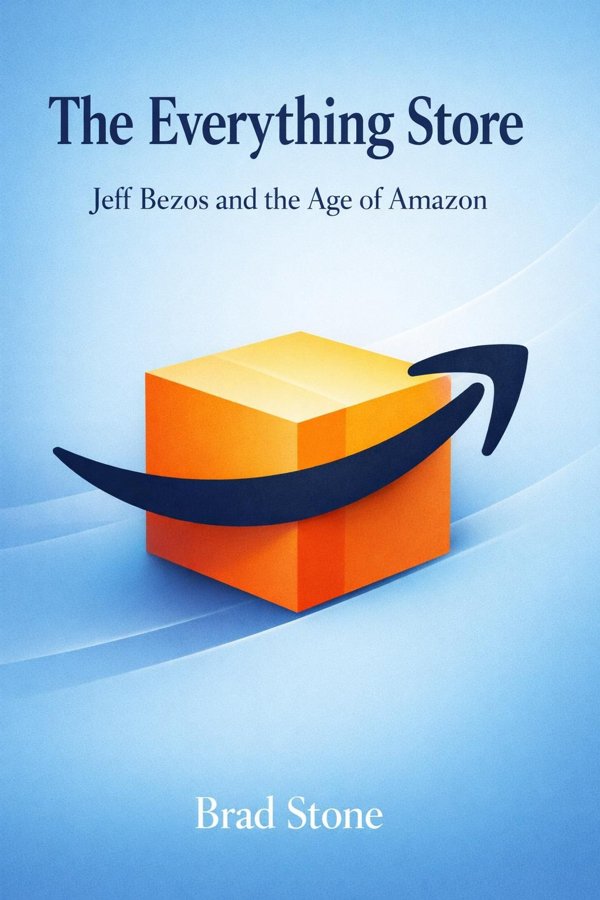
The Everything Store: Jeff Bezos and the Age of Amazon: Summary & Key Insights
by Brad Stone
 10 min9 chaptersAudio available
Key Takeaways from The Everything Store: Jeff Bezos and the Age of Amazon
Great companies often begin not with certainty, but with a willingness to act on a trend before the rest of the world fully understands it.
Most companies say they care about customers; Amazon built an operating system around that claim.
Some organizations are pleasant places to work; others are machines built for output.
Amazon did not become powerful simply by selling more products; it became powerful by building the systems that made scale possible.
Disruption is most powerful when a company is willing to threaten its own origins.
What Is The Everything Store: Jeff Bezos and the Age of Amazon About?
The Everything Store: Jeff Bezos and the Age of Amazon by Brad Stone is a biographies book spanning 5 pages. The Everything Store: Jeff Bezos and the Age of Amazon is a vivid, deeply reported portrait of one of the most consequential companies of the modern era and the founder who shaped it through force of will, intellectual rigor, and relentless ambition. Brad Stone traces Amazon’s rise from a scrappy online bookstore founded in a garage in 1994 to a global empire spanning retail, logistics, cloud computing, publishing, hardware, and media. More than a business story, the book is an examination of how Jeff Bezos built a company designed to outthink competitors, delight customers, and sacrifice short-term comfort for long-term dominance. It also confronts the human cost of that vision, revealing a culture famous for intensity, experimentation, and unforgiving standards. The book matters because Amazon has changed how people shop, read, store data, and think about convenience itself. Stone’s authority comes from extensive interviews with Bezos, family members, early colleagues, and current and former employees, allowing him to capture both the brilliance and the brutality behind Amazon’s expansion. The result is an essential biography of a founder and a company that helped redefine the digital age.
This FizzRead summary covers all 9 key chapters of The Everything Store: Jeff Bezos and the Age of Amazon in approximately 10 minutes, distilling the most important ideas, arguments, and takeaways from Brad Stone's work. Also available as an audio summary and Key Quotes Podcast.
The Everything Store: Jeff Bezos and the Age of Amazon
The Everything Store: Jeff Bezos and the Age of Amazon is a vivid, deeply reported portrait of one of the most consequential companies of the modern era and the founder who shaped it through force of will, intellectual rigor, and relentless ambition. Brad Stone traces Amazon’s rise from a scrappy online bookstore founded in a garage in 1994 to a global empire spanning retail, logistics, cloud computing, publishing, hardware, and media. More than a business story, the book is an examination of how Jeff Bezos built a company designed to outthink competitors, delight customers, and sacrifice short-term comfort for long-term dominance. It also confronts the human cost of that vision, revealing a culture famous for intensity, experimentation, and unforgiving standards. The book matters because Amazon has changed how people shop, read, store data, and think about convenience itself. Stone’s authority comes from extensive interviews with Bezos, family members, early colleagues, and current and former employees, allowing him to capture both the brilliance and the brutality behind Amazon’s expansion. The result is an essential biography of a founder and a company that helped redefine the digital age.
Who Should Read The Everything Store: Jeff Bezos and the Age of Amazon?
This book is perfect for anyone interested in biographies and looking to gain actionable insights in a short read. Whether you're a student, professional, or lifelong learner, the key ideas from The Everything Store: Jeff Bezos and the Age of Amazon by Brad Stone will help you think differently.
- ✓Readers who enjoy biographies and want practical takeaways
- ✓Professionals looking to apply new ideas to their work and life
- ✓Anyone who wants the core insights of The Everything Store: Jeff Bezos and the Age of Amazon in just 10 minutes
Want the full summary?
Get instant access to this book summary and 100K+ more with Fizz Moment.
Get Free SummaryAvailable on App Store • Free to download
Key Chapters
Great companies often begin not with certainty, but with a willingness to act on a trend before the rest of the world fully understands it. In 1994, Jeff Bezos was a successful executive at hedge fund D.E. Shaw when he encountered a startling statistic: internet usage was growing by more than 2,000 percent a year. Rather than seeing this as an abstract data point, Bezos treated it as a signal that a historic shift was underway. He made a list of products that could be sold online and chose books because they were plentiful, standardized, and easier to ship than many alternatives. That decision became Amazon’s starting point.
Brad Stone shows that Amazon’s origin story was not pure luck or pure genius, but a disciplined response to technological change. Bezos left security for uncertainty, drove west with his wife MacKenzie, and began building the company from Seattle, a strategic location near book distributors and technical talent. The early vision was already much bigger than books. The bookstore was the entry point, not the destination. Bezos wanted to create what he called "the everything store," a place where selection, convenience, and low prices could outperform physical retail.
This founding moment offers a practical lesson in entrepreneurship and career decision-making. Bezos did not chase novelty for its own sake; he paired a massive trend with a business model that could exploit the internet’s strengths. He also used a “regret minimization framework,” asking himself what choice he would regret least at age eighty. That mindset helped him tolerate short-term risk in pursuit of long-term meaning.
Actionable takeaway: When evaluating a major opportunity, combine trend analysis with personal conviction. Ask not only whether something is growing, but whether you would regret ignoring it when the future arrives.
Most companies say they care about customers; Amazon built an operating system around that claim. One of the central insights in The Everything Store is that Bezos treated customer obsession not as a slogan, but as a governing philosophy that shaped hiring, decision-making, pricing, product design, and strategy. While many firms focus on competitors, quarterly profits, or internal politics, Amazon repeatedly asked what would make life easier, faster, cheaper, or more reliable for the customer.
Stone explains that this principle justified many of Amazon’s boldest moves. The company invested in a broader catalog so customers could find nearly anything in one place. It pushed prices down, often at the expense of short-term margins. It streamlined checkout, refined recommendation algorithms, and accelerated delivery because friction was the enemy. Even Amazon Prime, which looked financially irrational to skeptics, reflected this same logic: if customers value convenience enough, loyalty deepens and the business grows around that bond.
Yet the book also reveals the complexity of customer obsession. A company can claim to serve customers while creating punishing internal demands on employees or squeezing suppliers. Bezos’s version of customer-first leadership was powerful because it imposed clarity, but it was also uncompromising. People inside Amazon learned that if a decision benefited customers over internal comfort, customer interests would almost always win.
This idea has practical use beyond technology. A teacher can redesign communication around student needs. A clinic can reduce waiting time and confusion. A small business can simplify returns or improve follow-up. Customer obsession means understanding the real experience of the person you serve, not merely the product you deliver.
Actionable takeaway: Identify the top three sources of friction in your customer or user experience and remove one of them this week. Consistent convenience becomes a competitive advantage.
Some organizations are pleasant places to work; others are machines built for output. Brad Stone portrays Amazon as the latter. Bezos intentionally created a culture of intensity, analytical rigor, and constant pressure, believing that high standards were necessary to build an enduring, category-defining company. Meetings were famously data-driven, PowerPoint was discouraged in favor of tightly reasoned memos, and weak thinking could be publicly challenged. At Amazon, ideas had to survive scrutiny, not sentiment.
The book shows how this culture produced both innovation and fear. Bezos wanted employees who were resourceful, ambitious, and resilient. He valued “high-judgment” people and developed unusual hiring methods, including the role of “bar raisers” who helped ensure each new hire improved the organization. Amazon’s internal language reinforced discipline: teams were expected to move fast, own results, and work backward from customer needs. Frugality was celebrated as a virtue because constraints were believed to spur invention.
At the same time, Stone does not romanticize this environment. The same rigor that drove performance also led to burnout, internal competition, and emotional strain. Employees described a workplace where excellence could be thrilling but also exhausting. This tension is one of the book’s most important contributions: it helps readers understand that a company’s edge is often inseparable from its costs.
In practice, leaders can learn from Amazon’s clarity without copying its harshest extremes. Strong cultures are explicit about expectations, reward high-quality thinking, and avoid complacency. But they also need trust, sustainability, and room for human limits. High standards should sharpen performance, not destroy morale.
Actionable takeaway: Raise the quality of one recurring team process by replacing vague discussion with written reasoning, clear ownership, and measurable standards.
Amazon did not become powerful simply by selling more products; it became powerful by building the systems that made scale possible. Stone emphasizes that Bezos understood earlier than many rivals that retail on the internet would not be won by branding alone. It required logistics, software, warehousing, and infrastructure that could support vast selection, fast fulfillment, and constant experimentation. In other words, the hidden machinery mattered as much as the storefront.
As Amazon expanded beyond books into music, electronics, toys, apparel, and countless other categories, it invested aggressively in fulfillment centers, inventory systems, distribution networks, and engineering talent. This was expensive and often unpopular with investors focused on profits. But Bezos repeatedly chose long-term capability over short-term appearance. That choice gave Amazon increasing control over speed, reliability, and customer experience. Over time, the infrastructure became a moat that competitors struggled to replicate.
Stone also shows that Amazon’s infrastructure mindset led naturally into new lines of business. Once the company had developed world-class systems for handling traffic spikes, data storage, and computing needs, it recognized that those capabilities could serve others. This logic laid the groundwork for Amazon Web Services, which transformed a support function into a major profit engine.
The broader lesson is that sustainable advantage often comes from owning critical capabilities rather than outsourcing everything. Whether in manufacturing, education, healthcare, or media, the organizations that invest in core systems can move faster and adapt more effectively. Infrastructure is not glamorous, but it compounds.
Actionable takeaway: Look beneath your visible product or service and ask which underlying system most affects quality, speed, or trust. Improving that foundation may create more value than adding another feature.
Disruption is most powerful when a company is willing to threaten its own origins. One of the most compelling sections of The Everything Store explores how Amazon launched the Kindle and accelerated the shift from physical books to digital reading. For a company that began as an online bookseller, this was a risky move. E-books could unsettle publishers, reshape pricing, and undermine established norms in the industry. But Bezos believed that if digital reading was inevitable, Amazon had to lead it rather than resist it.
Stone details how the Kindle emerged from Bezos’s conviction that books should become as instantly accessible as music and information already were online. The device was designed less as a glamorous gadget and more as a seamless gateway to a vast digital bookstore. Buy a book, receive it in seconds, and start reading immediately. That convenience fundamentally changed consumer expectations. The Kindle also tied users more closely to Amazon’s ecosystem, strengthening the company’s influence over publishing and distribution.
The Kindle story illustrates Bezos’s long-range thinking. He was willing to endure conflict with major publishers and absorb uncertainty in order to shape the future of reading. This move also reflected Amazon’s larger pattern: use technology to remove friction, then scale the resulting behavior change. For readers, the Kindle made books more portable and accessible. For the industry, it forced a reckoning with digital formats, pricing power, and direct customer relationships.
The practical lesson is clear: innovation sometimes means cannibalizing your own success before someone else does it for you. Businesses that cling too tightly to legacy models often lose the future to more adaptive competitors.
Actionable takeaway: Identify one part of your current success that could be made obsolete by a better customer experience, and begin experimenting with that future before the market forces it on you.
Sometimes the most important business breakthrough begins as an internal frustration. Amazon Web Services, or AWS, grew from Amazon’s need to solve its own technical bottlenecks. Stone presents AWS as one of Bezos’s most consequential strategic bets because it turned Amazon from a retailer with powerful technology into a technology company with global economic influence. By offering cloud computing services to outside developers and businesses, Amazon created a new market and reshaped the digital economy.
The genius of AWS lay in recognizing that many startups and companies faced the same challenge Amazon had already solved: they needed reliable computing power, storage, and infrastructure without building their own expensive systems from scratch. Instead of treating those capabilities as internal plumbing, Amazon packaged them as services. This lowered barriers to entry for entrepreneurs, accelerated software innovation, and eventually generated high-margin revenue that contrasted with the thinner margins of retail.
Stone’s account highlights Bezos’s capacity to see hidden assets as future businesses. What looked like back-end functionality became a global platform. This is a recurring Amazon pattern: build for scale internally, then externalize the capability once it proves useful. AWS also reveals why Amazon cannot be understood merely as an online store. Its reach extends into the technical architecture of modern business itself.
For leaders and creators, the AWS story offers a practical way to think about innovation. Valuable opportunities may already exist inside your workflow, embedded in tools, systems, or methods you have developed to solve recurring problems. If those solutions matter to you, they may matter to others too.
Actionable takeaway: Audit your organization’s internal strengths and ask whether one of them could become a product, service, or platform for a broader market.
Abundance can make companies lazy; constraints can make them inventive. Stone describes frugality as one of Amazon’s defining principles and one of Bezos’s favorite tools for shaping behavior. Even as Amazon grew, symbols of thrift persisted: cheap desks made from doors, modest spending habits, and skepticism toward unnecessary perks. This was not merely cost-cutting theater. Bezos believed that resource constraints forced teams to focus, prioritize, and invent.
Frugality at Amazon worked on several levels. Operationally, it helped preserve capital for major strategic investments like fulfillment centers, technology, and new business lines. Culturally, it signaled that comfort and prestige were not the company’s mission. Psychologically, it reminded employees that customers, not internal luxury, should benefit from efficiencies. In Bezos’s view, every dollar saved internally could support lower prices or future growth.
Stone also shows the downside. Frugality can energize problem-solving, but when overapplied it can become demoralizing or penny-wise and pound-foolish. A company may underinvest in people, communication, or support systems if austerity becomes identity rather than discipline. Amazon walked this line constantly, using cost-consciousness to sharpen execution while risking resentment among employees who felt the burden of that philosophy.
Outside of giant corporations, the lesson remains useful. Frugality is most productive when it is purposeful. A startup may skip fancy offices to invest in product development. A family may simplify spending to fund education or freedom. A nonprofit may reduce administrative excess to extend mission impact. The key is aligning restraint with strategic intent.
Actionable takeaway: Cut one status-driven expense and redirect those resources toward a capability that improves long-term value, customer experience, or resilience.
Every empire has a shadow, and Stone is careful to show that Amazon’s brilliance came with real human consequences. Bezos is portrayed as visionary, disciplined, and intellectually fearless, but also demanding, emotionally tough, and often indifferent to conventionally warm leadership. Inside Amazon, this translated into a culture where people were pushed hard, measured relentlessly, and expected to perform at a very high level for sustained periods. Outside Amazon, it affected partners, publishers, competitors, and entire industries that had to adapt to Amazon’s scale and pressure.
This is one of the book’s most valuable dimensions because it prevents easy hero worship. Amazon’s rise delivered extraordinary convenience, lower prices, and technological breakthroughs. It also intensified debates about labor conditions, supplier power, market concentration, and the ethics of growth at all costs. Stone does not reduce Bezos to villain or hero. Instead, he presents a leader whose strengths and blind spots were deeply intertwined. The same refusal to accept limits that made Amazon transformative could also make it harsh.
For readers, this raises a practical leadership question: what are you willing to demand in pursuit of excellence, and what lines should not be crossed? Ambition is essential to meaningful achievement, but ambition without reflection can normalize damage. Sustainable success requires more than winning; it requires understanding the systems and people affected by that victory.
This idea applies in personal life as well. High achievement at work can strain families, health, and emotional well-being if no limits exist. The book implicitly asks whether scale and intensity are always worth the trade-offs.
Actionable takeaway: Define in advance the non-negotiable values you will protect while pursuing growth, so success does not quietly erode what matters most.
What makes Bezos especially unusual is that he never saw Amazon as the endpoint. Stone portrays him as a founder driven by a civilization-scale imagination, someone who viewed commerce, technology, media, and even space exploration as parts of a larger future waiting to be built. The title The Everything Store captures Amazon’s ambition to sell almost anything, but the deeper story is about a mindset that constantly widened the horizon.
As Amazon matured, Bezos continued to think in decades rather than quarters. He pursued new categories, devices, digital media, cloud computing, and global expansion with the assumption that the company should remain in a state of permanent reinvention. This same long-term orientation also appeared in Blue Origin, his space venture, which reflected childhood fascinations and a belief that humanity’s future would eventually extend beyond Earth. Stone uses these details to show that Bezos was motivated not only by competition or wealth, but by a desire to build systems that endure and alter the future.
This future-facing mentality is one reason Amazon repeatedly entered industries that seemed unrelated to its original business. Bezos looked for underlying patterns: infrastructure, scale, customer friction, and platform leverage. If Amazon could solve a major problem in one field, it might use that capability elsewhere. This perspective made the company unusually adaptive and unusually hard to categorize.
For readers, the lesson is not to imitate grandiosity, but to adopt a wider time horizon. People often make timid choices because they think in days or months. Longer horizons can make bold investments rational, whether in learning, relationships, business, or health.
Actionable takeaway: Choose one goal and evaluate it on a ten-year horizon instead of a one-year horizon. The shift in time frame may reveal bolder and wiser next steps.
All Chapters in The Everything Store: Jeff Bezos and the Age of Amazon
About the Author
Brad Stone is an American journalist and author widely recognized for his reporting on technology, innovation, and Silicon Valley. He has covered many of the world’s most influential companies and entrepreneurs, with a focus on how digital businesses reshape industries and everyday life. Stone has held senior editorial roles at Bloomberg and has also written for prominent publications including The New York Times. He is known for combining rigorous reporting with clear, engaging storytelling, making complex corporate and technological subjects accessible to general readers. In The Everything Store, Stone draws on extensive interviews with Jeff Bezos, Amazon insiders, and people close to the company to deliver a nuanced portrait of both the founder and the empire he built. His work is especially valued for its depth, balance, and narrative energy.
Get This Summary in Your Preferred Format
Read or listen to the The Everything Store: Jeff Bezos and the Age of Amazon summary by Brad Stone anytime, anywhere. FizzRead offers multiple formats so you can learn on your terms — all free.
Available formats: App · Audio · PDF · EPUB — All included free with FizzRead
Download The Everything Store: Jeff Bezos and the Age of Amazon PDF and EPUB Summary
Key Quotes from The Everything Store: Jeff Bezos and the Age of Amazon
“Great companies often begin not with certainty, but with a willingness to act on a trend before the rest of the world fully understands it.”
“Most companies say they care about customers; Amazon built an operating system around that claim.”
“Some organizations are pleasant places to work; others are machines built for output.”
“Amazon did not become powerful simply by selling more products; it became powerful by building the systems that made scale possible.”
“Disruption is most powerful when a company is willing to threaten its own origins.”
Frequently Asked Questions about The Everything Store: Jeff Bezos and the Age of Amazon
The Everything Store: Jeff Bezos and the Age of Amazon by Brad Stone is a biographies book that explores key ideas across 9 chapters. The Everything Store: Jeff Bezos and the Age of Amazon is a vivid, deeply reported portrait of one of the most consequential companies of the modern era and the founder who shaped it through force of will, intellectual rigor, and relentless ambition. Brad Stone traces Amazon’s rise from a scrappy online bookstore founded in a garage in 1994 to a global empire spanning retail, logistics, cloud computing, publishing, hardware, and media. More than a business story, the book is an examination of how Jeff Bezos built a company designed to outthink competitors, delight customers, and sacrifice short-term comfort for long-term dominance. It also confronts the human cost of that vision, revealing a culture famous for intensity, experimentation, and unforgiving standards. The book matters because Amazon has changed how people shop, read, store data, and think about convenience itself. Stone’s authority comes from extensive interviews with Bezos, family members, early colleagues, and current and former employees, allowing him to capture both the brilliance and the brutality behind Amazon’s expansion. The result is an essential biography of a founder and a company that helped redefine the digital age.
More by Brad Stone
You Might Also Like
An American Marriage
Tayari Jones
10 min
Benjamin Franklin: An American Life
Walter Isaacson
10 min
I Know Why The Caged Bird Sings
Maya Angelou
10 min
Long Walk to Freedom
Nelson Mandela
10 min
Persepolis
Marjane Satrapi
10 min
Surely You're Joking, Mr. Feynman!
Richard P. Feynman
10 minBrowse by Category
Ready to read The Everything Store: Jeff Bezos and the Age of Amazon?
Get the full summary and 100K+ more books with Fizz Moment.