
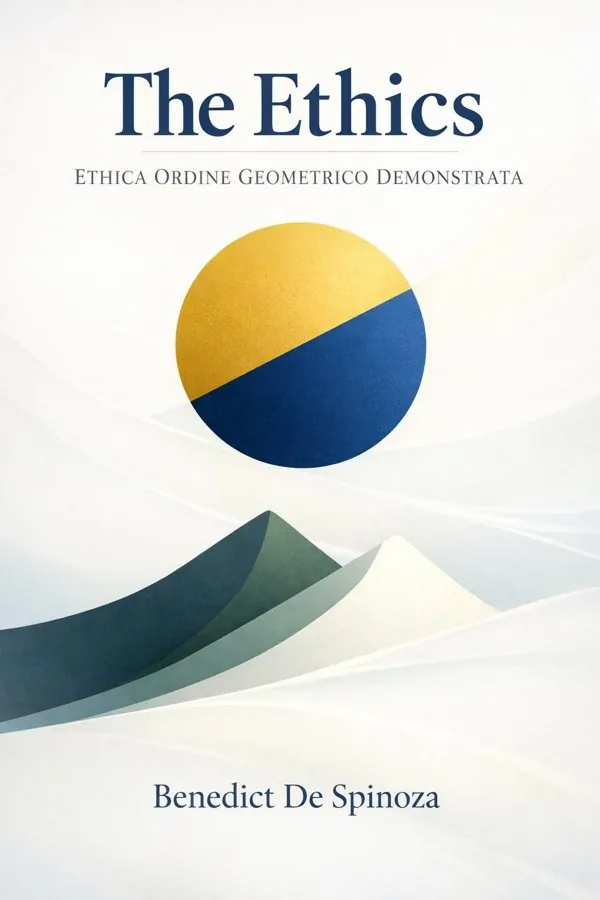
The Ethics: Ethica Ordine Geometrico Demonstrata: Summary & Key Insights
 10 min9 chaptersAudio available
Key Takeaways from The Ethics: Ethica Ordine Geometrico Demonstrata
The most disruptive idea in The Ethics is also its foundation: reality is not divided between a supernatural God and a separate created world.
Freedom, in common speech, often means the ability to have done otherwise.
One of Spinoza’s most original claims is that the human mind is the idea of the human body.
Spinoza distinguishes between inadequate knowledge, reason, and intuitive knowledge, and this hierarchy is crucial to his ethics.
Spinoza does not treat emotions as moral stains or irrational interruptions.
What Is The Ethics: Ethica Ordine Geometrico Demonstrata About?
The Ethics: Ethica Ordine Geometrico Demonstrata by Benedict De Spinoza is a western_phil book spanning 5 pages. The Ethics: Ethica Ordine Geometrico Demonstrata is one of philosophy’s boldest attempts to explain reality, human emotion, and freedom as parts of a single rational order. Written by Benedict de Spinoza in the 17th century, the book argues that God is not a distant creator standing outside the world, but the infinite substance of reality itself: God or Nature. From this radical starting point, Spinoza develops a complete system covering metaphysics, the human mind, the emotions, moral life, and the possibility of genuine freedom. He presents his ideas in a geometric style of definitions, axioms, propositions, and proofs, giving the work an unusual sense of rigor and inevitability. What makes The Ethics endure is not only its philosophical ambition, but its practical aim: to show how human beings can move from confusion, fear, and emotional slavery toward clarity, strength, and peace. Spinoza’s authority rests on the originality and coherence of his system, which deeply influenced modern philosophy, psychology, political thought, and secular spirituality. This is not merely a book about ethics; it is a guide to understanding existence itself.
This FizzRead summary covers all 9 key chapters of The Ethics: Ethica Ordine Geometrico Demonstrata in approximately 10 minutes, distilling the most important ideas, arguments, and takeaways from Benedict De Spinoza's work. Also available as an audio summary and Key Quotes Podcast.
The Ethics: Ethica Ordine Geometrico Demonstrata
The Ethics: Ethica Ordine Geometrico Demonstrata is one of philosophy’s boldest attempts to explain reality, human emotion, and freedom as parts of a single rational order. Written by Benedict de Spinoza in the 17th century, the book argues that God is not a distant creator standing outside the world, but the infinite substance of reality itself: God or Nature. From this radical starting point, Spinoza develops a complete system covering metaphysics, the human mind, the emotions, moral life, and the possibility of genuine freedom. He presents his ideas in a geometric style of definitions, axioms, propositions, and proofs, giving the work an unusual sense of rigor and inevitability. What makes The Ethics endure is not only its philosophical ambition, but its practical aim: to show how human beings can move from confusion, fear, and emotional slavery toward clarity, strength, and peace. Spinoza’s authority rests on the originality and coherence of his system, which deeply influenced modern philosophy, psychology, political thought, and secular spirituality. This is not merely a book about ethics; it is a guide to understanding existence itself.
Who Should Read The Ethics: Ethica Ordine Geometrico Demonstrata?
This book is perfect for anyone interested in western_phil and looking to gain actionable insights in a short read. Whether you're a student, professional, or lifelong learner, the key ideas from The Ethics: Ethica Ordine Geometrico Demonstrata by Benedict De Spinoza will help you think differently.
- ✓Readers who enjoy western_phil and want practical takeaways
- ✓Professionals looking to apply new ideas to their work and life
- ✓Anyone who wants the core insights of The Ethics: Ethica Ordine Geometrico Demonstrata in just 10 minutes
Want the full summary?
Get instant access to this book summary and 100K+ more with Fizz Moment.
Get Free SummaryAvailable on App Store • Free to download
Key Chapters
The most disruptive idea in The Ethics is also its foundation: reality is not divided between a supernatural God and a separate created world. Spinoza argues that there is only one substance, infinite, eternal, and self-caused, and this substance is what he calls God or Nature. Everything that exists is not outside God but in God, as a mode or expression of this one reality. This means that nothing is contingent in the ordinary sense; everything follows from the necessity of the divine nature.
This view overturns traditional religious and philosophical assumptions. God is not a king who gives commands, changes plans, becomes angry, or intervenes from beyond nature. Instead, God is the lawful, intelligible order of existence itself. To understand the world scientifically and rationally is, for Spinoza, to understand God more adequately. This also removes the idea that humans occupy a privileged place at the center of creation. We are parts of nature, governed by the same necessity as everything else.
In practical terms, this changes how we respond to events. Instead of seeing illness, loss, or misfortune as punishment, chaos, or meaningless tragedy, Spinoza invites us to ask what causes produced them and how they fit into a larger order. A storm does not rage because nature is hostile to us; it follows from natural laws. Likewise, human conflict often reflects causes, limitations, and passions rather than cosmic evil.
The takeaway is simple but profound: replace resentment and superstition with understanding. When facing any event, ask not “Why did this happen to me?” but “What caused this, and how can understanding it free me from confusion?”
Freedom, in common speech, often means the ability to have done otherwise. Spinoza challenges this idea at its root. He insists that everything that exists and happens follows necessarily from the nature of God or Nature. Nothing is uncaused, and nothing escapes the chain of explanation. Human beings feel free mainly because they are conscious of their desires but ignorant of the causes that produce them.
This is not meant to humiliate us; it is meant to educate us. Spinoza compares our ordinary sense of choice to a stone that, if conscious, might believe it freely decided to continue flying after being thrown. We experience intentions, preferences, and decisions, but rarely grasp the full network of bodily states, habits, social pressures, past experiences, and external influences shaping them. Determinism, for Spinoza, is not a denial of human life. It is a call to deeper self-knowledge.
Applied practically, this view softens blame without eliminating responsibility. If a person acts harshly under stress, Spinoza would urge us to look beyond moral outrage and examine the causes: fatigue, fear, insecurity, conditioning, or misinformation. In our own lives, this can improve decision-making. If you repeatedly procrastinate, for example, it may be more useful to study the causal pattern—anxiety, distraction, unrealistic goals—than to condemn yourself as lazy.
Spinoza’s idea of freedom is therefore not exemption from causality, but understanding necessity. The more adequately we understand why we think, feel, and act as we do, the less we are passively pushed around by hidden forces.
Actionable takeaway: when you feel stuck in a pattern, stop asking whether you “should” be different and start mapping the causes that make the pattern recur. Understanding is the first form of liberation.
One of Spinoza’s most original claims is that the human mind is the idea of the human body. Rather than treating mind and body as two separate substances that mysteriously interact, he argues that they are two attributes of the same reality seen under different aspects. What happens in the body is expressed in the mind, and what is understood in the mind reflects the condition of the body. There is no ghost in the machine; there is one being described in two ways.
This position avoids the split that often troubles philosophy and daily life alike. We speak as if our bodies betray us and our minds fight them, but Spinoza encourages a more integrated picture. Mental confusion can be connected to bodily disorder, and bodily vitality can support clearer thinking. A person who is sleep-deprived, overstimulated, and physically depleted may not simply have a “bad attitude”; the body’s state shapes the mind’s power to think.
Spinoza also explains that the mind knows itself only through the ideas of bodily affections. We do not begin with transparent self-awareness. Instead, we experience ourselves through changing encounters with the world. This means self-knowledge requires attention to patterns in our lived experience: what energizes us, what exhausts us, what brings clarity, and what clouds judgment.
In modern terms, this idea resonates with psychology, neuroscience, and embodied cognition. Anxiety may be worsened by stress chemistry and bodily tension; focus may improve through movement, sleep, and environment. The wise person does not despise the body but understands it.
Actionable takeaway: improve thought by caring for the conditions of thought. Before trying to solve every problem mentally, examine your bodily state—sleep, breath, nutrition, movement, and environment—and treat mind and body as one system.
Not all knowing is equal. Spinoza distinguishes between inadequate knowledge, reason, and intuitive knowledge, and this hierarchy is crucial to his ethics. At the lowest level, we form opinions from fragmentary experience, hearsay, and confused images. This is how most people navigate the world most of the time: reacting to appearances, generalizing hastily, and mistaking partial truths for complete understanding. Such knowledge is unstable and often feeds fear, prejudice, and emotional volatility.
The second level is reason. Here we grasp common notions and lawful relations. We understand not just that something happens, but why it happens according to patterns shared across nature. For example, instead of believing that a colleague’s criticism proves personal malice, we might reason about incentives, misunderstanding, and human emotional habits. Reason produces more reliable and universal understanding.
The highest level is intuitive knowledge, in which the mind perceives particular things through their place in the whole order of nature. This is not intuition in the casual sense of a hunch; it is a direct intellectual grasp of how something follows from the nature of reality. It yields the deepest peace because it sees necessity without distortion.
Practically, the distinction matters because many personal problems are intensified by inadequate ideas. Rumors create panic, assumptions breed conflict, and emotional reactions harden around half-truths. Better knowledge changes experience. If you understand the mechanics of stress, addiction, or social dynamics, you become less vulnerable to confusion.
Actionable takeaway: when upset, identify the level of knowledge you are using. Are you reacting to impressions and assumptions, or are you seeking causes, patterns, and clearer understanding? Move one level upward whenever possible.
Spinoza does not treat emotions as moral stains or irrational interruptions. He analyzes them as natural events governed by causes. At the center of this analysis is conatus, the striving by which each thing endeavors to persevere in its being. Human desire, joy, and sadness all express changes in this striving. Joy is the passage to greater perfection or power; sadness is the passage to lesser perfection or power. Emotions are therefore signs of how our capacity to act is being increased or diminished.
This framework is remarkably practical. Instead of dividing feelings into good and bad in a simplistic way, Spinoza asks what they do to our power of acting. Does an emotion strengthen us, clarify us, and connect us to reality, or does it weaken us, confuse us, and make us dependent? Love, anger, envy, hope, fear, pride, shame, and pity can all be studied in terms of causes and effects rather than judged only morally.
Consider social media envy. Seeing others succeed may produce sadness because it decreases our sense of power. If we do not understand that mechanism, envy turns into resentment or self-contempt. But if we recognize what is happening, we can redirect attention toward activities that genuinely increase our power: learning, creating, exercising, building relationships, and clarifying values.
Spinoza’s emotional science invites both compassion and discipline. We are not guilty for having emotions; we are responsible for understanding them. Once we see that feelings follow causes, we can stop identifying with every passing passion and begin shaping the conditions that produce more active states.
Actionable takeaway: track your emotions by asking one question—does this increase my power to act or diminish it? Use the answer to choose environments, habits, and relationships that support stronger, clearer living.
Spinoza’s account of bondage is one of the most psychologically penetrating parts of The Ethics. Human beings are in bondage when they are ruled by passive emotions rather than guided by adequate understanding. Even when we know what is better, we often do what is worse because strong affects overpower abstract judgment. Bondage is not chains imposed from outside alone; it is inner captivity to fear, habit, craving, and imagination.
This explains a familiar human frustration. A person may know that rage damages relationships, that doom-scrolling worsens anxiety, or that impulsive spending creates long-term stress, yet still repeat the pattern. For Spinoza, this happens because knowledge in the weak sense is not enough. A merely verbal or theoretical idea cannot defeat a stronger emotion. To change, we need more powerful and more adequate ideas, joined to lived understanding and reordered desires.
Spinoza also notes that external things affect us constantly, and because we are finite beings, we are vulnerable. We cannot become invincible or fully independent of circumstance. But we can become less passive by learning how emotions arise, which situations trigger them, and which forms of thought strengthen us. Bondage decreases as understanding increases.
Modern readers can apply this in habit change, conflict, and self-regulation. If a person wants to reduce compulsive behavior, moral scolding may help little. Better results come from identifying triggers, changing environments, strengthening alternative routines, and reframing the underlying beliefs.
Actionable takeaway: choose one recurring behavior you regret and study it without self-condemnation. Identify the trigger, the emotion, the imagined reward, and the real consequence. Freedom begins when the pattern becomes intelligible.
A surprising feature of Spinoza’s ethics is how social it is. Because human beings share a common nature, what truly benefits one person can often benefit others as well. Reason shows that cooperation is usually more useful than conflict, and that nothing is more valuable to a human being than another human being living rationally. This is not sentimental idealism; it is practical realism grounded in mutual advantage.
When people act from passive emotions, they become rivals, suspicious, unstable, and easy to manipulate. Fear breeds domination; envy breeds hostility; wounded pride breeds revenge. But when people act from reason, they seek what genuinely increases their power, and this tends to align them with peace, fairness, honesty, and friendship. A rational person does not help others out of self-sacrifice alone, but because flourishing is more secure in a well-ordered community.
This has direct application in workplaces, families, and public life. In a team, for instance, competition for status can undermine shared goals. A Spinozist approach asks which structures increase collective power: clear communication, shared incentives, emotional steadiness, and commitment to truth over ego. In personal relationships, understanding another person’s causes can reduce blame and open the door to wiser boundaries and more generous interpretation.
Spinoza is not naive. He knows people often act irrationally. Yet he insists that hatred is not overcome by hatred, and that stable life depends on institutions and habits that support reason rather than inflame passions.
Actionable takeaway: in your next conflict, ask not “How do I win?” but “What response increases the long-term power of both the relationship and the truth?” That question shifts emotion toward reason.
For Spinoza, virtue is not obedience to arbitrary moral commands. Virtue is power: the capacity to act according to the laws of one’s own nature as guided by reason. To be virtuous is to live in a way that expresses one’s real essence rather than being dragged around by external causes. This reframes ethics from guilt and prohibition to flourishing and strength.
Because each being strives to persevere in existence, seeking one’s true advantage is natural. But Spinoza sharply distinguishes true advantage from apparent advantage. Short-term pleasures, vanity, domination, and excess may seem beneficial, yet they often weaken us by making us dependent on unstable externals. Real advantage lies in whatever increases our power to understand, act, and live harmoniously with others. Thus moderation, honesty, courage, and generosity are not pious decorations; they are forms of intelligent self-preservation.
This vision is useful in ordinary decisions. If a promotion demands deceit, if entertainment becomes numbing escapism, or if social approval pushes us into inauthentic choices, Spinoza would ask whether these gains actually strengthen our nature. A choice that brings immediate reward but deepens confusion or dependency is not truly good.
His ethics also removes the drama from moral life. We do not become better through self-hatred. We become better by growing in understanding and arranging life to support active rather than passive states. Virtue is less like passing a test and more like developing a durable capacity.
Actionable takeaway: define one “true advantage” for your life this month—such as clearer thinking, steadier health, or more honest speech—and judge daily choices by whether they strengthen or weaken that advantage.
The final movement of The Ethics offers Spinoza’s deepest answer to the human search for peace. If bondage comes from confused emotions and partial understanding, freedom comes from the mind’s active understanding of itself, nature, and God. This culminates in what Spinoza calls the intellectual love of God: a joyful, clear awareness of reality as a necessary expression of the one infinite substance.
This love is not emotional dependence on a personal deity who rewards devotion. It is the mind’s delight in understanding the whole more adequately and seeing itself as part of that whole. The more we grasp things under the aspect of eternity, the less we are tormented by random resentment, fear, and egoic agitation. We still live in time, suffer losses, and face limitation, but our perspective changes. We are no longer trying to force the world to revolve around our wishes.
In modern language, this resembles a form of rational spirituality. A scientist marveling at the order of the cosmos, a thinker seeing personal pain within broader causal patterns, or a person reaching calm through deep understanding all approach what Spinoza means. It is a joy grounded not in possession but in comprehension.
Importantly, this state is not reserved for saints. Every increase in adequate understanding is already a movement toward freedom. Whenever we replace confusion with clarity, compulsion with insight, or bitterness with comprehension, we participate in this higher form of life.
Actionable takeaway: practice seeing one difficult event “under the aspect of eternity.” Step back from personal grievance, trace the causes, and ask what larger order it reveals. Even a brief shift in perspective can convert suffering into understanding.
All Chapters in The Ethics: Ethica Ordine Geometrico Demonstrata
About the Author
Benedict de Spinoza (1632–1677) was a Dutch philosopher of Sephardic Jewish descent and one of the most influential thinkers of the early modern period. Born in Amsterdam, he was educated within the Jewish community but was later excommunicated for views considered heretical. Spinoza lived quietly and modestly, supporting himself in part by grinding lenses while devoting his life to philosophy. His thought challenged traditional religion by identifying God with Nature and treating human beings as part of a universal causal order. Though controversial in his own time, he became a major influence on Enlightenment philosophy, biblical criticism, political thought, psychology, and modern secular ethics. His masterpiece, The Ethics, remains a landmark work for its bold metaphysics, rigorous structure, and profound analysis of emotion, freedom, and human flourishing.
Get This Summary in Your Preferred Format
Read or listen to the The Ethics: Ethica Ordine Geometrico Demonstrata summary by Benedict De Spinoza anytime, anywhere. FizzRead offers multiple formats so you can learn on your terms — all free.
Available formats: App · Audio · PDF · EPUB — All included free with FizzRead
Download The Ethics: Ethica Ordine Geometrico Demonstrata PDF and EPUB Summary
Key Quotes from The Ethics: Ethica Ordine Geometrico Demonstrata
“The most disruptive idea in The Ethics is also its foundation: reality is not divided between a supernatural God and a separate created world.”
“Freedom, in common speech, often means the ability to have done otherwise.”
“One of Spinoza’s most original claims is that the human mind is the idea of the human body.”
“Spinoza distinguishes between inadequate knowledge, reason, and intuitive knowledge, and this hierarchy is crucial to his ethics.”
“Spinoza does not treat emotions as moral stains or irrational interruptions.”
Frequently Asked Questions about The Ethics: Ethica Ordine Geometrico Demonstrata
The Ethics: Ethica Ordine Geometrico Demonstrata by Benedict De Spinoza is a western_phil book that explores key ideas across 9 chapters. The Ethics: Ethica Ordine Geometrico Demonstrata is one of philosophy’s boldest attempts to explain reality, human emotion, and freedom as parts of a single rational order. Written by Benedict de Spinoza in the 17th century, the book argues that God is not a distant creator standing outside the world, but the infinite substance of reality itself: God or Nature. From this radical starting point, Spinoza develops a complete system covering metaphysics, the human mind, the emotions, moral life, and the possibility of genuine freedom. He presents his ideas in a geometric style of definitions, axioms, propositions, and proofs, giving the work an unusual sense of rigor and inevitability. What makes The Ethics endure is not only its philosophical ambition, but its practical aim: to show how human beings can move from confusion, fear, and emotional slavery toward clarity, strength, and peace. Spinoza’s authority rests on the originality and coherence of his system, which deeply influenced modern philosophy, psychology, political thought, and secular spirituality. This is not merely a book about ethics; it is a guide to understanding existence itself.
More by Benedict De Spinoza
You Might Also Like
A Little History of Philosophy
Nigel Warburton
10 min
Areopagitica
John Milton
10 min
How To Think Like A Philosopher: Essential Principles For Clear Thinking
Peter Cave
10 min
Language, Truth and Logic
A. J. Ayer
10 min
The Age of Reason
Thomas Paine
10 min
The Essays
Michel De Montaigne
10 minBrowse by Category
Ready to read The Ethics: Ethica Ordine Geometrico Demonstrata?
Get the full summary and 100K+ more books with Fizz Moment.