
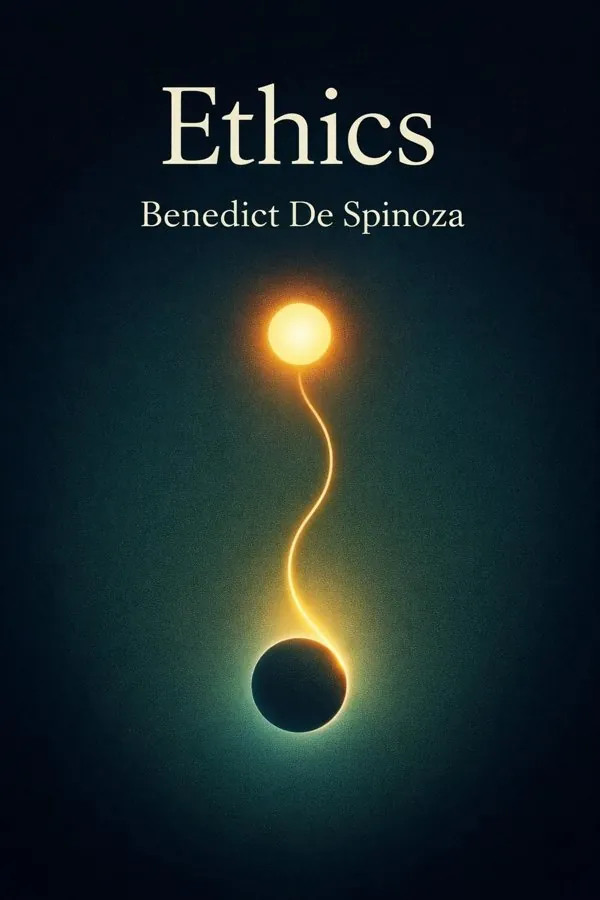
Ethics: Summary & Key Insights
 10 min5 chaptersAudio available
What Is Ethics About?
Ethics by Benedict De Spinoza is a western_phil book spanning 5 pages. A profoundly beautiful and uniquely insightful description of the universe, Benedict de Spinoza's 'Ethics' is one of the masterpieces of Enlightenment-era philosophy. Written in the 17th century and published posthumously, it presents a rational and geometric approach to understanding God, nature, and human existence. Spinoza argues that everything in the universe is part of a single, infinite substance, and that true freedom arises from understanding the necessity of nature and living in accordance with reason.
This FizzRead summary covers all 5 key chapters of Ethics in approximately 10 minutes, distilling the most important ideas, arguments, and takeaways from Benedict De Spinoza's work. Also available as an audio summary and Key Quotes Podcast.
Ethics
A profoundly beautiful and uniquely insightful description of the universe, Benedict de Spinoza's 'Ethics' is one of the masterpieces of Enlightenment-era philosophy. Written in the 17th century and published posthumously, it presents a rational and geometric approach to understanding God, nature, and human existence. Spinoza argues that everything in the universe is part of a single, infinite substance, and that true freedom arises from understanding the necessity of nature and living in accordance with reason.
Who Should Read Ethics?
This book is perfect for anyone interested in western_phil and looking to gain actionable insights in a short read. Whether you're a student, professional, or lifelong learner, the key ideas from Ethics by Benedict De Spinoza will help you think differently.
- ✓Readers who enjoy western_phil and want practical takeaways
- ✓Professionals looking to apply new ideas to their work and life
- ✓Anyone who wants the core insights of Ethics in just 10 minutes
Want the full summary?
Get instant access to this book summary and 100K+ more with Fizz Moment.
Get Free SummaryAvailable on App Store • Free to download
Key Chapters
I begin my inquiry with God, not as a personal deity separated from the world, but as the infinite substance that constitutes all existence. Everything that is, is in God; nothing can be outside of God. To conceive of anything apart from this infinite reality is to misunderstand the very nature of substance. Substance, I define, is that which is in itself and is conceived through itself. It requires no other idea to be known. Attributes express what the intellect perceives as the essence of substance—thought and extension being among them—and modes are the particular manifestations, the forms in which infinite substance expresses itself.
This conception was radical in my time, for it shattered the image of a God who governs Nature as an external artisan. There is no God beyond Nature, and there is no Nature without God. The divine is the one being whose essence involves existence, eternal and infinite. When I write *Deus sive Natura*, I do not reduce God to matter nor exalt matter into God; I reveal that both are expressions of one underlying reality. The recognition of this unity is not merely theoretical—it dissolves the fear inherent in seeing oneself as apart from the world. For if you are a mode of God’s infinite substance, then your existence participates directly in the eternal order. Nothing happens to you that is not a part of that whole.
When you begin to see reality through this lens, you feel a quiet liberation. There is no room for superstition, no need for miracles. Everything follows from the necessity of divine nature. Freedom does not mean contingency; it means understanding necessity. The more we comprehend the causes of things, the more we understand how each event is an expression of infinite intelligence. To know God in this sense is not to obey commandments, but to perceive eternal truth and rejoice in it.
Having established that all things exist within God, I turn now to one particular manifestation of this infinite substance—the human being. The mind and the body are not separate substances, as many imagine, but two attributes of the same thing. The mind is the idea of the body, and whatever happens in the body has its correlate in the mind as an idea. This view, often called parallelism, reveals that mental and physical phenomena are two expressions of one order of nature.
Consider what this means for you. Every thought arises from the structure and motion of your body’s interactions with the world; every bodily action reflects a corresponding idea within your mind. There is no dualism, no mysterious soul detached from the physical. You exist as a unity—a finite mode expressing God through both thought and extension.
From this understanding flows a profound consequence: knowledge is embodied, experience is divine. When you perceive something, you are participating in nature’s infinite intelligence through your own finite configuration. The mind’s striving—the *conatus*—is its effort to persevere in its being. We all feel this impulse intimately. All our desires, emotions, and endeavors originate from this fundamental drive toward continued existence.
This recognition transforms how you relate to your own thoughts and actions. You no longer blame yourself for the involuntary arising of passions, nor imagine your soul imprisoned within a body. Instead, you see your entire nature as a direct expression of necessity. Through understanding the relationship between mind and body, you begin to grasp how true freedom must be intellectual—a liberation through comprehension, not through escape.
+ 3 more chapters — available in the FizzRead app
All Chapters in Ethics
About the Author
Benedict de Spinoza (1632–1677) was a Dutch philosopher of Sephardic Jewish origin. One of the great rationalists of the 17th century, his works, including 'Ethics', profoundly influenced modern philosophy, particularly Enlightenment thought and later existential and pantheistic traditions.
Get This Summary in Your Preferred Format
Read or listen to the Ethics summary by Benedict De Spinoza anytime, anywhere. FizzRead offers multiple formats so you can learn on your terms — all free.
Available formats: App · Audio · PDF · EPUB — All included free with FizzRead
Download Ethics PDF and EPUB Summary
Key Quotes from Ethics
“I begin my inquiry with God, not as a personal deity separated from the world, but as the infinite substance that constitutes all existence.”
“Having established that all things exist within God, I turn now to one particular manifestation of this infinite substance—the human being.”
Frequently Asked Questions about Ethics
Ethics by Benedict De Spinoza is a western_phil book that explores key ideas across 5 chapters. A profoundly beautiful and uniquely insightful description of the universe, Benedict de Spinoza's 'Ethics' is one of the masterpieces of Enlightenment-era philosophy. Written in the 17th century and published posthumously, it presents a rational and geometric approach to understanding God, nature, and human existence. Spinoza argues that everything in the universe is part of a single, infinite substance, and that true freedom arises from understanding the necessity of nature and living in accordance with reason.
More by Benedict De Spinoza
You Might Also Like
A Little History of Philosophy
Nigel Warburton
10 min
Areopagitica
John Milton
10 min
How To Think Like A Philosopher: Essential Principles For Clear Thinking
Peter Cave
10 min
Language, Truth and Logic
A. J. Ayer
10 min
The Age of Reason
Thomas Paine
10 min
The Essays
Michel De Montaigne
10 minBrowse by Category
Ready to read Ethics?
Get the full summary and 100K+ more books with Fizz Moment.