
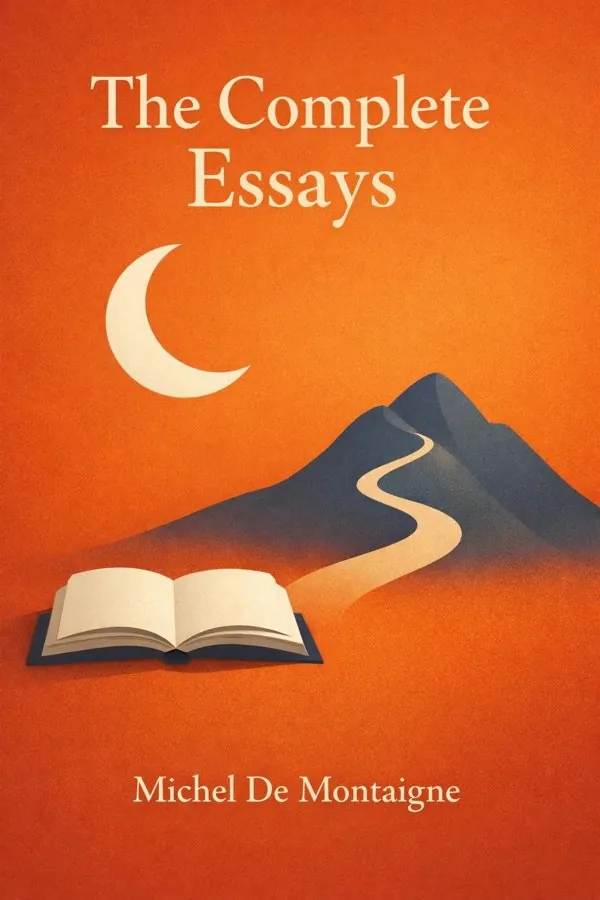
The Complete Essays: Summary & Key Insights
 10 min10 chaptersAudio available
Key Takeaways from The Complete Essays
A person may reveal more truth by admitting inconsistency than by pretending to be coherent.
We often speak as if character were fixed, but Montaigne insists that human behavior is far less stable than we imagine.
An educated person is not one who can recite facts, but one who can think well about life.
Most relationships are built on advantage, pleasure, convenience, or shared circumstance; true friendship, for Montaigne, is far rarer and deeper.
What feels natural is often only familiar.
What Is The Complete Essays About?
The Complete Essays by Michel De Montaigne is a western_phil book spanning 10 pages. First published in 1580 and expanded until Michel de Montaigne’s death in 1592, The Complete Essays is one of the founding texts of modern self-examination. Rather than offering a rigid philosophy, Montaigne turns inward and uses his own mind, habits, fears, memories, and contradictions as material for inquiry. From death, friendship, and education to custom, politics, bodily experience, and the limits of reason, he explores what it means to be human with unusual honesty and flexibility. What makes this work endure is not only the range of its themes, but the method: Montaigne does not preach from certainty. He doubts, revises, wanders, and tests ideas against lived experience. In doing so, he invents the essay as a form of free yet disciplined thinking. His authority comes from a rare combination of classical learning, political experience, and psychological candor. The Complete Essays still matters because it teaches a timeless skill: how to live thoughtfully without pretending to have final answers. It is philosophy made intimate, skeptical, humane, and deeply practical.
This FizzRead summary covers all 10 key chapters of The Complete Essays in approximately 10 minutes, distilling the most important ideas, arguments, and takeaways from Michel De Montaigne's work. Also available as an audio summary and Key Quotes Podcast.
The Complete Essays
First published in 1580 and expanded until Michel de Montaigne’s death in 1592, The Complete Essays is one of the founding texts of modern self-examination. Rather than offering a rigid philosophy, Montaigne turns inward and uses his own mind, habits, fears, memories, and contradictions as material for inquiry. From death, friendship, and education to custom, politics, bodily experience, and the limits of reason, he explores what it means to be human with unusual honesty and flexibility. What makes this work endure is not only the range of its themes, but the method: Montaigne does not preach from certainty. He doubts, revises, wanders, and tests ideas against lived experience. In doing so, he invents the essay as a form of free yet disciplined thinking. His authority comes from a rare combination of classical learning, political experience, and psychological candor. The Complete Essays still matters because it teaches a timeless skill: how to live thoughtfully without pretending to have final answers. It is philosophy made intimate, skeptical, humane, and deeply practical.
Who Should Read The Complete Essays?
This book is perfect for anyone interested in western_phil and looking to gain actionable insights in a short read. Whether you're a student, professional, or lifelong learner, the key ideas from The Complete Essays by Michel De Montaigne will help you think differently.
- ✓Readers who enjoy western_phil and want practical takeaways
- ✓Professionals looking to apply new ideas to their work and life
- ✓Anyone who wants the core insights of The Complete Essays in just 10 minutes
Want the full summary?
Get instant access to this book summary and 100K+ more with Fizz Moment.
Get Free SummaryAvailable on App Store • Free to download
Key Chapters
A person may reveal more truth by admitting inconsistency than by pretending to be coherent. That insight lies at the heart of Montaigne’s preface and of the entire project of The Complete Essays. He explains that he writes not to build a formal system, win scholarly prestige, or pose as a moral authority, but to present himself plainly. The book is a portrait of a mind in motion. Montaigne records not an ideal self, but an ordinary one: changing, uncertain, proud in one moment, humble in another, capable of reflection yet still vulnerable to habit and vanity.
This approach was revolutionary. Instead of beginning with abstract principles and applying them to life, Montaigne begins with life itself. He studies his memory, moods, health, tastes, fears, and reactions. In doing so, he suggests that careful self-observation is a legitimate path to wisdom. The self is not a distraction from philosophy; it is philosophy’s first testing ground.
This idea remains practical today. Journaling, therapy, reflective writing, and honest conversation all follow Montaigne’s basic method: observe yourself without excessive judgment, and you will see how human nature works. A leader who notices their impatience governs better. A parent who recognizes their anxieties reacts more wisely. A student who understands their own distractions learns more effectively.
Montaigne’s preface also invites intellectual humility. If we are mixed creatures, then our ideas should be held with care, not arrogance. Actionable takeaway: begin a regular practice of self-observation—write down one reaction, fear, or habit each day and ask what it reveals about your character.
We often speak as if character were fixed, but Montaigne insists that human behavior is far less stable than we imagine. In Book I, he observes that people shift with circumstance, emotion, health, social pressure, and fortune. The brave person may become timid under pain. The disciplined person may collapse under temptation. What looks like solid virtue is often a temporary alignment of mood, habit, and environment.
This is not cynicism. Montaigne is not saying that morality is impossible; he is saying that self-knowledge requires realism. We flatter ourselves when we think one noble action proves a noble soul. Likewise, one failure does not necessarily define a life. Human beings are fluid. We are mixtures of strength and weakness, often changing from hour to hour.
This perspective helps explain why moral judgment should be cautious. In personal relationships, it reminds us not to idolize or condemn too quickly. In politics, it warns against trusting appearances alone. In our own lives, it encourages us to build systems rather than rely on heroic moods. Someone who wants to be kind should not merely value kindness; they should create routines that make patience easier. Someone who wants integrity should simplify decisions before stress distorts judgment.
Montaigne’s realism also has a compassionate side. If we are unstable, then we should expect struggle in ourselves and others. Improvement comes less from perfectionism than from repeated adjustment.
Actionable takeaway: identify one area where you rely too much on willpower alone, and replace that reliance with a practical habit, boundary, or routine that supports the person you want to be.
An educated person is not one who can recite facts, but one who can think well about life. Montaigne’s reflections on education are among his most modern and influential ideas. He criticizes schooling that stuffs the mind with borrowed knowledge while neglecting judgment, curiosity, and moral formation. To him, learning should not produce a well-filled memory alone; it should produce a well-formed person.
He prefers tutors and teachers who encourage dialogue, questioning, and experience. Students should not merely repeat Aristotle or Cicero. They should test what they read against observation and personal understanding. Knowledge becomes meaningful only when digested, not when memorized whole. Montaigne uses the metaphor of bees that gather from many flowers but make their own honey. Learning should transform what we receive into something inwardly our own.
This matters far beyond formal education. In modern work, for example, many people collect information but struggle to apply it. A manager may read books on leadership yet fail to listen well. A student may ace exams but lack practical judgment. A citizen may consume endless news but never develop independent thought. Montaigne would call all of these incomplete forms of learning.
His educational vision is experiential, ethical, and conversational. Travel, discussion, comparison of customs, and direct contact with difficulty all sharpen the mind. The goal is not merely to know more, but to become wiser, steadier, and freer in judgment.
Actionable takeaway: after reading or hearing something important, pause and ask three questions: Do I understand it? Do I believe it? How will I apply it in one concrete situation this week?
Most relationships are built on advantage, pleasure, convenience, or shared circumstance; true friendship, for Montaigne, is far rarer and deeper. In his famous essay on friendship, shaped by his bond with Étienne de La Boétie, he describes an ideal companionship in which two souls meet with extraordinary mutual understanding. Such a friendship cannot be reduced to utility. It exists not because each person gains something measurable, but because each recognizes the other with a profound sense of affinity.
Montaigne distinguishes this from ordinary social ties. Family bonds may be governed by duty, romance by desire, and alliances by interest. But genuine friendship rests on free, wholehearted trust. It allows for candor without fear and intimacy without possession. It enlarges the self because it creates a space in which one can be fully known.
Even if few people experience friendship in this highest form, Montaigne’s reflections remain practical. They challenge us to ask whether our relationships are transactional or rooted in mutual respect. In professional life, this means valuing colleagues for more than usefulness. In personal life, it means making room for honesty, loyalty, and presence. A real friend is not only someone who celebrates your success, but someone who can correct you without humiliating you.
His vision is also a reminder that friendship is a moral education. Through worthy companions, we become more truthful and less self-enclosed.
Actionable takeaway: strengthen one important friendship this week by replacing superficial contact with a serious conversation marked by honesty, listening, and gratitude.
What feels natural is often only familiar. Montaigne’s essay on custom and habit exposes one of the most powerful forces in human life: we mistake repeated practice for truth. People defend their own manners, laws, diets, rituals, and beliefs not because they have examined them carefully, but because they inherited them. Custom becomes invisible authority.
This insight leads Montaigne toward skepticism and tolerance. If our convictions are shaped so heavily by local habit, then we should be slower to assume that our way is universally correct. He does not deny that some customs are better than others, but he insists that much human certainty rests on accident of upbringing. A person born in another country might feel equally certain of the opposite.
The practical importance of this idea is enormous. It helps explain workplace traditions that persist even when inefficient, family patterns that reproduce harm, and social norms that no one openly chose. It also helps us understand moral blind spots. Practices once accepted as obvious may later appear cruel or absurd. Montaigne encourages us to examine our assumptions before enforcing them on others.
At the same time, he recognizes that custom stabilizes life. Habit gives structure and predictability. The challenge is not to abolish custom, but to become conscious of its power. We should preserve what is humane and useful while questioning what is arbitrary or degrading.
Actionable takeaway: choose one belief or routine you consider obvious and ask how much of it is based on evidence and principle, and how much is simply inherited familiarity.
The more honestly we think, the more aware we become of how little we truly know. In Book II, Montaigne develops one of his central themes: the limits of human knowledge. Drawing on ancient skepticism, especially the spirit of asking “What do I know?”, he challenges the arrogance of those who speak with certainty about morality, religion, nature, or the self. Human reason is valuable, but it is also unstable, biased, and easily deceived.
For Montaigne, this is not a call to despair. It is a call to moderation. If our understanding is partial, then dogmatism becomes foolish. Humility, patience, and openness become virtues of the mind. We should test our beliefs, compare perspectives, and resist the temptation to turn every opinion into a final truth.
This lesson is strikingly relevant in an age of loud certainty. Online debates, ideological tribes, and expert overconfidence all show how quickly people convert limited evidence into absolute conviction. Montaigne offers another way: thoughtful doubt. A doctor may need confidence, but also awareness of uncertainty. A teacher may guide students best by modeling inquiry rather than omniscience. A citizen may contribute more responsibly by asking better questions instead of repeating slogans.
Montaigne also links humility to peace of mind. People who need certainty about everything become rigid and anxious. Those who accept limits can think more calmly and live more humanely.
Actionable takeaway: in your next disagreement, state one thing you might be wrong about before defending your position; this simple habit strengthens both judgment and character.
We like to imagine that our actions flow from a single, stable identity, but Montaigne repeatedly shows that conduct varies with context. In his reflections on the inconstancy of our actions, he argues that people should not be judged too quickly by isolated moments. One person may act generously in public and selfishly at home. Another may appear timid in conversation yet show courage under pressure. Human character is not a uniform block; it is uneven, situational, and often contradictory.
This idea complicates simplistic moral storytelling. We want heroes and villains, but Montaigne sees mixtures. He refuses to flatten people into labels because labels hide the complexity of motives, moods, and circumstances. The same person can be noble and petty, disciplined and weak, thoughtful and impulsive. Honest self-knowledge requires us to admit this plurality.
In daily life, this insight improves both self-management and judgment of others. A company evaluating employees should not rely on one dramatic incident alone. A family should not assume a single mistake reveals the whole soul of a loved one. Individuals trying to improve should track patterns instead of obsessing over exceptions. If you lose patience once, that matters; if you lose patience every day under the same conditions, that reveals something deeper.
Montaigne’s lesson is not moral relativism. Patterns still matter, and character can be cultivated. But cultivation requires observation across time, not conclusions drawn from isolated performances.
Actionable takeaway: review one recurring behavior in your life across different settings—work, home, stress, rest—and identify the conditions that bring out your best and worst tendencies.
The so-called barbarian is often only a mirror held up to civilization. In “On Cannibals,” one of Montaigne’s most famous essays, he compares reports of Indigenous peoples in the New World with European society and asks a disquieting question: who is truly savage? Europeans condemn unfamiliar customs, yet they tolerate cruelty, hypocrisy, war, and torture within their own world. The foreigner becomes a lens through which Europe’s moral vanity is exposed.
Montaigne does not romanticize other cultures as perfect. Instead, he uses comparison to challenge ethnocentrism. We too quickly define normality by our own habits and then judge others by that narrow standard. The result is not wisdom but provincial arrogance. By looking outward, we discover that many things we call natural are local, and many things we call civilized are deeply violent.
This remains an essential lesson in a global age. Travel, cross-cultural work, immigration, and digital communication constantly place us in contact with different norms. Montaigne teaches that difference should first awaken curiosity, not superiority. A business leader working across cultures must ask how assumptions about time, hierarchy, or communication shape misunderstanding. A citizen encountering unfamiliar customs should examine whether discomfort comes from moral principle or mere habit.
His larger point is ethical: moral judgment becomes more reliable when it includes self-critique. We become fairer by comparing, not by assuming our own center is universal.
Actionable takeaway: when you encounter a custom or value unlike your own, ask first, “What does this reveal about my assumptions?” before deciding whether to praise or condemn it.
Life is understood less by abstraction than by contact. In “On Experience,” one of the culminating essays of Book III, Montaigne argues that wisdom grows from lived reality rather than from detached theory alone. He pays close attention to the body, health, appetite, aging, routine, and the practical texture of everyday existence. The result is a philosophy that refuses to separate thought from life.
Montaigne values books and classical learning, but he insists that they must return us to experience. We learn how to endure pain by suffering it, how to govern ourselves by facing temptation, how to age by feeling time in our own bodies. The body is not an enemy of wisdom; it is one of its teachers. This marks a mature turn in his work: philosophy should help us inhabit our lives more fully, not escape them through grand abstractions.
This insight has many practical applications. Professionals often mistake expertise for wisdom when they have theories untested by real conditions. People give advice on relationships, leadership, grief, or health without sufficient lived understanding. Montaigne reminds us to trust seasoned judgment, embodied knowledge, and careful observation. Even in ordinary life, we often overcomplicate matters that experience can clarify. How much rest do you need? What kind of work sustains you? Which pleasures leave you peaceful rather than depleted? These are not merely theoretical questions.
Montaigne’s emphasis on experience also supports moderation and self-acceptance. To know oneself is to attend closely to one’s actual life.
Actionable takeaway: choose one recurring problem and study your direct experience of it for a week before seeking more advice; let observation precede theory.
To learn how to live, we must learn how to die. Across The Complete Essays, and especially in the later essays of Book III, Montaigne returns to mortality as a central human fact. Death frightens us partly because we imagine it as an alien interruption, but he argues that it belongs to the structure of life itself. We are always moving toward it. Wisdom does not eliminate this truth; it teaches us to look at it steadily.
Montaigne’s treatment of death is notable for its sobriety and gentleness. He does not urge dramatic contempt for life. Instead, he recommends familiarity with finitude. By remembering that life is fragile and limited, we become less enslaved to status, fear, and frantic accumulation. Acceptance of mortality can make us more present, more moderate, and less easily manipulated by ambition or panic.
This is also where his mature voice becomes most humane. Aging, illness, bodily decline, and uncertainty are not philosophical side issues; they are part of everyone’s condition. Rather than resisting every sign of limitation with bitterness, Montaigne seeks accommodation, balance, and dignity. He teaches that a good life is not a life of control, but a life of lucid participation.
For modern readers, this can reshape priorities. Awareness of mortality often clarifies what matters: time with loved ones, integrity, meaningful work, and attention to ordinary pleasures. It also reduces perfectionism. Since life is finite, there is freedom in living more simply and honestly.
Actionable takeaway: spend ten minutes this week reflecting on what your mortality reveals about your real priorities, then remove or reduce one commitment that no longer deserves your limited time.
All Chapters in The Complete Essays
About the Author
Michel Eyquem de Montaigne (1533–1592) was a French Renaissance writer, magistrate, and statesman whose Essays transformed Western literature. Born into a wealthy family near Bordeaux, he received a humanist education steeped in classical learning, especially Latin authors such as Seneca, Plutarch, and Cicero. After serving in public office, including as mayor of Bordeaux, he withdrew periodically from political life to write and reflect. Montaigne’s great achievement was the creation of the essay as an open, exploratory form of thought rooted in personal experience. His writing blends skepticism, psychological insight, moral reflection, and literary elegance. Rather than claiming certainty, he examined the human condition through his own shifting thoughts and habits. His influence can be seen in thinkers and writers from Pascal and Emerson to Nietzsche and Virginia Woolf.
Get This Summary in Your Preferred Format
Read or listen to the The Complete Essays summary by Michel De Montaigne anytime, anywhere. FizzRead offers multiple formats so you can learn on your terms — all free.
Available formats: App · Audio · PDF · EPUB — All included free with FizzRead
Download The Complete Essays PDF and EPUB Summary
Key Quotes from The Complete Essays
“A person may reveal more truth by admitting inconsistency than by pretending to be coherent.”
“We often speak as if character were fixed, but Montaigne insists that human behavior is far less stable than we imagine.”
“An educated person is not one who can recite facts, but one who can think well about life.”
“Most relationships are built on advantage, pleasure, convenience, or shared circumstance; true friendship, for Montaigne, is far rarer and deeper.”
“What feels natural is often only familiar.”
Frequently Asked Questions about The Complete Essays
The Complete Essays by Michel De Montaigne is a western_phil book that explores key ideas across 10 chapters. First published in 1580 and expanded until Michel de Montaigne’s death in 1592, The Complete Essays is one of the founding texts of modern self-examination. Rather than offering a rigid philosophy, Montaigne turns inward and uses his own mind, habits, fears, memories, and contradictions as material for inquiry. From death, friendship, and education to custom, politics, bodily experience, and the limits of reason, he explores what it means to be human with unusual honesty and flexibility. What makes this work endure is not only the range of its themes, but the method: Montaigne does not preach from certainty. He doubts, revises, wanders, and tests ideas against lived experience. In doing so, he invents the essay as a form of free yet disciplined thinking. His authority comes from a rare combination of classical learning, political experience, and psychological candor. The Complete Essays still matters because it teaches a timeless skill: how to live thoughtfully without pretending to have final answers. It is philosophy made intimate, skeptical, humane, and deeply practical.
More by Michel De Montaigne
You Might Also Like
A Little History of Philosophy
Nigel Warburton
10 min
Areopagitica
John Milton
10 min
How To Think Like A Philosopher: Essential Principles For Clear Thinking
Peter Cave
10 min
Language, Truth and Logic
A. J. Ayer
10 min
The Age of Reason
Thomas Paine
10 min
The Essays
Michel De Montaigne
10 minBrowse by Category
Ready to read The Complete Essays?
Get the full summary and 100K+ more books with Fizz Moment.